
Tag: Business and finance
The digital upstarts taking on Britain’s dominant few banks

CHRIS MATTHEWS joined Monzo last May. “A friend mentioned it over a curry. Everyone signed up at once. Nine or ten of us.” Mr Matthews, a structural engineer living in London, transfers money monthly from the big bank where his salary lands to the online upstart, for everyday expenses. Monzo’s smartphone app lets him track his spending precisely. He has found big banks’ security procedures frustrating, but he can block and reactivate his Monzo debit card with a tap on the app.
For some British millennials, Monzo is as close to a cult as a bank can be. Its coral-pink cards are hard to miss. “People in bars will get very excited if they see you are a fellow Monzo user,” says Mr Matthews, who is 29. Founded in 2015, it has had a full banking licence since April. It launched current accounts in the autumn; more than 370,000 have been opened, mainly by customers converting pre-paid cards, with which Monzo began. Tom Blomfield, the chief executive, says its marketing budget has been…Continue reading
How to ensure Ryanair foots the bill for flight delays

THERE is little doubt that Ryanair takes umbrage at EU261, a piece of European law that guarantees passengers compensation in the event of most flight delays and cancellations. Michael O’Leary, the low-cost carrier’s boss, insists that he complies with the “ridiculous” piece of legislation. But many say otherwise. Indeed, Mr O’Leary seems to revel in refusing to give out compensation; he once told a customer who dared to ask for one “you’re not getting a refund so fuck off”. Last year, when a pilot-rostering mishap grounded thousands of Ryanair flights, Britain’s Civil Aviation Authority (CAA) accused it of “persistently misleading” customers about their rights. Which?, a British consumer group, agreed that Ryanair fell “woefully short” of its obligations. Media reports exposing poor treatment of passengers abounded. Yet, in the past five months, Gulliver has received two EU261 pay-outs from Ryanair. The circumstances surrounding them…Continue reading
Those Brexit clichés explained

Ever since February 2016, when David Cameron, the British prime minister, called a referendum on the
Project Fear
This was how the Leave campaign dubbed the economic forecasts made by the Treasury and bodies like the OECD and IMF about the potential adverse impact of a Brexit vote. George Osborne, the chancellor, certainly went over the top with his threats of a “punishment Budget” after a Leave vote. So far, the
A hamster is the latest victim in the row over emotional-support animals

THE roster of emotional-support animals that are and are not allowed onto flights in America can sound, at times, like a retelling of the story of Noah’s Ark. Although the number allowed on for nothing has grown in recent years, airlines—which believe that the loophole is being abused by those not wanting to pay to transport their pets—are fighting back. Only last month a peacock was barred from a United Airlines flight for bending the rules, and for not even being the right size for a normal plane seat. But the debate has now taken a deadly twist. The victim is a hamster.
Belen Aldecosea, a college student, booked a flight on Spirit Airlines, a low-cost carrier, from Baltimore to her home in Florida in November for medical treatment, according to the Miami Herald, a local paper. Concern about a growth on her neck had led her to buy a hamster, whom she named Pebbles, for comfort. She called Spirit to ask if she could bring Pebbles on…Continue reading
Financial markets abhor an equilibrium
THE recent volatility in the stockmarket has come as a shock in part because equities have been performing well for an extended period. Share prices have been on a broadly upward trend ever since the spring of 2009. That follows the long bull market of 1982 to 2000. As the chart shows (on a log scale), there has been a tendency for bull markets to be longer-lasting than they were in the 1960s or 1970s.
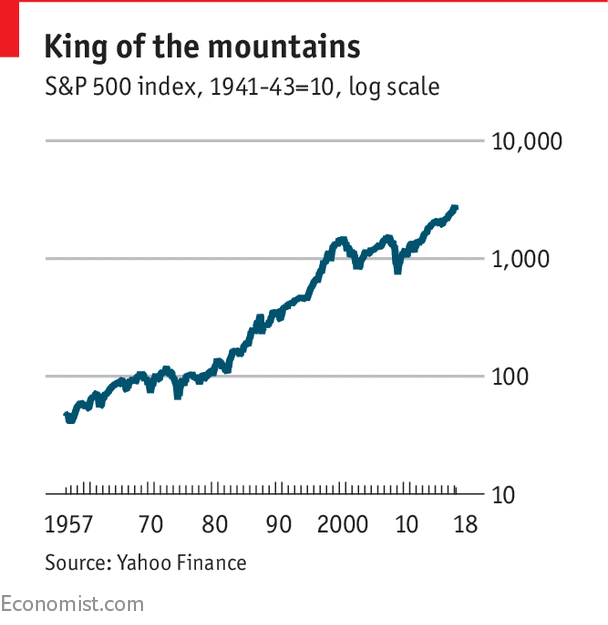
The same can be said for the economy. The average business cycle since the Second World War has lasted around six years. By that standard the current expansion is elderly, at…Continue reading
The next generation of wireless technology is ready for take-off
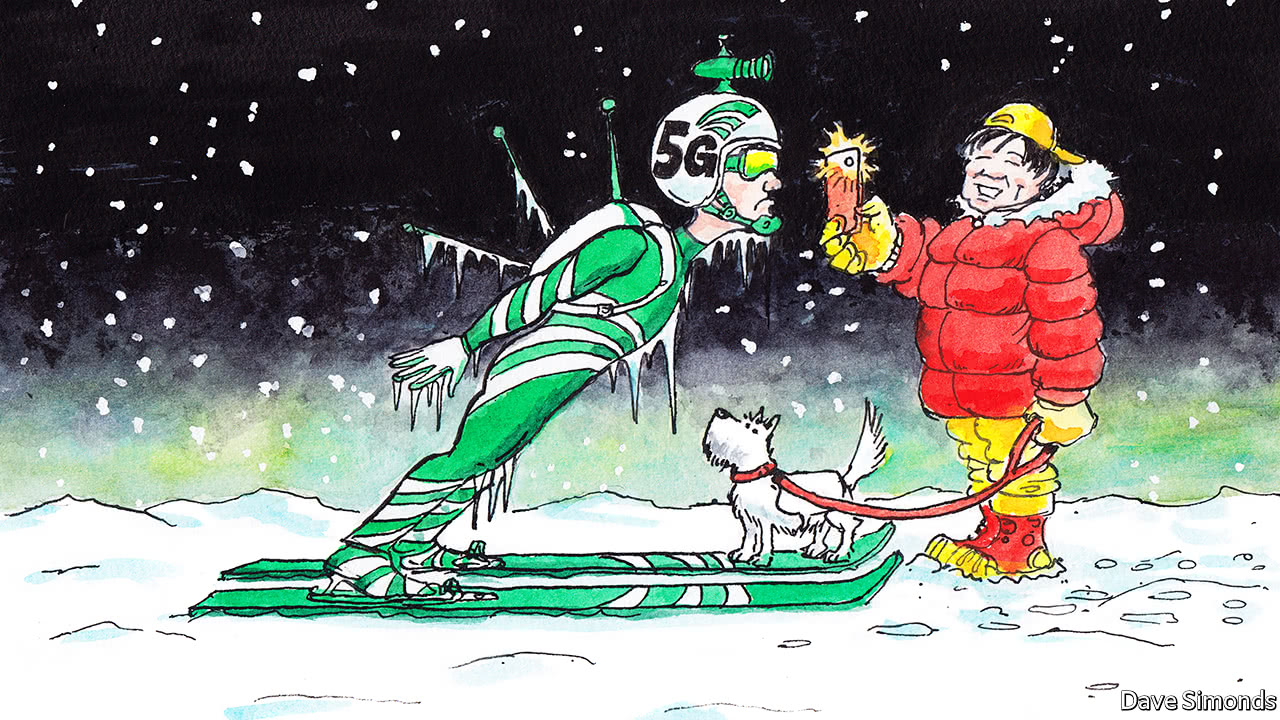
NORTH KOREAN athletes will not be the only unusual participants at the winter Olympics in Pyeongchang in South Korea, which begin on February 9th. Anyone can take part, at least virtually. Many contestants will be watched by 360-degree video cameras, able to stream footage via a wireless network. At certain venues around the country sports fans will be able to don virtual-reality, head-mounted displays to get right into the action. Flying alongside a ski jumper, for instance, will offer an adrenalin rush without any risk of a hard landing.
These virtual experiences will be offered by KT, South Korea’s largest telecoms firm. They are meant to showcase the latest generation of wireless technology, known as “5G”. But just as ski jumpers never know exactly how far they will leap after leaving the ramp, it is unclear where 5G will land.
On paper, the new technology should go far. The International Telecommunication Union (ITU), a UN body which helps develop technical standards, has…Continue reading
Mining firms are dismayed by a new Congolese mining law

ROBERT Friedland, the boss of Ivanhoe Mines, a large Canadian firm that digs out copper and zinc in Africa, is not one for pessimism. In his speech to an annual mining industry jamboree, Mining Indaba, in Cape Town, his promises about the potential of the business were as copious as the ore bodies his firm mines. But amid the hyperbole about electric cars, Chinese consumers and the “most disruptive copper discovery in the world” there was a note of panic. Money, he warned, is “a coward”, and may be about to flee.
The cause of fear is a new mining code that was passed by parliament in the Democratic Republic of Congo on January 24th. Congo is Africa’s biggest copper producer; its reserves, mostly in the southern copper belt, are among the world’s richest. As important, it has emerged recently as the world’s leading producer of cobalt, a by-product of copper smelting that is used in batteries for electric cars. It also produces gold, zinc, tin and diamonds.
The new law, which has yet to be signed by Joseph Kabila, the…Continue reading
What Natarajan Chandrasekaran must do next at Tata

FACED with complexity humans often resort to a heuristic, a rough mental template that gets the job done. That could come in handy at Tata Group, India’s largest business, whose dizzying mix of scale, palace politics and sense of moral purpose defy any categorisation. Tata’s boss, Natarajan Chandrasekaran, known as Chandra, has been in the job for a year. He spent 2017 pepping up morale and extinguishing fires. Now he must squeeze Tata into a new strategic framework that clarifies its structure and purpose.
Is it a 150-year-old national monument, a philanthropic vehicle or a conglomerate? In Schumpeter’s view Tata should instead be positioned as a holding company—like Berkshire Hathaway but minus the personality cult and with Indian characteristics.
Tata is a handful. It has 695,000 staff and is active in 17 industries. Its family of firms has a market value of $155bn. It mixes virtue with profits; Tata’s leaders are expected to exude decency and probity. The group was an…Continue reading
How a brothel owner created the world’s biggest industrial park

PAST the neon lights of Reno and the cookie-cutter homes of neighbouring Sparks, the I-80 highway winds through a thinly populated expanse of arid hills and lunar valleys in Storey County. On one side of the road flows the Truckee River; on the other bands of wild horses forage for parched grass. Signs of civilisation are restricted to electricity pylons and the odd rundown farmhouse. The Wild Horse Saloon, a dark and smoky room connected to a legal brothel, is the only sit-down restaurant for miles. It is not an area that immediately seems conducive to hosting a business park. Yet Storey County in Nevada is home to the world’s largest by some measures: the Reno Tahoe Industrial Centre (TRI). The park spans 104,000 acres in total—three times the size of San Francisco.
Near its eastern border hulks Tesla’s “gigafactory”, a gargantuan white structure where the company hopes to produce batteries for 500,000 electric cars a year….Continue reading
Airbus executives get swept away by a corruption investigation
“THE success of Airbus is intimately linked to the success of John,” says Eric Schulz, successor to John Leahy, who has been chief salesman for the planemaker since 1994. Mr Leahy’s aggressive strategy to gain orders expanded Airbus’s market share for civil jets from 18% in 1994 to over 50%. Salesmen at Boeing, Airbus’s rival, say they wish their bosses were as good. But this year’s Singapore Airshow, which began on February 6th, will be Mr Leahy’s last before retirement.
That is in itself a big change for Airbus, but staff turnover does not stop there. In December the firm said Tom Enders, its German-born chief executive, would step down in 2019; his French second-in-command, Fabrice Brégier, will leave this month. These changes follow the news that several countries, including Britain, France and America, are investigating allegations that in the past Airbus bribed officials to win contracts. That created divisions between French and German executives over how to respond.
The recent troubles began in 2014, when an internal review of supplier payments at Airbus exposed irregularities. It ended up reporting itself to Britain’s Serious Fraud Office and to France’s equivalent body for lying to export-credit agencies about bribes given by third-party consultants to secure sales. In October Airbus said it may have violated…Continue reading