
Tag: Business and finance
How microcredit can help poor countries after natural disasters

BOTH, in different ways, worry about liquidity. And global warming may, indeed, be bringing meteorologists and financiers together. On January 18th, VisionFund, a microlending charity, and Global Parametrics, a venture that crunches climate and seismic data, launched what they billed as the “world’s largest non-governmental climate-insurance programme”. The scheme will offer microfinance to about 4m people across six countries in Asia and Africa affected by climate-change-related calamities.
Natural disasters are becoming more frequent and severe. They disproportionately affect poor countries, where many eke livings from vulnerable agricultural land. Yet it is often in the aftermath of disaster that credit is hardest to obtain. As non-performing loans rise and the perception of risk increases, microfinance institutions (MFIs) rein in lending; they receive little support from donors and relief programmes, which tend to favour humanitarian aid….Continue reading
Monetary policy suffers a shortage of central bankers
IN THEIR quest to stabilise the job market, central banks are setting a bad example. Jerome Powell, whom senators this week confirmed as the next chairman of America’s Federal Reserve, will lead an institution with three existing vacancies on its seven-member board, and a fourth that will open up imminently. Not since July 2013 has its rate-setting committee boasted the full complement of 12 voting members.
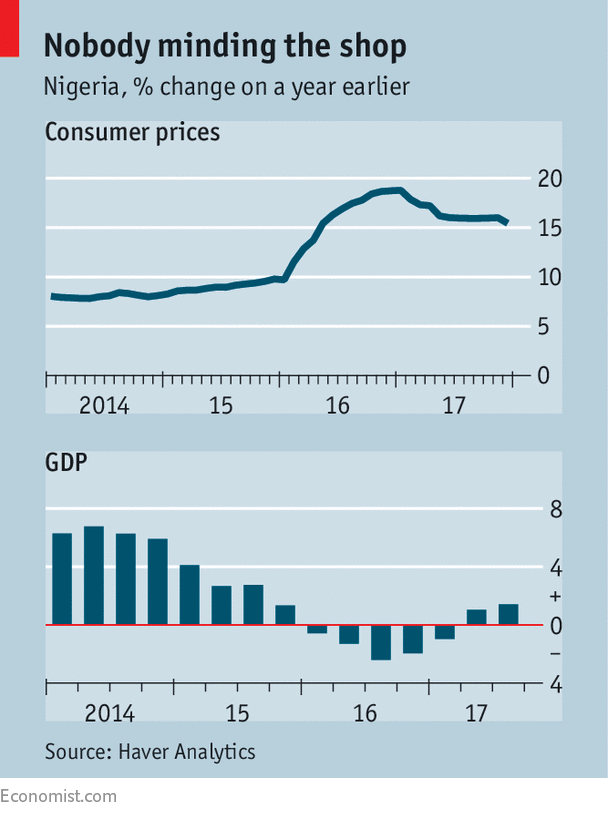
This monetary undermanning is, however, much worse in Nigeria. Its monetary-policy committee was unable to meet as scheduled on January 22nd-23rd because it lacked the six members necessary for a quorum. Five recent nominees still await confirmation by the country’s Senate. The chamber is holding up all but a few executive appointments in retaliation for President Muhammadu Buhari’s failure to remove an official (the acting anti-corruption tsar) whom the Senate twice rejected. In the absence of a monetary-policy meeting (and the lengthy communiqué that eventually follows it), the central bank…Continue reading
WhatsApp: Mark Zuckerberg’s other headache
“THERE’S too much sensationalism, misinformation and polarisation in the world today,” lamented Mark Zuckerberg, the boss of Facebook, recently. To improve things, the world’s largest social network will cut the amount of news in users’ feeds by a fifth and attempt to make the remainder more reliable by prioritising information from sources which users think are trustworthy.
Many publishers are complaining: they worry that their content will show up less in users’ newsfeeds, reducing clicks and advertising revenues. But the bigger problem with Facebook’s latest moves may be that they are unlikely to achieve much—at least if the flourishing of fake news on WhatsApp, the messaging app which Facebook bought in 2014 for $19bn, is any guide.
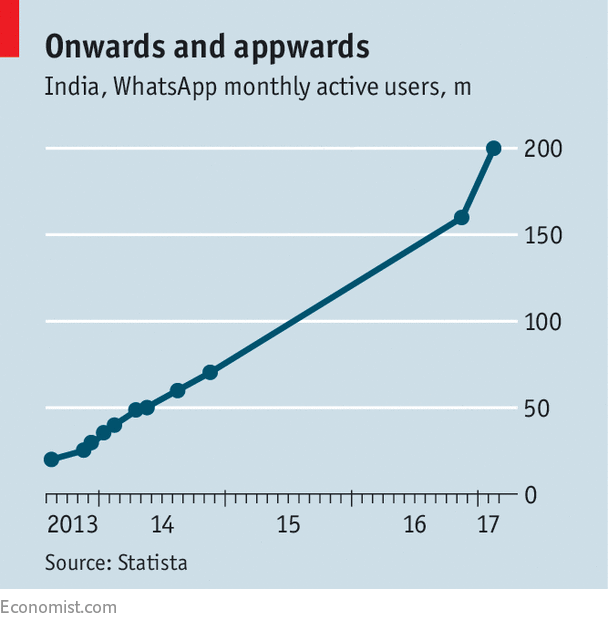
In more ways than one, WhatsApp is the opposite of Facebook. Whereas posts on Facebook can be seen by all of a user’s friends, WhatsApp’s messages are encrypted. Whereas Facebook’s newsfeeds are curated by algorithms that try to maximise the time users spend on the service, WhatsApp’s stream of messages is solely generated by users. And whereas Facebook requires a fast connection, WhatsApp is not very data-hungry.
Bangladesh experiments with a new approach to poverty alleviation
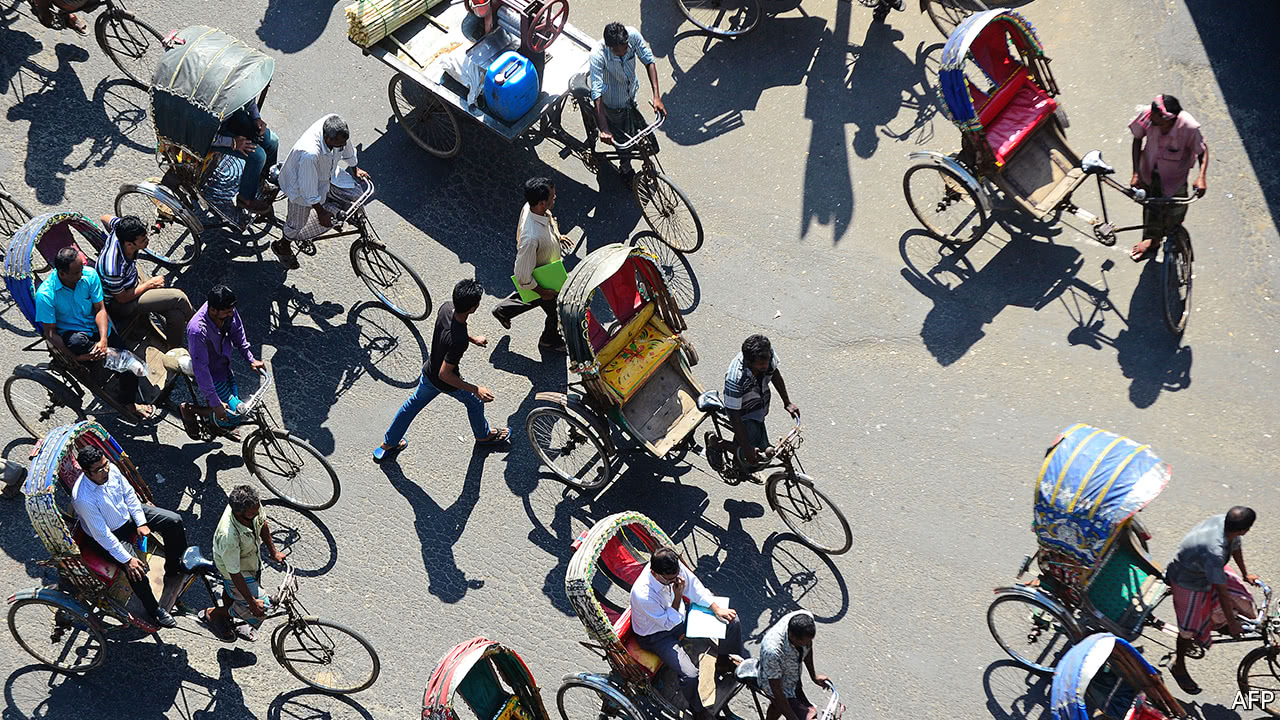
BESIDES shoes and shrimp, Bangladesh exports poverty cures. Microfinance was developed there in the late 1970s before spreading. In 2002 BRAC, a charity, started giving assets such as cows (and training in how to manage them) to desperately poor women. That approach has spread, too. The latest poverty remedy to emerge from Bangladesh is different: it targets men, and rather than trying to make people more productive in their villages, it encourages them to move.
In Rangpur, a northern district, agricultural labourers endure an annual hunger in the autumn, known as monga. The rice crop has been planted but is not ready to harvest, so work is scarce. Jobs abound in the cities, but poor farmers are loth to use their dwindling savings on a bus ticket. It is a good example of a poverty trap.
So, for the past ten years, researchers led by Mushfiq Mobarak, an economist at Yale University, have tried offering cash to poor households so long as somebody moves to a city to…Continue reading
When you cannot sue your employer

IMAGINE wanting to sue your employer, because you have been harassed or discriminated against, only to find that your access to the courts is blocked. It turns out you signed away your right to use the judicial system when you started the job: somewhere, hidden in the documents that came with your employment contract, was a clause obliging you to resolve future disputes through private arbitration, rather than in court.
An increasing number of American employees find themselves in this situation. Over half of non-unionised employees are covered by arbitration requirements, estimates Alexander Colvin of Cornell University, based on a survey in 2017 of 627 private-sector workplaces. Such agreements have come under greater scrutiny after the wave of workplace sexual-harassment revelations last year. Gretchen Carlson, a former news anchor for Fox, a broadcaster, has called arbitration “the harasser’s best friend”. Prevented by an arbitration clause from suing the network, Ms Carlson sued her boss…Continue reading
Venezuela’s currency plumbs unknown depths
EVEN a modest rate of inflation compounds over time. This is why your tipsy grandfather might wistfully recall how little a pint of beer cost in his heyday. In Venezuela, where prices are rising at a four-figure annual rate, the good old days were last month. The defence minister, Vladimir Padrino López, on January 19th urged business leaders to peg back prices to their levels of December 15th, when presumably everything was just fine.
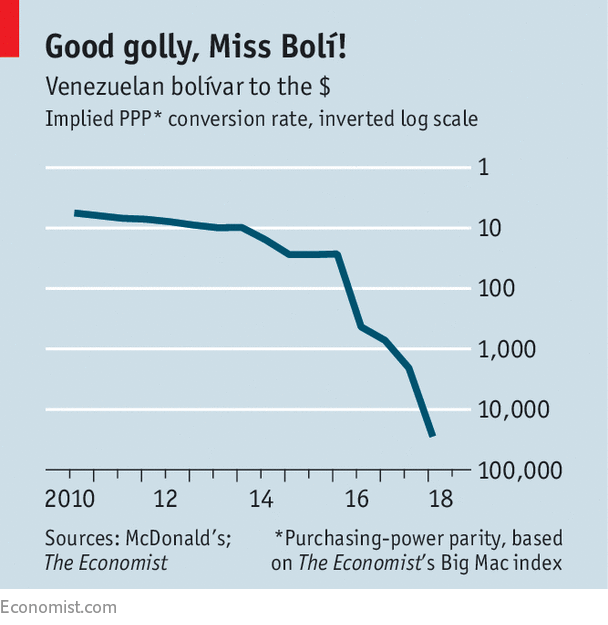
The spending power of the bolívar, Venezuela’s currency, had collapsed long before then. The Economist’s Big Mac Index gives a rough guide to how fast it has fallen. The index is based on the idea of purchasing-power parity (PPP), which says a fair-value exchange rate is one that leaves consumer prices the same in different countries. In our index, the price of a Big Mac is a proxy for all goods. In Caracas, this week, a Big Mac cost 145,000 bolívars; in American cities, it cost an average of $5.28. The ratio of those prices gives a PPP exchange rate of 27,500 bolívars. Two years ago, the rate was 27 bolívars. By this yardstick, the currency has lost 99.9% of its value in almost no time.
GM takes an unexpected lead in the race to develop autonomous vehicles

GENERAL MOTORS reveals barn-sized truck at Detroit motor show. What else is new, you might now ask. But the launch on January 20th of the Chevrolet Silverado, a pickup that will go on sale at the end of the year, highlights a surprising turnaround for America’s largest carmaker.
The good news is not just the Silverado’s outsized margins, which are important for a firm that relies heavily on trucks—after Mary Barra, GM’s boss, gave an ebullient performance at an investors’ conference that coincided with the motor show, the release of GM’s quarterly results on February 6th are likely to include record profits. It is also that the money thrown off by vehicles such as the Silverado will help the firm navigate the tricky terrain that lies ahead of all the world’s big carmakers.
One task is to ensure that their current business of selling vehicles with internal-combustion engines stays healthy. At the same time, they must prepare for a future of electric and autonomous cars (EVs…Continue reading
Market volatility has been low, encouraging risk-taking
MAY YOU live in boring times. Financial markets have become dull, if profitable. The S&P 500 index, America’s leading equity benchmark, has notched up its longest-ever streak without a 5% reversal. Bond yields may have inched up in recent months, but are still at the bottom of historical ranges. Institutions famed for their trading prowess, such as Goldman Sachs, have seen profits dented by the quiescence of the markets.
This lack of market volatility owes much to the steadiness of monetary policy since the depths of the financial crisis. Central banks have kept short-term rates low and have intervened to push down bond yields through their programmes of quantitative easing (QE). The classic method of pricing financial assets is to say they are worth the discounted value of future cashflows; since central banks have kept the discount rate steady, prices have been steady too.
The late Hyman Minsky, an economist, thought that long booms sowed the seeds of their own destruction. He argued that, when the economy was doing well, investors tended to take more risk (such as taking on more debt). These speculative positions are vulnerable to a shock, such as a sudden rise in interest rates, which can turn into a fully fledged crisis.
In these days of sophisticated markets, speculators are not restricted to their own capital or even to borrowed money to…Continue reading
Qualcomm is fined for anti-competitive practices—again

THE tech industry hardly needs another reminder that trustbusters are on its case. But the European Commission is always happy to oblige. On January 24th Europe’s executive body slapped a penalty of €1bn ($1.2bn) on Qualcomm, one of the world’s largest chip-designers, for abusing its dominance in baseband processors, a critical component in mobile phones.
Large fines are becoming something of a habit for Qualcomm, which will have paid out nearly $1bn a year, on average, to trustbusters the world over since 2015. This week’s penalty, which amounts to nearly 5% of the company’s global annual revenue, is a reflection of what Margrethe Vestager, the European competition commissioner, described as its “very illegal behaviour” between 2011 and 2016. During that time, according to Ms Vestager, the company attempted to shore up its dominant position—it is estimated to supply up to four-fifths of essential types of baseband chips—by paying Apple, its biggest customer, billions of dollars in…Continue reading
GE’s flow of financial information has become fantastically muddled

IN THEIR documentary “The Vietnam War”, Ken Burns and Lynn Novick, the directors, dwell on the flawed information that American politicians got from Indo-China. The generals on the ground focused on the “kill ratio”, or the number of enemies killed per American or South Vietnamese soldiers killed. That bore no relationship to victory—North Vietnam quickly replaced its dead soldiers. And it corrupted behaviour, leading American troops to embellish numbers and count dead civilians as “wins”.
The curse of rotten information can strike companies, too. That seems to be the case with General Electric (GE), which has had a vertiginous fall. Its shares, cashflow and forecast profits have dropped by about 50% since 2015. On January 16th it disclosed a huge, $15bn capital shortfall at its financial arm due to a revision in insurance reserves. And on January 24th it revealed a $10bn loss for the fourth quarter. In its core industrial arm, returns on capital have sunk from 20% in 2007 to a puny 5%…Continue reading