
Tag: Business
Looking good can be extremely bad for the planet

STYLE is supposedly for ever. But the garments needed to conjure up eternal chic are spending less time on shop racks and in homes than ever before. Global clothing production doubled between 2000 and 2014, as apparel firms’ operations became more efficient, their production cycles became quicker and fashionistas got more for their money. From just a few collections a year, fast-fashion brands such as Zara, owned by Spain’s Inditex, now offer more than 20; Sweden’s H&M manages up to 16.
Dressing to impress has an environmental cost as well as a financial one. From the pesticides poured on cotton fields to the washes in which denim is dunked, making 1kg of fabric generates 23kg of greenhouse gases on average, according to estimates by McKinsey, a consultancy. Because consumers keep almost every type of apparel only half as long as they did 15 years ago, these inputs go to waste faster than ever before. The latest worry is shoppers in the developing world, who have yet to buy as many clothes as rich-world consumers but are quickly catching up.
Most apparel companies know that sooner or later, consumers’ awareness of this subject will rise. That is a…Continue reading
Westinghouse files for bankruptcy
 Who will see it through?
THERE are few more storied innovators than Westinghouse. Founded in 1886, it is the company that brought electricity to the masses. When you plug in your toaster or flip your light switch, you have George Westinghouse’s alternating-current system to thank. In the 21st century the firm seemed poised to unleash a new revolution in nuclear energy. Its AP1000 pressurised water reactor was supposed to make nuclear plants simpler and cheaper to build, helping to jump-start projects in America and around the world.
But those nuclear ambitions have gone awry. On March 29th the firm filed for Chapter 11 bankruptcy in New York. Its troubles have been a running sore at Toshiba, its Japanese parent, a headache for its creditors, and the latest bad tidings for a nuclear industry beset with problems.
Toshiba was triumphant in 2006 when it paid $5.4bn for Westinghouse after a bidding war, beating out General Electric (founded by George Westinghouse’s archrival, Thomas Edison). Around the same time, Southern and SCANA, two big utilities based in Georgia and South Carolina, respectively, chose the AP1000 design for new nuclear…Continue reading
Luxury-goods companies in the digital era

IT TAKES at least a month to wash, comb, spin and otherwise prepare fine mohair to become cloth that is stitched into suits by Ermenegildo Zegna, a 107-year-old Italian brand. In Trivero, an Alpine village west of Milan, 150 artisans in an elegant factory work at carding, dying, weaving and warping. As looms rattle, bespectacled women stretch cloth over illuminated screens and check for imperfections. Others use a rack crammed with dried Spanish thistles to remove excess hair from fabric.
Zegna, run by its fourth generation of family owners, is distinctive in many ways. Big corporate successes are rare in Italy, which tends to nurture smaller firms. Sales from Zegna’s 500-odd shops worldwide, plus earnings from selling to other producers, amount to an annual €1.2bn ($1.3bn) or so. It controls its entire supply chain, which is unusual even in an industry that cherishes raw materials. Three years ago it bought a 6,300-acre farm with 10,000 sheep in Australia. A spokeswoman brags that vertical integration at Zegna runs “from sheep to shop”.
The company is also unusual because it has stayed independent of the few swaggering giants that bestride the luxury-goods…Continue reading
The nominee to run America’s drug regulator is a sound choice

WHEN the names of potential candidates for the new head of America’s regulatory agency for drugs, the Food and Drug Administration (FDA), were first circulated, you could almost hear the sound of jaws hitting desks throughout the pharmaceuticals industry. One contender was Jim O’Neill, head of Mithril Capital Management, an investment firm, who is such a libertarian that he doesn’t think the FDA should insist that medicines have to work. Another was Balaji Srinivasan, an entrepreneur from Silicon Valley, who thought roughly the same.
Removing such a core regulation might seem appealing to business. In fact, the idea of not approving drugs for efficacy is as unwelcome to the industry as it is to doctors and patients. It spends billions of dollars every year on research to deliver better treatments; this would be impossible to justify if drugs had merely to be safe. Patients, meanwhile, would face the awful prospect of having to identify which life-saving medications worked.
So, when the name of the FDA nominee was announced in March, there was widespread relief. Scott Gottlieb (pictured) a resident fellow at the American Enterprise Institute, a conservative…Continue reading
Luxury-goods companies are belatedly trying to go digital
IT TAKES at least a month to wash, comb, spin and otherwise prepare fine mohair to become cloth that is stitched into suits by Ermenegildo Zegna, a 107-year-old Italian brand. In Trivero, an Alpine village west of Milan, 150 artisans in an elegant factory work at carding, dying, weaving and warping. As looms rattle, bespectacled women stretch cloth over illuminated screens and check for imperfections. Others use a rack crammed with dried Spanish thistles to remove excess hair from fabric.
Zegna, run by its fourth generation of family owners, is distinctive in many ways. Big corporate successes are rare in Italy, which tends to nurture smaller firms. Sales from Zegna’s 500-odd shops worldwide, plus earnings from selling to other producers, amount to an annual €1.2bn ($1.3bn) or so. It controls its entire supply chain, which is unusual even in an industry that cherishes raw materials. Three years ago it bought a 6,300-acre farm with 10,000 sheep in Australia. A spokeswoman brags that vertical integration at Zegna runs “from sheep to shop”.
The company is also unusual because it has stayed independent of the few swaggering giants that bestride the luxury-goods…Continue reading
Masayoshi Son goes on a $100bn shopping spree

IF YOU want to find a spectacular vision of the future, Silicon Valley is not the only place to look. In Tokyo Masayoshi Son, the boss of SoftBank, a Japanese telecoms group, is starting an investment fund worth $100bn which, he hopes, will make him the Warren Buffett of technology. “Masa” is no stranger to risky bets: SoftBank was an early investor in Alibaba, a Chinese e-commerce company, and has sunk $22bn in Sprint, a struggling American telecoms firm. Now he has been seized by the kind of Utopian fever that would make the Sage of Omaha choke on his Cherry Coke.
Mr Son, who is 59, believes that the world will soon encounter what is known as the Singularity, the point at which artificial intelligence exceeds the human kind. The brains of people and machines will become enmeshed (see article). Every person will have over 1,000 devices linked by a seamless global network, with the data analysed by machines in the cloud. As well as smart glasses, people will wear smart shoes and every car and washing machine will…Continue reading
YouTube highlights problems with digital advertising
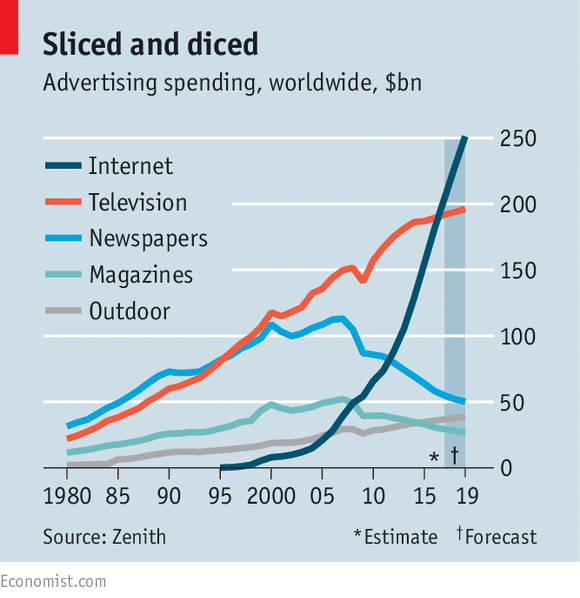
EVEN advertisers can be seduced by slick marketing. Google and Facebook have built huge businesses by promising that online ads are more effective and easily measured than traditional media, such as television, radio and print. This year the amount spent on internet advertising, globally and in America, is forecast to surpass television advertising for the first time (see chart). But a controversy at YouTube, an online-video site owned by Google, shows how digital advertising still has problems to sort out before it lives up to the dazzling sales pitch.
A slew of advertisers, including stalwarts such as Coca-Cola, Walmart and General Motors, have announced plans to suspend usage of, or move ad spending away from, YouTube because ads (in some cases their own) were appearing alongside offensive content, including videos by jihadist and neo-Nazi groups. Google’s own brand has suffered: the damage to the firm’s sales could be as much as $1bn in 2017, or around 1% of its gross advertising revenue. Shares of its parent company, Alphabet, have fallen by around 3% owing to the controversy.
It is not the first time that brands have fretted about where…Continue reading
Ameerpet, India’s unofficial IT training hub
 Eat your heart out, Stanford
UNIVERSITY campuses can take a while to get going in the mornings, as students recover from extra-curricular antics. Contrast that with Ameerpet, a squeezed neighbourhood of Hyderabad that has become India’s unofficial cramming-college capital. By 7.30am the place is already buzzing as 500-odd training institutes cater to over 100,000 students looking to improve their IT skills. If there are ivory towers here, they are obscured by a forest of fluorescent billboards promising skills ranging from debugging Oracle servers to expertise in Java coding to handling Microsoft’s cloud.
Expertise in the IT industry erodes fast as software programs are upgraded or become obsolete. Indian outsourcing giants such as Infosys and Wipro spend heavily to keep employees’ skills up to date. But staff looking to change their career paths—to say nothing of those who didn’t crack the interview in the first place—need rapid systems upgrades of their own. Training courses authorised by software providers exist but cost up to 375,000 rupees ($5,765). Fees at Ameerpet’s informal institutes are typically below 25,000 rupees for classes…Continue reading
Swiss watchmakers try to keep pace

BASELWORLD, a giant watch fair that ended this week, usually runs like clockwork. Companies show off new products; buzz and higher sales follow. However, something seems to have jammed. Exports of Swiss watches sank by a tenth in 2016, the worst performance since the financial crisis. Swatch, the world’s biggest watch company, saw profits plunge by 47%. In February exports were 10% lower than they had been a year earlier.
Swiss watchmakers have been around for long enough not to panic: Blancpain, owned by Swatch, dates back to 1735; Vacheron Constantin, owned by Richemont, a Swiss luxury conglomerate and Swatch’s closest rival, was founded 20 years later. In La Chaux-de-Fonds, a watch-manufacturing hub, workers toil much as they always have, at chin-high desks, using slim instruments to assemble springs, wheels, jewels and other tiny parts. But swings in demand have of late been particularly extreme.
The period from around 2004 to 2012 saw high growth. Chinese shoppers accounted for about half of Swiss watch sales during that time, reckons Thomas Chauvet of Citi, a bank. Manufacturers introduced pricier products and raised the cost of existing ones. The financial…Continue reading
Companies are racing to add value to water

PRESENTED in an unusually-shaped heavy glass bottle with outsized black lettering, it could be a fine vodka. On sale for £80 ($99) in Harrods, an upmarket department store in London, it has a price tag to match. In fact, it is a bottle of water. Harvested directly from Norwegian icebergs that are up to 4,000 years old, Svalbardi is one of hundreds of water brands that are sourced from exotic places and marketed as luxury products.
From the basic to the expensive, the market for bottled water is an attractive place to be. According to Zenith Global, a consulting firm, the global market has grown by 9% annually in recent years and is worth $147bn. The main reason is changing lifestyles. People are spending more time, and eating more of their meals, away from home. They are also switching from soft drinks and alcohol to healthier fare. Data from Beverage Marketing Corporation (BMC), another consultancy, show that consumption of bottled water overtook that of sugary soft drinks in America in 2016 (see chart).