
Tag: Business
Elon Musk supercharges progress on energy storage
 Storage salesman
HOW much power does a tweetstorm involving two tech tycoons, the prime minister of Australia and 8.5m Twitter followers generate? Enough, at least, to supercharge a debate about the future role of batteries in the world’s energy mix.
Elon Musk, a Silicon Valley entrepreneur (pictured), may be best known for his gravity-defying ambition, but his core product is the battery: whether for his Tesla cars, for the home or for grid-scale electricity storage. He gave the last of these an unexpected jolt of publicity on March 10th, by responding to a blackout-inspired challenge on Twitter from an Australian software billionaire, Mike Cannon-Brookes. Mr Musk said he could install 100 megawatt hours (MWh) of battery storage in the state of South Australia in 100 days to help solve an energy crisis it faces, or it would be free of charge. “That serious enough for you?” he asked.
In response, Malcolm Turnbull, the prime minister, communicated with Mr Musk and appeared to turn from pro-coal sceptic into battery believer. On March 14th Jay Weatherill, the premier of South Australia, went further. Declaring…Continue reading
Citigroup’s decade of agony is almost over

IF YOU ask financial types in New York for their views on the world’s big banks, they usually come up with similar vignettes for each one. They agree that JPMorgan Chase is an unstoppable force under its boss, Jamie Dimon. Goldman Sachs is on a roll, with its shares up by 36% since the election (even if some worry that its Darwinian culture is going soft given all the regulation it faces). Across the pond Deutsche Bank is struggling to keep its head above water; its leader, John Cryan, embarked on a capital-raising and cost-cutting plan on March 5th. Yet one big bank elicits shrugs of bafflement: Citigroup. Its managers are anonymous and they get paid about a fifth less than their peers at other financial groups. No one is quite sure what Citi is up to or what it exists for. Once too big to fail, it is now too drab to mention.
That Citi has become the world’s half-forgotten bank is surprising. It was America’s biggest firm before the financial crisis, measured by size of assets; it is now the fourth-largest. After suffering huge losses on loans and subprime securities, in 2008-09 it received the biggest bail-out of any American bank. Citi can still…Continue reading
What Satya Nadella did at Microsoft

A DECADE ago, visiting Microsoft’s headquarters near Seattle was like a trip into enemy territory. Executives would not so much talk with visitors as fire words at them (one of this newspaper’s correspondents has yet to recover from two harrowing days spent in the company of a Microsoft “brand evangelist”). If challenged on the corporate message, their body language would betray what they were thinking and what Bill Gates, the firm’s founder, used often to say: “That’s the stupidest fucking thing I’ve ever heard.”
Today the mood at Microsoft’s campus, a sprawling collection of more than 100 buildings, is strikingly different. The word-count per minute is much lower. Questions, however ignorant or critical, are answered patiently. The firm’s boss, Satya Nadella (pictured), strikes a different and gentler tone from Mr Gates and Steve Ballmer, his immediate predecessor (although he, too, has a highly competitive side).
Both these descriptions are caricatures. But they point to an underlying truth: how radically the world’s biggest software firm has changed in the short time since Mr Nadella took charge in early 2014. Back…Continue reading
America’s pot industry shrugs off Donald Trump’s harder line on legal drugs

THESE are high times for America’s marijuana-industrial complex. More than half the country’s states have legalised medical cannabis, often rather loosely defined. Eight have voted to legalise the drug for recreational purposes. The industry was worth about $6bn last year, a figure that is likely to rise sharply in 2018 when recreational sales begin in California.
Yet in Washington, DC, the mellow mood has been harshed. Donald Trump may have said in 1990 that “You have to legalise drugs to win that war.” But after entering politics he became more conservative. While campaigning for the presidency he called Colorado’s legal cannabis market a “real problem”. Last month his press secretary, Sean Spicer, said he expected to see “greater enforcement” of the laws that still ban cannabis at the federal level.
That worries pot peddlers. The fact that they are in breach of federal law means that in theory their profits are criminal proceeds, subject to forfeiture. In 2013 the deputy attorney-general of the day, James Cole, published a memo reassuring states that had legalised cannabis that federal agents would not interfere…Continue reading
America’s pot industry shrugs off Donald Trump’s harder line on drugs

THESE are high times for America’s marijuana industrial complex. More than half the country’s states have legalised medical cannabis, often rather loosely defined. Eight have voted to legalise the drug for recreational purposes. The industry was worth about $6bn last year, a figure that is likely to rise sharply in 2018 when recreational sales begin in California.
Yet in Washington, DC, the mellow mood has soured. Donald Trump said in 1990 that “You have to legalise drugs to win that war”, but in politics he became more conservative. Campaigning for the presidency he called Colorado’s legal cannabis market a “real problem”. His press secretary, Sean Spicer, recently said he expected to see “greater enforcement” of the laws that still ban cannabis at the federal level.
That worries pot-pedlars. The fact that they are in breach of federal law means that in theory their profits are criminal proceeds, subject to forfeiture. In 2013 the deputy attorney-general of the day, James Cole, published a memo reassuring states that had legalised cannabis that federal agents would not interfere unless the states allowed the industry…Continue reading
Can a railway legend deliver at America’s CSX?
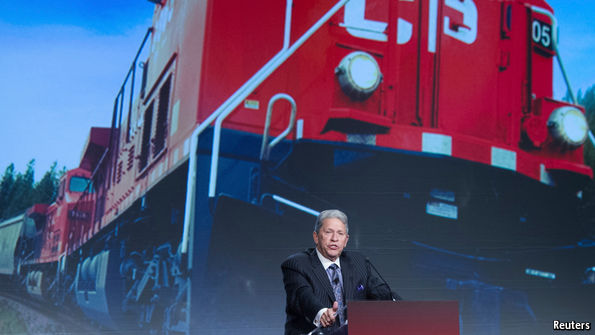
E. HUNTER HARRISON, a veteran railway executive, tried retiring in 2010, after he made Canadian National (CN), a formerly state-owned company, the best-performing of the large railways in North America. But once he pocketed the gold watch and attended the retirement party he faced a void that raising and training horses for showjumping did not fill. By mid-2012 he was back at the helm of another railway, Canadian Pacific (CP), whose glory days were long past. Once he had turned around CP, he didn’t make the same mistake again. On January 18th the 72-year-old Tennesseean both announced his departure and entered negotiations with Florida-based CSX to become that railway’s CEO.
Just the rumour that Mr Harrison might be moving to CSX caused the share price to rise by 23% in 24 hours. It continued to rise when the negotiations became public. At last, on March 6th, CSX appointed Mr Harrison as CEO and met the condition set by Mantle Ridge, an activist hedge fund with which he has partnered, to name five new board directors. Mr Harrison made long-term shareholders in CP and CN rich, tripling profits at both during his tenures. CSX shareholders expect…Continue reading
New technologies could slash the cost of steel production
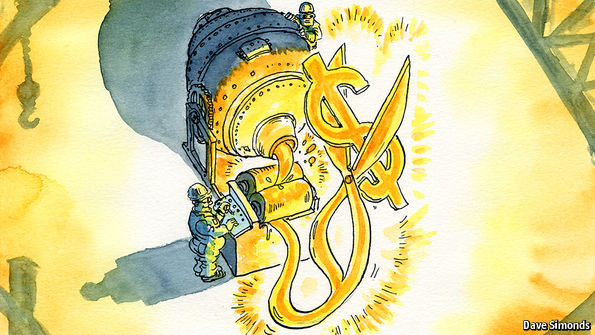
ALTHOUGH he is best known for developing a way to mass-produce steel, Henry Bessemer was a prolific British inventor. In the 1850s in Sheffield his converters blasted air through molten iron to burn away impurities, making steel the material of the industrial revolution. But Bessemer knew he could do better, and in 1865 he filed a patent to cast strips of steel directly, rather than as large ingots which then had to be expensively reheated and shaped by giant rolling machines.
Bessemer’s idea was to pour molten steel in between two counter-rotating water-cooled rollers which, like a mangle, would squeeze the metal into a sheet. It was an elegant idea that, by dint of having fewer steps, would save time and money. Yet it was tricky to pull off. Efforts to commercialise the process were abandoned.
Until now. Advances in production technology and materials science, particularly for new types of high-tech steel, mean that Bessemer’s “twin-roll” idea is being taken up successfully. An alternative system that casts liquid steel directly onto a single horizontally moving belt is also being tried. Both techniques could cut energy…Continue reading
A deal sparks talk of car-industry mega-mergers

THE Peugeot 3008, a striking SUV, was voted European car of the year on March 6th, the eve of the opening of the Geneva motor show, an annual industry shindig. PSA Group, the maker of Peugeots and Citroëns, would doubtless view it as the second prize it scooped that day. News also came that the French carmaker was buying Opel (branded as Vauxhall in Britain), the European operation of America’s General Motors (GM). Few of the car-industry experts at the show, however, would call Opel a trophy.
The consensus was that GM was right to rid itself of a business that had lost money for 16 years straight. Opel has around 6% of the European market; that makes it too small and inefficient in a business where scale is key. It has been confined mostly to Europe for three reasons: the particular tastes of the region’s car buyers (for instance, for small diesel cars); tighter emissions regulations outside Europe; and GM’s fear of taking sales from its other brands further afield. The result has been to leave it boxed in and isolated.
Shorn of Opel, the American firm can redirect investment to China and America, where its profit margins are…Continue reading
Mining companies have dug themselves out of a hole
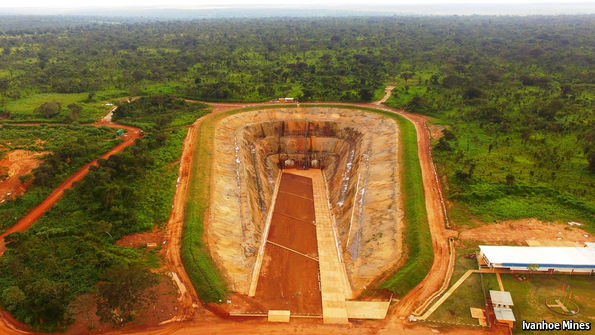
FOR mining investors there is something sinfully alluring about Glencore, an Anglo-Swiss metals conglomerate. It is the world’s biggest exporter of coal, a singularly unfashionable commodity. It goes where others fear to tread, such as the Democratic Republic of Congo (DRC), which has an unsavoury reputation for violence and corruption. It recently navigated sanctions against Russia to strike a deal with Rosneft, the country’s oil champion.
Yet Glencore could still acquire a halo for itself. It is one of the world’s biggest suppliers of copper and the biggest of cobalt, much of which comes from its investment in the DRC. These are vital ingredients for clean-tech products and industries, notably electric vehicles (EVs) and batteries.
The potential of “green” metals and minerals, which along with copper and cobalt include nickel, lithium and graphite, is adding to renewed excitement about investing in mining firms as they emerge from the wreckage of a $1trn splurge of over-investment during the China-led commodities supercycle, which began in the early 2000s. The most bullish argue that clean energy could be an even bigger source of…Continue reading
Chinese startups push into foreign markets
 They’re coming your way
ON THE outskirts of Guangzhou, a city in southern China, lies an abandoned park filled with crumbling replicas of the wonders of the world. To the right are fading golden spires that are meant to represent Angkor Wat, a temple in Cambodia. On the left, a row of dusty Egyptian statues towers over a desolate Greek amphitheatre. Adding to the surrealism, the tops of the trees have been lopped off and a buzzing noise fills the night air.
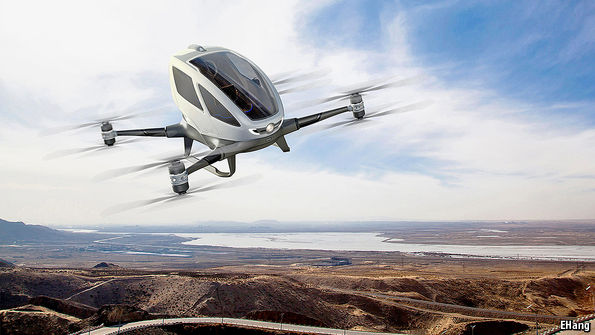
This strange place is the testing ground for EHang, a Chinese startup that makes drones. (The treetops were chopped off, an employee explains, because drones kept crashing into them.) Hu Huazhi, EHang’s founder, is beaming. His firm has just set a world record for a drone-swarm light show in Guangzhou, where it flew a thousand small drones in perfect unison. Next it plans to launch an autonomous flying-taxi service with a giant drone big enough to take a person (pictured). Dubai has just signed a deal with EHang to launch drone taxis this summer.
EHang is an example of a new kind of Chinese firm, labelled “micro-multinationals” by some. In the past,…Continue reading