
Tag: Business
Cream of the crop

TO CELEBRATE its 40th birthday, Vinamilk, a big Vietnamese dairy firm, filmed a children’s choir crooning adorably from the helipad of one of the country’s tallest towers. In truth the company hardly needs to sing its own praises. Vinamilk is probably Vietnam’s most familiar consumer brand, and it is widely considered to be the country’s best-run firm. Over a decade its profits have grown by close to one-third each year.
Hence the interest among foreigners in a 9% share to be sold by the government this year—the first tranche in a disposal which should eventually see Vietnam’s communist government give up its entire 45% stake in the firm. It is one of several big companies which the ruling party now promises to part with; two others are the Hanoi and Saigon beer companies, known as Habeco and Sabeco. After years of divesting mainly small slivers of unappealing enterprises, Vietnam is at last offering foreigners a slice of its best assets.
Vinamilk meets much of Vietnam’s daily demand for dairy products, including four-fifths of its condensed milk (most often found lurking sweetly at the bottom of the country’s famous…Continue reading
Charred chaebol

WHEN Samsung Electronics announced on October 11th that it would discontinue its flagship smartphone, the Galaxy Note 7, one crucial event in the history of the world’s second-biggest technology company by revenues (after Apple) sprang to mind. In 1995 Lee Kun-hee, then its boss, ordered 150,000 mobile phones burned and bulldozed in front of 2,000 weeping employees. Business partners who had received the devices as gifts from him had reported back that they did not work properly.
The South Korean auto-da-fé is said to have helped create a culture of permanent crisis at the firm, which drives employees to work incredibly hard. Now the question is how the ignominious end of the Galaxy Note 7 handset, which some hardware aficionados had called the best “phablet” (or large smartphone) ever made, will change Samsung, which is going through a leadership transition. In the midst of the crisis, the firm announced that Lee Jae-yong, the son of Mr Lee, would join the board of Samsung Electronics later this year, taking another step towards succeeding his father, who two years ago suffered a debilitating heart…Continue reading
The business of outrage

ONE of the gentler quips uttered by the writer and thinker H.L. Mencken was that nobody ever went broke underestimating the intelligence of the American public. By the same token, nobody ever went broke overestimating the anger of the American people. The country is in an unusually flammable mood. This being America, there are plenty of businesspeople around to monetise the fury—to foment it, manipulate it and spin it into profits. These are the entrepreneurs of outrage and barons of bigotry who have paved the way for Donald Trump’s rise.
The very first of them was Rush Limbaugh who, back in the 1980s, transformed himself from a disc jockey into a radio commentator. Mr Limbaugh shook up the ossified talk-show format by dispensing with the tedious call-ins and adding anarchic humour. Soon an army of “ditto-head” followers hung on his every word. He has 13m regular listeners and hundreds of imitators, ranging from national stars such as Sean Hannity to local ranters.
The second entrepreneur of outrage was Roger Ailes, a Republican operative who teamed up with Rupert Murdoch to build Fox News. Mr Ailes took talk radio and added TV…Continue reading
Change of tune
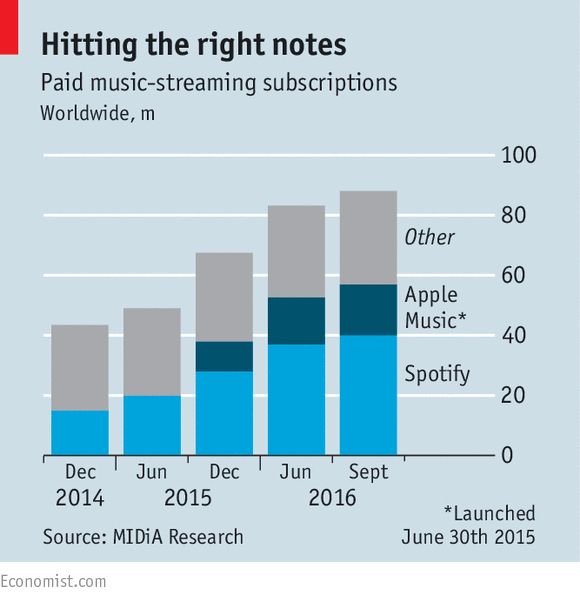
IT WAS an eventful summer in the business of streaming music. Taylor Swift and other artists attacked YouTube over rampant free streaming. Frank Ocean and Katy Perry cut exclusive deals with Apple Music, to the dismay of executives at Spotify, a Swedish rival. Behind the scenes, Pandora, a radio-like service, and Amazon, an e-commerce giant, stepped up their efforts to take on Spotify and Apple. Then last month Spotify began talks to buy SoundCloud, another streaming firm.
All this drama obscures two emerging realities. The first is that subscription streaming is now the future of the music business. The industry suffered a catastrophic collapse in sales from 1999 onwards before beginning to recover last year. Selling music to own, whether via iTunes downloads or CDs, is still a declining business globally.
But American record labels and music publishers are now on track for a second consecutive year of growth. Recent reports on sales of music from Europe, where some countries are experiencing double-digit increases in revenues, suggest that the recovery will also continue in other parts of the world.
Most…Continue reading
Techno parties

CAMPAIGNING is no longer the preserve of big organisations like political parties and trade unions. Online platforms have given voice to individuals around the world and increasingly, the firms behind those platforms are taking activist positions of their own. Facebook’s founder, Mark Zuckerberg, is on a mission “to connect the world”. Apple’s boss, Tim Cook, has vigorously defended customers’ privacy rights. This week the campaigning side of two other technology giants was on display.
On October 3rd Microsoft published a book that could easily be mistaken for a manifesto. Entitled “A Cloud for Global Good”, the 200-page volume offers no fewer than 78 “public-policy recommendations” in 15 “categories”, ranging from protecting privacy to preventing cybercrime. Most intriguing, Microsoft wants the computing clouds to be inclusive. They shouldn’t just benefit the rich and the able, says the firm. As income inequality widens, the book notes, “there are very real concerns about who will benefit.”
The next day 170,000 people descended on San Francisco to attend Dreamforce, a shindig organised by Salesforce, a big provider…Continue reading
A yen for cheapness
 Best-sellers from Tokyo to Texas
IT HAS become a staple story in the local American press: a Daiso store opening near you. Last month it was the turn of Plano, Texas, to get a branch of the Japanese chain of shops where everything costs ¥100. (In America it actually charges $1.50 per item, giving it a premium over the current exchange rate of 97 cents per ¥100.) The Plano store is the second of 44 shops planned for the state. To date California has 49 branches.
America is far from alone. As well as its 3,000-odd stores in Japan, Daiso has 1,500-plus outlets abroad. Its bargain range of products, from value-for-money bags to Japanese “kawaii” or “cute” figures, are sold around the world, from countries in Latin America to the Gulf states and throughout the rest of Asia. (As yet there are no ¥100 stores in Europe.)
This roll-out is orchestrated from a headquarters in the eastern suburbs of Hiroshima. The building looks bland from the outside. But its interior is decked out in Daiso’s trademark pink. One floor is abuzz with buyers examining packs of wet wipes and plastic toys;…Continue reading
They’re watching Yahoo

A FAILED turnaround and then, last month, the biggest data breach from a single site in history. Yahoo, an online firm, has had a bad run of news. On October 4th came a fresh blow when Reuters, a newswire, reported that the company had written customised software to scan all incoming e-mail for certain keywords, complying with a request either from America’s National Security Agency or the FBI.
The company’s first response was to say that it is a law-abiding company. It later issued a statement saying that the Reuters article was “misleading” and that the “mail scanning” the article described “does not exist on our systems”. But that is only a partial denial, and does not rule out the possibility that Yahoo did some kind of scanning. According to Reuters, Yahoo’s chief information-security officer, Alex Stamos, left Yahoo in 2015 because of a decision by Marissa Mayer, its chief executive, to obey an order from a government agency. (He now does the same job at Facebook.)
Even the possibility of a real-time wiretap raises important questions. If the government has demanded such bulk scanning it may represent an expansion…Continue reading
Putting it all on grey
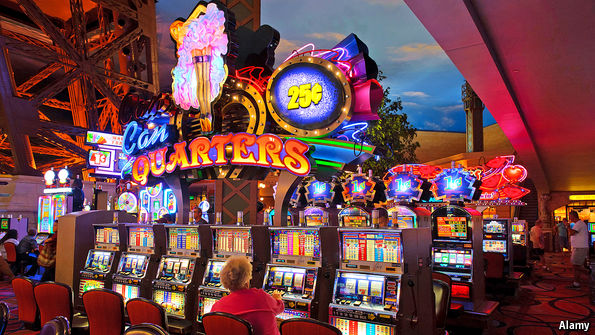
SHORTLY after Mark Frissora took over as chief executive of Caesars Entertainment last year, he paced the floors of his American casinos, with their rows and rows of idle slot machines, and grasped the scale of the existential threat that faces his industry. Casino customers are ageing, and younger people have little interest in taking their place. Mr Frissora called on his company to brainstorm a new “casino within a casino” to draw in millennials who grew up playing video and mobile-phone games.
Next door on the Las Vegas Strip, Jim Murren, CEO of MGM Resorts International, the city’s largest gaming operator, is making similar moves. Mr Murren has convened a committee of millennial employees to work out how to keep the business relevant to future generations. Both firms will soon open experimental spaces for young people, including new types of slot-machine games that test players’ skills as much as their wallets.
These offer a glimpse of a casino of the future that looks very different indeed. There are gravity-free rooms where you can literally climb the walls; LED screens that continuously change interior backgrounds; and…Continue reading
Peacocks of the sea

THE Monaco Yacht Show, which ran from September 28th to October 1st, is arguably the world’s most extravagant game of one-upmanship. This year more visitors than ever—34,500—came to gawp at 125 superyachts with a collective value of $2.7 billion, tied up in the principality’s Port Hercules. But the yachts were only the beginning. Monaco is essentially a bazaar for the 0.1%: everywhere you look there are hawkers in pop-up tents trying to sell things that you never knew you needed. There were submersibles that can take six people to the bottom of the ocean; armour-plated Land Rovers; jet-skis and 3D goggles; military-style helicopters and flying boats. Among the variety of servants for hire were armed guards and on-board DJs.
In this world, size counts for a lot. The bit of the yacht industry that has recovered most strongly since the financial crisis is the “monster yacht” segment. The Superyacht Intelligence Agency says 62 yachts of 70 metres plus were delivered in 2011-16. Another 59 are under construction, despite the fact that some of the usual big spenders have pulled in their horns a bit. The decline in the oil price has hit both…Continue reading