
Tag: Business
Turning the tables
 All wood, few trees
WALK through the workshop of Vinayak Home, a furniture-making outfit based in the outskirts of Jodhpur in the state of Rajasthan in north-west India, and the results of globalisation are evident. Sleek hardwood furniture that would suit Scandinavian interiors is being readied for shipment; carpenters distress the paint on a newly-made chest of drawers to make it look as if it has come straight from a flea market in Brooklyn. But the company’s order book suggests that globalisation is fading. Vinayak Home is one of a cluster of Rajasthan furniture-makers that used to do nothing except export to Europe and America, but nearly all of what they make today they ship into Indian living rooms.
Jodhpur, on the edge of a desert with few trees to feed sawmills, is an unlikely woodworking hub. But when tourists came to survey the arid landscape and the 15th-century fort that overlooks the city, many also admired the hardwood carvings by skilled artisans (pictured). When India liberalised its economy in the early 1990s, a small group of European exporting agents encouraged independent furniture-makers. Then volumes…Continue reading
The trials of Juno

IN THE pharma business, Juno Therapeutics, a small firm based in Seattle, is just a stripling. It is three years old, has not a single drug approval to its name but is nonetheless valued at $2.8 billion. That value is derived from the fact that it is on the forefront of the most promising area of cancer treatments in decades: immuno-oncology.
Juno’s edge comes from its attempts to master one of the most important parts of the immune system: the T-cell. It is developing a so-called CAR-T therapy, in which its scientists extract T-cells from a cancer patient, modify them with gene therapy so that they can recognise cancer cells, and then put them back in the patient’s body ready to attack. The process has a reputation for inducing rapid remissions in cancers of the blood for patients who have exhausted all other options.
Small, innovative biotech firms such as Juno are intriguing because nowadays they are the main engine of global drug innovation. Alexis Borisy, a partner in Third Rock Ventures, a venture-capital firm in Boston, notes that pharma companies now buy in three-quarters of their pipelines, and develop only…Continue reading
Techno wars
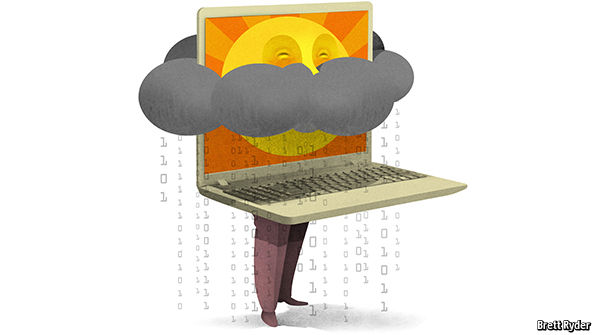
THE most striking battle in modern business pits the techno-optimists against the techno-pessimists. The first group argues that the world is in the middle of a technology-driven renaissance. Tech CEOs compete with each other for superlatives. Business professors say that our only problem will be what to do with the people when the machines become super-intelligent. The pessimists retort that this is froth: a few firms may be doing wonderfully but the economy is stuck. Larry Summers of Harvard University talks about secular stagnation. Tyler Cowen, of George Mason University, says that the American economy has eaten all the low-hanging fruits of modern history and got sick.
Until recently the prize for the most gloom-laden book on the modern economy has gone to Robert Gordon of Northwestern University. In “The Rise and Fall of American Growth”, published in January, Mr Gordon argues that the IT revolution is a minor diversion compared with the inventions that accompanied the second industrial one—electricity, motor cars and aeroplanes—which changed lives profoundly. The current information upheaval, by contrast, is merely altering a narrow range of…Continue reading
Channelling Trump
 Hot property
AS HIS chances of making it to the White House have narrowed in recent weeks, another avenue has opened for Donald Trump. The notion that he might start his own media network has been the subject of speculation for months. Now industry executives are discussing the possibility in some detail.
In September the Republican candidate’s son-in-law, Jared Kushner, owner of the New York Observer, asked his friend Aryeh Bourkoff, a banker who has been a dealmaker in the media industry, for advice. (A spokeswoman for Mr Bourkoff said he personally had no interest in such a project). Mr Trump himself has denied any intention to start a network. But a look at the numbers suggests that Trump TV could be a success, media folk say—far from a juggernaut like Fox News, which has revenues of more than $2 billion a year, but lucrative nonetheless.
Such a product would have a good shot at going mainstream because Mr Trump could sell it directly to consumers over the internet, as a subscription streaming service. The Trump brand may now be too toxic for a publicly-owned media company to go…Continue reading
Overdoing it

LATE of an evening, Japan’s black-suited salarymen let their hair down in the streets of Shimbashi, a district of Tokyo. Shirts untucked, ties off, liquor flowing, they stagger around before heading home, or directly back to the office via a konbini (convenience store) to buy a clean shirt.
This is the harmless outlet for their stress: karoshi, or death by overwork, is the darker, and until recently, more overlooked one. This month the first ever government report into the scale of karoshi found that employees put in over 80 hours of overtime a month at almost a quarter of companies surveyed. At 12% of those firms the figure rose to a whopping 100 hours. These numbers may underestimate the problem; under a fifth of 10,000 companies contacted responded, which is a normal response rate, but firms with still worse overtime figures may have kept out of the study.
Little wonder that 93 people committed or attempted to commit suicide in the year to the end of March 2015 because of overwork. These are the cases where the government has officially recognised that families are owed compensation;…Continue reading
Worth it?

While many MBA programmes are feeling the pinch, life is rosy for the very best business schools. Chicago retains its place at the top of our ranking of full-time MBAs. It is the sixth time in seven years that it has taken first place. Like most of Chicago’s peers, nearly all of its MBA class can expect to find a job immediately after graduation, with a basic salary well in excess of $100,000. Such degrees do not come cheap. The average cost of tuition at the top 15 schools is $112,000. America, the spiritual home of the MBA, dominates our list, accounting for 11 of the top 15 schools. The ranking is based on a mix of hard data and subjective marks given by students. It weights data according to what students tell us is important. The four categories covered are: opening new career opportunities (35% weighting), personal development and educational experience (35%), increasing salary (20%) and the potential to network (10%).
Campus vs beach

THE CONVICTION that the secrets of commerce can be taught in a classroom, whether real or virtual, shows little sign of fading. In America, more master’s degrees are awarded in business than in any other discipline—over 189,000 in the 2013-14 academic year, the latest for which figures are available. Business is the most sought-after master’s qualification in the world. The majority are masters of business administration (MBA), covering a broad range of business skills, a qualification that is close to a mandatory requirement for a budding tycoon. At any one time, around two-fifths of chief executives at Fortune 500 companies are likely to hold an MBA.
Yet a fresh case study on the MBA may be in the making. Interest in the full-time variety has waned markedly in recent years. Applications to most programmes are either falling or static, according to the Graduate Management Admission Council (GMAC), an association of business schools. Data from The Economist’s own latest ranking of full-time MBA programmes tell the same story. Five years ago, a business…Continue reading
Gold posts
 He’s got the moves
HAVING just received the latest PlayStation console from Sony, Dele Alli, an English footballer, posts a photo of it to his Instagram account. He dutifully thanks his benefactor and concludes the message: “#ad”.
It is the latest frontier of a rapidly growing industry. Since January, more than 200,000 posts per month on Instagram, a picture-sharing app owned by Facebook, have been tagged with “#ad,” “#sp” or “#sponsored”, according to Captiv8, a firm that connects brands to people like Mr Alli. Most are reaching Instagram users via such celebrities. Hiring “influencers”, as they are known, connects brands to a vast network of potential customers. Kim Kardashian West, a reality-TV star, for example, reaches 160m people across Facebook, Instagram and Twitter.
Consumers love the unprecedentedly deep access to the lives of the rich and/or famous that platforms offer. DJ Khaled, a music producer and prolific poster on Snapchat (another picture-messaging app), delighted millions of his followers with live video updates of himself lost at sea at night on a jet ski. He is also an…Continue reading
Made men
AT A bar called “University” in San Giovanni a Teduccio, a rundown suburb of Naples, two blown-up photos adorn the walls: Albert Einstein and Steve Jobs, founder of Apple. Nelson Ciarravolo, the owner, put them up when the bar opened two years ago, long before the news came that Apple would open its first European iOS (its mobile operating system) developer academy in the district. Locals joke that Mr Jobs’s photo may have gone up more recently. Either way, it signals that Naples has embraced the American tech giant. On October 6th Apple held the opening event for the new academy, which it will run in collaboration with Federico II University, after which the bar is named.
“We go to places nobody thought were possible”, explained Lisa Jackson, vice president of environment, policy and social initiatives at Apple, at the inaugural event. Naples lags far behind northern Italy for transport and digital infrastructure, and criminality is rife. The Camorra, a mafia gang, runs one of the biggest drug-trafficking enterprises in the world from the city. The neighbourhood in which Apple has opened the academy (it is located inside a new campus of Federico II University) used to be more dangerous. “We used to see our friends die on the ground,” recalls Davide Varlese, a cousin of Mr Ciarravolo. But things have improved over the past decade as authorities have…Continue reading
Insanely virtual
 Better reality
AT THE heart of an emerging technology cluster in London’s Shoreditch lies the Stage, a big mixed-use building complex that is being developed by Vanke, a Chinese real-estate company, among a few others. A potential Chinese buyer of one of the flats in its 37-storey residential tower recently had a look around. She went from room to room, observing the furnishings and fittings. She marvelled at the city views from the balcony and peeped inside the refrigerator. There was no need for a flight to London. She toured the property using virtual reality (VR) goggles at Vanke’s global marketing centre in Shanghai.
The use of VR kit is quickly becoming widespread in China’s property industry. Few real-estate firms in other countries are as advanced. China is fast emerging as the world’s most important VR market, thanks to rapid adoption by property firms and by companies in other industries. The prompt take-up is not because Chinese firms make the best VR headsets, which they do not. In fact, the pioneers in cutting-edge hardware are America’s Oculus, which is owned by Facebook, Japan’s Sony, South Korea’s…Continue reading