
Tag: Business
Fighting fit

CONTROVERSY over the relationship between BAE Systems, Europe’s largest defence company, and one of its main customers, Saudi Arabia, was raging when Ian King, its chief executive, started his job in 2008. BAE’s link to Saudi Arabia was forged 30 years ago with the first “al-Yamamah” arms deal. It saved the firm amid a difficult business environment, but embroiled it in a long-running corruption scandal that even led to Mr King’s immediate predecessor, Mike Turner, being briefly detained by America’s Department of Justice just before he stepped down.
The new boss’s mandate eight years ago was to banish BAE’s old, buccaneering ways and make it the acme of squeaky-clean corporate governance. Now, as Mr King prepares to leave and hand over to a successor, the firm is once again under fire for its ties to the house of Saud, this time for supplying its wares to support the kingdom’s war in neighbouring Yemen. A rising chorus accuses the Saudi-led coalition of using its Western-supplied and maintained air power indiscriminately in its campaign against Iranian-backed Houthi rebels.
Human-rights activists are trying to use…Continue reading
Meet the new boss

ALTHOUGH he styles himself as a chief executive who can turn the country around, Donald Trump is an outsider in the world of American business. His commercial operation is tiny by the standards of the country’s mega-firms and few of their bosses have ever viewed the president-elect as an equal or ally. He has “no friends” among the business elite, sniffed a private-equity baron a few weeks ago, who will doubtless now join a queue of executives waiting at Trump Tower to curry favour and to assess the new man’s priorities before he assumes office.
Those supplicants will soon discover that Mr Trump’s attitude towards business has three contradictory strands. He is passionate about unleashing the might of the private sector in order to revive growth. There is certainly plenty of scope: last year listed American companies invested a mediocre 46% of their total cashflow. Yet he is also a populist who thinks the economy is rigged in favour of big business and crony capitalists, and he is a protectionist. In the coming months these three different strands will respectively excite, worry and scare the business world.
Start, first, with the…Continue reading
China’s big aerospace ambitions are delayed
 I think we need to make it bigger
STEALTH fighter jets are designed to be as furtive as possible and sneak through radar without being noticed. China’s new J-20 stealth fighter demanded plenty of attention as it roared over the heads of spectators during its public debut at the Zhuhai air show this week. The message was clear: China is aiming high in the aerospace business. That ambition, though, is as much about commercial aircraft as it is about fighter jets, and in particular one model was noticeably absent from the show: the C919, a single-aisle short-haul passenger jet which China is developing to take on Airbus and Boeing.

\Over the next 20 years both the European and the American aerospace giants forecast that China will become their biggest single market due to demand for new aircraft by Chinese airlines keen to meet the rising middle classes’ desire for air travel. Boeing estimates that…Continue reading
Digital advertisers battle over online privacy
ONLINE advertising is booming. Digital-ad revenues in America in the first half of the year reached a record $32.7bn, according to the latest figures from the Interactive Advertising Bureau, a trade group. For marketing folk, digital ads have great appeal because consumers’ online data can be used to direct what they think are the right advertisements to the right shoppers. But tracking has become increasingly contentious in both America and Europe.
On October 27th America’s Federal Communications Commission (FCC) announced a new rule to protect personal privacy online. Internet-service providers, such as AT&T and Comcast, must now ask consumers for permission if they want to gather and share data deemed to be sensitive, including financial information and users’ browsing history.
However, the FCC’s rule is notable not for settling a debate, but stirring it. Marketers and digital-ad firms insist that they already police themselves well. They consider data on browsing and apps, in particular, to be essential for targeted advertising. Under the FCC’s rule consumers can “opt in” to share this information, but firms fear that many will not.
There is a limit to the FCC’s order, which perversely makes it only more controversial. It will restrict data collection by internet providers, but have little impact on broader online tracking….Continue reading
How to rev up Japanese startups
 Naka does it her way
WANTEDLY, a LinkedIn for Japan’s millennials, would not be out of place in California. The thriving firm’s offices feature trendy furniture and a ping-pong table. Akiko Naka, the 32-year-old chief executive leads a young team that forgoes the usual black-and-white attire of Japanese business to pad around in jeans and socks. Meeting rooms are named after characters from a famous manga comic.
Yet Wantedly is a rarity. Since the fertile years of the 1980s, and a brief dotcom boom that began in the late 1990s, Japan has fared badly in encouraging similar startups. Just 31% of Japanese think being an entrepreneur is a good career choice, beating only Puerto Rico at the bottom of a study carried out in 2014 by Global Entrepreneurship Monitor (GEM), a report compiled by a group of universities worldwide. By comparison, America scored 65%, China 66% and the Netherlands 79%. Shinzo Abe, Japan’s prime minister, has tried to encourage people to start new businesses to help revive the economy. Startups create more jobs, and more productive ones—something Japan desperately needs. (Its…Continue reading
Tech firms shell out to hire and hoard talent

LARGE technology firms used to hold on to their high-flying employees by agreeing not to poach them from each other. “If you hire a single one of these people, that means war,” Steve Jobs, Apple’s then boss, warned Sergey Brin, a founder of Google, in 2005. That was an illegal arrangement, and in 2015 Apple, Google, Adobe and Intel paid a $415m settlement to engineers whose pay had been held down as a result.
Today wage suppression in Silicon Valley is even more of a distant memory than dial-up internet and mainframe computers. Last year technology companies in America recorded expenses of more than $40bn in stock-based compensation. Exact comparisons are difficult, but to put that sum in perspective it is roughly 60% more than the bonus pool paid to the New York employees of Wall Street banks.
The money tech firms throw at employees has ballooned as competition to hire and hang on to top talent in engineering, data science, artificial intelligence and digital marketing has soared. Even entry-level engineers can easily earn $120,000 a year, more than most people their age can make on Wall Street; mid-career executives with technical…Continue reading
The niche in phones that are different
 You’ll have to speak up, I’m on my niche phone
ON JANUARY 9th 2007 Steve Jobs stood before an audience of some 45,000 people in San Francisco and announced a “revolutionary and magical product”: a slight slab of expansive black touchscreen with just a single button. Compared with the ugly, cluttered devices of the day, the iPhone was revolutionary. It was also hugely influential. A technicolour pageant of rival designs—the clamshell, the slide, the banana, the candybar and the BlackBerry—resolved into a uniform black mirror. And nearly every smartphone on the planet still looks like the device which Jobs revealed that day.
Nor is that similarity to be found just in hardware design. Nearly a fifth of smartphones sold last year operate on Apple’s iOS software. The rest run variations of Android, an open-source operating system provided by Google. Just two companies—Apple and Samsung—accounted for over 40% of smartphones sold in 2015, according to CCS Insight, a research firm. Huawei came in a distant third with 8%.
In this bland and uniform market some producers spy an opportunity. One of those is…Continue reading
Los Angeles booms as a startup hub
 Better than surfing down Sand Hill Road
HOLLYWOOD has produced plenty of films about underdogs rising to claim the limelight. Now Los Angeles is experiencing its own real-life Cinderella story, as the area’s technology scene has been transformed from backwater to boomtown in just a few years. Hordes of venture capitalists from northern California, once long dismissive of their southern neighbour, now regularly commute in search of deals in a less heavily hunted spot than the Bay Area. In 2016 the city’s startups received around $3bn in funding, around six times more than in 2012, according to CB Insights, a research firm.
Evan Spiegel went to Stanford University in the heart of Silicon Valley, but he wanted to live and work close to the sea. So he based his new company one block from the Pacific in Venice Beach, which is better known in Los Angeles for its silicone-enhanced bodies than the silicon chips that gave the Valley its name. Mr Spiegel’s firm, Snap, is best known for its ephemeral Snapchat social-media messages and is now valued at a whopping $18bn. Other successful technology firms are thriving nearby, including…Continue reading
Political business
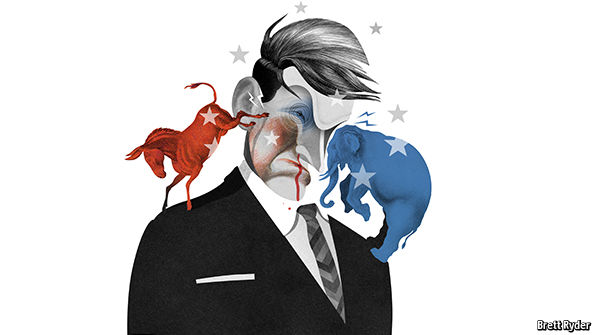
AS AMERICA’S presidential election approaches the country’s business class is in its weakest political position for decades. Twenty years ago both parties competed to be the most pro-business. Today they compete to denounce the malefactors of great wealth. The most startling change is that business has lost control of its ancestral party, the Republicans. Donald Trump may well embody many an American business type: somebody who inherits a fortune and goes on to make it even bigger. But he has taken over the Republican Party by channelling blue-collar anger against all elites.
Mr Trump has trashed free trade, liberal immigration rules and other corporate non-negotiables. Big companies have shied away from donating to his campaign. Meg Whitman, the boss of Hewlett Packard Enterprise, has called him “reckless and uninformed”. Tom Donohue, head of the United States Chamber of Commerce, has described his policies as “pretty sort of stupid”.
All this has driven lots of business people to cross the political aisle: an Ipsos poll shows that 53% of those earning $250,000 or more (the top 5% of households) plan to vote for Hillary Clinton,…Continue reading
Angling for the future of TV

IMAGINE a television which, as in the old days, has only a handful of channels to choose from instead of hundreds, as a typical cable set-up might offer today. In a decade or so TVs will once again have only a few channels, but each will run miles deep, with content that can be viewed on demand. Netflix might be one such offering; Amazon another. Both firms are spending billions of dollars making and buying TV shows and films to sell directly to viewers to watch when they like, and on devices other than the box in the corner of the room. And other rich tech firms may join them.
It is this vision that is now driving the direction of television and media. Broadcasters are willing to pay more to show live sporting events, and to invest more in producing TV shows, to make their networks the must-see choice for viewers. This trend has spurred the largest-ever merger of a telecommunications company with a media firm. AT&T, America’s wireless and pay-TV giant, announced on October 22nd an offer for Time Warner, the owner of HBO, CNN and Warner Brothers studio, worth $109bn. In doing so AT&T is betting that a few vertically integrated platforms will…Continue reading