
Tag: Business
The business of reselling returned shop items
 Can I send him back, too?
IN STORES and warehouses across America, they wait: towers of toys, scarves piled on scarves, box upon box of shoes. The official start of holiday shopping in America begins on “Black Friday” on November 25th. Retailers hope to sell more than $650bn of goods this season, roughly the annual economic output of Switzerland. Ideally, companies’ supply of products would precisely match demand for them. In reality millions of items will stay on shelves or get sent back after purchase—in all of 2015 Americans returned goods worth $261bn, out of a total $3.3trn sold. What happens next?
Some returned goods will be resold by the very same retailer, but many will not. By the time an item is returned it might be either damaged or stale, points out Steven Barr of PwC, an accounting firm and consultancy; shops might want to offer newer wares. And resale is not an option for the stacks of goods that are never sold at all.
For retailers and manufacturers, this is a big headache. Dealing with unwanted goods can amount to a tenth of the cost of making and distributing them in the first place. But for…Continue reading
The future of the A380

AT THE world’s major airports, plane-spotters often spend days waiting for the world’s largest passenger plane, the Airbus A380, to make an appearance. The nerds at Dubai International Airport are spoilt for choice. It is home to Emirates, an airline that owns 86 of the monster aircraft, almost half of the global A380 fleet. These planes have propelled Emirates from insignificance a decade ago to its position as the world’s biggest carrier (measured by international passenger mileage in 2015). Now the airline has hit a rough patch. That is bad news for Airbus, the European aerospace and defence giant which makes the A380, and for the plane itself.
Demand once seemed insatiable for flights through Emirates’ hub in Dubai, which is known in the industry as a “super-connector” airport. Now its location helps explain the airline’s difficulties as well as its spectacular past growth, says its president, Sir Tim Clark. When he helped set up the airline in 1985, he says, Dubai was “an enchanting Arab village” that generated little air traffic. Instead of filling up the planes with locals, his strategy was to use its position halfway between…Continue reading
Donald Trump’s conflicts of interest
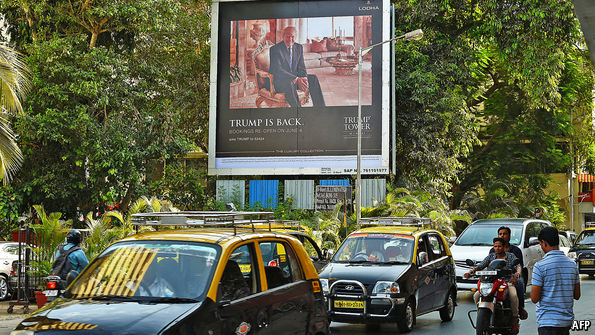
THE NEW Trump Tower in Worli, a buzzing district of Mumbai, looks like any building site but its marketing sells a dream. A golden structure soars to the sky alongside a picture of Donald Trump. He is—potential residents are assured—the gold standard around the globe, a dealmaker without peer who operates across the gateway cities of the world and the man who built the American dream. Until a few days ago the developer, Lodha, carried a message on its website: “Congratulations Mr President-elect”. But now that a storm has blown up over the possible conflicts of interest between the various operations of Mr Trump’s group and his new job, it has been deleted.
The self-embellished legend is of a global tycoon. In a kind of mirror image, outraged suspicion is mounting that the Trump Organisation could morph into a vast global network of cronyism. America has been treated to reports of multi-billion dollar projects across the planet, to photos of Mr Trump glad-handing businessmen and to images of exotic, Trump-branded buildings standing like monuments to the decay of American ethics. Paul Krugman, a left-of-centre economist, has suggested that the…Continue reading
False news items are not the only problem besetting Facebook

“MARK ZUCKERBERG, dead at 32, denies Facebook has problem with fake news.” The satirical headline, which made the rounds online this week, nicely encapsulates the most recent woes of the world’s largest social network: its algorithms, critics say, filled users’ newsfeeds with misinformation—and in the process influenced the American election result. But this is not the only problem the firm is grappling with. A volatile share price, privacy policies and advertising metrics have also kept Mr Zuckerberg (pictured) busy.
“News” that the Pope had endorsed Donald Trump or that a pizzeria in Washington, DC, is the home base of a child-abuse ring led by Hillary Clinton, were not confined to Facebook (nor were fake stories only a right-wing phenomenon). They often originate elsewhere, for instance on fake-news websites in Macedonia, which make good money via online ads, and on Twitter. But Facebook’s algorithms give prominence to such misinformation. They are tuned to maximise “engagement”, meaning they present users with the type of content that has already piqued their interest, as outrageous headlines tend to do.
Yet despite…Continue reading
Samsung is sucked into South Korea’s political crisis

IT WAS the third raid on the Samsung group in as many weeks. On November 23rd state prosecutors combed more offices of the South Korean consumer-electronics firm, part of a probe into an influence-peddling case that could be the undoing of President Park Geun-hye’s administration. The deepening inquest compounds a miserable few months for Samsung, which recently recalled 3m faulty washing machines and killed a new line of Galaxy Note phones after dozens exploded due to flawed batteries.
Last week prosecutors accused Ms Park of conspiring to coerce 50-odd companies to funnel 80bn won ($70m) to two foundations, Mir and K-Sports, controlled by Choi Soon-sil, a confidante indicted for abuse of power. The biggest grant, 20.4bn won, came from Samsung. Prosecutors suspect that it funnelled a further €2.8m ($3m) to Ms Choi through Widec Sports, a German company she used to buy horses and equestrian lessons for her daughter, a dressage athlete.
Investigators had said that the firms, including many in the pantheon of South Korean business, such as Lotte, a retail giant, and SK Group, a conglomerate, both of whose offices were raided this week,…Continue reading
Technology firms may struggle to disrupt the food business

THE office parks of Silicon Valley boast many firms that are trying to change the world. But there are plenty with more modest goals. Zume Pizza, a tiny startup that is located a few miles from the sprawling headquarters of Google, wants to redesign the way pizzas are made. Zume has programmed robots to make pizzas that are then baked inside vans as they hurtle towards customers. Ovens are timed to finish cooking in sync with the vehicles’ arrival at their destination, so the pies are always piping hot.
In recent weeks spies from rival pizza companies and from food-delivery firms have been driving by in unmarked cars taking photographs of the office and the vans, says Julia Collins, one of Zume’s co-founders. To protect its business, the startup has patented the process of cooking food in ovens while a vehicle is moving (the patent probably gives Zume fairly defensible intellectual property, according to one patent lawyer). The company only operates in Mountain View, but has expansion plans. Since its founding last year it has reportedly raised $6m from investors, among them Jerry Yang, a co-founder and former boss of Yahoo, an early giant of the…Continue reading
The sharing economy brings tycoon lifestyles within reach of some

LAMENTING the rise of inequality is one of the few growth industries in an age of stagnation. One authority on the American wealthy, Robert Frank of CNBC, a TV channel, worries that the rich are “floating off” into their own country. Chrystia Freeland, a journalist-turned-politician, frets about the rise of the “new global super-rich” and the fall of everyone else. Charles Murray, America’s gloomiest social scientist, warns that society is “coming apart” as the rich retreat into their gated communities.
At the top of the income scale, however, a small counter-trend is observable. Never before have so many people been able to get access to the accoutrements of tycoonery—private planes, luxury yachts, fancy cars and interior-designed, exclusive homes. There is only so much comfort to be had from the fact that it is easier for the merely rich to lay claim to the lifestyle of the super-rich. But as a result of a combination of new technologies and businesses, that is nonetheless what is happening.
Tycoon living begins with a private jet. Whereas yachts are dispensable (not everyone wants to float around for weeks with the…Continue reading
Amp my ride

“THE car is the ultimate mobile device,” said Jeff Williams, an executive at Apple, last year. It was taken as another sign that the maker of iGadgets would be deepening its interest in the automotive sector (among other projects, it is developing an in-house smart car that is codenamed Project Titan). Now Samsung Electronics, its big rival in the smartphone world, is following. On November 14th the South Korean company said it would pay $8bn for Harman, a firm based in Stamford, Connecticut, that makes internet-connected audio, information and security systems for cars. The deal is Samsung’s largest ever, and the first big transaction for its vice-chairman and heir apparent, Lee Jae-yong, grandson of the firm’s founder.
Though it is best known for its sound systems, Harman is one of the world’s largest supplier of smart parts for “connected cars” that help owners to drive by linking to the internet and to chip-enabled devices. It made $7bn in revenue in the year to September, two-thirds or so of it from the car sector, and has over three times that in new orders. Its products are the first step towards autonomous vehicles. Over 30m…Continue reading
Clash of the Tatas

COMPANY bosses who get the sack react in different ways: some quietly leave, others graciously wish their successor luck, most try to nurse hurt pride as best they can. Not Cyrus Mistry, who on October 24th was ousted as chairman of the Tata Group, India’s biggest conglomerate. Bemused and angered at having his predecessor, Ratan Tata, suddenly seize back control, he has refused to go. The schism at the heart of Tata has drawn attention to what made it possible in the first place: an overly complex structure trying to oversee too many businesses, deficient corporate governance and a penchant for opacity. Whether these problems are addressed, and how, will shape the group and its reputation for decades to come.
Tata’s reasons for sacking Mr Mistry are unclear. He is from a family that has had a nearly 20% shareholding in the group for decades (most of the other shares are controlled by charities that are chaired by Mr Tata). Allies say that after four years in the job, Mr Mistry had got to grips with the inner workings of the company. He was ready to start changing it.
His critics, on the other hand, never believed that any executive…Continue reading
Vein hope

DONALD TRUMP’S grandfather, Fred, got his start in the hotel industry at the turn of the 20th century supplying rooms, food, booze and female company to prospectors flocking to north-western Canada in the so-called Klondike gold rush. It may be part of this legacy that gave America’s president-elect his taste for golden fixtures and fittings. But it may also make miners a bit wary of Mr Trump. After all, their pockets have been “mined” by a Trump once before.
So the world’s biggest mining companies are downbeat about the rally in commodities prices that accompanied Mr Trump’s election victory, which briefly pushed up prices of copper at their fastest rate in five years and sent iron-ore prices to two-year highs close to $80 a tonne. On November 15th Rio Tinto, one of the world’s biggest mining companies, told 440 workers at an iron-ore mine in Western Australia to take two weeks off at Christmas, not as a celebration, but as a precautionary measure to reduce supply. It expects conditions to get much tougher in 2017. Its main rival, BHP Billiton, is also nonplussed. It predicts economic uncertainty, political instability and a…Continue reading