
Tag: Business
Charles Koch is a rare thing, a businessman besotted with ideas

CHARLES KOCH may well be the most demonised businessman in America, with his younger brother, David, a close second. Journalists argue that he is the mastermind of the country’s vast right-wing conspiracy. Lunatics have made death threats. The ultra-rich, particularly those who made their original fortunes in oil and gas, are supposed to make amends by giving their money to liberal causes. The Kochs have instead spent hundreds of millions backing conservative political causes (though Charles Koch has no love for Donald Trump), lobbying for lower taxes and attacking the idea of man-made global warming.
Mr Koch doesn’t come across as Dr Evil. True, the headquarters of Koch Industries is a collection of black boxes outside Wichita, Kansas; the security screening is rigorous. But its CEO has more of the air of a university professor. Despite his $40bn fortune, he lives in a nondescript neighbourhood in one of America’s most boring cities, puts in nine or more hours a day in the office and lunches in the company canteen. He doesn’t seem that interested in his surroundings: complimented on the firm’s art collection, he says his wife takes care of that…Continue reading
Glencore stuns the oil-trading business with a deal to take a big stake in Rosneft
 Wild celebrations between Putin and Sechin
GLENCORE, a Swiss-based commodities company, and its biggest shareholder, the Qatar Investment Authority, are set to take a €10.2bn ($11bn) stake in the Russian oil giant Rosneft, giving them 19.5% of a business targeted by Western sanctions since Russia fuelled a war in eastern Ukraine in 2014. The unexpected deal, the largest in an ambitious Russian privatisation plan, delivers Vladimir Putin and Igor Sechin, Rosneft’s boss, a victory. The Russian state will keep control of the company, while filling a gap in the 2016 budget.
The transaction will also stir up old jealousies in the oil-trading business, which, as one industry participant puts it, is in “a pissing match to be top dog with Rosneft”, the world’s second-biggest crude producer. Last year Glencore was forced by the commodities slump to suspend its dividend, sell assets and issue $2.5bn of new shares. Its acquisitive boss, Ivan Glasenberg, had not been expected to make such an expansive move so soon.
In a statement Glencore said it will put only €300m of its own equity into the deal. The rest of the…Continue reading
South Korea’s chaebol bosses face parliament

FOR the South Korean public, the sight of nine of their most powerful business chiefs, who are rarely seen, submitting to a day-long grilling by South Korean MPs on December 6th was remarkable (eight of them are pictured). During the hearing, broadcast live on television, the heads of CJ, LG, Hanwha, SK, Samsung, Lotte, Hanjin, GS Group and Hyundai, all family-owned conglomerates, or chaebol, denied they had sought favours in return for the billions of won they paid into two foundations controlled by Choi Soon-sil, a former confidante of President Park Geun-hye. (As The Economist went to press, Ms Park faced an impeachment motion by parliament over her ties to Ms Choi.) Samsung’s Lee Jae-yong, whose 20.4bn won ($17.6m) grant was the biggest, was the most intensively interrogated. On many minds was the last time big bosses were thus summoned, during an inquiry in 1988 into the corporate funding of a foundation run by then-dictator Chun Doo-hwan. Six of those tycoons’ sons were among those testifying this week.
Breitbart News is taking the business of outrage to Europe

A NOTABLE American commentator, Charles Krauthammer, once explained Rupert Murdoch’s success in founding Fox News, a cable channel, by pointing out that he had found a niche market—half the country. The same may be true of Breitbart News, a conservative website whose fortunes have risen with those of Donald Trump, and whose chairman, Stephen Bannon (pictured) is Mr Trump’s chief strategist.
Milo Yiannopoulos, an editor at Breitbart, explained after Mr Trump’s victory that half of voters are “repulsed by the Lena Dunham, Black Lives Matter, third-wave feminist, communist, ‘kill-all-white-men’ politics of the progressive left.” Breitbart saw it coming a while ago, he added. The company’s expansion plans suggest it sees something coming in Europe, too. It already has a website in Britain and in January it will launch French and German sites.
Founded by Andrew Breitbart, the site is just nine years old. Its formula—outraging and fascinating readers with “clickbait”, occasional fake news, polemics and attacks on mainstream media—has taken off. Ten days after the election it said it had received 45m unique visitors in 31 days—modest compared…Continue reading
Breitbart News pushes deeper into Europe
 He stoops to conquer
A NOTABLE American commentator, Charles Krauthammer, once explained Rupert Murdoch’s success in founding Fox News, a cable channel, by pointing out that he had found a niche market—half the country. The same may be true of Breitbart News, a conservative website whose fortunes have risen with those of Donald Trump, and whose chairman, Stephen Bannon (pictured), is Mr Trump’s chief strategist.
Milo Yiannopoulos, an editor at Breitbart, explained after Mr Trump’s victory that half of voters are “repulsed by the Lena Dunham, Black Lives Matter, third-wave feminist, communist, ‘kill-all-white-men’ politics of the progressive left.” Breitbart saw it coming a while ago, he added. The company’s expansion plans suggest it sees something coming in Europe, too. It already has a website in Britain and in January it will launch French and German sites.
Founded by Andrew Breitbart, a conservative journalist who died in 2012, the site is just nine years old. Its formula—outraging and fascinating readers with “click bait”, occasional fake news, polemics and attacks on mainstream media—has taken off. Ten days…Continue reading
Siemens and General Electric gear up for the internet of things

IT DOESN’T take long to walk from Siemens’s old headquarters in Munich to its new one, inaugurated in June: the German industrial conglomerate has built it right next door. The design is cutting-edge, as are the building’s environmental features. It is packed with energy-saving sensors; channelled rainwater is used to flush the toilets.
General Electric, Siemens’s big American rival, will soon have a new base, too. But it takes three hours to drive from the old site in Fairfield, a Connecticut suburb, to the new one in Boston. Its building will also boast plenty of green technology, such as a huge canopy made of solar panels, as well as spaces that the public can enter, including co-working areas and lounges. There will be laboratories both for internal startups and some from outside.
The two industrial giants aren’t so much showing off as signalling transformation. Both firms are going through the most profound change in their corporate histories, attempting to switch from being makers of machines into fully digital businesses. GE’s chief executive, Jeff Immelt, says the plan is to join the world’s top ten software firms…Continue reading
France’s nuclear-energy champion is in turmoil
 Under pressure
THESE are difficult times for Electricité de France (EDF), the country’s quasi-monopolistic electricity provider, serving 88% of homes. Outages at no fewer than 18 of the 58 EDF-owned nuclear reactors that provide three-quarters of France’s electricity have meant a slump in production: the company says annual nuclear output could fall to 378 terawatt hours (TWH), from 417 TWH last year. Eight reactors are currently lying idle and several may not restart for weeks or months. Power stations are burning coal at a rate not seen since the 1980s. As electricity imports and prices soar, officials are having to deny that a cold snap could bring blackouts.
The cause of the crisis—possibly faulty reactor parts throughout EDF’s fleet—suggests it may not be easily contained. France’s nuclear regulator, the Autorité de Sûreté Nucléaire (ASN), this summer ordered urgent tests of reactor parts, mostly bases of cylindrical steam generators. Inspectors are worried about high carbon levels found in steel forged by Creusot Forge, which is owned by Areva, another French firm, and by Japan Casting & Forging…Continue reading
Donald Trump’s win has sent the shares of small American companies on a tear

THERE have been plenty of swings in financial markets since America’s election on November 8th. The Mexican peso has fallen against the dollar, reflecting worries about Donald Trump’s protectionist tendencies. Ten-year bond prices have tumbled as investors factor in the likelihood of much higher government borrowing. One particularly striking move has been a surge in the share prices of small firms. The Russell 2000 index of American midgets has leapt by 12%, compared with a 3% rise for the S&P 500 index of multinational leviathans (see chart).
Small companies are the backbone of America’s economy, employing about half of the private-sector workforce. But they have had a rotten decade. The Russell index had lagged the stockmarket until the election. The country’s 28m small firms—most of them unlisted—have never fully recovered from the financial crisis of 2008. As of October, confidence had yet to rise back to the level of 2006, according to an index of optimism that is based on surveys by the National Federation of Independent Business, a lobbying group. Giant firms, meanwhile, have been playing a bigger role: two-thirds…Continue reading
Japanese golf courses hunt for a new driver
 Slow fade
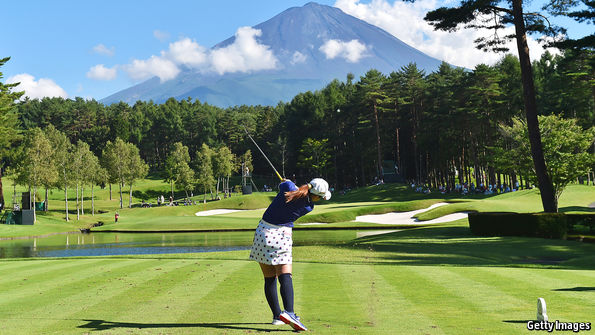
THE gold-coloured golf club priced at $4,700 that Japan’s prime minister, Shinzo Abe, gave to Donald Trump, America’s president-elect, in their first meeting last month may have been a piece of polished diplomacy. But it is unlikely to revive its posh Japanese maker, Honma, which calls itself “golf’s aristocracy”, presumably because it crafts the world’s most expensive clubs. It went bankrupt after Japan’s bubble-era splurge on new golf courses. Seven years ago a businessman from China bought the firm, hoping for an upswing.
Golf, long associated with extravagance in Japan, is flagging. Clubs have trimmed green fees as the level of golf-playing among Japanese has fallen by over 40% since a high in the early 1990s. As elsewhere, courses are in oversupply: Japan has over 2,300—half of Asia’s total.
More than 120 have closed since 2010. Entrepreneurial types have converted about 70 into solar-panel plants, encouraged by state subsidies for alternative-energy production following the disaster in March 2011 at the Fukushima Dai-ichi nuclear-power plant. A few others have been turned back into…Continue reading
How companies should treat their most enthusiastic customers

THE hero of Nick Hornby’s novel, “High Fidelity”, cannot get enough of vinyl records. By day Rob Fleming runs a record shop where he spends his time sampling the stock and constructing fantasy compilations with his equally obsessive assistants. By night he moons over his favourite songs. “Is it so wrong, wanting to be at home with your record collection?” he asks himself. “There’s a whole world in here, a nicer, dirtier, more violent, more peaceful, more colourful, sleazier, more dangerous, more loving world than the world I live in.”
Rob is an example of what management gurus dub “super-consumers”, “lead consumers” or “high-passion fans”. Only a tenth of customers are super-consumers but they account for 30-70% of sales, an even greater share of profits and almost 100% of “customer insights”, says a new book, “Super-Consumers”, written by Eddie Yoon of the Cambridge Group, a consultancy.
These people are not defined simply by the amount of stuff they buy (though they tend to be heavy users), but by their attitude to the product. Like Rob, they regard the things that they consume as answers to powerful…Continue reading