
Tag: Business
Behind the bid for Sky is a less powerful Murdoch empire

IT WOULD seem to be a stunning comeback for Rupert Murdoch and his clan. Five years ago News Corporation was engulfed by scandal. One of its British papers, the News of the World, had routinely hacked private phones. In the aftermath the company gave up a bid it had made for BSkyB (now simply called Sky), a satellite broadcaster in which it had a stake. A parliamentary report declared Mr Murdoch unfit to lead a large company. James Murdoch, his son, resigned as chair of BSkyB and chief of the newspaper division. Ofcom, Britain’s media regulator, eviscerated his leadership as “difficult to comprehend and ill-judged”.
Now the Murdoch empire appears to be striking back. On December 9th, 21st Century Fox, the Murdochs’ entertainment business, said it had reached a preliminary deal to pay £11.2bn ($14.1bn) for the 61% of Sky it does not already own. James Murdoch is ascending once more: indeed, this deal is chiefly his doing. Last year he succeeded his father as boss of 21st Century Fox, and in January he reclaimed his Sky chairmanship. But the show of strength comes with new weaknesses.
Much has…Continue reading
France’s corporate raider, Vincent Bolloré, makes a bid for Italy’s biggest broadcaster

NO BOSS in French business can match Vincent Bolloré for swagger and aggression. Variously described by the press in France as a stubborn Breton, a ruthless profiteer and a smiling killer, the 64-year-old corporate raider has acquired interests in media, transport, advertising, telecoms and more, scattered across Europe and Africa. Opinion at home is divided between those who say his methods are too brutal and others who welcome his effect on an often dozy business world.
This week it was the turn of Italian newspapers to rant against the French “pirate” and “mercenary”. On December 13th the news came that France’s Vivendi, a media firm in which Mr Bolloré’s company, Bolloré Group, owns 20% (he effectively controls it) was racing to buy up shares in Mediaset, Italy’s biggest TV-broadcaster. Things moved swiftly. By the next day Vivendi had a 20% stake in Mediaset, up from 3% two days earlier. The Italian firm claims a hostile takeover attempt—the smiling killer’s speciality—is under way.
Mr Bolloré has long aimed at winning a share of Mediaset. Earlier this year, Vivendi had agreed a plan with Mediaset in which…Continue reading
Alphabet’s Google is searching for its next hit
 Deflated hopes
“JUDGE a man by his questions, rather than his answers,” Voltaire advised. Google has become one of the most successful firms in history by heeding that advice. It evaluates the intention of web-surfers’ queries and returns relevant advertising alongside search results. But for years there has been a lingering question about Google: can it create a new, highly profitable unit to rival its search business?
Not yet. In the past five years, Alphabet, formed as a holding company for Google and other disparate projects in October 2015, has spent $46bn on research and development (see chart). Much has gone to so-called “moonshot” projects, such as self-driving cars, smart contact lenses and internet delivered via balloons. Its British artificial-intelligence unit, DeepMind, also falls into the category of other projects. Since the start of 2015, these bets have together recorded a loss of $6bn.
 Continue reading
What DeepMind brings to Alphabet

DEEPMIND’S office is tucked away in a nondescript building next to London’s Kings Cross train station. From the outside, it doesn’t look like something that two of the world’s most powerful technology companies, Facebook and Google, would have fought to acquire. Google won, buying DeepMind for £400m ($660m) in January 2014. But why did it want to own a British artificial-intelligence (AI) company in the first place? Google was already on the cutting edge of machine learning and AI, its newly trendy cousin. What value could DeepMind provide?
That question has become a little more pressing. Before October 2015 Google’s gigantic advertising revenues had cast a comfortable shade in which ambitious, zero-revenue projects like DeepMind could shelter. Then Google conjured up a corporate superstructure called Alphabet, slotting itself in as the only profitable firm. For the first time, other businesses had their combined revenues broken out from Google’s on the balance-sheet, placing them under more scrutiny (see Continue reading
Management theory is becoming a compendium of dead ideas
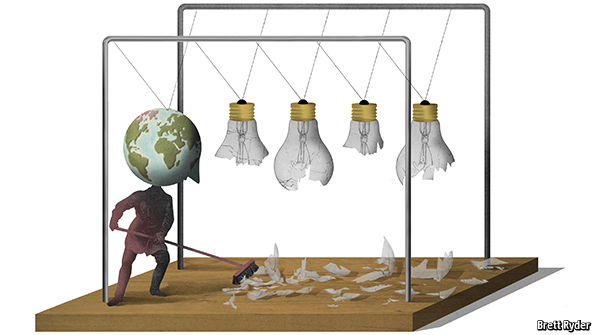
NEXT year marks the 500th anniversary of the event which, more than any other, gave birth to the modern world: Martin Luther promulgated his 95 theses and called the Catholic church to account for its numerous theological errors and institutional sins. Revisionist historians have inevitably complicated the story (including questioning whether he did actually nail his proposals to the door of All Saints’ Church in Wittenberg) but the narrative remains clear. The church was ripe for change. It was sunk in corruption and divorced from the wider life of society. And by unleashing that change, Luther brought the Christian faith, including Roman Catholicism itself, a new lease of life.
The similarities between medieval Christianity and the world of management theory may not be obvious, but seek and ye shall find. Management theorists sanctify capitalism in much the same way that clergymen of yore sanctified feudalism. Business schools are the cathedrals of capitalism. Consultants are its travelling friars. Just as the clergy in the Middle Ages spoke in Latin to give their words an air of authority, management theorists speak in mumbo-jumbo. The medieval…Continue reading
Food packaging is not the enemy of the environment that it is assumed to be

ROUGHLY a third of food produced—1.3bn tonnes of the stuff—never makes it from farm to fork, according to the UN’s Food and Agriculture Organisation. In the poor world much of this waste occurs before consumers even set eyes on items. Pests feast on badly stored produce; rough roads mean vittles rot on slow journeys to market. In the rich world, waste takes a different form—items that never get picked off supermarket shelves, food that is bought but then goes out of date.
Such prodigious waste exacts multiple costs, from hunger to misspent cash. Few producers and processors record accurately what they throw away, and supermarkets resist sharing such information. But some estimates exist: retailers are reckoned to mark down or throw out about 2-4% of meat, for example. Even a tiny reduction in that amount can mean millions of dollars in savings for large chains.
Waste also damages the environment. The amounts of water, fertiliser, fuel and other resources used to produce never-consumed food are vast. The emissions generated during the process of making wasted food exceeds those of Brazil in total. Squandering meat is particularly…Continue reading
America’s audit watchdog uncovers serious misconduct at Deloitte Brazil

ACCOUNTING scandals are nothing new in Brazil. Its former president, Dilma Rousseff, was impeached in August for cooking her government’s books. The bosses of its biggest building firms have landed behind bars for padding contracts with Petrobras, the state-run oil company. At least, governance gurus joke, all the imbroglios—and a three-year-old law against bribery—have prompted companies to replace what people used to call corruption departments with compliance offices. How ironic, then, that Brazil’s latest affair involves a firm that is meant to ensure that firms stay on the straight and narrow.
On December 5th it emerged that America’s Public Company Accounting Oversight Board (PCAOB) fined the Brazilian arm of Deloitte, the biggest of the “Big Four” accounting networks, $8m, for what Claudius Modesti, the watchdog’s director of enforcement, called “the most serious misconduct we’ve uncovered”. Deloitte is the first of the Big Four to be accused of failing to co-operate with a probe by the PCAOB, created by the Sarbanes-Oxley act of 2002, itself a response to a massive accounting scandal at Enron, an energy giant. The firm will also have to pay 5.4m reais ($1.6m) to Brazil’s…Continue reading
The oil industry is bouncing back after OPEC’s meeting

PROUDLY, they call themselves elephant hunters. They are the geologists who scour the treacherous depths of the Arctic, or Brazil’s Atlantic pre-salt fields, or offshore west Africa, or the deep waters of the Gulf of Mexico, hoping to bag giant oil discoveries that can generate billions of dollars of cash for their firms over a span of decades. In some cases, they get naming rights. The Gulf of Mexico is peppered with fields named after geologists’ wives (risky if they are duds), or their favourite albums, bands, stars and football chants. They are part of the industry’s folklore. The question is, are they a dying breed?
Several prospective deals announced this month, from the deep waters of the Gulf of Mexico to onshore Iran, suggest that the industry may be shying away from expensive forays into uncharted territory, and taking a more cost-conscious approach to exploration and production. It remains to be seen whether they can maintain their discipline if oil prices recover. But, for now, “they’ve all gone back to the drawing boards,” says Andy Brogan, an oil-and-gas specialist at EY, a consultancy.
On December 1st BP, a…Continue reading
Europe’s nastiest takeover battle reaches its second anniversary

THE life of a predator can be fraught. Expend too much energy on hunting your prey and even success can be costly. Saint-Gobain, a French maker of glass and other building materials, might be learning that lesson. It mostly grows by snapping up smaller fry, but an attempt to buy a midsized Swiss rival, Sika, has gone on for two years. It could take as long again for Swiss courts to resolve the most intractable corporate struggle in Europe.
Pierre-André de Chalendar, Saint-Gobain’s CEO since 2007, was doubtless impressed by Sika’s high returns on its business selling industrial adhesives, mortar and construction chemicals. Its annual return on capital over the past decade has been an attractive 12.6%, more than double Saint-Gobain’s 5.1% (see chart). So when in 2014 the current, fourth generation of the Burkard family, which founded Sika in 1910, offered to sell 52.4% of the voting rights in their firm, Mr de Chalendar bit.
The family investment is kept in a body called Schenker-Winkler Holding (SWH) which, following the death of the matriarch in 2013, the dynasty agreed to sell to the French firm for SFr2.75bn…Continue reading
A new motorcycle brand springs from a computer
 Engine of progress
WHEN the covers come off the Vanguard Roadster at the New York Motorcycle show on December 9th the moment will mark the launch not only of a brawny new bike but also of a new brand with big ambitions. Vanguard is an audacious startup that reckons it can use the increasing digitisation of manufacturing to ride with the pack of long-established bike companies, such as Honda, Yamaha, Harley-Davidson, BMW and others, who are together set to sell some 500,000 motorcycles and scooters in America this year.
That might sound laughable. So far, Vanguard has built a grand total of one machine. At around $30,000, complete with a thumping 1.9 litre V-twin engine, it is priced at the premium end of the market (though well below the price of some superbikes, which can cost three times as much). But if Vanguard has its way, within a few years it will be selling several thousand motorcycles annually from a range of several different models.
What enables a startup to aim so high is the way digital technologies are lowering the cost of entry to manufacturing businesses that were once seen as the preserve of giants….Continue reading