
Tag: Business
Polluting the outlook
 So they hope
IT WAS on November 16th that the International Energy Agency (IEA), an organisation that represents oil- and gas-consuming countries, announced its prediction that over the next quarter of a century renewable energy, such as wind and solar, and natural gas will hugely eclipse the traditional role that coal and oil have played in satisfying the world’s growing demand for energy (see chart). That is the base case for what it says is a powerful shift in the global energy landscape towards cleaner fuels.

The trouble is that after the projections were calculated, Donald Trump, who is both a climate sceptic and a fossil-fuel fan, was elected as America’s next president. As Fatih Birol, the IEA’s executive director, pointed out this week, no one knows what his energy policies will be. Yet he will run the world’s biggest producer and consumer of oil and natural gas.
Many…Continue reading
Pot of gold
 Flat white joint to go
IN THE 1990s Snoop Dogg, a rapper, called cannabis “chronic”. The drug was illicit and cool. In 2016 Mr Dogg is a cannabis investor, and the drug is poised to earn another title: consumer staple. On November 8th four states, including California, voted to approve recreational cannabis use. Four other states eased rules for medical marijuana. About three-fifths of America’s population lives in states that now allow cannabis use in some form.
So pot entrepreneurs face the thrilling prospect of normality. This week industry leaders were meeting in Las Vegas to discuss how the sector might expand. They have in prospect a vast, partially established market. More than 32m Americans already use cannabis. As the business becomes more normalised, it is sure to attract new customers. “It’s not often that you see an industry and you know the inevitability of it,” says Brendan Kennedy of Privateer Holdings, a private-equity firm that specialises in cannabis. Last year legal sales reached $6bn, according to the Arcview Group, an investment and market-research firm. By 2020 Arcview expects legal sales to be…Continue reading
An uncertain time for business

AN AGE of uncertainty is upon us. For the past three decades or so, businesspeople have been able to steer by a few lodestars. Trade negotiators lowered and simplified trade barriers. Central bankers tried to keep inflation to a minimum. Policymakers around the world negotiated multilateral treaties on the environment. Global bodies such as NATO provided security in Europe. Today the lodestars are exploding, one after the other.
Meanwhile, Donald Trump is making policy on the hoof. It turns out that the Affordable Care Act of 2010, or Obamacare, is not so bad after all. A big section of his planned wall on the border with Mexico will be a fence. In the past presidents have always arrived in the White House with a detailed set of policies. Mr Trump arrives with a tatty envelope scrawled with a few jottings on the back. Across the Atlantic, Brexit has opened a Pandora’s box: nobody knows whether Britain will leave the European single market or negotiate the equivalent of an associate membership. The Supreme Court has yet to determine how much say Parliament will have in shaping the negotiations.
One of the big promises from…Continue reading
Uncertain business
AN AGE of uncertainty is upon us. For the past three decades or so, businesspeople have been able to steer by a few lodestars. Trade negotiators lowered and simplified trade barriers. Central bankers tried to keep inflation to a minimum. Policymakers around the world negotiated multilateral treaties on the environment. Global bodies such as NATO provided security in Europe. Today the lodestars are exploding, one after the other.
Meanwhile, Donald Trump is making policy on the hoof. It turns out that the Affordable Care Act of 2010, or Obamacare, is not so bad after all. A big section of his planned wall on the border with Mexico will be a fence. In the past presidents have usually arrived in the White House with a detailed set of policies. Mr Trump arrives with a tatty envelope scrawled with a few jottings on the back. Across the Atlantic, Brexit has opened a Pandora’s box: nobody knows whether Britain will leave the European single market or negotiate the equivalent of an associate membership. The Supreme Court has yet to determine how much say Parliament will have in shaping the negotiations.
One of the big promises from populists is…Continue reading
Seize the day
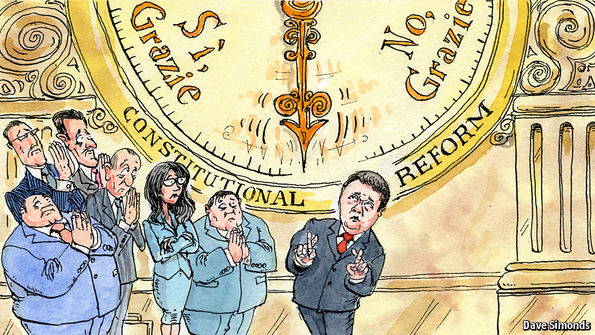
“THE biggest risk in Europe is the Italian referendum,” said Gianfelice Rocca, head of Assolombarda, Milan’s chamber of commerce, this summer. For corporate Italy, much is at stake in the vote on constitutional reform, which will be held on December 4th. Victory for Matteo Renzi, the business-friendly prime minister, could mean a big fillip for firms of all sizes, whereas a loss would be “a shock in the system”, said Mr Rocca.
The national employers’ federation, Confindustria, agrees with him. If those campaigning for a “yes” vote are to be believed, firmer government, easier conditions for investors and generally brighter economic prospects would follow. The two main issues to be decided are reform of the Senate’s powers—whether to let the lower chamber pass future laws, even when opposed by the Senate—and whether decision-making powers should be brought back from regional governments to the centre.
Francesco Starace, the chief executive of Enel, a giant European electricity company that is one of Italy’s more successful firms, sets out a strong case that the proposed changes would bring important benefits to…Continue reading
System crash
 The world according to Thiel
“I’D LIKE to wake up now please,” tweeted Sam Altman, who heads Y Combinator, Silicon Valley’s foremost startup school. The sentence neatly encapsulates the mood in the high-tech hub. To many in the technology industry, America under Donald Trump means dystopia. Perhaps no other sector regards his victory with less enthusiasm.
The main reason is that his stated views are antithetical to the beliefs that most entrepreneurs and tech types hold on a range of topics from trade to offshoring to policy on immigration. By one estimate the tech industry gave nearly $8m to Hillary Clinton’s campaign. Silicon Valley also worries that it will lose its direct lines to the administration in Washington. According to the Campaign for Accountability, a transparency group, no fewer than 22 former White House officials have gone to work for Google since Barack Obama moved in. Under Mrs Clinton the door would have kept revolving.
Only one noted Valleyite is likely to have the president’s ear: Peter Thiel, a venture capitalist. He alone supported Mr Trump, speaking at the Republican convention…Continue reading
The great divergence

ONE of Joseph Schumpeter’s best-known observations was that successful businesses stand on ground that is “crumbling beneath their feet”. A danger is that standing still and resting on your laurels can precipitate a swift tumble. Rivals, meanwhile, can draw on the available stock of knowledge and technology to catch up with the leaders. To stay ahead, front-runners must keep inventing new things. This means that capitalism is inherently unforgiving: today’s leader is tomorrow’s failure. But it also means that it is inherently progressive, since clever ideas are quickly spread through the economy.
Some striking new research suggests that this Schumpeterian mechanism may have broken down. The leaders are staying ahead much longer than is desirable. A group of researchers at the OECD, a club of mostly rich countries, examined the performance of a representative set of companies in 24 of its 35 member countries between 2001 and 2013. They discovered that the top 5% of them, dubbed “frontier firms”, have continued to increase their productivity while the other 95% (the laggards) have been stagnant in this regard.
Plenty of economists…Continue reading
African potholes
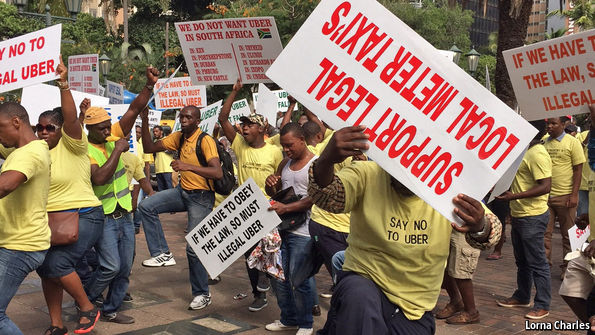
“I WAS lucky my customers were three big white guys,” says Themba, an Uber driver in Johannesburg recounting a close call with taxi-drivers who tried to block him from collecting passengers at the airport that serves South Africa’s economic hub. “They pushed them out the way and we managed to drive off.”
The ride-hailing app has made a splashy if slow start in Africa. Of the 529 cities in which Uber connects riders with drivers, just 14 are on the continent. Yet Africa is fertile ground for a firm offering cheap and safe transport. Most passengers have to spring for overpriced cabs or catch a white-knuckled ride on the back of a motorcycle taxi.
In Abuja, locals have long used a low-tech version of ride-sharing. Many folk simply stick out a hand at the roadside to hail any passing car before negotiating a fare. Yet locals warn that fake taxis cruise the streets with robbers hiding in the boot, ready to jump out at a traffic light. In Lagos some taxi-drivers are even thought to be in cahoots with kidnappers. Not surprisingly, Uber seems to be growing quickly in the few cities where it has launched. In many places rides cost less…Continue reading
A long road to recovery

THERE are two ways of dealing with a worrying problem in a car engine. One is a complete overhaul; the other is to tinker under the bonnet and hope the trouble goes away. Volkswagen’s efforts to deal with an emissions-cheating scandal that emerged in September 2015 are of the tinkering type. The German carmaker is desperate to draw a line under its ill-fated decision to fit software to 11m diesel cars that detected emissions tests and artificially reduced the amount of nitrogen oxide pumped out. But the disconcerting rumbles continue.
The latest setback came on November 6th, when VW said that a German investigation of market manipulation was examining the role of Hans Dieter Pötsch, chairman of its supervisory board. The probe, which began in June, is looking at whether Martin Winterkorn, VW’s former chief executive, and Herbert Diess, who oversees the core VW brand, should have disclosed the emissions cheating before the company publicly admitted wrongdoing. This is deeply uncomfortable for both VW and Mr Pötsch, who used to be the chief financial officer and was nominated to become chairman on the day the crisis began. It is also a reminder…Continue reading
The big sort

“THE vultures all start circling, they’re whispering, ‘You’re out of time’…but I still rise!” Those lyrics, from a song by Katy Perry, an American pop star, sounded often at Hillary Clinton’s campaign rallies but will shortly ring out over a less serious event: a late-night party in Shenzhen to kick off “Singles’ Day”, an online shopping extravaganza that takes place in China on November 11th every year.
The event was not dreamt up by Alibaba, but the e-commerce giant dominates it. Shoppers spent $14.3bn through its portals during last year’s event. That figure, a rise of 60% on a year earlier, was over double the sales racked up on America’s two main retail dates, Black Friday and Cyber Monday, put together. Chinese consumers are still confident, so sales on this Singles’ Day should again break records.
It points to an intriguing question: how will all of those purchases get to consumers? Around 540m delivery orders were generated during the 24-hour spree last year. That is nearly ten times the average daily volume, but even a slow shopping day in China generates an enormous number. By the reckoning of…Continue reading