
Tag: Business
New York deflates Airbnb
 No rules broken here
IN 2007, Brian Chesky and Joe Gebbia came up with a wheeze to rent out two air beds in their San Francisco apartment, because a conference had left the local hotels full-to-overflowing. Thus, Airbed & Breakfast was born. Since then, the firm’s only contraction has been its name. Today, Airbnb’s website lists over 2m properties for short-term let in 191 countries. Piper Jaffray, an investment bank, estimates that bookings through the firm will reach $14.4bn in 2016, compared with $52m in 2010. Analysts think the upstart might fetch $30bn were it to be taken public. That would make Airbnb worth more than Marriott, the world’s largest hotel chain.
But legislation signed in New York state on October 21st has taken some of the puff out of Airbnb’s mattress. New York City is the firm’s largest market in America, with around 35,000 properties available for rent. But many of the hosts offer their apartments illegally. In 2010, the state passed a law banning rentals of whole units in residential blocks for less than 30 days. (It is legal to do so if the tenant is living there at the same time.) To…Continue reading
Brazilian firms emerge from the gloom
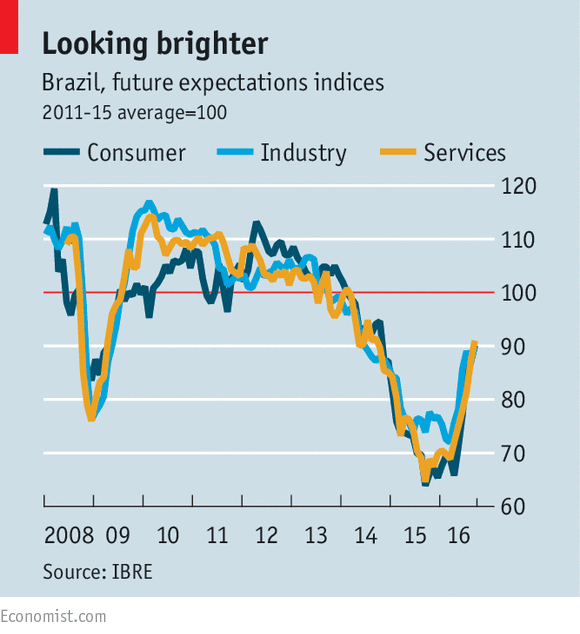
“BRAZIL is back in business,” proclaimed Abílio Diniz, chairman of BRF, a Brazilian pork and poultry giant, at a recent investor shindig. Really? The economy, mired in recession since mid-2014, is not expected to stir before the end of the year—and then only sluggishly. After rebounding in the first half of 2016, industrial production plummeted again in August. Retail sales fell by more than forecast. Firms expect to hire just 100,000 temporary workers in the run-up to Christmas, 3% fewer than last year’s already low tally. BRF’s own domestic operations are hardly a picture of health. Sales dropped by 5% in the second quarter, year on year (though this was offset by rising global revenues).
For all that, Mr Diniz is not alone in his optimism. Surveys point to rising confidence among bosses and consumers alike (see chart). Investors’ spirits are up—and with them the São Paulo stockmarket, which has returned to levels last seen in 2012. The real has strengthened by a third against the dollar since January.
The collective mood swing has less to do with the real economy, and more with realpolitik. In August the…Continue reading
How to confront a dark corporate past
“WE THOUGHT we knew our story, and we knew it wasn’t great,” says Maurice Brenninkmeijer, chairman of COFRA Holding, which owns C&A, a 175-year-old Dutch clothing retailer with over 2,000 stores globally. Yet the full account of how the German branch of his family behaved in the second world war “tore through your heart when you heard it”, he adds. Mr Brenninkmeijer’s ancestors—considered to be genial, virtuous, Catholic and reserved—turned out to have been avid Nazi collaborators. Old letters revealed cosy, corrupt, ties to Hermann Goering. From 1942 onwards C&A and Siemens, a German engineering firm, together exploited forced Eastern European labourers in Germany, keeping them in such a wretched state that malnutrition killed several women and children. C&A profited from “Aryanisation”, grabbing business and property from terrified Jewish owners. Perhaps worst, it used Jewish tailors and leather-workers, corralled in Lodz, a dreadful ghetto in Poland. Of some 200,000 people trapped in inhumane conditions there, only 1,000 survived to liberation.
Such grim details are now public thanks to Mark Spoerer, a historian in Regensburg who specialises in archival research to assess companies’ dark pasts, putting “immoral business behaviour” into historical context. Remarkably, his new book “C&A: A family business in Germany, the…Continue reading
Big tobacco’s new ambitions
 Innovator at work
BIG Tobacco is about to get even bigger. On October 21st British American Tobacco (BAT) announced that it had bid $47bn for the 58% of Reynolds American that it does not already own. Though Brexit has weighed on some British companies, BAT is unencumbered, with most of its revenue earned overseas. Many investors expect the deal to go ahead, although BAT might need to puff up its offer. BAT would then become the world’s largest tobacco company by sales and profits.
As in other volume businesses, like beer, some of the merger logic is simply to cut costs. With consolidation, BAT reckons its deal would generate $400m of annual savings. However, it also underscores two big, long-term changes for cigarette-makers.
The first is that America has become an attractive market for tobacco firms and buying Reynolds, whose brands include Camel and Newport, is the easiest way for BAT to grow there. This is a reversal from the recent past. Not long ago America seemed stale and overrun by lawsuits, particularly compared with fast-growing economies. Cigarette firms quarantined their American businesses. In 2004…Continue reading
Jail bait

ONE thing right-wing populists and left-wing progressives can agree on is that society is too soft on white-collar crime. Conservatives abandon their admiration for business when it comes to “crooked bankers”. Left-wingers forget their qualms if locking up “corporate evil-doers”. Hillary Clinton’s line that “there should be no bank too big to fail but no individual too big to jail” would go down equally well at a Donald Trump rally.
But is society really soft on corporate wrongdoing? And would locking up bankers and businessmen and throwing away the key really solve any problems? Two new books try to inject reason and evidence into a discussion more commonly driven by emotion and hearsay: “Why They Do It: Inside the Mind of the White Collar Criminal” by Eugene Soltes, of Harvard Business School, and “Capital Offenses: Business Crime and Punishment in America’s Corporate Age” by Samuel Buell, the lead prosecutor in the Enron case, who now teaches at Duke University.
Messrs Soltes and Buell both demonstrate that America is getting tougher on business crime. Between 2002 and 2007 federal prosecutors convicted more than 200…Continue reading
Cyrus Mistry hits back at being ousted from Tata

THERE have only been six chairmen of the Tata Group since it was founded in 1868. There will soon be a seventh after Cyrus Mistry, the first boss of the conglomerate not connected to the founding family, was ousted after less than four years in charge. Even though he undertook few of the reforms needed to bring vast swathes of the Tata empire to profitability, he will prove a difficult act to follow. That the ousted man has now embarked on an extraordinary rampage against his old employer will scarcely help.
Mr Mistry might reasonably have expected to serve for a couple of decades at the helm of India’s biggest group, with interests from IT to cars, hotels, salt, steel and much else besides. His departure on October 24th was a surprise. For a company with a culture of consensus, the abruptness of his sacking—the board did not even give him the option of stepping down, and the purging of many of the top executives he had hired—is about as brutal as it comes. Ratan Tata, his predecessor, will take over while a new boss is found.
The catalyst for the defenestration was the lack of performance at some of the group’s big companies….Continue reading
AT&T and Time Warner plot a blockbuster media future

A DEAL worth $85.4bn is by any standards a blockbuster. The agreement by wireless and pay-television giant AT&T to buy Time Warner, owner of Warner Bros, HBO and a trove of hit films and TV shows, is the biggest bet yet that the future of media will be dictated by massive companies that best marry distribution with content.
The merger, announced by the two companies in the evening on October 22nd, does not ensure that AT&T, a traditional telecommunications company, will end up as one of those winners. But Randall Stephenson, who as AT&T’s chief executive will steer the combined company, is assembling the pieces he believes he needs to get there.
AT&T just last year completed the $48.5bn purchase of DirecTV, a satellite provider, making the company the largest pay-TV distributor in America with 25m subscribers. AT&T is also the country’s second-largest wireless carrier, behind Verizon Communications. The company now is set to add one of Hollywood’s most storied studios in the form of Warner Bros, a prestigious cable network in HBO, valuable cable channels like TNT, TBS and CNN, and a rich library of film and…Continue reading
Push my buttons

TRILLIONS of dollars of consumer spending have, historically, depended on a few steps. A shopper learns about a product, considers whether to buy it, decides to do so, goes to a shop. If he likes it, he may buy it again. Marketers have long obsessed over each step, and consultants have written treatises on how to nudge people along. E-commerce is already changing the process, but now retailing gurus are imagining a future in which shopping becomes fully automatic.
The idea is that a combination of smart gadgets and predictive data analytics could decide exactly what goods are delivered when, to which household. The most advanced version might resemble Spotify, a music-streaming service, but for stuff. This future is inching closer, thanks to initiatives from Amazon, lots of startup firms and also from big consumer companies such as Procter & Gamble (P&G).
Buying experiments so far fall into two categories. The first is exploratory. A service helps a shopper try new things, choosing products on his or her behalf. Birchbox, founded in 2010, sends beauty samples to subscribers for $10 each month. Imitators have proliferated, offering everything from dog…Continue reading
Countdown

LIKE most technology tycoons, Elon Musk exudes disdain for finance. Convertible bonds and lease accounting are problems for Wall Street, while the visionaries in California focus on driverless cars and space travel. Yet while he might be loth to admit it, Mr Musk has become America’s most audacious corporate financier as well as its best-known entrepreneur. In just over a decade he has created an empire valued at a cool $44 billion despite its heavy losses (see chart). A blend of financial laboratory, corporate labyrinth and buttock-clenching thrill ride, Musk Inc has pushed the boundary of what was thought possible.

As has been the case for a decade, Mr Musk’s businesses face a difficult struggle to sustain their market valuations over the next 18 months, and to bolster confidence he is expected to unveil new financial measures and also new products over the next few weeks. Mr Musk has repeatedly defied the odds. But…Continue reading
Well-connected

INSIDE the atrium of a gleaming new building on the outskirts of Addis Ababa, trainee air stewards flit between the classrooms and aeroplane simulators that surround a large indoor swimming pool. The expensive aviation academy belongs to Ethiopian Airlines, and seems a world away from the unrest that on October 9th prompted the government to declare a national state of emergency. The firm’s CEO, Tewolde Gebremariam, brushes off the idea that the airline will be affected. “We are not concerned,” he shrugs.
He has reason to be confident about the business. Ethiopian is Africa’s largest and most profitable airline, earning more than its rivals on the continent combined. Its expansion has been rapid: by 2015 it served 82 international destinations, with 13 more added this year. According to unaudited figures, it nearly doubled its profits in the last financial year (see chart). And that is amid national turmoil.
It helps that its regional rivals are competing only feebly on routes in Africa. According to the International Air Transport Association, African carriers are likely collectively to record a net loss of $500m this year….Continue reading