
Tag: Buttonwood’s notebook
The infrastructure dilemma; castles in the air or bridges to nowhere?

IF THERE is a consensus right now in American politics, it must be that infrastructure spending is a good thing. It employs workers, improves economic efficiency and, at the moment, can be financed at rock-bottom bond yields. So why don’t governments get on with it?
The problem is multi-faceted. Although people tend to be enthusiastic about infrastructure in general, they are more critical of specific projects. If they are in the country, then they ruin the currency; if they are in the town, then they ruin neighbourhoods or impinge on private-property rights. When it comes to public infrastructure projects, the benefits are long term but the costs are short term. The politician that authorises the project is rarely the same one that opens it. So an elected leader gets all the flak from those who oppose this white elephant/blot on the landscape but none of the praise for the reduced traffic jams or cheaper power that ensue. Occasionally a leader might be tempted into authorising a big scheme (like Britain’s high-speed rail) but, as the
Are big infrastructure projects castles in the air or bridges to nowhere?
IF THERE is a consensus right now in American politics, it must be that infrastructure spending is a good thing. It employs workers, improves economic efficiency and, at the moment, can be financed at rock-bottom bond yields. So why don’t governments get on with it?
The problem is multi-faceted. Although people tend to be enthusiastic about infrastructure in general, they are more critical of specific projects. If they are in the country, then they ruin the currency; if they are in the town, then they ruin neighbourhoods or impinge on private-property rights. When it comes to public infrastructure projects, the benefits are long term but the costs are short term. The politician that authorises the project is rarely the same one that opens it. So an elected leader gets all the flak from those who oppose this white elephant/blot on the landscape but none of the praise for the reduced traffic jams or cheaper power that ensue. Occasionally a leader might be tempted into authorising a big scheme (like Britain’s high-speed rail) but, as the
Attack of the zombie firms

WHY has economic growth been so sluggish in the developed world? The previous post showed that productivity in the global economy had been flat or falling in the last three years. And it suggested that the existence of «zombie» firms—uncompetitive survivors—might be one explanation.
As it happened, the OECD published a new paper yesterday which showed that might indeed be the case. The paper concludes that
the prevalence of, and resources sunk in, zombie firms have risen since the mid-2000s, which is significant given that recessions typically provide opportunities for restructuring and productivity-enhancing allocation
and that
a higher share of industry capital sunk in zombie firms tends to crowd-out the growth—measured in terms of investment and employment—of the typical non-zombie firm.
All in all
a 3.5% rise in…Continue reading
The curious case of missing global productivity growth

WORK smarter, not harder. It is one of the more irritating things that a boss can tell you. But at the macroeconomic level, it is important. Growth can come from having more labour (recruiting more workers, or making existing employees work for longer hours), more capital, or from using that labour and capital more effectively—something known as total factor productivity (TFP). This can come from the kind of brilliant innovations devised by Thomas Edison (pictured) or the less-heralded but equally important improvements such as the adoption of the moving conveyor belt to speed up assembly work. Since there are limits to the amount of additional capital and labour, productivity is key to long-run growth.
Measuring productivity is far from easy; it tends to be the residual left over when all other factors have been accounted for. The OECD says it «can often be a measure of our ignorance». Still, the attached table is very striking. It comes from the American Chamber of Commerce (here’s the link, with thanks to…Continue reading
The Greenspan legacy

MORE than ten years have elapsed since Alan Greenspan stepped down from the Federal Reserve; a decade that has not been kind to his reputation. Having just read Sebastian Mallaby’s comprehensive biography*, «The Man Who Knew», it struck me that his career was a classic example of cognitive dissonance.
The main post-crisis criticism of Mr Greenspan was that he was a naive believer in market efficiency, failing to pop bubbles in the late 1990s or mid-2000s and failing to regulate the financial sector properly. He was, for a while, a disciple of the libertarian novelist, Ayn Rand. But Mr Mallaby shows that things were rather more complex than that characterisation suggests.
In a paper written back in 1959, for example, Mr Greenspan clearly seemed to understand the detrimental effect that bubbles could have. He wrote that
The higher the stock market gets at its peak and hence the greater decline required to return to «normal», the deeper the decline in economic activity
In 2002, after the Enron scandal, Greenspan also spoke in favour of greater regulation of corporate accounting standards. smacking the table, he told a meeting…Continue reading
The manufacturing jobs delusion

INDUSTRIAL policy via Twitter is a new development in economics but we may all have to get used to it over the next four (or eight) years. Donald Trump’s tweets on the car industry (and his planned cuts to corporate income tax) may or may not have persuaded Ford to keep a plant in Michigan, creating 700 jobs. But the problem with such headline-grabbing is that there are thousands of companies in the US, and jobs are being created or destroyed every day; intervening in all these situations is impossible. Even in cars, for example, GM has recently announced 3,300 lay-offs, almost five times greater than the Ford additions.
History suggests that the aim of creating large numbers of manufacturing jobs will be a lost cause. In 1979, the high point for US manufacturing jobs was reached at 19.5m. The subsequent recession of the early 1980s caused that number to fall but there were regularly 17m-18m jobs in the 1980s and 1990s. From the turn of the millennium, however, the total fell pretty remorselessly, with the 2008-09 recession proving the coup de grace. The low was just under 11.5m in early…Continue reading
Dorothy meets the Mnuchins

DOROTHY was unhappy. Life on the Kansas farm seemed dull, and her pocket money hadn’t risen in real terms for years. It was time for a change; time to make Kansas great again. Then, as she was sitting in the farmhouse with her dog Toto, a tornado came along, sweeping them up and taking her away, far from reality.
With a bump, the farmhouse landed on a woman. As Dorothy emerged, she saw a crowd of cheering little people.“You have killed the wicked witch of the east wing” they shouted. “We could not abide her charitable foundation or lax e-mail security procedure. But you have saved us.”
“Who are you?” asked Dorothy.
“We are the Mnuchins” they proclaimed “and we raise all the finance for the Wonderful Wizard of Oz, who lives in a giant tower with his name on the side.”
“What’s it called?” asked Dorothy.
“Ozterity” came the reply.
“Can the Wizard of Oz restore prosperity to my Kansas farm?” she asked.
“Of course” they cried.
“Can the Wizard help me and my dog Toto?” she asked.
“It depends. Is Toto a Hispanic name?” said one Mnuchin. “And…Continue reading
Dow 20,000?
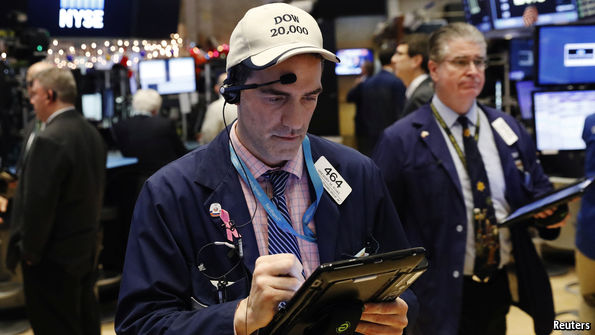
SOME time soon, the Dow Jones Industrial Average seems likely to break through the 20,000 barrier, an event that will be greeted with banner headlines and a sign that capitalism is flourishing again. In fact, the Dow is a flawed measure, which uses the odd approach of weighting its component companies by share price. The biggest stock in the Dow is Goldman Sachs and despite its prominence on the campaign trail (and among Donald Trump’s new team), it is hardly the most important company in America; its weight depends on its near-$240 share price. Like other financial shares, it has shot up in the wake of Mr Trump’s election; boosted both by hopes of bank deregulation and of potentially higher interest rates, which tend to boost bank profits. William Wright of New Financial estimates that Goldman staff’s wealth, in the form of options and shares, has risen by $2.3bn since the polls; not exactly a «revolt against the elite».
The Dow is up 9% since November 7th, well ahead of the more broadly-based S&P 500’s 6.6% gain. The S&P uses a weighting by market value—its…Continue reading
Dude, where’s my toga?

AS THE parade of billionaires and generals joins Donald Trump’s cabinet, it is hard not to be reminded of the Roman republic. Parallels between Rome and America have been made in the past, of course; Paul Kennedy’s «The Rise and Fall of the Great Powers» talked of imperial overstretch—excessive military spending that eventually undermined an empire’s position.
But the current parallels date from much earlier in Roman history; how the republican system eventually turned into plutocracy or «rule by the rich». In her history of Rome, «SPQR», Mary Beard writes that
The first qualification for office was wealth on a substantial scale. No one could stand for election without passing a financial test that excluded most citizens
This is not to say that the poor were ignored. Ms Beard adds that
The votes of the poor mattered and were eagerly canvassed. The rich were not usually united, and elections were competitive.
The nature of that competition, however, would often depend on the amount of food and drink that candidates were able to supply to the voting public; indeed political slogans were…Continue reading
Schrödinger’s Brexit

SOMETIMES an analogy strikes you on the head with the force of a plummeting cricket ball. On Radio 4 yesterday, Hamish Johnson, editor of physicsworld.com, had the brilliant insight to explain the British government’s policy in terms of physics; Schrödinger’s Brexit.
The poor cat is stuck in a box with a radioactive substance and a poison; when the substance decays, the poison is released. Since it is impossible to predict when the substance will decay, the cat may be deemed simultaneously alive and dead. The only way to know is to open the box.
Before Britain voted to leave the European Union in June, then prime minister David Cameron promised to trigger Article 50 (the exit mechanism) immediately. Five months on, Article 50 has yet to be triggered. The new prime minister, Theresa May, has promised to do so by the end of March. But in terms of what Britain wants, we have heard nothing but platitudes: “Brexit means Brexit”, or “have our cake and eat it”. Pushed for details, Ms May has said there will be “no running commentary” on negotiations. In fact, it is quite easy to do a running…Continue reading