
Tag: Buttonwood’s notebook
William Jennings Trump and the monetary elite
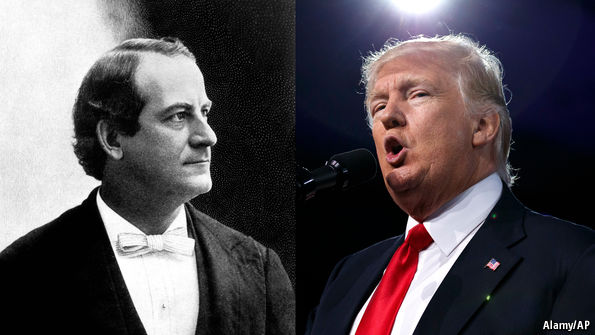
DONALD Trump has been compared with many past politicians—Richard Nixon for his suspicion of the press and Warren Harding for his isolationism are two obvious examples. Steve Bannon, Mr Trump’s alt-right hand man, has just compared him with William Jennings Bryan, who ran unsuccessfully for President in 1896, 1904 and 1908 on the Democratic ticket.
Mr Bannon said that Mr Trump was an orator in the class of Bryan, although that seems pretty hard to credit. The current President has displayed nothing like the eloquence used by Bryan in his most famous speech, to the 1896 Democratic convention.
You come to us and tell us that the great cities are in favour of the gold standard. I tell you that the great cities rest upon these broad and fertile prairies. Burn down your cities and leave our farms, and your cities will spring up again as if by magic. But destroy our farms and the grass will grow in the streets of every city in the country.
Having behind us the commercial interests and the labouring interests and all the toiling masses, we shall answer their demands for a…Continue reading
Euphoria returns to markets
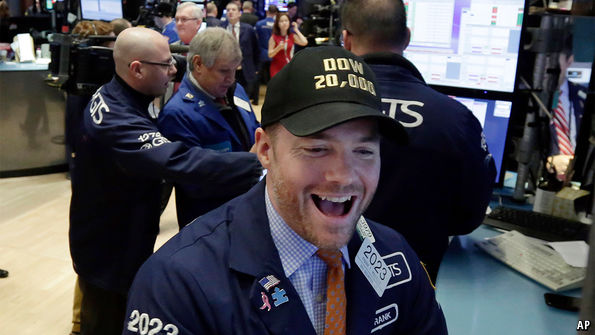
LIKE the weather in Chicago, you don’t have to wait long for a new trend in the stockmarkets. Just a few weeks ago, investors seemed to have second thoughts about their Trump-related euphoria (which itself was a contrast to the widespread nervousness ahead of the election). Now they have been recording new highs again.
While the spark for the rally seems to have been a Presidential comment about forthcoming tax cuts, the causes have been much broader; the MSCI World Index has also hit new highs. Commodity prices have perked up, which may be a sign that the Chinese economy is holding up (if you recall, a Chinese slowdown was the big worry 12 months ago). Asian trade has perked up after a long period of sluggishness (the exports of South Korea, a bellwether in this respect, have risen for three months in a row). According to…Continue reading
The problem that links business, finance and politics

THE problem is as old as mankind. The Roman author Juvenal encapsulated it into a phrase “Quis custodiet ipsos custodes” or “Who guards the guards themselves?” It was neatly illustrated in the classic BBC series “I, Claudius”. The infirm Claudius wants the return of the Republic. But the Praetorian guard, set up by his relatives, needed an Emperor to ensure their special status. So on the murder of Caligula, they drag Claudius from his hiding place behind a curtain, and make him Emperor.
Throughout history, dictators have faced this problem. They can surround themselves with men with swords or guns. But it only takes one guard with a sword or gun to turn into an assassin or to seize power for himself. The Shah of Iran had a huge army in 1979 but it did him no good; the soldiers had more sympathy with the revolutionaries than with the Shah himself.
In business and finance, this is known as the “principal-agent” problem. Shareholders employ managers to run a company; investors use fund managers to look after their savings. That makes sense. It allows us to take advantage of the expertise of others, and of…Continue reading
Stockmarkets are confident, banks not so much

THE headline-grabbing market event of 2017 so far has been the move of the Dow Jones Industrial Average through 20,000 (although the average is a flawed measure). But while investors have been pushing the value of shares up, the credit rating of its constituents has been deteriorating.

That is the conclusion of a new service called Credit Benchmark, which has the ingenious idea of aggregating the private credit ratings used by banks (in other words, the ratings generated by the bank’s internal risk models). At the moment, the service is getting data from 13 banks although another 12 have signed up; it has ratings for 10,000 companies. Donal Smith, one of the firm’s founders says that banks tend to be more conservative in their approach than the ratings agencies and move their ratings more quickly.
The…Continue reading
Taking the dollar down, or is it up?

IF THERE was a consensus view at the start of the year, it was that the dollar would rise. Fund managers surveyed by Bank of America Merrill Lynch were overweight the currency (even though they worried that it was a crowded trade).
The stars seemed aligned in the greenback’s favour. The Federal Reserve was set to raise rates, while other major central banks were keeping monetary policy loose; that should boost the dollar’s attractiveness in terms of yield. The new Trump administration was set to unveil a fiscal stimulus and boost growth; that should encourage those who wanted to buy American equities or invest in American factories. And tax proposals were designed to persuade American companies to repatriate overseas profits, giving the dollar a further lift.
So why has the dollar retreated to hit a 12-week low? The main reason is the rhetoric of the new administration. Mr Trump told the Wall Street Journal that
Our companies can’t compete with them (Chinese companies) now because our…Continue reading
Talking the dollar down, or is it up?
IF THERE was a consensus view at the start of the year, it was that the dollar would rise. Fund managers surveyed by Bank of America Merrill Lynch were overweight the currency (even though they worried that it was a crowded trade).
The stars seemed aligned in the greenback’s favour. The Federal Reserve was set to raise rates, while other major central banks were keeping monetary policy loose; that should boost the dollar’s attractiveness in terms of yield. The new Trump administration was set to unveil a fiscal stimulus and boost growth; that should encourage those who wanted to buy American equities or invest in American factories. And tax proposals were designed to persuade American companies to repatriate overseas profits, giving the dollar a further lift.
So why has the dollar retreated to hit a 12-week low? The main reason is the rhetoric of the new administration. Mr Trump told the Wall Street Journal that
Our companies can’t compete with them (Chinese companies) now because our…Continue reading
Making protectionism unpopular again

BACK in 1906, an insurgent politician called Joseph Chamberlain (once known as Radical Joe, he had switched to the Conservatives over home rule for Ireland*) lured the government into a campaign in favour of tariffs. The result was a devastating defeat for the Conservatives. The opposition Liberal party recognised that tariffs were a tax on the goods bought by the poor, particularly on food, and warned that the policy would lead to a «smaller loaf». They portrayed tariffs as «stomach taxes».
A hundred years ago, then, it was easy to make protectionism unpopular. Despite the prosperity brought by 70 years under a more open trading system, it now seems that opinion may have changed: tariffs are favoured by «populist» politicians.**
The trick for modern populists has been to focus on the positive benefits to American workers in terms of jobs, rather than the adverse impact on consumers. In fact, protectionism is highly unlikely to restore American manufacturing jobs, which are under threat from automation as well as globalisation, as our
The markets have second thoughts on Donald Trump

MARKETS are always full of surprises. In the run-up to the Presidential election, many investors were nervous about the possibility of a Trump victory. But on the night of the results, there was a dramatic turnaround. Within a few weeks, the market capitalisation of global equities had risen by $3trn and that of government bonds had fallen by the same amount. Markets were betting on “Trump lite”—that his tax cuts and infrastructure spending would be pushed through boosting growth and possibly inflation. By contrast, they downplayed the other “Donnie Darko” element of his policies—his threats to tear up trade agreements and heighten geopolitical risk in the middle east and Asia.
So far, however, we have seen more of Donnie Darko than Trump lite. First there was his “I have a nightmare” inauguration speech with its references to “American carnage” and protection. Then there were his early actions…Continue reading
You can’t be both a populist and a free-market conservative

IT WOULD be hard to find two more different characters than Theresa May and Donald Trump; the former a suburban vicar’s daughter, the latter a brash reality TV star. But they face similar problems—how to keep both the markets and their supporters satisfied.
For Mrs May, the problem is her dissonant rhetoric. On the one hand, she has used what was once known as “one nation” Tory rhetoric, arguing against the worst excesses of capitalism and the need to help those who are “just about managing”. So here she is in her Davos speech saying of her new approach that
It means businesses paying their fair share of tax, recognising their obligations and duties to their employees and supply chains, and trading in the right way;
Companies genuinely investing in—and becoming part of—the communities and nations in which they operate, and abiding by the responsibilities that implies;
And all of us taking steps towards addressing executive pay and accountability to shareholders.
In practice, however, she has already retreated from a proposal to put workers on boards, plans to push ahead with…Continue reading
The infrastructure dilemma facing policymakers
IF THERE is a consensus right now in American politics, it must be that infrastructure spending is a good thing. It employs workers, improves economic efficiency and, at the moment, can be financed at rock-bottom bond yields. So why don’t governments get on with it?
The problem is multi-faceted. Although people tend to be enthusiastic about infrastructure in general, they are more critical of specific projects. If they are in the country, then they ruin the currency; if they are in the town, then they ruin neighbourhoods or impinge on private-property rights. When it comes to public infrastructure projects, the benefits are long term but the costs are short term. The politician that authorises the project is rarely the same one that opens it. So an elected leader gets all the flak from those who oppose this white elephant/blot on the landscape but none of the praise for the reduced traffic jams or cheaper power that ensue. Occasionally a leader might be tempted into authorising a big scheme (like Britain’s high-speed rail) but, as the