
Tag: Buttonwood’s notebook
Britain’s vote catches out the markets—again

SO AN election that was called to give Theresa May a mandate to negotiate Brexit looks like it has done anything but. The exit poll suggested that the Conservatives would have the most seats, but short of a majority with 314. Add in the Ulster Unionists and allow for the fact that Sinn Fein MPs don’t take their seats and Parliament would be a virtual tie.
This would lead to enormous uncertainty. Just before the polls closed, the pound was trading at $1.2950, while the euro was worth £0.866. Within minutes of the exit poll, the pound had dropped nearly two cents to $1.2768, while the euro was up to £0.8791.
If this poll is borne out by the results (and it was pretty close to the mark in 2015), there will be turmoil in the markets in the morning. The FTSE 100 index closed on Thursday down 0.3% at 7,449.98. Ten-year gilt yields rose three basis points to 1.03%. That left share prices close to a record high, and gilt yields close to a record low. That leaves plenty of scope for disappointment.
On the plus side, this…Continue reading
What will the markets do if Labour wins?

WHEN the British election started, a victory for Theresa May looked a nailed-on certainty. The Conservative lead was as high as 20 percentage points and the party was 1/20 on to claim the most seats. But a poorly run campaign means that the gap has narrowed; the latest from Survation had the Conservatives with just a one-point lead.
The betting markets still assume that the Tories will win, albeit with a majority of 70 or so rather than the 100 plus that was assumed earlier in the campaign. But what if the gambling markets are wrong, as they were about Brexit and Trump? Nate Silver, the American polling guru, argues that
May’s mandate melts
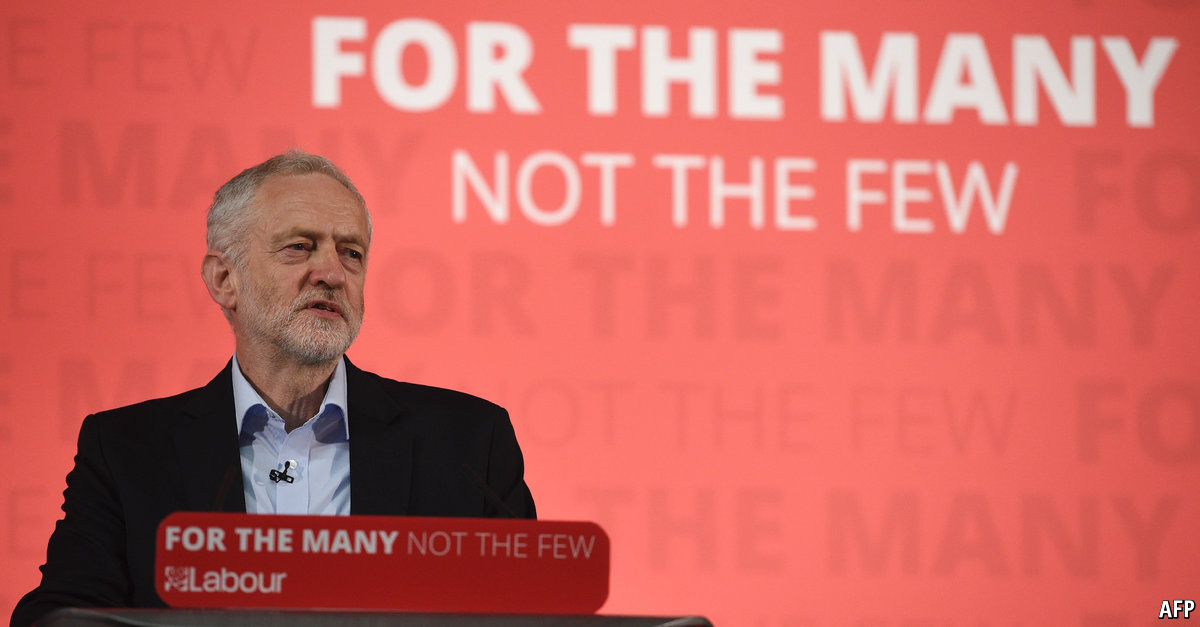
THERESA MAY, Britain’s prime minister, called a surprise election for June 8th arguing that she needed a strong mandate for negotiating Brexit. The pound rallied on the news, in the belief that a large Conservative majority would allow Mrs May the flexibility to do a deal with the EU, and see off the hard-liners among her party.
For a while, it looked as if the plan was going well. The Conservatives had a 20-point lead in some polls. But the party’s campaign, heavily reliant on the appeal of its leader and the repeated use of soundbites like “strong and stable”, has been misjudged. The manifesto launch was disastrous and included a pledge to charge the elderly (a key Tory demographic) for social care. That pledge was quickly reversed, but Mrs May’s refusal to admit to an obvious U-turn undermined her strong leadership…Continue reading
The “I’ve paid in all my life” fallacy

SOCIAL security is often described as the “third rail” of American politics—touch it and you die. Britain’s prime minister has just tied herself into a tangle over the way to fund long-term care for the elderly.
The problem is made more difficult because of the way that such benefit schemes were established and marketed to the public—as insurance schemes in which what you receive in benefits relates to what you put in. When pension schemes were set up by Franklin Roosevelt (pictured left) in the 1930s or in Britain, by David Lloyd George (pictured, right) in the Edwardian era, the insurance notion was something people could easily grasp (private schemes already existed) and could be seen as fair.
This was fine in the early years of such schemes when the number of people contributing was far greater than the number of people taking benefits. But as our societies age, the costs rise and the inadequacy of…Continue reading
From Russia with risk

BE CAREFUL what you wish for. Traders were bored last week and now they have got some excitement. The US equity market suffered its worst trading day in eight months, falling 1.8%, with banks dropping 4%. The Volatility index, or Vix, which recently dipped below 10, jumped above 15. The dollar has lost most of its gains since Donald Trump was elected in November (see chart).

The catalyst for the sell-off seems to be the latest set of…Continue reading
Not Maggie May, but muddled May

THE Conservative election campaign so far has been duller than an afternoon looking at Jeremy Corbyn’s collection of pictures of manhole covers. Blessed by an extremist opposition and a big opinion poll lead, the government is coasting, muttering platitudes like «strong and stable» and emphasising its newish prime minister, Theresa May, rather than its party name.
The odd thing is that the Conservatives are trying to develop a personality cult based on someone who (to put it politely) does not have a particularly fascinating personality. Perhaps that’s the point; people are looking for someone calm and competent. Labour tried something similar with Gordon Brown – “Not flash, just Gordon” was the slogan – with little success. The Conservative strategy seems to be working for now but one…Continue reading
Old McDonnell has a plan. He eyes IOUs
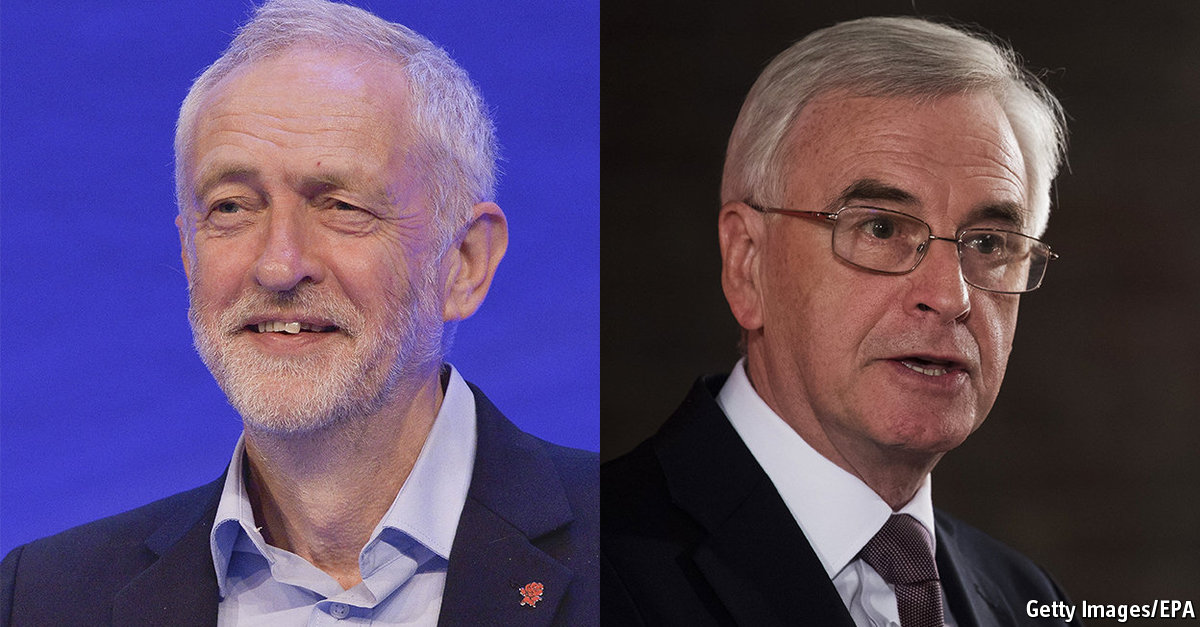
WITH the Labour Party 17 percentage points behind in the opinion polls, it may not be worth analysing the tax and economic aspects of its manifesto. The belief that the party will lose is so widespread that you can get odds as high as 20/1 on a victory for the party; market indifference is such that its plans to nationalise the water industry have caused shares in the biggest provider, United Utilities, to fall just 1.6%. Still, the manifesto is such a mishmash of ideas that it is worth a look at the ideas of Jeremy Corbyn and John McDonnell (pictured), the shadow chancellor of th exchequer.
One eye-catching proposal is for a £250bn “National Transformation Fund”, spread over ten years, to invest in:
infrastructure—transport, energy systems, communications—scientific research and housing fit for the 21st century
There is an argument for borrowing to fund…Continue reading
On China, commodities, credit and complacency

THERE is a familiar scene in westerns where the cavalry is riding through the mountain pass and the captain says «I don’t like it. It’s quiet. Too quiet.» Seconds later, a soldier gets an arrow in his chest and all hell breaks loose. Some people feel that about markets at the moment. Deutsche Bank reckons the S&P 500 has had 10 out of 11 days with a move of less than 0.2%, the quietest period since 1927. The volatility index, or Vix, fell to a 23-year low after the French election result.
This calmness is in striking contrast to the political turmoil that has followed the election of the Trump administration; the tensions over North Korea, the firing of the FBI director and the trade policies that have pushed Citibank to issue a regular «US protectionism round-up». Is it all a sign of complacency?
There certainly have been occasions in the…Continue reading
The Tory and Labour parties fail to face the realities of Brexit

FOG in channel: continent cut off is an (alas apocryphal) newspaper headline that points to the innate British sense of superiority. Victory in two world wars and a long history without invasion has given Britain a sense of detachment from its European neighbours. As a result, it was always a reluctant member of the European Union.
Now that Britain is leaving, it must work out its own path to economic prosperity. The task is not impossible. But the superior attitude needs to be dropped. The Conservatives under Theresa May seem also certain to win the forthcoming election, with an 18-point lead on the latest polling average. Mrs May was a lukewarm member of the Remain campaign, and was only brought to power by the sudden demise of the government’s leading duumvirate, David Cameron and George Osborne. It clearly took time for her to decide on her negotiating strategy; the key Article 50 provision was not triggered until nine months after the vote.
One approach that…Continue reading
The markets are uninspired by the Trump tax plan

REMEMBER why the «Trump bump» began, all the way back in November? The rationale for the surge in stockmarkets was that the new administration would cut taxes and allow American growth to accelerate. And so we waited for the details. When they came yesterday, it was only a one-page set of bullet points, containing around 200 words. If, as one expert pointed out, it had really taken 100 experts to come up with the plan, they averaged two words each.
The response from the markets was a yawn. Analysts at Clear Treasury said that
Much of yesterday was a non-event, markets were waiting to hear what came of Trump’s tax plans but there was certainly an air of disappointment when finally released.
The S&P 500 and Dow Jones Industrial Average were slightly lower on the day, and the European markets have fallen today. Of course that could be related to the other story floating around yesterday—that America might withdraw from Nafta. With the country also reviving its trade complaints about Canadian lumber and imported steel, Citigroup has taken to issuing a «US Protectionism Round-Up». But this is only a reminder that, in market terms, there has always been a «Trump…Continue reading