
Tag: Buttonwood’s notebook
Foreign investors snap up London’s iconic buildings
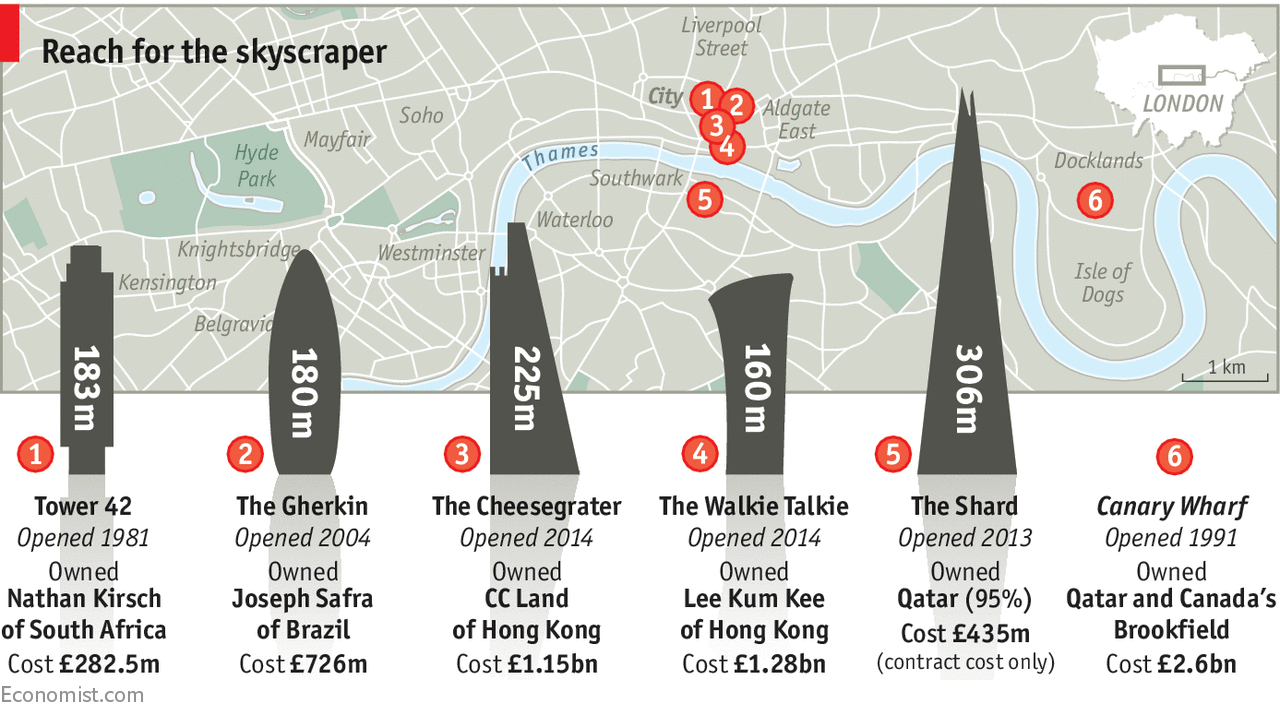
LONDON’S skyline has altered a lot in the last 30 years. While it can’t match Manhattan or Chicago, there are quite a few trophy buildings that can be seen from this columnist’s office window (for the moment*). The British sense of humour means these offices often acquire their own nicknames, regardless of the developer’s intentions—the Cheesegrater or the Gherkin, for example.
And the buildings also tend to get snapped up by foreign investors (see map). The latest to go is the “Walkie Talkie” at 20, Fenchurch Street which has been bought by Lee Kum Kee, a Hong Kong food company, for £1.3bn, the highest amount ever paid for a British building. Presumably the company, best known for its oyster sauce, is not planning to transfer production to the site; this is a punt on the London property market.
Ironically, it was only a year ago that many
The euro’s obituaries were premature
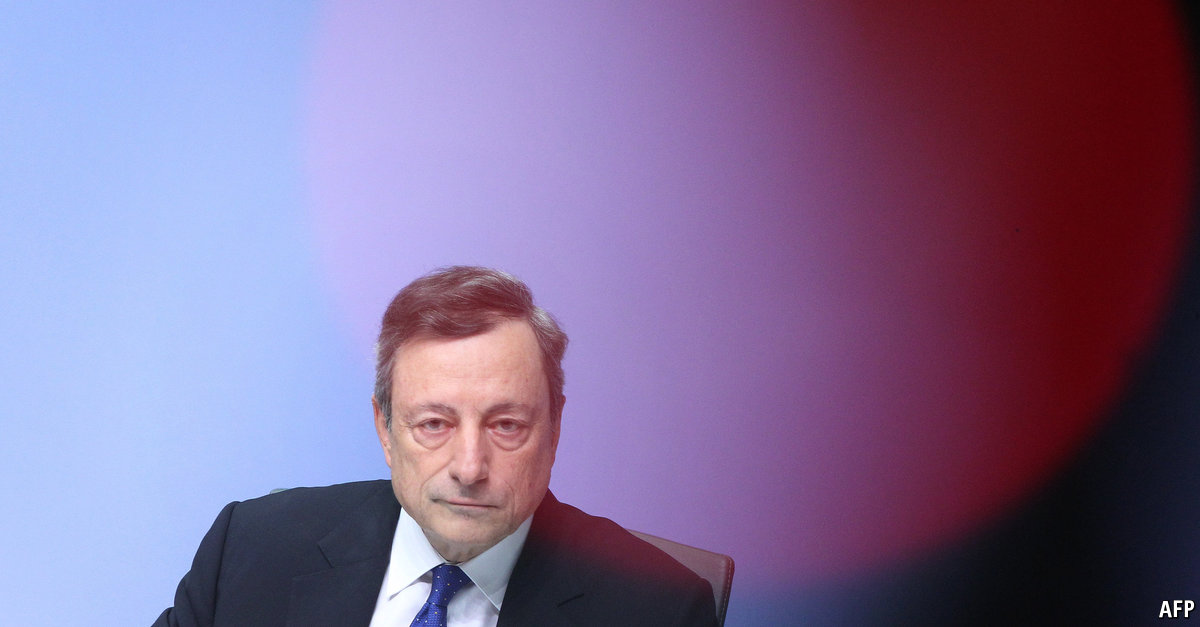
FIVE years ago, Mario Draghi, head of the European Central Bank, pledged to do “whatever it takes” to save the euro. At the time, many people were predicting that the euro zone would break up. But Mr Draghi pulled off the trick; no countries have left the single currency. Borrowing costs have come down and even Greece has been able to tap the markets.
Keeping the euro together may have been the aim of the game, but was it worth it? As M&G, the fund management group, points out, the record has been mixed. Economic growth has rebounded to a respectable 1.5% year-on-year. This is not stellar but it is hard for the euro zone to grow rapidly when its population is ageing; the IMF suggests a greater proportion of older workers may weigh on productivity growth.
Of course, the euro zone could get more of the current…Continue reading
Britain: back to being the sick man of Europe?
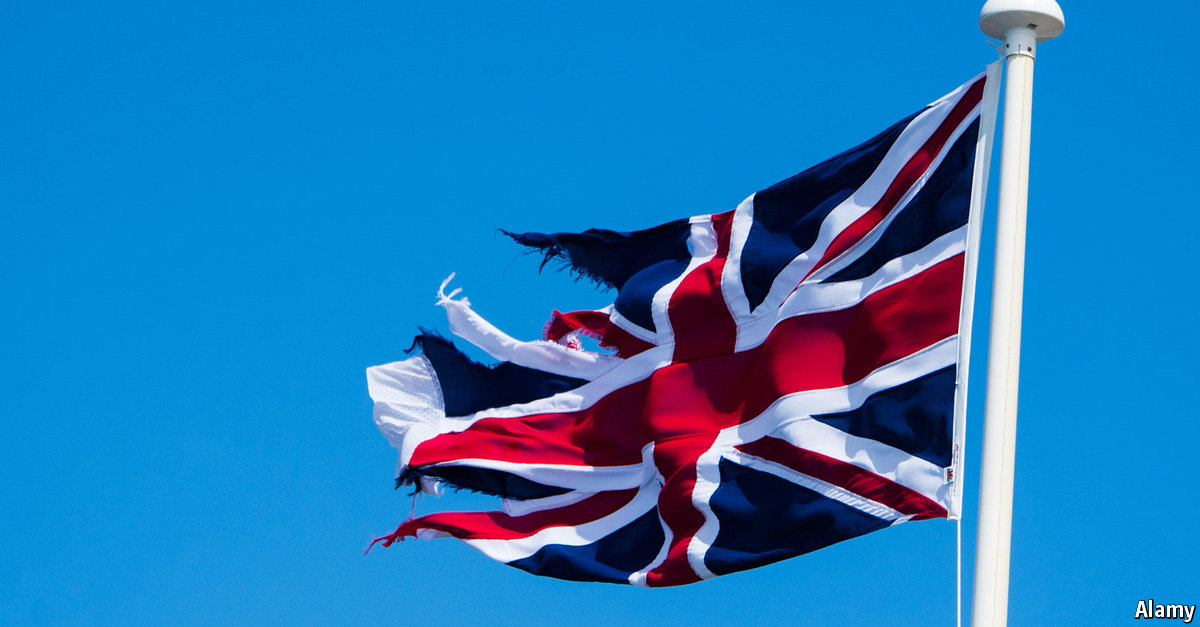
IN THE 1970s, Britain was dubbed «the sick man of Europe», a role previously played by the Ottoman empire in the late 19th century. A poor growth record since the Second World War was combined with terrible industrial relations (29m days lost to strikes in 1979) to make many ask the question «Is Britain governable?».
The reason Britain joined what was then the EEC in 1973 (at the third attempt) was, in large part, a desperate attempt to find a way of forcing the country to become more competitive. Whether Europe was the key factor, or whether it was Margaret Thatcher’s reforms, by the mid-1990s, the trick seemed to have worked. In particular, London, which lost a quarter of its population between 1939 and the early 1990s, became a global, self-confident city, attracting expats from all…Continue reading
The psychic Brexit ballot paper
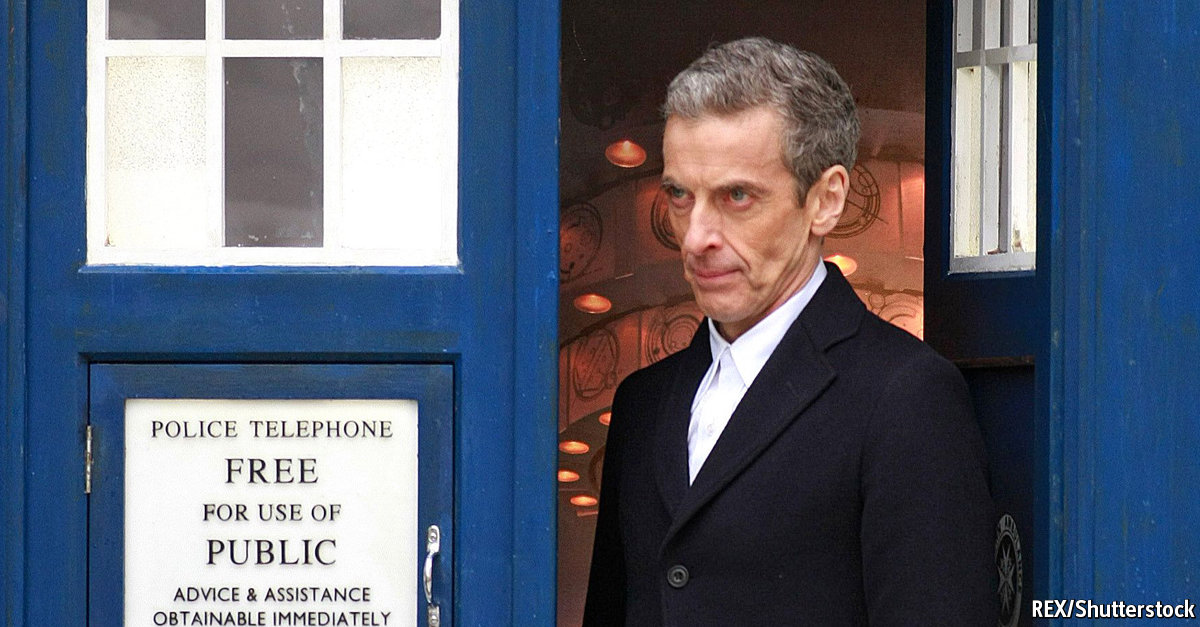
DR WHO, the long-running British science-fiction hero, has a long-standing device to get him out of tricky situations; a piece of «psychic paper» that lulls the viewer into accepting the doctor’s credentials. Apparently blank, the paper says whatever the Doctor wants it to say.
The British government under Theresa May apparently thinks the 2016 EU referendum ballot paper had psychic qualities. The question merely asked «Should the UK remain a member of the EU or leave the EU?». But on BBC Radio 4 this morning, Damian Green, who is (in effect) deputy prime minister, said Britain had to leave bodies like Euratom because the people voted for it.
The argument seems to be that Britain must rid itself of all traces of the EU like someone leaving an area of intense radiation needs a complete detox. So no EU means no single market, no customs union, no free movement and no regulation by the European Court of Justice. It is the ECJ’s role that dooms Euratom, apparently.
Euratom governs the
Can the fund management industry deliver a better deal for investors?
IMAGINE an industry where the average profit margins were 36%, where the regulator found little evidence of price competition and where the average person did not get the benefit of the lower charges available to the wealthiest customers. You would probably expect the regulator to throw a book the size of Thomas Piketty’s “Capital” at it. The industry’s executives ought to be as nervous as a very small nun at a penguin shoot.
But that has not happened with the report of the Financial Conduct Authority (FCA), Britain’s regulator, into the fund management industry. What the FCA proposes in terms of greater transparency of fees and better governance standards is fair enough. But one wonders how much difference it will make. The industry has reacted to the findings with equanimity.
Perhaps the most damning of the report’s findings is point 1.9
We find weak price competition in a number of…Continue reading
Why the falling oil price isn’t hurting markets

INVESTORS could easily get confused about the impact of oil-price rises on the economy and markets. The story seemed to be clear: high prices bad, low prices good. The two great oil shocks in the 1970s were unambiguously bad for Western economies—ushering in stagflation and transferring spending power to the oil-producing countries. In turn, low oil prices in the late 1990s coincided with the dotcom boom.
But when oil fell in the second half of 2015, that was seen as a bearish sign for the global economy and markets. Now oil is falling again, with both Brent crude and West Texas intermediate dropping more than 20%. But the decline has barely made a dent in the upward march of the S&P 500 index.
The key to the differing market reaction is why the oil price is falling. Back in 2015, the fear was falling demand. Investors worried in particular that the Chinese economy was slowing. If that assumption had been right, demand for much more than oil would have suffered. The equity markets did not…Continue reading
The globalisation counter-reaction

WHEN the Archduke Franz Ferdinand (pictured right) was assassinated in 1914, there were few initial indications that world war would follow. In retrospect, many people have argued that the killing was a freak event that should not have resulted in the folly of war.
But was the subsequent war really an exogenous event? Or was it the near-inevitable consequence of the tensions resulting from the first great era of globalisation? If Franz Ferdinand had survived, maybe something else would have triggered the conflict. If the latter possibility is right, that may be a warning sign for the current era.
From 1870 to 1914, the first great era of globalisation saw rapid economic growth, trade that grew faster than GDP, mass migration from Europe to the
Britain’s political outlook seems toxic to investors

SUDDENLY Britain looks a lot less attractive as a home for international investors. The Conservative party under Theresa May gambled on a snap election to deliver a «mandate for Brexit». It unveiled a muddled manifesto that alienated voters and was out-campaigned by the veteran left-winger Jeremy Corbyn. The party lost its overall majority and will now be propped up by the very odd ducks in Ulster’s Democratic Unionist party.
The markets reacted less severely than might have been expected. That seems to be based on the view that a «soft Brexit» looks more likely. But it is far from clear that this is the case. David Davis, Britain’s Brexit minister, seems to be ploughing ahead with plans to leave the single market and the
Markets struggle to make sense of the election chaos

THERESA MAY decided to call a snap election on a walking holiday in Wales. History will regard it as the most disastrous ramble since Captain Oates wandered out of the Antarctic tent in 1912. Having failed to anticipate the result, investors (like everybody else) are struggling to understand what will happen next.
It looks as if the Conservatives can carry on in power, with the support of the Democratic Unionists in Northern Ireland. This would give them a bare majority. But Mrs May’s position has been severely weakened ahead of Brexit negotiations. Another election later this year is possible.
For the markets, two factors are offsetting each other. On the one hand, there is uncertainty and the possibility that a left-wing Corbyn government could still take power in the near future. On the other hand, this result may change calculations about a hard Brexit. The Unionists backed Brexit but they will not want a hard border with the rest of Ireland; something that may require Britain to make concessions to the EU….Continue reading
Markets struggle to make sense of Britain’s election chaos
THERESA MAY decided to call a snap election on a walking holiday in Wales. History will regard it as the most disastrous ramble since Captain Oates wandered out of the Antarctic tent in 1912. Having failed to anticipate the result, investors (like everybody else) are struggling to understand what will happen next.
It looks as if the Conservatives can carry on in power, with the support of the Democratic Unionists in Northern Ireland. This would give them a bare majority. But Mrs May’s position has been severely weakened ahead of Brexit negotiations. Another election later this year is possible.
For the markets, two factors are offsetting each other. On the one hand, there is uncertainty and the possibility that a left-wing Corbyn government could still take power in the near future. On the other hand, this result may change calculations about a hard Brexit. The Unionists backed Brexit but they will not want a hard border with the rest of Ireland; something that may require Britain to make concessions to the EU….Continue reading