
Tag: Buttonwood’s notebook
Can you afford to retire?

HOW much money do you need to retire? Depending on your age, it is a question you think about a lot (if retirement is imminent) or barely at all. For younger people, the subject is a combination of too far away, too complex and too boring, and too depressing. When you consider that you might live for 20, 25 or even 30 years after you stop working, it is a pretty important issue.
Say you want to retire on £20,000 a year (not a fortune) and you are 65. The best annuity rate at the moment in the UK is just under 5.2% which means you would need a pot of £385,000 to afford this. But hold on a minute. That is a flat £20,000 which does not account for inflation; if prices rise at 3% a year, the value of that pension will halve by your 90th birthday. To get an income of £20,000 that is guaranteed to rise in line with prices, you would need a pot of £619,000. (For American readers, the dollar amounts won’t be exactly the same, but they will be in the ballpark).
These are very big sums and explain why private sector…Continue reading
Why a Labour government might mean a fall in sterling
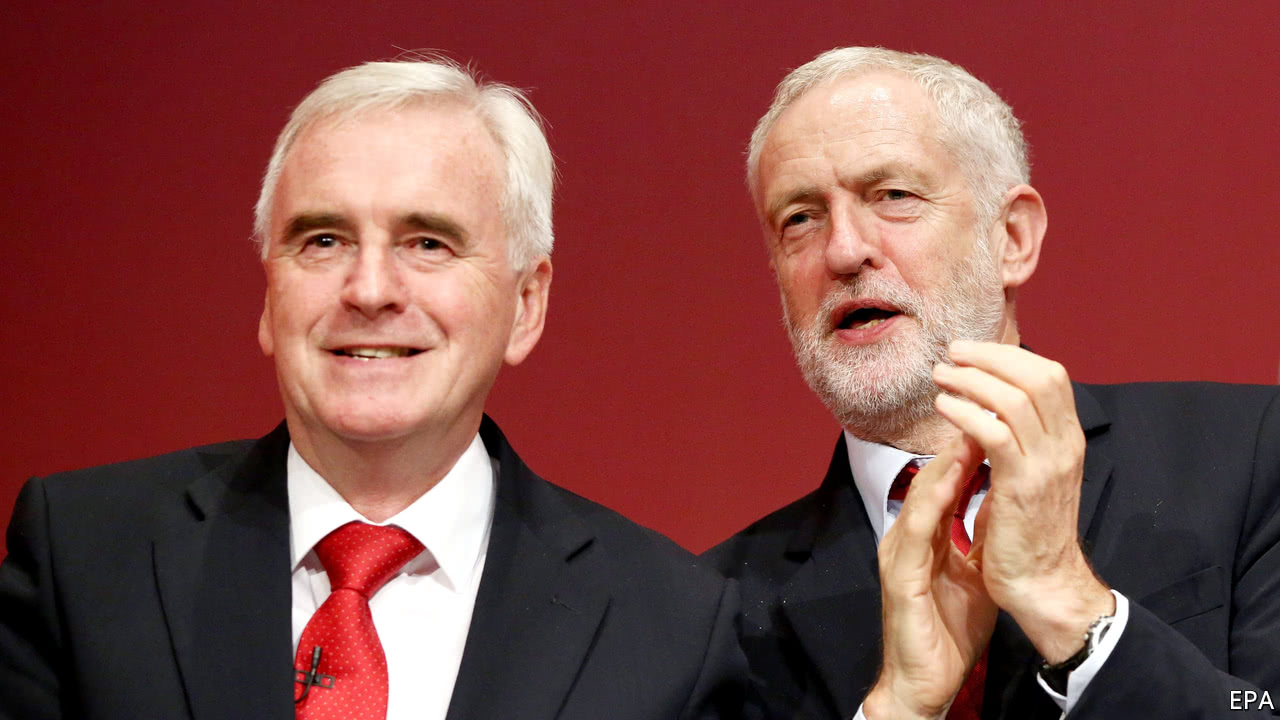
THE British Labour party is in buoyant mood at its annual conference, expecting to be in power very soon. And it has already started to think about the consequences, including a possible run on the pound if it takes office. But not everyone thinks this is likely; Simon Wren-Lewis, an economist, challenged people to think of “a serious economic reason why stering would fall on the election of a Labour government?” Well, this blogger can think of several.
1. Labour plans to increase the rate of tax on corporate profits from (what will be) 17% to 26%. That means the profits available to overseas investors will be reduced accordingly. They will demand a lower price to compensate for this lower return—this will either come in the form of a fall in the stockmarket or in the pound, or probably a bit of both.
2. Labour plans to nationalise various utilities (railways, water, the Royal Mail and some energy) and to cancel some private finance initiatives, by…Continue reading
Picking a fund manager? The odds aren't great

WHO wants mediocrity? That is what a lot of people say when the subject of index-tracking, or passive fund management, comes up. They would rather choose a fund manager (an active manager in the jargon) who tries to beat the market by picking the best stocks. It does sound like a good idea.
The tricky bit is finding the right manager. The temptation is to look at past performance but fund managers rarely beat the market for long.
The average fund manager is always going to struggle to beat the market (this is a separate argument from whether markets are «efficient»). That is because the index reflects the performance of the average investor before costs. In a world dominated by professional fund managers, there aren’t enough amateurs for the professionals to beat. Even the hedge funds, those supposed «masters of the universe», haven’t been able to do it; Warren Buffett looks set
A positive sign from the bond market

THE stockmarket’s positive mood has managed to survive the tensions over North Korea’s nuclear programme. In part, this is because investors believe that global economic growth and corporate profits will continue to do well.
One reassuring signal is from the corporate bond market. The global default rate on speculative (junk) bonds has been dropping; fewer companies are going bust (see chart).
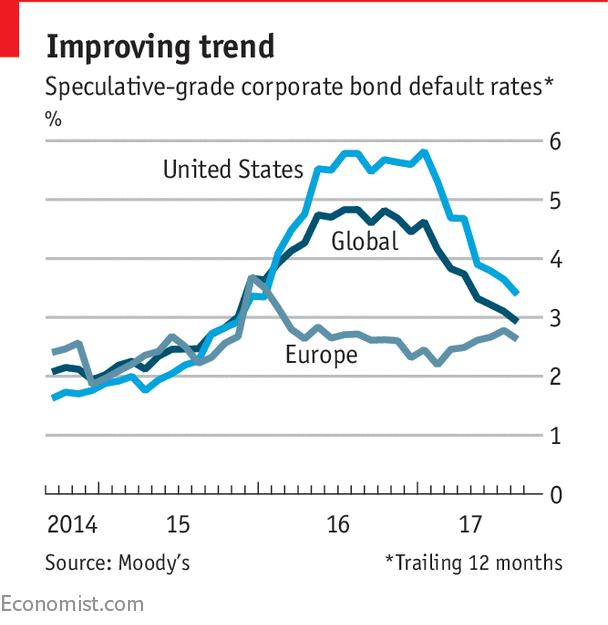
This is the first time the default rate has dropped…Continue reading
Will credit cause a slowdown?

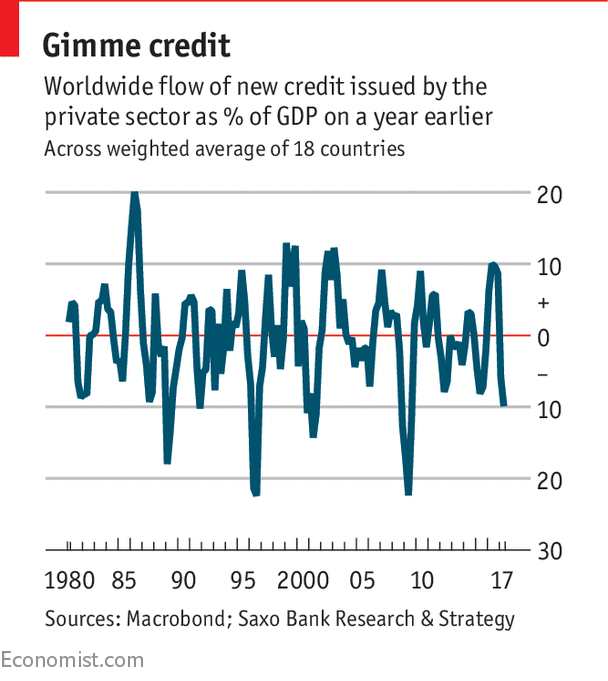
IF THERE is a consensus at the moment, it is that the global economy is finally managing a synchronised recovery. The purchasing managers’ index for global manufacturing is at its highest level for six years; copper, the metal often seen as the most sensitive to global conditions, is up by a quarter since May.
The bond market defies the doomsters

THE yield on the ten-year Treasury bond fell to 2.13% on August 28th, after North Korea fired a missile over Japanese territory. Investors tend to buy government bonds when they feel risk-averse. That will have come as a surprise to those commentators who have called the bond market a “bubble” that is sure to burst; one British magazine made this a cover story back in September 2001. Every time the ten-year yield falls close to 2%, press references to a bond bubble seem to increase (see chart; the yield is inverted).

It is not just the press. Investors have been cautious about bonds for a while; the vast…Continue reading
How do you solve a problem like Korea? Investors are unsure

EUROPEAN markets have started the day with losses of 1% or so, following a 2% decline in Hong Kong’s Hang Seng index and the 1% loss in the S&P 500 index on Thursday. The Vix, a much used measure of market fear, jumped to 16, its highest level since the presidential election.
These are significant moves by the standards of recent months but, to anyone who lived through 2008 (or 1987) they are hardly signs of outright panic. Gold is at $1,288 an ounce, up 2% or so over the week. The Japanese stockmarket was barely changed today, and Japan is right in the firing line of North Korea’s missiles. South Korea would suffer terribly in any war but the Seoul market was down just 1.7% today, and 3.2% on the week.
Clearly, the markets are more worried than they were on August 9th, when President Trump warned of “fire and fury” against Kim Jong-Un’s regime. Investors did not take too seriously the statement from the president, who is known for his intemperate (and often factually inaccurate) tweets….Continue reading
Where might the next crisis come from?
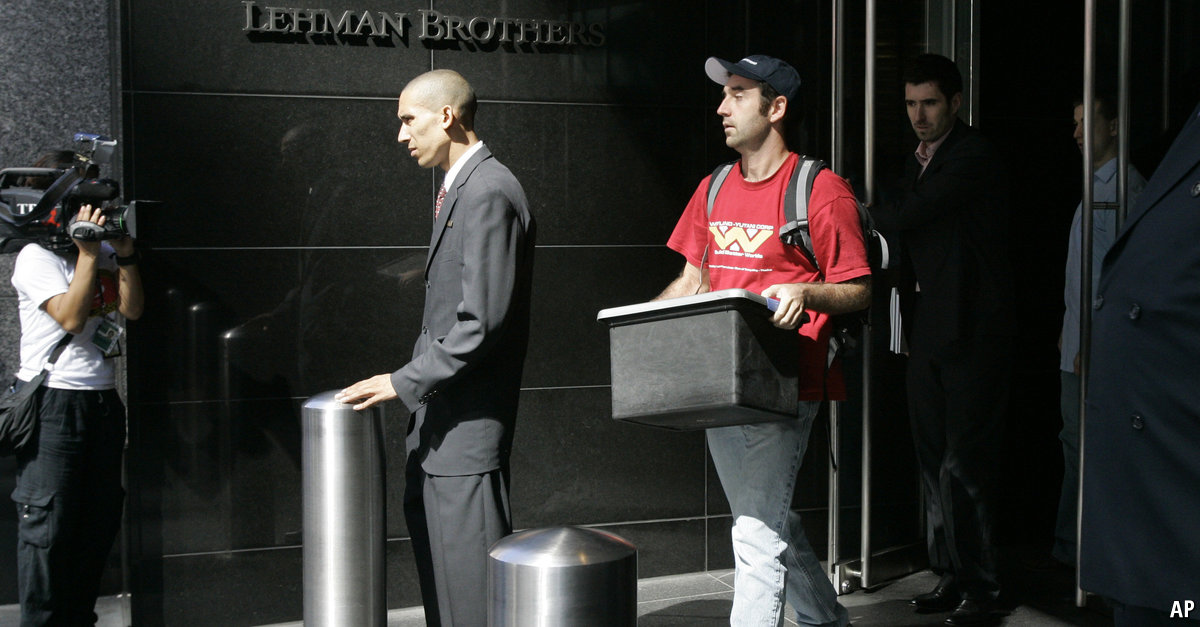
TEN years ago, BNP Paribas, a French bank, temporarily suspended dealings in three funds, citing “the complete evaporation of liquidity in certain market segments of the US securitisation market”. Many people treat this as the start of the credit crunch but one can trace it back to the need for Bear Stearns to rescue hedge funds that invested in mortgage-backed securities in June, or the signs of home loan defaults and failing mortgage lenders that emerged in late 2006. The subsequent tightening of credit and loss of confidence in the banking system eventually led to the collapse of Lehman Brothers, when the crisis reached its height in the autumn of 2008 (see picture).
The inevitable question on the occasion…Continue reading
Capitalism and the absence of creative disruption

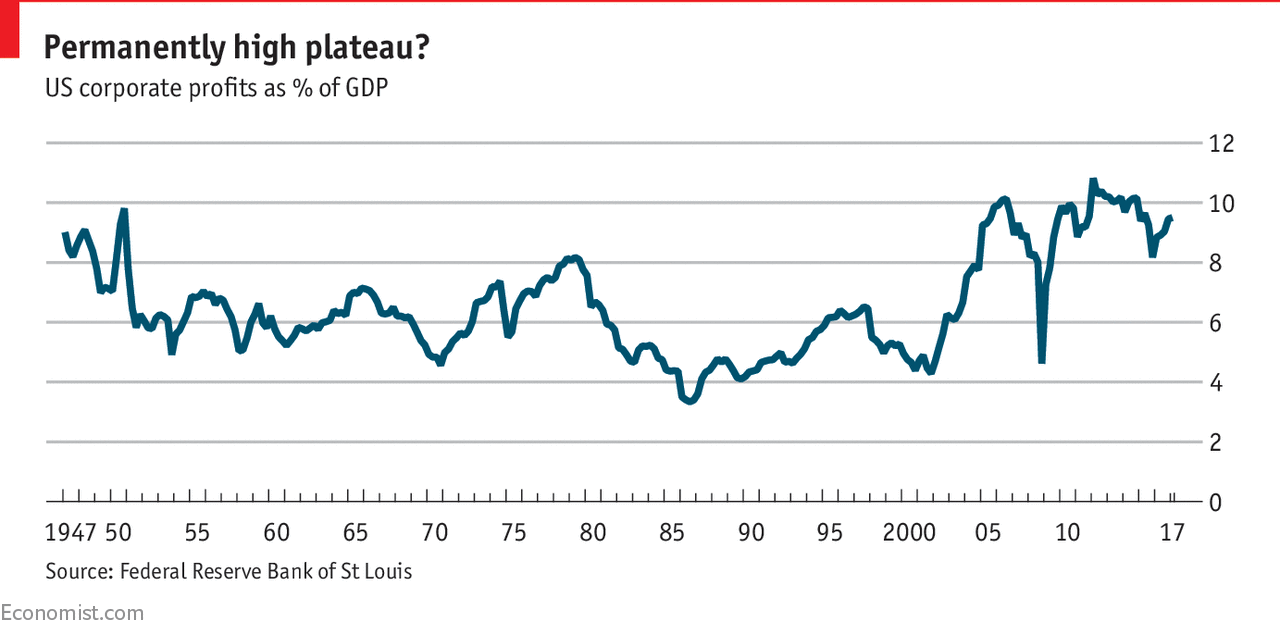
NINE straight highs for the Dow Jones Industrial Average might suggest that all is well with capitalism. But on the contrary, they could be a sign that things have been going profoundly wrong with the way the system is working.
The main driver for the surge in share prices this year has been the strength of profits; second quarter profits for S&P 500 companies are around 12.6% higher than a year ago, according to Andrew Lapthorne at SG, a French bank. As the chart shows, relative to GDP, profits seem to be regaining their levels of recent years. And those levels are much higher than they have been in much of the post-war era (see chart).
A tale of two markets
THE DOW Jones Industrial Average closed above 22,000 on August 2nd, something President Trump is almost certain to mention in a tweet soon*. So it might seem as if the “Trump bump”, which began on the night of the election, is continuing smoothly. But the picture is a lot more complex than that as a look at the euro/dollar rate shows (see chart). The euro fell (and the dollar rose) between election day and the end of 2016. But then came a turning point. The euro has been climbing (and the dollar retreating) for much of 2017.
For dollar-based investors, that means European shares have been a much better bet this year. As of august 2nd, euro zone shares (as measured by the FTSE Euro 100) were up 19.9% since the start of the year, while the S&P 500 was up10.7%. Looked at another way, the American market has dropped by 8% in euro terms since February 2nd.