
Tag: Buttonwood’s notebook
The rise and fall of Bitcoin
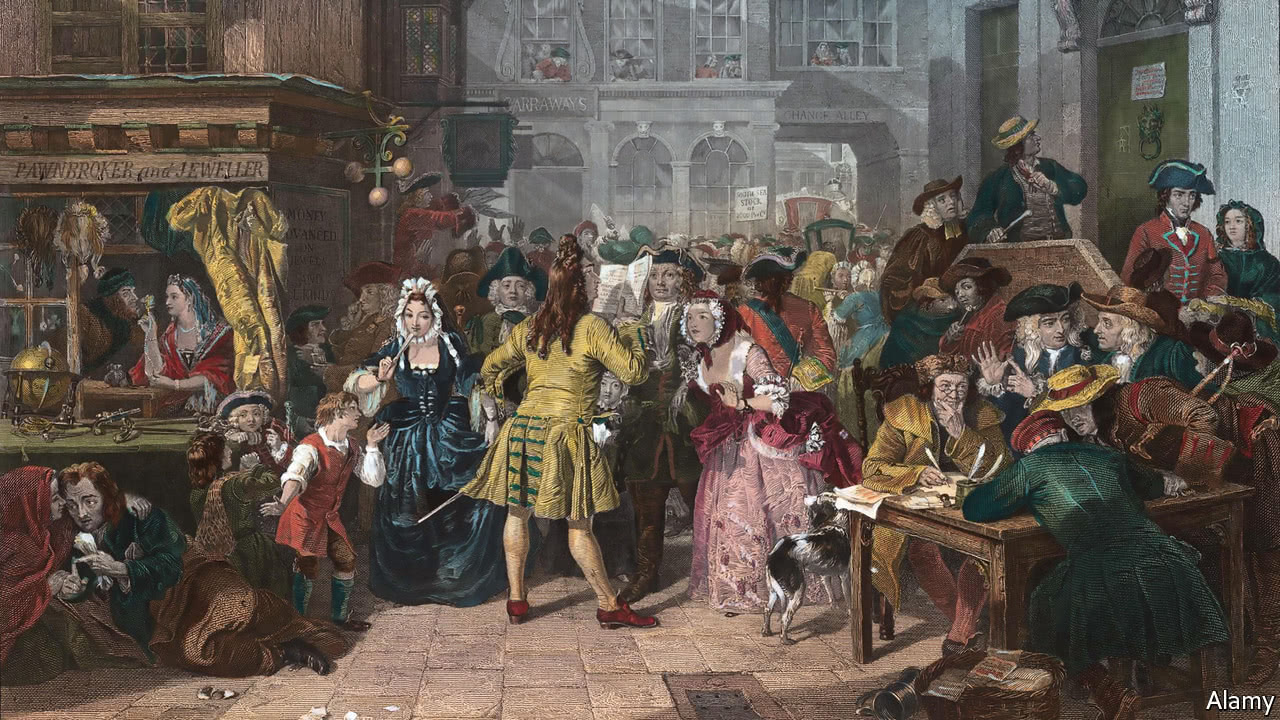
THE great Sir Isaac Newton may have revolutionised our knowledge of the world but he still had his blind spots. He was sucked into the great mania of his day, the South Sea Bubble (pictured) and lost a lot of money. «I can calculate the motion of heavenly bodies but not the madness of people» he ruefully reflected. In retrospect, he should have pondered the popular saying that was used to define his law of gravity: «What goes up, must come down».
Investors in Bitcoin are learning this old truth. The price of the cryptocurrency peaked last month at somewhere over $19,000 (there is a very wide spread, a problem in itself) but, at the time of writing (around 11am GMT), some exchanges now show a price below $10,000.
Perhaps the best way of understanding bitcoin is through a model of how bubbles operate. The classic model, developed by Hyman Minsky and elaborated by Charles Kindleberger, a historian who studied bubbles, has five stages:…Continue reading
Predicting doom for the bond market
INVESTORS are dragging their attention away from the stockmarket for a moment to figure out what is going on in the other main part of their portfolios: government bonds. Yields have been rising so far this year and Bill Gross, one of the sector’s gurus, has said the long bull market (which dates back to the early 1980s) is finally over.
This certainly seems to be the month for big calls; the noted equity bear Jeremy Grantham has already pointed to the potential for a «melt-up» in the stockmarket. Mr Gross, who runs money for Janus but made his name at Pimco, said that the 25-year trend lines had been broken for both the five- and ten-year bonds.
The end of the bond bull market has been called many times, dating back at least to September 2011. There…Continue reading
Where did the inflation go?

THE strength of the global economy is one reason why the stockmarket has started 2018 in buoyant mood (with the Dow passing 25,000). At some point, in any expansion, businesses find it harder to recruit workers or get the materials they need; these bottlenecks cause wages and prices to rise. Central banks then start to tighten monetary policy, a process that can eventually turn the market (and the economy) down.
After many years of ultra-low interest rates, the Federal Reserve has started to tighten monetary policy. There were three rate rises in 2017, and three are expected this year. The idea is to tighten gradually and (keep ahead of the curve) so that inflation does not accelerate so fast that a very sharp monetary tightening is needed.
The problem is that inflation remains hard to spot.
Is the bubble only starting?

READY for a melt-up? Investors are generally upbeat about the prospects for equity markets this year but one intrepid fund manager thinks it is likely that American share prices could rise by 50% in the next six months to two years. Perhaps the biggest surprise is the identity of that pundit: Jeremy Grantham.
Mr Grantham, one of the founders of the fund management group GMO, is best known for a cautious approach to valuations. He was one of the investors who got out of the dotcom boom well before the top. His firm’s most recent prediction for seven-year returns are for an annual loss of 2% from American largecap equities; indeed among all the asset categories, only cash and emerging market equities and bonds are expected to produce a positive real return over the seven-year period.
So how can Mr Grantham justify his views? He does not…Continue reading
What 2018 has in store for the markets

WHAT is in store for economies and markets in 2018? Around this time of year, a large number of analysts and fund managers are giving their views. Among the most interesting and thoughtful approaches can be found at Absolute Strategy Research (ASR), an independent group founded by David Bowers and Ian Harnett.
ASR adds extra depth to its analysis by contrasting its own views with those of the consensus. To do so, the group polled 229 asset allocators, managing around $6trn of assets, for their views on the outlook for economies and markets. They found a groundswell of optimism; the probability of equities being higher by the end of 2018 was 61%, and that shares will beat bonds is 70%. The allocators think there is only a 27% chance of a global recession. And they are not worried about the prospect of the Federal Reserve pushing up interest rates.
There are some disconnects within the consensus view. The first is that investors expect volatility (as measured by the Vix) to rise next year. Usually, equities struggle in such…Continue reading
The financial markets are not the whole economy
DONALD TRUMP is fond of pointing out that the stockmarket has reached many record highs under his presidency. It is a capricious measure to boast about, and one that may not fully reflect the concerns of those who voted for him and probably care more about real wage growth. A look at the ratio of stockmarket capitalisation relative to GDP shows that this measure is close to a record high. That led me to reflect on a sentence I wrote a few years ago: we are better at creating new claims on wealth than at creating wealth itself.
That sentence was written in the context of the huge rise in debt in the 40 years leading up to the 2008 crisis, and on the multiplication of obscure financial instruments that preceded it. It reflected the…Continue reading
When the revolution eats itself
WHEN a revolution happens, the consequences are not obvious straight away. The British referendum on EU membership in June 2016 was seen as a revolt of ordinary people against a globalised elite. The politicians who led the Leave campaign did not seem to expect to win; as wags remarked, they were like «the dog that caught the car».
This helps to explain the general chaos that has enveloped British policy since the result. The Leave campaign had contained two contradictions. The first was that Britain could have all the advantages of EU membership without the bother of actually belonging; the country could «have its cake and eat it» as Boris Johnson, Leave campaigner and now foreign secretary put it. The second was the split between the free market, Liberal brexiters, who envisaged Britain as open to the world, and the nativist camp led by Nigel Farage.
Theresa…Continue reading
Economic optimism drives stockmarket highs

BARELY a day goes by at the moment without Wall Street hitting a new record high. The market has kept marching upwards despite all the headlines about the North Korean nuclear threat, a potential break-up of NAFTA, and natural disasters like hurricanes.
If you want to know why the market keeps rising, just look at the latest poll of global fund managers by Bank of America Merrill Lynch. Almost half of all the managers now expect above-trend growth and below-trend inflation, what is dubbed the Goldilocks economy (she wanted porridge that was not too hot, or too cold, but just right). That is the highest proportion recorded in the history of the survey. Indeed, for the last six years, a plurality of managers have taken the view that both inflation and growth would be below trend.
A net 41% of those managers think global growth will strengthen over the next 12 months. Putting their money behind those beliefs, a net 45% are overweight (have a higher holding than usual) in equities. A remarkable 85% of managers think bond…Continue reading
Taxing the rich
FOR once, The Daily Mail and the Guardian, British newspapers of the right and left, agree. In the former, Alex Brummer says «IMF’s new line of thinking of tax should please Corbyn & co» while the latter says that the IMF «analysis supports tax strategy of Labour in UK«. Both are responding to the IMF’s fiscal monitor which does indeed say that
there would appear to be scope for increasing the progressivity of income taxation without significantly hurting growth for countries wishing to enhance income redistribution.
The report details how income tax progressivity in advanced economies declined in the 1980s and 1990s and that the tax system has done little to reduce inequality in…Continue reading
When investors get stuck in the past

THE award of the Nobel economics prize to Richard Thaler is a reminder that economics has been struggling, in the past 30 years, to adapt its models to the real-life decision-making processes of actual humans. The problem applies as much in investment as anywhere else.
One of the biggest problems is the tendency to assume that the future will resemble the past. Despite all the warnings inserted by regulators, investors often believe that fund management performance will persist, but the evidence is against it. Another issue is the assumption that overall market returns will persist.
This may be one of the factors explaining the big deficits at state and local pension funds in America. Those funds are allowed to make their own calculations…Continue reading