
Tag: FINANCE
OPEC mulls a long-term alliance with Russia to keep oil prices stable

OIL bears beware. On February 20thSuhail al-Mazrouei, OPEC’s rotating president and energy minister of the United Arab Emirates, said the 14-member producers’ group is working on a plan for a formal alliance with ten other petrostates, including Russia, aimed at propping up oil prices for the foreseeable future. If it comes to anything, it could be OPEC’s most ambitious venture in decades.
The result will not be, he insists, a “supergroup”. The notion of Saudi Arabia and Russia joining forces as the Traveling Wilburys of the oil world may be a bit jarring. It remains an idea in “draft” form. But whatever its chances, it attempts to shift a belief widely held by participants in oil markets: that non-American oil producers are helpless against the shale revolution.
That belief has strengthened because of a renewed flood of American shale production in the latter part of 2017 after prices of West Texas Intermediate climbed above $50 a barrel. The International Energy Agency…Continue reading
The long-term returns from collectibles
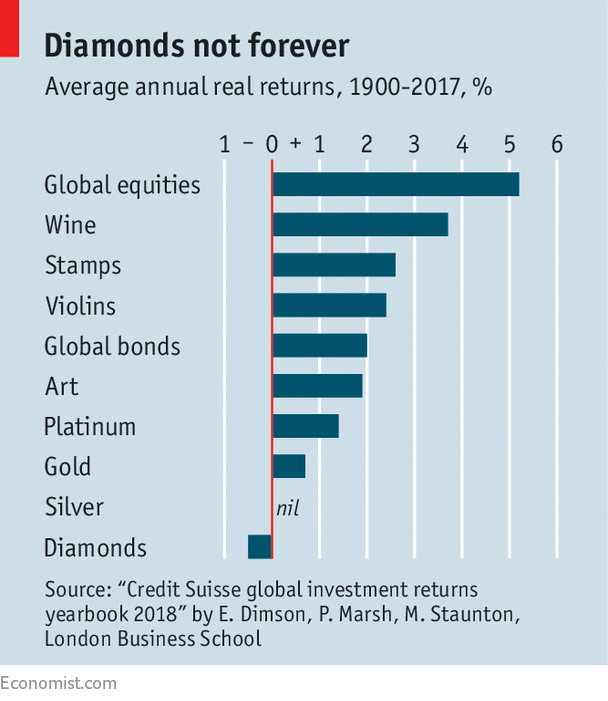
BONDS, shares and Treasury bills are all very well, but in the end they are just pieces of paper. They are not assets you can hang on the wall or display to admiring neighbours. Many rich people like to invest their wealth in more tangible form; property, of course, but also collectibles such as art, fine wine and classic cars.
Is that wise? Elroy Dimson, Paul Marsh and Mike Staunton of the London Business School (LBS) have run the numbers for their annual analysis of the financial markets in the Credit Suisse global investment-returns yearbook. Some of these assets have done rather better than others (see chart). Fine wine delivered the best returns; surprising to cynics who might assume that, in the long run, the value of wine vanishes as it turns into vinegar. Really old wine often has historical resonance. A bottle of Chateau Lafite Rothschild from 1787 was sold for $156,450 in 1985 because it was thought to belong to Thomas Jefferson.
Estimating the returns from these assets, after…Continue reading
A banking centre seeks to reinvent itself

ON A clear day, sunset over Lake Zug is magnificent. Snow-dusted mountains cut through the orange glow above and are mirrored in the lake below. “Zug is our spiritual home,” says Jeremy Epstein, from Washington, DC, who has just taken 40 foreigners to tour the small Swiss town south of Zurich. They came not for sunsets, though, but to find out how Zug has become known as “crypto-valley”—meaning the home of many firms dealing in crypto-currencies and related activities.
Switzerland’s famous banking secrecy is falling to a global assault on money-laundering and tax evasion. But financial security remains in demand. The country should seek to become the “crypto-nation”, said the economy minister, Johann Schneider-Ammann, last month. Zug aims to be the capital of that nation.
To that end, Switzerland is maintaining loose rules for crypto-businesses, even as other countries are tightening theirs. An industry is developing to store tangible crypto-assets, such as the hard…Continue reading
Economists cannot avoid making value judgments
AMID the name-calling and bluster that mar many fights between economists are a few common tactics. Belligerents may attack the theory used to support a claim, or the data analysis used to quantify an effect. During the debate over President Donald Trump’s tax bill, to take a recent example, economists bickered over which side had more credibly calculated the economic effect. They did not, for the most part, argue about whether it was morally acceptable to pass a regressive tax reform after years of wage stagnation and rising inequality. To do so would strike many economists as entirely un-economist-like. Yet economics has not always been so shy about moral philosophy. As well as “The Wealth of Nations”, Adam Smith wrote a “Theory of Moral Sentiments”. Great 20th-century economists like Paul Samuelson and Kenneth Arrow also took questions of values very seriously. Their successors would do well to take several pages from their books.
Modern economists have attempted…Continue reading
Recent tax reforms in America will hurt charities

DESPITE its oft-professed pro-market orthodoxy, America has always had an unusually large non-profit sector. Americans gave $390bn to charity in 2016, with the bulk of contributions coming from individual donors. Historically, revenues at non-profits tend to track GDP growth. The recent tax reforms imply that despite strong economic growth, charitable contributions in America are poised to fall for the first time since the financial crisis.
The most significant threat to charities comes from changes to income tax. American taxpayers can choose either to “itemise” specific expenses, such as charitable gifts or mortgage payments, or take a “standard deduction”. In an effort both to simplify the tax code and to lower overall tax rates, the Republican-led Congress almost doubled the standard deduction to $12,000 for individuals and $24,000 for married couples. This will make filing taxes a lot easier for many. But it also means that far fewer Americans will have a financial incentive…Continue reading
The markets still have plenty to fret about
BULL markets always climb a wall of worry, or so the saying goes. For much of 2017, the main concerns were political and the markets seemed to surmount them as easily as a robot dog opens doors (the latest internet sensation).
But February has shown that the market is still vulnerable. The immediate trigger seems to have been the fear that inflationary pressures would cause bond yields to rise and central banks to push up interest rates; this week’s surprisingly high American inflation numbers will only add to the worries. In a narrow sense, that makes bonds look cheaper, compared with equities. In a broader sense, it increases the discount rate investors apply to future profits, lowering the present value of shares. (A caveat is needed: if higher rates reflect stronger growth, then estimates of future profits should rise, offsetting the discount-rate effect.)
The immediate effect has been to create uncertainty for investors about the direction of central-bank policy, after many years in which it could reliably be assumed that rates would stay low. This translates into a more volatile market, as illustrated by the sharp jump in the Vix, or volatility index, in early February.
The danger is that many investors seem to have treated volatility as an asset class, and have organised their portfolios accordingly. Eric Lonergan of M&G, a…Continue reading
China’s stockmarket plunge: this time it’s different

A CHINESE new-year message from the American embassy in Beijing looked innocuous. It welcomed the Year of the Dog on Weibo, a microblog, with photos of the embassy staff’s pooches and a video greeting from the ambassador and his wife, each with a dog in hand. But it soon attracted 10,000 angry responses. The post had become an unlikely lightning rod for public discontent about the stockmarket.
A plunge on February 9th had left Chinese shares down by 10% on the week, their steepest fall in two years. Some punters found solace in blaming the American embassy for the rout, which started on Wall Street. For others it was a matter of convenience, because their real target, the Chinese securities regulator, knew to disable comments on its Weibo account on such a grim day for stocks.
Even so, their protests seem to have been heard. Before the market reopened this week, Chinese officials urged big shareholders to buy stocks to restore confidence. The Shanghai Stock Exchange warned…Continue reading
India’s state-owned banks endure a string of bad news
OF LATE Indian bankers have felt an unfamiliar sensation: optimism. A 1.3trn-rupees ($21bn) bail-out from the government seemed to have cleaned up the bad lending decisions of years gone by. A new bankruptcy law gave them an edge in long-standing battles with recalcitrant borrowers. It seemed a few Indian companies, having for years eschewed fresh investment, might even start borrowing again.
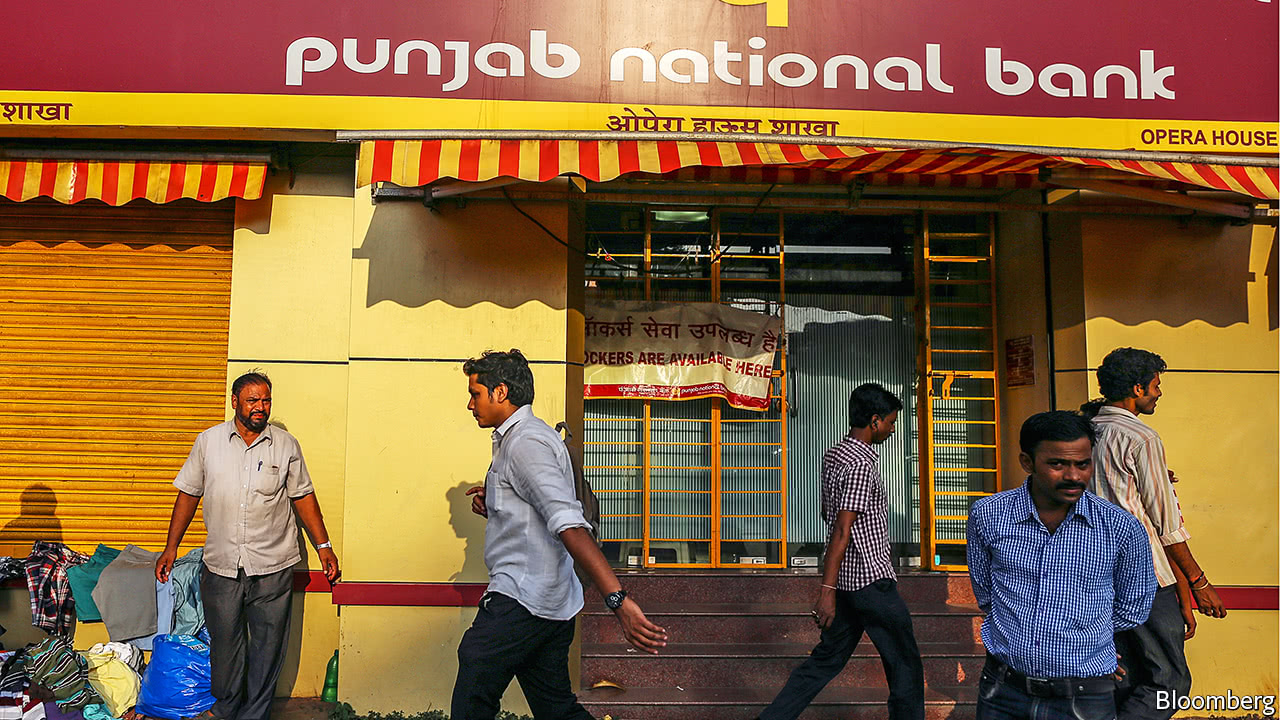
This week woes linked to mismanagement at India’s three biggest partially state-owned lenders plunged the bankers back to their habitual gloom. On February 14th Punjab National Bank (PNB) announced it was investigating a fraud worth 114bn rupees, equivalent to about a third of its market capitalisation. A few days earlier the State Bank of India (SBI) unveiled its first quarterly loss since 1999. And Bank of Baroda has hastily announced the closure of its South African operation, accused of having shady business associations there.
The Punjab heist is…Continue reading
Men and women in economics have different opinions
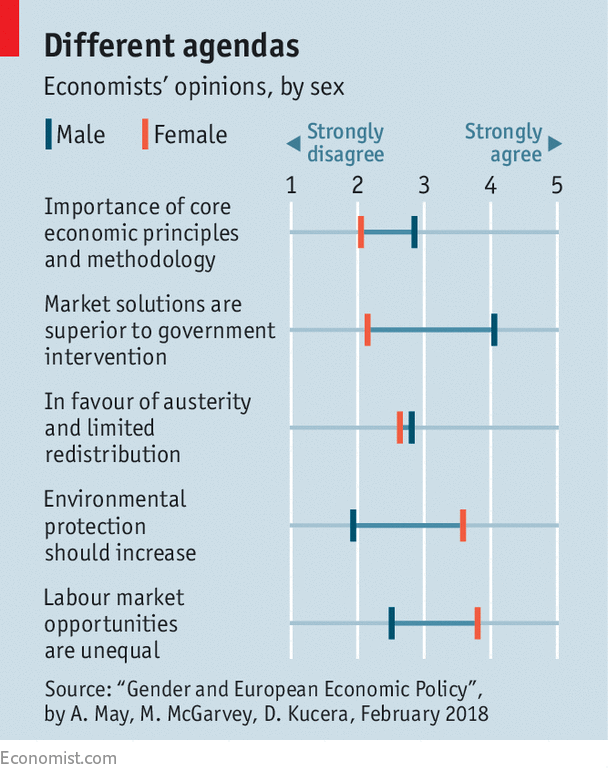
MEN may hail from Mars and women from Venus. But economists, surely, inhabit planet Earth, surveying it dispassionately. Alas, a new paper suggests that even dismal scientists divide on gender lines. Ann Mari May and Mary McGarvey of the University of Nebraska-Lincoln and David Kucera of the International Labour Organisation surveyed economists from 18 European countries, and found that differences in the wider population can survive even an economics education. Male economists are more likely than female ones to prefer market solutions to government intervention, are more sceptical of environmental protection, and are (slightly) less keen on redistribution (see chart).
A similar study of American economists by Ms May and others also found men more sceptical of government regulation, more comfortable with drilling in the Arctic National Wildlife Refuge, and more likely to believe that a higher minimum wage would cause unemployment. Women were 14 percentage points less likely to agree that Walmart…Continue reading
Tax reforms prompt upheaval in the private-equity industry
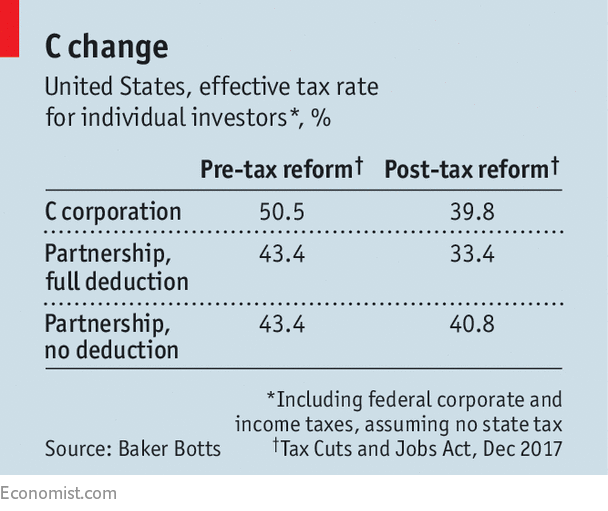
IN THE political cacophony surrounding America’s new tax law, the voice of the private-equity industry has been muted. This is perhaps unsurprising. The industry has managed in large measure to retain its favourable tax treatment, despite a threat from President Donald Trump to close the “carried interest” loophole on which it had grown fat.
So few expected the announcement on February 8th from KKR, a big private-equity firm, that the new law was prompting it to consider converting its status from that of a partnership to a “C corporation” (a corporate-tax-paying firm). As The Economist went to press, a competitor, Ares Management, was expected to make a similar announcement. The new law may have a lasting impact on private equity after all.
Tax has always been central to private-equity business models. The industry uses large amounts of debt, interest on which is tax-deductible, to acquire companies. So it has long been adept at minimising tax, both by…Continue reading