
Tag: FINANCE
Central banks should gamble on productivity-improving technology
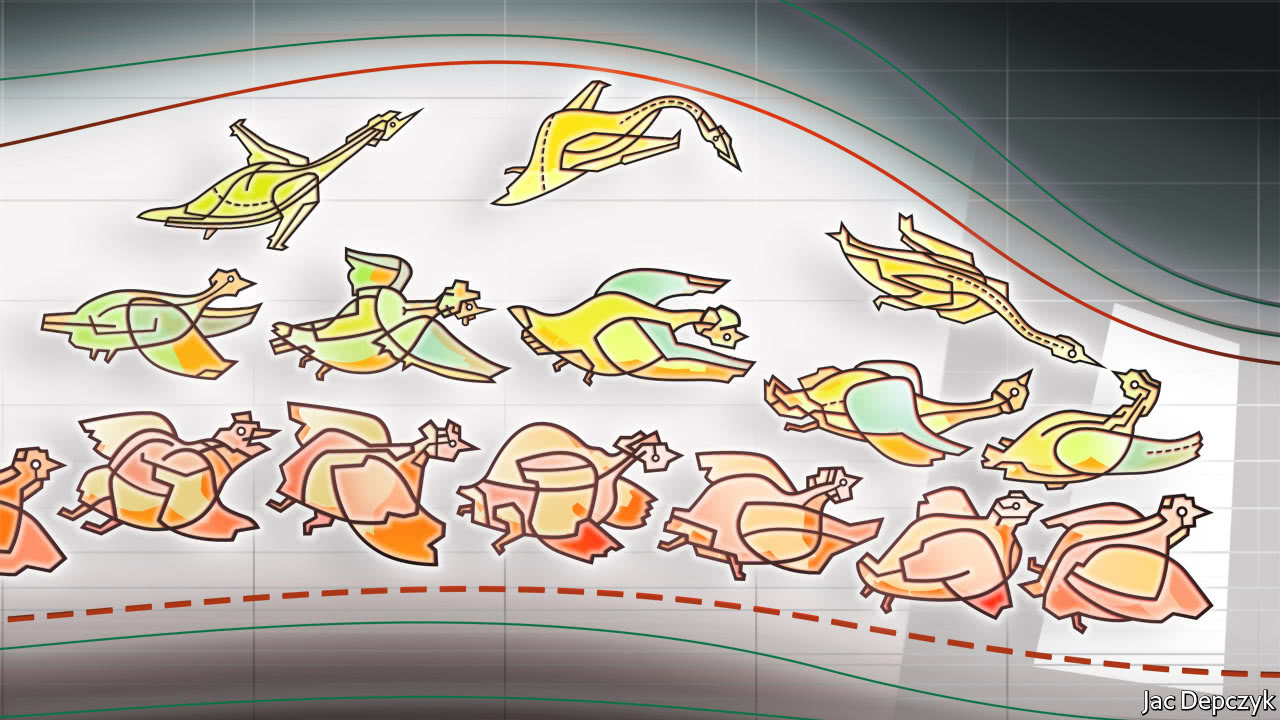
IN 1996 Alan Greenspan began asking why the flashy information technology spreading across America seemed not to be lifting productivity. He was not the first to wonder. A decade earlier Robert Solow, a Nobel prizewinner, famously remarked that computers were everywhere but in the statistics. But Mr Greenspan was uniquely positioned, as the chairman of the Federal Reserve, to experiment on the American economy. As the unemployment rate dropped to levels that might normally trigger a phalanx of interest-rate rises, Mr Greenspan’s Fed moved cautiously, betting that efficiencies from new IT would keep price pressures in check. The result was the longest period of rapid growth since the early 1960s. Despite his success, few central bankers seem eager to repeat the experiment and many remain blinkered to issues other than inflation and employment. That is unfortunate. A little faith in technology could go a long way.
Central bankers are not known to be a visionary bunch. Turning new ideas into more…Continue reading
Why sub-zero interest rates are neither unfair nor unnatural
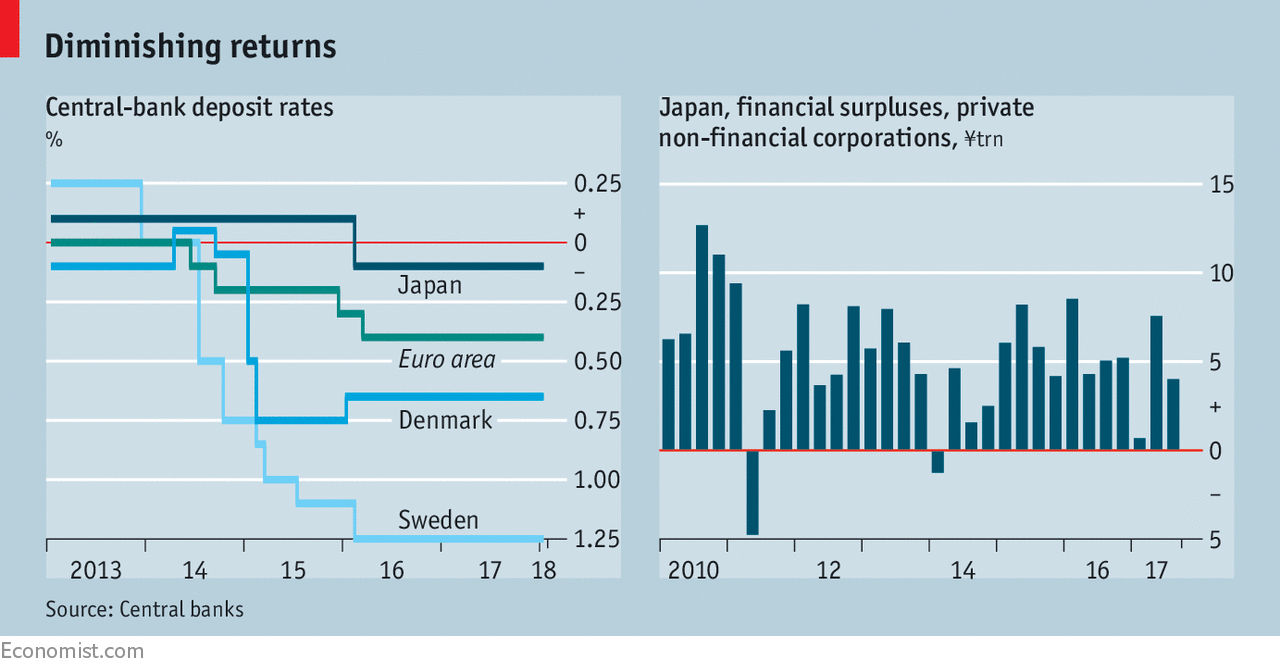
DENMARK’S Maritime Museum in Elsinore includes one particularly unappetising exhibit: the world’s oldest ship’s biscuit, from a voyage in 1852. Known as hardtack, such biscuits were prized for their long shelf lives, making them a vital source of sustenance for sailors far from shore. They were also appreciated by a great economist, Irving Fisher, as a useful economic metaphor.
Imagine, Fisher wrote in “The Theory of Interest” in 1930, a group of sailors shipwrecked on a barren island with only their stores of hardtack to sustain them. On what terms would sailors borrow and lend biscuits among themselves? In this forlorn economy, what rate of interest would prevail?
One might think the answer depends on the character of the unfortunate sailors. Interest, in many people’s minds, is a reward for deferring gratification. That is one reason why low interest rates are widely perceived as unjust. If an abstemious sailor were prepared to lend a biscuit to his crewmate rather than…Continue reading
Cancer is a curse, but also a growth market for investors

CANCER is a grim sort of growth market. By 2030 there will be over 22m new cases a year, up from 14m in 2012, according to the International Agency for Research on Cancer. But as the world marks World Cancer Day, on February 4th, scientists are speaking of a revolution in the battle to beat it. Money managers’ ears have pricked up. Oncology investing is “hot”.
The most straightforward way to invest in treating cancer is through shares in companies that sell blockbuster drugs. Alternatively, biotech indices track a basket of companies, of which typically 40% are oncology-related. Big Pharma now buys rather than builds much of its innovation. So backing oncology startups can be an especially lucrative (if risky) approach. According to CB Insights, a research firm, equity investment in cancer-therapeutics startups has grown from $2bn in 2013 to $4.5bn in 2017. Take Juno Therapeutics, founded in Seattle in 2013 to develop immunotherapy drugs. It was acquired on January 22nd by Celgene, a Biotech giant, for a whopping $9bn.
Eric…Continue reading
A big Blackstone deal shows how private equity has changed
THE financial crisis a decade ago brought the glory days of private equity to a screeching halt. The debt-fuelled megadeals on which the industry had built its fame (or notoriety) seemed over. But on January 30th a group of investors led by Blackstone, the world’s largest private-equity firm, announced a $17bn deal to carve out Thomson Reuters’ financial and risk business (F&R), a financial-data provider. The deal would be Blackstone’s largest since the crisis. But if the megadeal is making a comeback, it is in a new guise.
In the mid-2000s, huge transactions abounded. Deals from 2006 and 2007 alone account for nine of the ten largest ever. But, looking purely at value, the only true drought in big deals was from 2008-12. Every year since 2013 has seen at least one buy-out of more than $10bn, according to the private-equity database of Thomson Reuters F&R itself.
But in many of these deals private-equity firms have taken the unfamiliar role of companions to corporate acquirers. In a $23.5bn deal in 2013 to acquire Heinz, Berkshire Hathaway, a conglomerate, split ownership equally with 3G Capital, a Brazilian private-equity firm. Even private-equity led acquisitions are today much more likely to involve institutional investors or corporations, rather than other private-equity firms. The consortium that Bain Capital cobbled together last year…Continue reading
Cars block the road to a renegotiated NAFTA
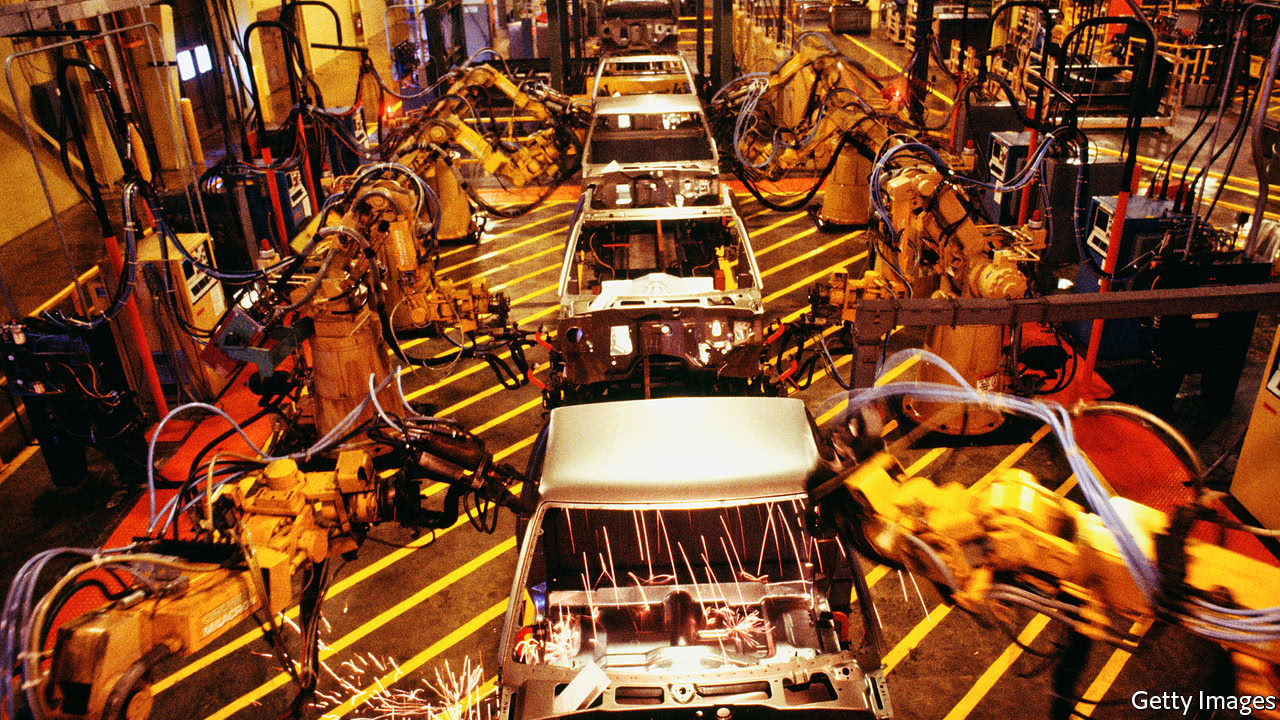
ROBERT LIGHTHIZER, the United States Trade Representative, wants renegotiation of the North-American Free Trade Agreement (NAFTA) to speed up. When the sixth round of talks ended on January 29th with only three chapters agreed, he griped: “We owe it to our citizens, who are operating in a state of uncertainty, to move much faster.” But given the changes he wants, any more speed risks a crash.
One of the biggest fights is over Mr Lighthizer’s desire to rewrite NAFTA’s rules about cars. Seen one way, the deal has been a boon for the industry. Trade in vehicles and their parts accounts for a quarter of America’s two-way trade with Mexico and Canada. But NAFTA’s critics see it as a big reason for America’s trade deficit with Mexico, and for its falling share of car assembly (see chart). Rules riddled with holes should be rewritten, they think, to yank back American jobs.
Might higher interest rates spoil America’s economic boom?
AMENDING a famous metaphor, Janet Yellen once said that the Federal Reserve would “keep refilling the punch bowl until the guests have all arrived”. This week investors began to wonder if Jerome Powell, who will shortly succeed Ms Yellen at the top of the Fed, might at last deem the party full. On January 29th the ten-year Treasury yield reached 2.7%, the highest since early 2014. The prospect of tighter money caused stockmarkets to sneeze. On January 30th the S&P 500 fell by 1.1%, its biggest decline since August, before recovering a tiny bit the next day. With unemployment low and tax cuts pending, investors are wondering whether inflation and interest rates might soon surge.
The economy grew by 2.5% in the year to the fourth quarter of 2017. According to Okun’s law, a rule of thumb relating unemployment to GDP, falling joblessness explains almost half of this growth. (The unemployment rate fell from 4.7% to 4.1% over the same period.) Early in the year inflation fell short, suggesting that fast growth could continue unabated. But pressure on prices has begun to build. Quarterly core inflation, which excludes volatile food and energy prices, was only just below the Fed’s 2% target at the end of 2017. Markets have recently come to believe rate-setters who say that they will tighten policy three times in 2018 (see chart), as happened in 2017.
A safe asset is devised for the euro zone

THESE are bright days in the euro area. Preliminary figures say that the currency zone’s GDP grew by 2.5% last year, the fastest since 2007. But many of the faultlines in the zone’s financial system, as revealed by the financial crisis, remain. A proposal published on January 29th by a group reporting to the European Systemic Risk Board, a prudential supervisor, may mend one of the more troubling flaws.
Euro-area banks favour their home countries’ debt. A sample of 76 lenders examined by supervisors last year had exposures of €1.7trn ($1.9trn) to euro-area governments, of which €1.1trn was lent to their home states. That exceeded the banks’ common equity tier-1 capital, their cushion against losses, of €1trn. The fortunes of states and banks are thus bound in a “doom loop”. Suppose an economic shock raises the risk of a sovereign default. Banks’ balance-sheets start to crumble. They need propping up by the already wobbly state. And as they cut lending, the real economy weakens,…Continue reading
“Factor investing” gains popularity

RETAIL investors tend to dream of finding a wonder stock—a Netflix or Apple that will multiply their savings many times over. But institutional investors cannot commit too much capital to one individual company. Instead, they hope to pick the right kind of stocks, a broadly based group that will beat the market.
Two or three decades ago, fund managers would have attempted this feat by favouring one industry over another. They might, say, have bought energy stocks in the hope that the oil price would rise, while avoiding retailers because of fears about consumer spending. But in these days of computers and algorithms, there are more systematic approaches to beating the market. The aim is to find stocks with characteristics or “factors” that make them outperform. In the industry jargon, funds tracking these factors are known as “smart beta”. The money allocated to smart-beta exchange-traded funds has reached $658bn; all told, more than $1trn is invested in an explicitly factor-based…Continue reading
Zhou Xiaochuan, China’s central-bank chief, is about to retire

WHEN Zhou Xiaochuan took the helm of China’s central bank 15 years ago, the world was very different. China had just joined the World Trade Organisation and its economy was still smaller than Britain’s. Foreign investors paid little heed to the new governor of the People’s Bank of China. He seemed safe to ignore: another black-haired, bespectacled official whose talk was littered with socialist bromides.
Mr Zhou is widely expected to retire in the coming weeks. He leaves with China far stronger and his own role much more prominent. No one person can take credit for the flourishing economy. But Mr Zhou, who is 70, deserves more than most. He helped forge the monetary environment for China’s growth. He also went a long way to dragging the financial system out of the mire of central planning, even if reforms fell short of his own wishes.
His achievements are surprising. China makes no pretence of having an independent central bank. The People’s Bank is under the State Council, or…Continue reading
Financial regulators too often think “this time is different”
FOR a phenomenon with such predictably bad outcomes, a financial boom is strangely seductive. Not a decade after the most serious financial crisis since the Depression, the world watches soaring markets with a mixture of serenity and glee. Natural impulses make finance a neck-snappingly volatile affair. Governments, though, deserve heaps of blame for policies that amplify both boom and bust. As regulators begin picking apart reforms only just enacted, it is worth asking why that is so.
Finance is hopelessly prone to wild cycles. When an economy is purring, profits go up, as do asset values. Rising asset prices flatter borrowers’ creditworthiness. When credit is easier to obtain, spending goes up and the boom intensifies. Eventually perceptions of risk shift, and tales of a “new normal” gain credence: new technologies mean profits can grow for ever, or financial innovation makes credit risk a thing of the past. But when the mood turns, the feedback loop reverses direction. As asset prices fall, banks grow stingier with their loans. Firms feel the pinch from falling sales, get behind on their debts and sack workers, who get behind on theirs. The desperate sell what they can, so asset prices tumble, worsening the crash. Mania turns to panic.
The pattern is an ancient one. In their book “This Time is Different”, Carmen Reinhart and Kenneth Rogoff,…Continue reading