
Tag: FINANCE
Morgan Stanley’s unexciting model takes the prize on Wall Street

MORGAN STANLEY emerged in 1935 out of a global financial disaster, as one of Wall Street’s leading firms. In a rare shred of consistency in America’s turbulent markets, history has repeated itself. But it was a close call. An ill-timed infatuation with debt ahead of the 2007-08 financial crisis threatened to add it to the industry’s towering funeral pyre, which consumed all its big competitors with the exception of Goldman Sachs.
Of the two, Morgan Stanley came out of the crisis the more tarnished, less for what it did than for what it was: less profitable; less connected, through its former employees, to political power; and less respected for having evaded disaster. But after the release of financial results from the fourth quarter of 2017, Morgan Stanley’s valuation has surpassed Goldman Sachs’s. This reflects not only the improvement in its profitability but also investors’ greater confidence in how it is managed.
Goldman, with some justice, finds the comparison unfair….Continue reading
Direct-lending funds in Europe
WHEN Caronte & Tourist, a Sicilian ferry company, needs a new ship, it is cheap and easy to borrow from a bank. But in 2016, when Caronte’s controlling families wanted to buy back the minority stake held by a private-equity firm, banks balked at the loan’s unusual purpose. Edoardo Bonanno, the chief financial officer, also worried that the €30m ($33m) in extra bank debt might make shipping loans harder to obtain from them in future. So he turned instead to a direct-lending fund run by Muzinich & Co, an asset manager.
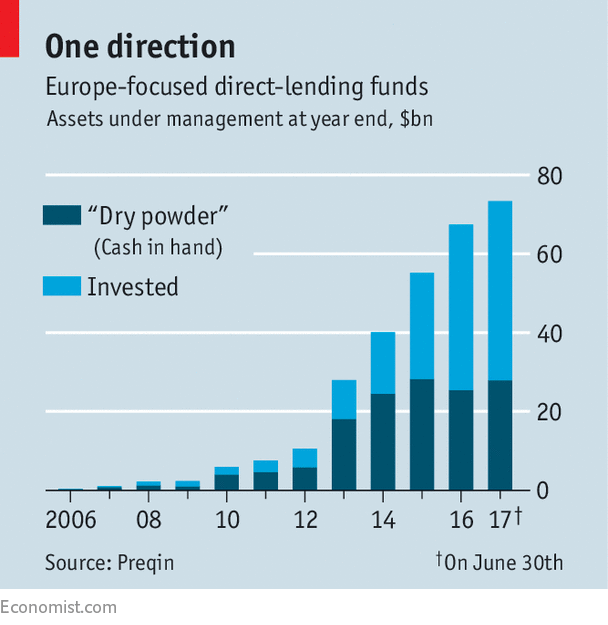
Such funds are only about a decade old in Europe (and not much older in America, where they started). Assets under management at Europe-focused funds increased from a mere $330m at the end of 2006 to $73.3bn by mid-2017, which includes $27.9bn of “dry powder”, or funds yet to be lent out (see chart). In 2017 alone 24 direct-lending funds raised a record $22.2bn. Such funds do what they say on the tin: lend directly to firms, usually in the form of big, multi-year loans. The borrowers are often either companies that are too small to raise equity or debt on capital markets, or private-equity funds buying such firms.
How microcredit can help poor countries after natural disasters

BOTH, in different ways, worry about liquidity. And global warming may, indeed, be bringing meteorologists and financiers together. On January 18th, VisionFund, a microlending charity, and Global Parametrics, a venture that crunches climate and seismic data, launched what they billed as the “world’s largest non-governmental climate-insurance programme”. The scheme will offer microfinance to about 4m people across six countries in Asia and Africa affected by climate-change-related calamities.
Natural disasters are becoming more frequent and severe. They disproportionately affect poor countries, where many eke livings from vulnerable agricultural land. Yet it is often in the aftermath of disaster that credit is hardest to obtain. As non-performing loans rise and the perception of risk increases, microfinance institutions (MFIs) rein in lending; they receive little support from donors and relief programmes, which tend to favour humanitarian aid….Continue reading
Monetary policy suffers a shortage of central bankers
IN THEIR quest to stabilise the job market, central banks are setting a bad example. Jerome Powell, whom senators this week confirmed as the next chairman of America’s Federal Reserve, will lead an institution with three existing vacancies on its seven-member board, and a fourth that will open up imminently. Not since July 2013 has its rate-setting committee boasted the full complement of 12 voting members.
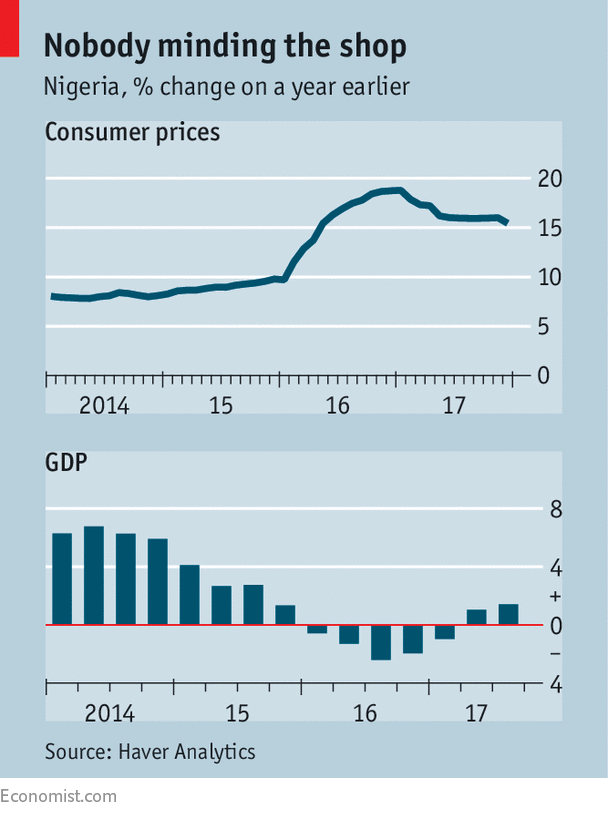
This monetary undermanning is, however, much worse in Nigeria. Its monetary-policy committee was unable to meet as scheduled on January 22nd-23rd because it lacked the six members necessary for a quorum. Five recent nominees still await confirmation by the country’s Senate. The chamber is holding up all but a few executive appointments in retaliation for President Muhammadu Buhari’s failure to remove an official (the acting anti-corruption tsar) whom the Senate twice rejected. In the absence of a monetary-policy meeting (and the lengthy communiqué that eventually follows it), the central bank…Continue reading
Bangladesh experiments with a new approach to poverty alleviation
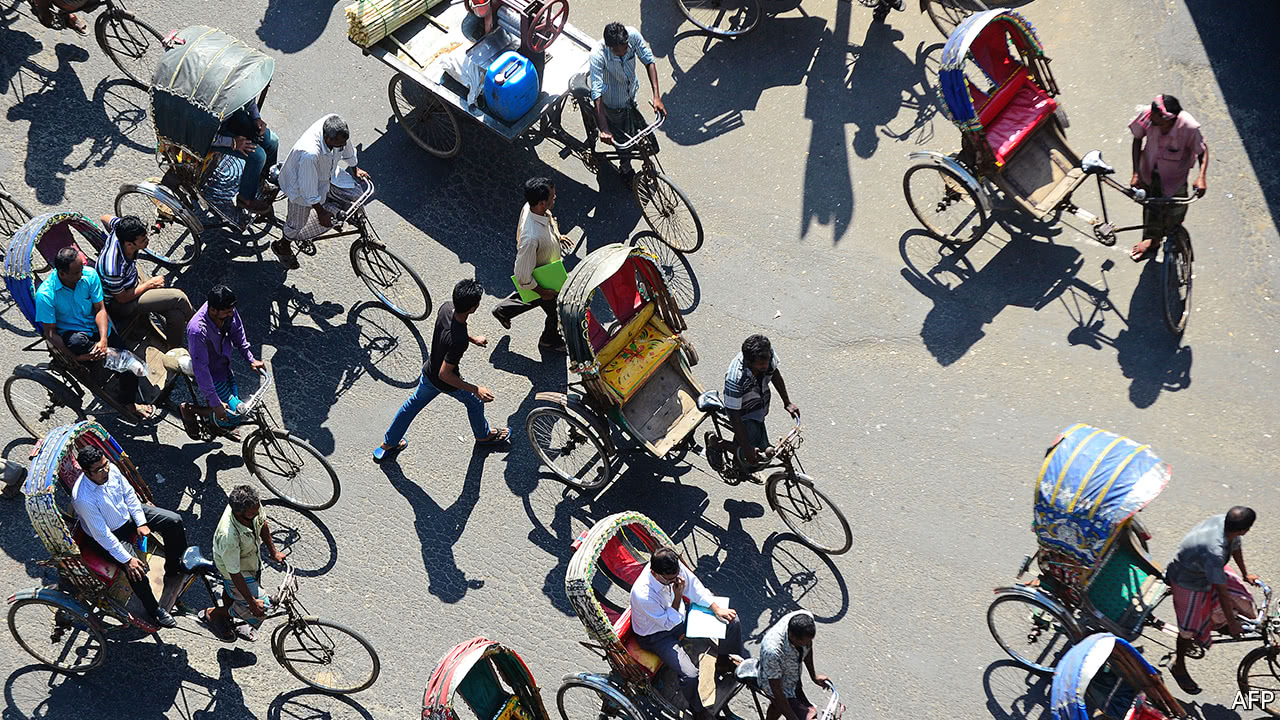
BESIDES shoes and shrimp, Bangladesh exports poverty cures. Microfinance was developed there in the late 1970s before spreading. In 2002 BRAC, a charity, started giving assets such as cows (and training in how to manage them) to desperately poor women. That approach has spread, too. The latest poverty remedy to emerge from Bangladesh is different: it targets men, and rather than trying to make people more productive in their villages, it encourages them to move.
In Rangpur, a northern district, agricultural labourers endure an annual hunger in the autumn, known as monga. The rice crop has been planted but is not ready to harvest, so work is scarce. Jobs abound in the cities, but poor farmers are loth to use their dwindling savings on a bus ticket. It is a good example of a poverty trap.
So, for the past ten years, researchers led by Mushfiq Mobarak, an economist at Yale University, have tried offering cash to poor households so long as somebody moves to a city to…Continue reading
Venezuela’s currency plumbs unknown depths
EVEN a modest rate of inflation compounds over time. This is why your tipsy grandfather might wistfully recall how little a pint of beer cost in his heyday. In Venezuela, where prices are rising at a four-figure annual rate, the good old days were last month. The defence minister, Vladimir Padrino López, on January 19th urged business leaders to peg back prices to their levels of December 15th, when presumably everything was just fine.
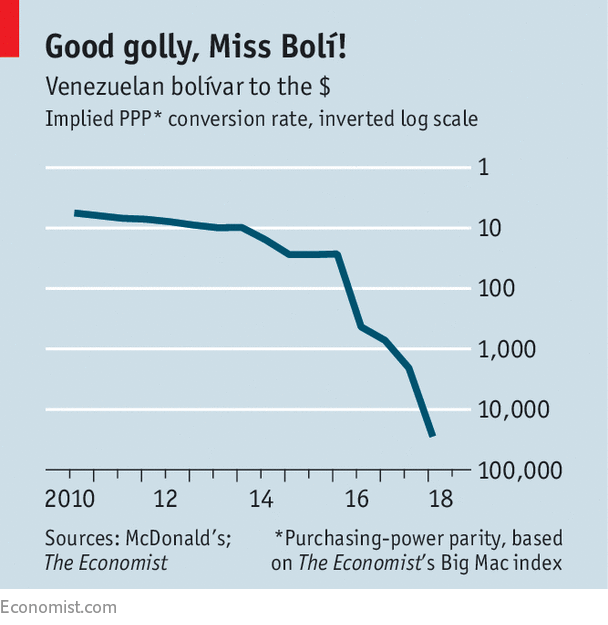
The spending power of the bolívar, Venezuela’s currency, had collapsed long before then. The Economist’s Big Mac Index gives a rough guide to how fast it has fallen. The index is based on the idea of purchasing-power parity (PPP), which says a fair-value exchange rate is one that leaves consumer prices the same in different countries. In our index, the price of a Big Mac is a proxy for all goods. In Caracas, this week, a Big Mac cost 145,000 bolívars; in American cities, it cost an average of $5.28. The ratio of those prices gives a PPP exchange rate of 27,500 bolívars. Two years ago, the rate was 27 bolívars. By this yardstick, the currency has lost 99.9% of its value in almost no time.
Market volatility has been low, encouraging risk-taking
MAY YOU live in boring times. Financial markets have become dull, if profitable. The S&P 500 index, America’s leading equity benchmark, has notched up its longest-ever streak without a 5% reversal. Bond yields may have inched up in recent months, but are still at the bottom of historical ranges. Institutions famed for their trading prowess, such as Goldman Sachs, have seen profits dented by the quiescence of the markets.
This lack of market volatility owes much to the steadiness of monetary policy since the depths of the financial crisis. Central banks have kept short-term rates low and have intervened to push down bond yields through their programmes of quantitative easing (QE). The classic method of pricing financial assets is to say they are worth the discounted value of future cashflows; since central banks have kept the discount rate steady, prices have been steady too.
The late Hyman Minsky, an economist, thought that long booms sowed the seeds of their own destruction. He argued that, when the economy was doing well, investors tended to take more risk (such as taking on more debt). These speculative positions are vulnerable to a shock, such as a sudden rise in interest rates, which can turn into a fully fledged crisis.
In these days of sophisticated markets, speculators are not restricted to their own capital or even to borrowed money to…Continue reading
The World Bank’s “ease of doing business” report faces tricky questions
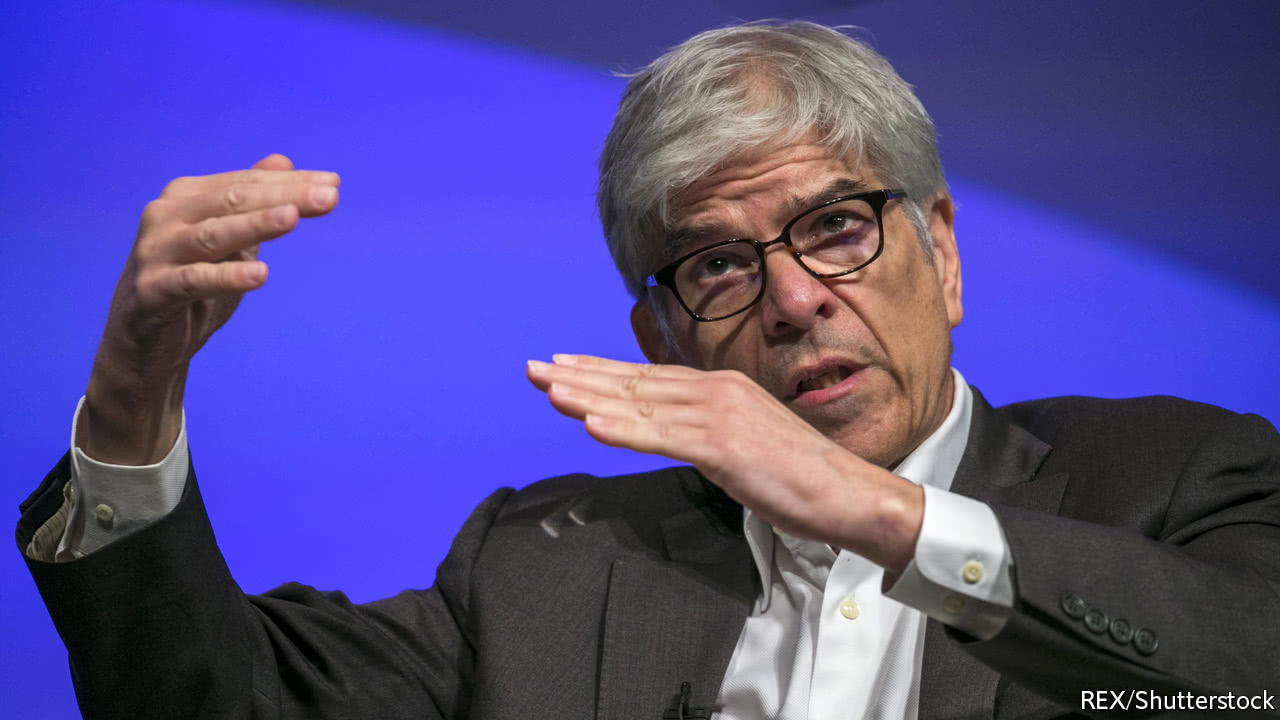
HOW many days does it take to correct a misleading newspaper interview? Four, in the case of Paul Romer, the World Bank’s chief economist. On January 12th a surprising article in the Wall Street Journal alleged that one of the bank’s signature reports—on the ease of doing business around the world—may have been tainted by the political motivations of bank staff. The story was based on an interview with Mr Romer, who pointed out that Chile’s ranking in the yearly report had dropped sharply during the presidency of Michelle Bachelet, a left-leaning politician who took office for the second time in 2014. Chile sank so heavily not because doing business had become harder, but because the bank had repeatedly changed its method of assessment.
That method mostly entails answering measurable questions, such as how many days does it take to start a business, register a property or file taxes. The answers determine a country’s score (known as its “distance to…Continue reading
The French government experiments with venture capitalism
AS A boy, Antoine Hubert used to catch butterflies. These days, the agro-engineer has eyes only for meal worms. In a demonstration factory near Dole in eastern France, he shows how trayfuls of plump, half-grown worms are fed, left to grow in a darkened dormitory, and then—after two months—slaughtered and cleaned with a blast of steam. A machine divides the resulting mush into oil and protein powder.
Around 70% of a worm is protein, making it ideal for animal feed. Demand is soaring, notably at fish and shrimp farms. Mr Hubert predicts aquaculture businesses will need 70m tons of feed annually in ten years’ time, up from 40m now. The global market for animal feed, he reckons, is already worth €500bn ($610bn).
Ynsect, his firm, thus expects to grow once it opens a new factory this year. He dreams of annual output exceeding 1m tonnes, hinting at a hunger for scale often left unsatisfied in a French entrepreneur: local…Continue reading
Our Big Mac index shows fundamentals now matter more in currency markets
IT IS usually considered quaint to predict foreign-exchange movements by reference to whether currencies are dear or cheap. Metrics such as The Economist’s Big Mac index, a lighthearted guide to exchange rates, hint at how far currency values are out of whack. But they are often driven further out of kilter by capital flows, by fear and greed, by the interventions of policymakers, and so on.
Since our last look at the index in July, cheap currencies have narrowed the valuation gap against the dollar—almost completely in case of the Canadian dollar (see chart). Fundamentals, such as fair value, seem (at last) to have greater sway in the foreign-exchange market.
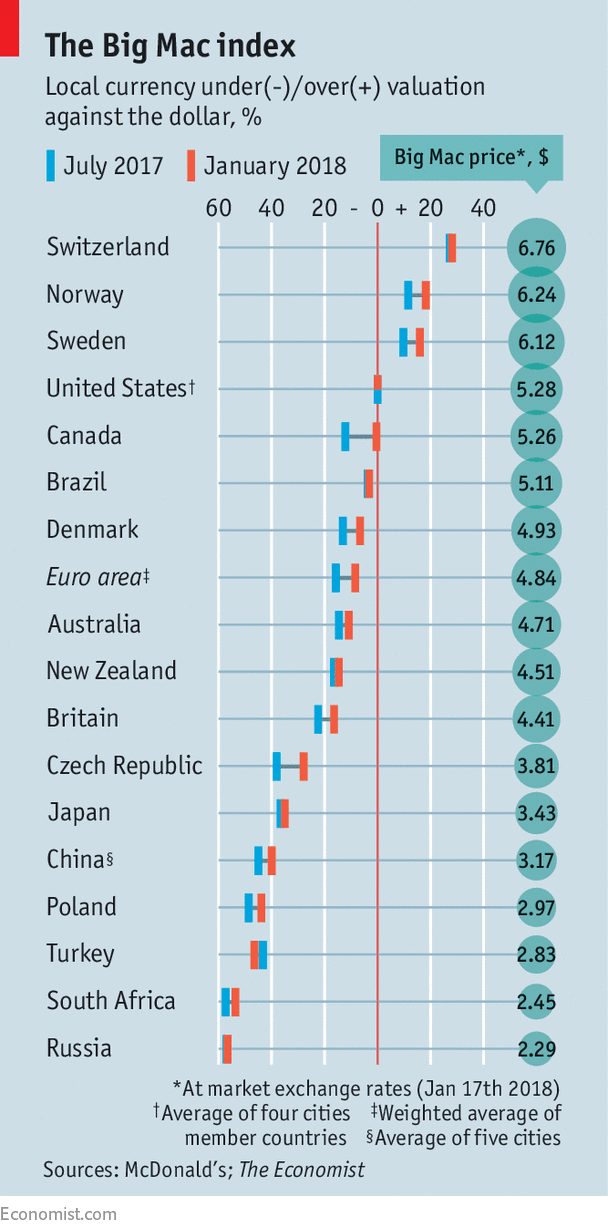
The index is based on the idea of purchasing-power parity, which says exchange rates should move towards the level that would make the price of a basket of goods the same in different countries. Our basket contains only one item, but it is found in around 120 countries: a Big Mac hamburger. If the local cost of…Continue reading