
Tag: FINANCE
Why driverless cars may mean jams tomorrow
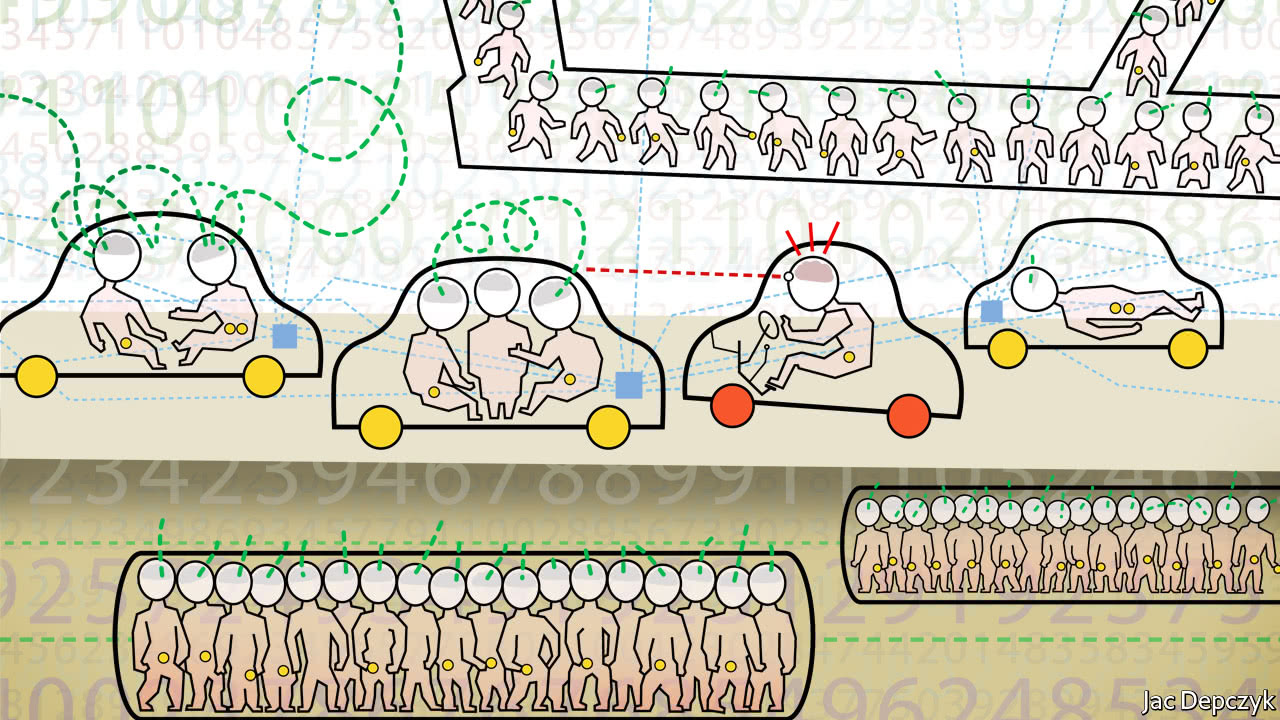
THE most distractingly unrealistic feature of most science fiction—by some margin—is how the great soaring cities of the future never seem to struggle with traffic. Whatever dystopias lie ahead, futurists seem confident we can sort out congestion. If hope that technology will fix traffic springs eternal, history suggests something different. Transport innovation, from railways to cars, reshaped cities and drove economic advance. But it also brought crowded commutes. Now, as tech firms and carmakers aim to roll out fleets of driverless cars, it is worth asking: might this time be different? Alas, artificial intelligence (AI) is unlikely to succeed where steel rails and internal-combustion engines failed.
More’s the pity. In America alone, traffic congestion brings economic losses estimated in the hundreds of billions of dollars each year. Such costs will rise unless existing transport systems receive badly needed investment. For example, fixing New York’s beleaguered, overcrowded subway will…Continue reading
Why the oil price is so high
PERHAPS the most vexing thing for those watching the oil industry is not the whipsawing price of a barrel. It is the constant updating of theories to explain what lies behind it. In March 2014, when the price of a barrel of Brent crude was in three figures, the then boss of Chevron, an oil giant, observed that the scarcity of cheap oil meant “$100 per barrel is becoming the new $20”. Two years later, when the oil price slumped below $28, the talk was of a global oil glut caused by the furious efforts of the OPEC cartel to regain market share. Now that oil prices have tested $70, analysts are again scratching their heads.
In “1984”, George Orwell coined the term “doublethink”, the ability to believe two contradictory things. Oil analysis seems to require similar cognitive gymnastics. Three big questions arise. First, why has the oil price more than doubled in the space of two years, against all expectation? Second, why has this surge been met with cheers from global stockmarkets and not…Continue reading
The threat of tough regulation in Asia sends crypto-currencies into a tailspin
IT HAS been another week of vertiginous swings in the prices of bitcoin and other crypto-currencies. This time, the moves have mostly been downwards, with some days seeing falls of over 20%. Views on this were as divided as they were during the giddy climb: did it mark the definitive bursting of a bubble as rapidly inflated as any in history (see chart)?

Asia provides both an explanation of this week’s sell-off and a glimpse of crypto-currencies’ future. The threat of a ban in bitcoin-trading in South Korea was the proximate cause of the plunge. As to the future, the question is which Asia? At one end of the spectrum…Continue reading
The hedge-fund delusion that grips pension-fund managers
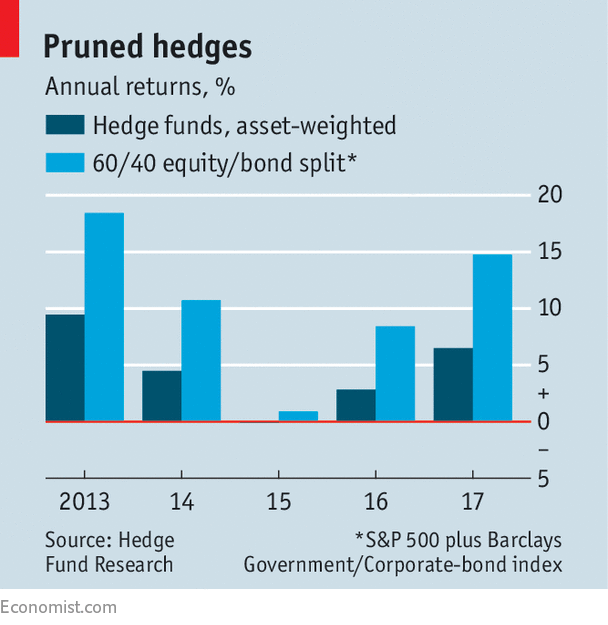
HEDGE-FUND managers may be feeling quietly smug about their performance in 2017. They returned 6.5% on average, according to Hedge Fund Research, a data provider, their best year since 2013.
But those returns do not really suggest that they are masters of the investing universe. The S&P 500 index, America’s main equity benchmark, returned 21.8%, including dividends, last year. More tellingly, a portfolio split 60-40 between the S&P 500 and a mixture of government and corporate bonds (an oft-used benchmark for institutional portfolios) would have returned 14.8%. Last year was the fifth in a row when hedge funds underperformed the 60/40 split (see chart).
That ought to be a salutary lesson for those institutions who think that backing hedge funds is the answer to their prayers. Despite the highs recorded by stockmarkets, many employers are struggling to fund their final-salary pension promises. In 2016 the average American public-sector plan was just 68%-funded, according to the Centre for…Continue reading
How China won the battle of the yuan
“THE horse may be out of the proverbial barn.” So wrote Ben Bernanke, a former chairman of the Federal Reserve, in early 2016, arguing that capital controls might be powerless to save China from a run on its currency. He was far from alone at the time. As cash rushed out of the country, analysts debated whether the yuan would collapse, and some hedge funds bet that day was coming fast. But two years on, the horse is back in the barn: the government’s defence of the yuan has succeeded, in part through tighter capital controls.
The latest evidence was an 11th consecutive monthly increase in foreign-exchange reserves in December. During that time China’s stockpile of official reserves, the world’s biggest, climbed by $142bn, reaching $3.14trn, roughly double the cushion usually regarded as needed to ensure financial stability. Another sign of China’s success is the yuan itself. At the start of 2017 the consensus of forecasters was that the currency would continue to weaken; it finished the year up by 6% against the dollar.
Investors and analysts were not wrong in viewing Chinese capital controls as porous. Enterprising types had—and have—umpteen ways to sneak money out, from overpaying for imports to smuggling cash across the border in luggage. But there is a wide spectrum between a fully open and fully closed capital account, and China has…Continue reading
Donald Trump’s difficult decision on steel imports
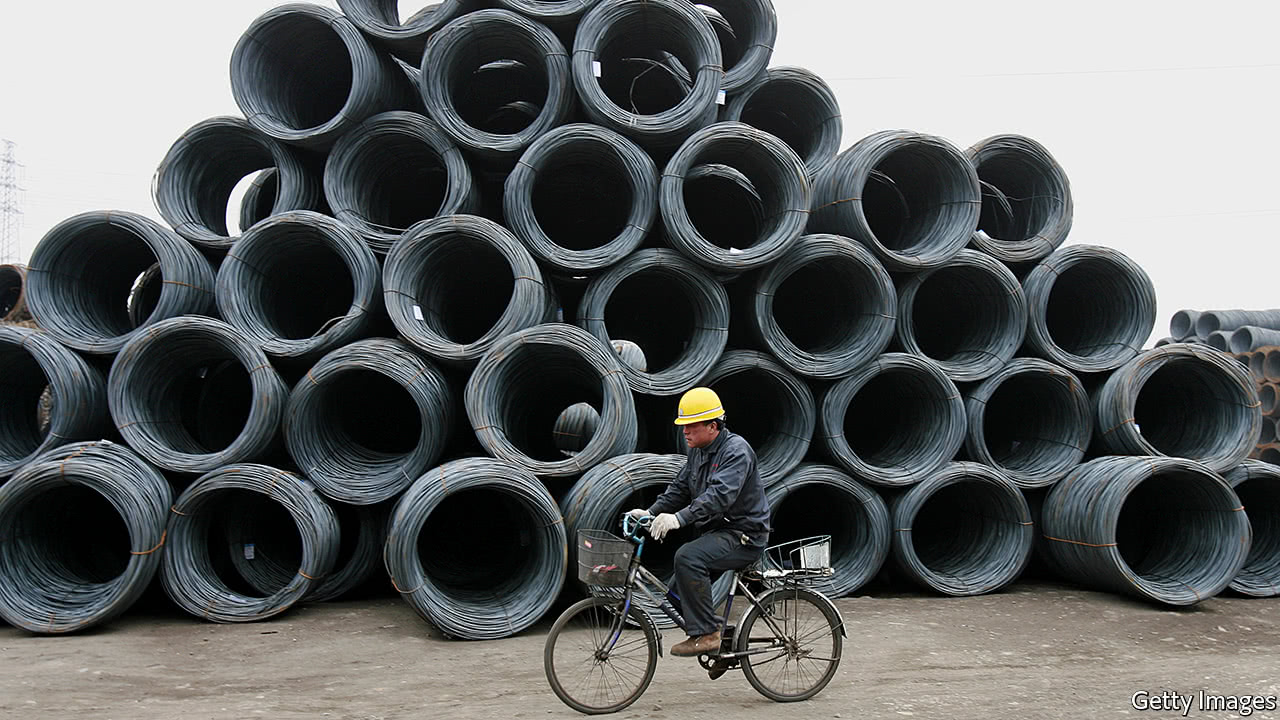
EVERY Tuesday, senior members of the administration gather in the White House to discuss trade. They are divided between hawks, who argue that America needs to be tougher in its defence against what they see as economic warfare waged by China, and doves, who worry about the costs of conflict. So far, against all expectations when President Donald Trump entered the White House, the doves have prevailed. The first of a series of legal deadlines could soon unleash the hawks.
Last April Wilbur Ross, the commerce secretary, initiated a probe into whether steel imports were a threat to America’s national security. His department pointed to a “dramatic” increase in steel imports over the previous year and to the idling of nearly 30% of America’s steel-production capacity, as imports feed a quarter of its consumption. If the report, due by January 15th, finds imports are a threat, Mr Trump, under Section 232 of the Trade Expansion Act of 1962, will have 90 days to respond.
The…Continue reading
Natural disasters made 2017 a year of record insurance losses
THAT 2017 suffered from more than its fair share of natural catastrophes was known at the time. In the wake of Hurricane Harvey, the streets of Houston, Texas, were submerged under brown floodwater; Hurricane Irma razed buildings to the ground on some Caribbean islands. That the destruction was great enough for insurance losses to reach record levels has only just been confirmed. According to figures released on January 4th by Munich Re, a reinsurer, global, inflation-adjusted insured catastrophe losses reached an all-time high of $135bn in 2017 (see chart). Total losses (including uninsured ones) reached $330bn, second only to losses of $354bn in 2011.
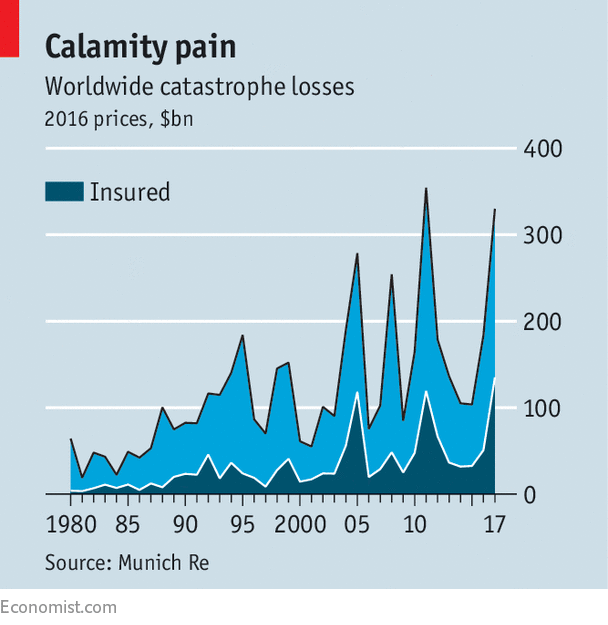
A large portion of the losses in 2011 was caused by one catastrophe: the earthquake and tsunami in Japan. Losses in 2017 were largely traceable to extreme weather. Fully 97% were weather-related, well above the average since 1980 of 85%. If climate change brings more frequent extreme weather, as Munich Re and others expect, last year’s loss levels may…Continue reading
Accountancy takes root in the inhospitable soil of Afghanistan
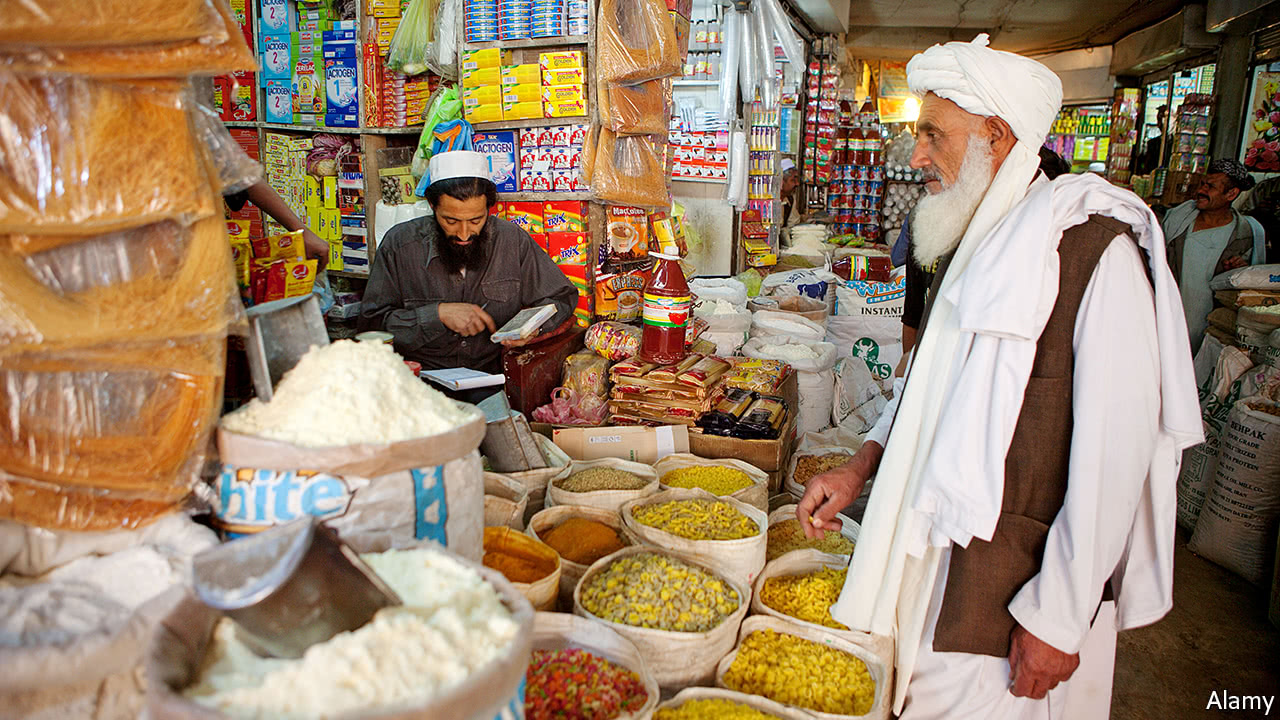
WHEN Afghan lawmakers were debating rules of conduct for accountants, some were confounded by their strictness. Why should those found guilty of murder, asked one member of parliament, be struck off? That is a sign of the challenges facing the professional body for bean-counters, Certified Professional Accountants (CPA) Afghanistan, which was launched last month.
Attempts to establish a home-grown profession start from a low base. Back in 2009 Kabul, a city of around 4m, had fewer than 20 qualified accountants. Neither standards nor oversight for the profession were in place. Most local outfits were branches of firms from elsewhere in South Asia or farther afield.
Boring old accountancy might not seem a priority for a war-torn country. But in business it can foster trust and transparency—scarce commodities in a country where corruption is systemic. Because of the difficulty of verifying borrowers’ financial positions and valuing…Continue reading
Bitcoin is no long the only game in crypto-currency town
IT STARTED as a joke. Dogecoin was launched in 2013 as a bitcoin parody, using as its mascot a Japanese shiba inu dog, a popular internet meme. The crypto-currency was never really used, except for tipping online, and one of its founders has called it quits. But recently its price has soared: on January 7th the dollar value of all Dogecoins in circulation reached $2bn, a sign of how crazy crypto-currency markets have become. It is also a reminder that, for all the focus on bitcoin, it is no longer the only game in town. Its market capitalisation now amounts to only about one-third of the crypto-market (see chart).
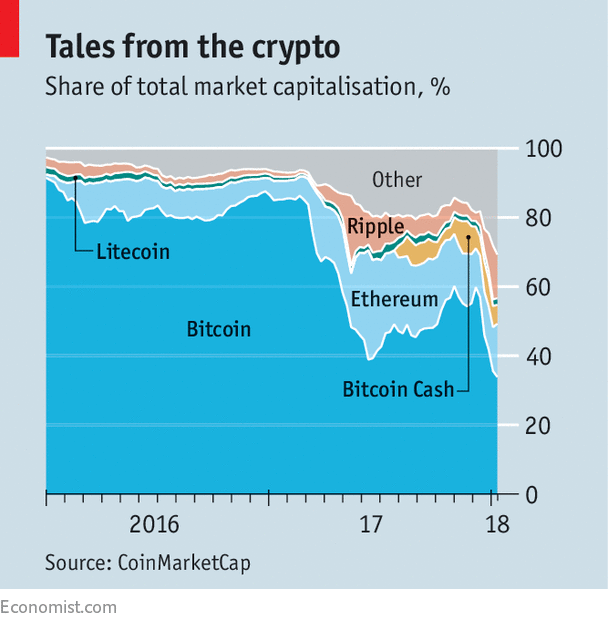
A new crypto-currency is born almost daily, often through an “initial coin offering” (ICO), a form of online crowdfunding. CoinMarketCap, a website, lists about 1,400 digital coins or tokens, including UFO Coin, PutinCoin, Sexcoin and InsaneCoin (worth $7m). Most are no more than curiosities, but by January 10th, around 40 had a market capitalisation of more than…Continue reading
Peter Sutherland, former head of the GATT and the WTO, dies

LIKE the showman he sometimes was, Peter Sutherland, on December 15th 1993, concluded seven years of torturous trade negotiations by banging a gavel. He received a standing ovation. Mr Sutherland, who died on January 7th, had an indispensable role in dragging the “Uruguay round” of trade talks to agreement. He did not know that this was to be the last such comprehensive, multilateral trade deal of his lifetime.
As director-general of the General Agreement on Tariffs and Trade and, on its founding, of the World Trade Organisation, the Irishman was the public face of bodies helping to integrate the global economy. The sobriquet “father of globalisation” was, at the time, a compliment. He remained proud of the WTO. In 2004 he wrote that “for the first time in history, the world can embrace a rules-based system for economic coexistence.”
Mr Sutherland, a lawyer by training, came to Geneva by way of the Irish attorney-general’s office and the European Union. Briefly…Continue reading