
Tag: FINANCE
Economists grapple with the future of the labour market
WHY is productivity growth low if information technology is advancing rapidly? Prominent in the 1980s and early 1990s, this question has in recent years again become one of the hottest in economics. Its salience has grown as techies have become convinced that machine learning and artificial intelligence will soon put hordes of workers out of work (among tech-moguls, Bill Gates has called for a robot tax to deter automation, and Elon Musk for a universal basic income). A lot of economists think that a surge in productivity that would leave millions on the scrapheap is unlikely soon, if at all. Yet this year’s meeting of the American Economic Association, which wound up in Philadelphia on January 7th, showed they are taking the tech believers seriously. A session on weak productivity growth was busy; the many covering the implications of automation were packed out.
Recent history seems to support productivity pessimism. From 1995 to 2004 output per hour worked grew at an annual average pace of 2.5%; from 2004 to 2016 the pace was just 1%. Elsewhere in the G7 group of rich countries, the pace has been slower still. An obvious explanation is that the financial crisis of 2007-08 led firms to defer productivity-boosting investment. Not so, say John Fernald, of the Federal Reserve Bank of San Francisco, and co-authors, who estimate that in America, the slowdown began in…Continue reading
A new market for old and ugly fruit and vegetables takes shape

NO ONE knows quite how much fruit and vegetable produce never reaches the grocery checkout till. A fifth perhaps—or maybe twice that—is judged to be beneath commercial standards. So it is put to use as animal-feed or compost, or simply thrown away in a landfill. This infuriates those appalled at waste. Their outrage, however, has not been enough to create for unwanted fruit and vegetable the kind of sophisticated market that exists for products with more obvious uses, such as securities, currencies, metals, oil and unsullied agriculture. That is starting to change.
At least two companies, Imperfect produce (whose logo is a misshapen potato that looks like a heart) and Hungry Harvest (whose slogan is “Rescued Produce. Delivered”), now provide boxes of subpar stuff directly to retail customers, one concentrating on the west coast of America, the other on the east. Another company, Full Harvest, has the wholesale market in its sights,…Continue reading
Should internet firms pay for the data users currently give away?

YOU have multiple jobs, whether you know it or not. Most begin first thing in the morning, when you pick up your phone and begin generating the data that make up Silicon Valley’s most important resource. That, at least, is how we ought to think about the role of data-creation in the economy, according to a fascinating new economics paper. We are all digital labourers, helping make possible the fortunes generated by firms like Google and Facebook, the authors argue. If the economy is to function properly in the future—and if a crisis of technological unemployment is to be avoided—we must take account of this, and change the relationship between big internet companies and their users.
Artificial intelligence (AI) is getting better all the time, and stands poised to transform a host of industries, say the authors (Imanol Arrieta Ibarra and Diego Jiménez Hernández, of Stanford University, Leonard Goff, of Columbia University, and Jaron Lanier and Glen Weyl, of Microsoft). But, in order to learn…Continue reading
Bitcoin is no longer the only game in crypto-currency town
IT STARTED as a joke. Dogecoin was launched in 2013 as a bitcoin parody, using as its mascot a Japanese shiba inu dog, a popular internet meme. The crypto-currency was never really used, except for tipping online, and one of its founders has called it quits. But recently its price has soared: on January 7th the dollar value of all Dogecoins in circulation reached $2bn, a sign of how crazy crypto-currency markets have become. It is also a reminder that, for all the focus on bitcoin, it is no longer the only game in town. Its market capitalisation now amounts to only about one-third of the crypto-market (see chart).
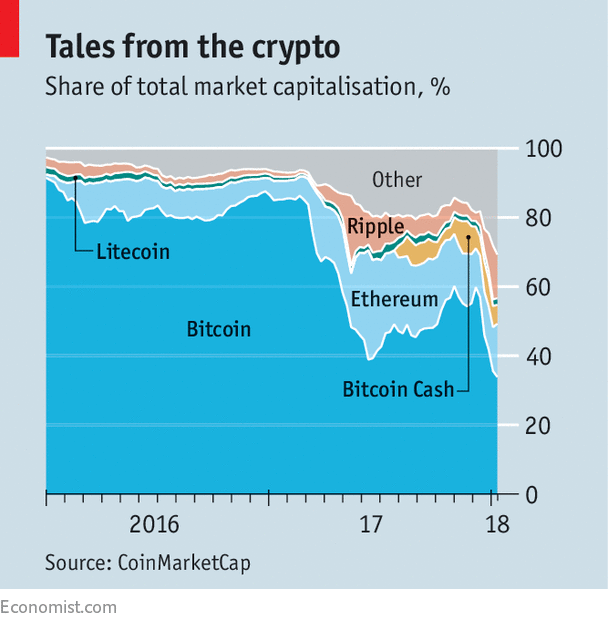
A new crypto-currency is born almost daily, often through an “initial coin offering” (ICO), a form of online crowdfunding. CoinMarketCap, a website, lists about 1,400 digital coins or tokens, including UFO Coin, PutinCoin, Sexcoin and InsaneCoin (worth $7m). Most are no more than curiosities, but by January 10th, around 40 had a market capitalisation of more than…Continue reading
Europe’s sprawling new financial law enters into force

AFTER years of rule-drafting, industry lobbying and plenty of last-minute wrangling, Europe’s massive new financial regulation, MiFID 2, was rolled out on January 3rd. Firms had spent months dreading (in some cases) or eagerly awaiting (in others) the “day of the MiFID” when the law’s new reporting requirements would enter into force. One electronic-trading platform, Tradeweb, even gave its clients a “MiFID clock” to count down to it.
Apprehension was understandable. The new EU law, the second iteration of the Markets in Financial Instruments Directive (its full, unwieldy name), affects markets in everything from shares to bonds to derivatives. It seeks to open up opaque markets by forcing brokers and trading venues to report prices publicly, in close to real time for those assets deemed liquid. It also requires them to report to regulators up to 65 separate data points on every trade, with the aim of avoiding market abuse.
The changes are greatest for markets, like those in…Continue reading
As China gets tough on pollution, will its economy suffer?

LEO YAO thought he had nothing to fear from the environment ministry. Before, when its inspectors visited his cutlery factory, he says, they generated “loud thunder, little rain”. After warning him to clean up, they would, at worst, impose a negligible fine. Not so this time. In August dozens of inspectors swarmed over his workshop in Tianjin, just east of Beijing, and ordered production to be halted. His doors remain shut today. If he wants to go on making knives and forks, he has been told that he must move to more modern facilities in a less populated area.
Mr Yao’s company, which at its peak employed 80 people, is just one minor casualty in China’s sweeping campaign to reduce pollution. For years the government has vowed to go green, yet made little progress. It has flinched at reining in dirty industries, wary of the mass job losses that seemed likely to ensue. But in the past few months it has taken a harder line and pressed on with pollution controls, hitting coalminers,…Continue reading
America’s bank profits take a hit from tax reform

WHEN Donald Trump won America’s presidential election 14 months ago, banks’ share prices leapt. One reason for that was the prospect of lower corporate taxes, which would both benefit banks directly and (investors hoped) ginger up the economy. Like Mr Trump’s legislative agenda, their shares were becalmed for much of 2017, but they perked up late in the year when the Tax Cuts and Jobs Act looked likely to become law—as it duly did when the president signed it on December 22nd.
Yet several banks expect the act to make deep dents in fourth-quarter profits. On December 28th Goldman Sachs said it was braced for a $5bn hit. A week before, Bank of America (BofA) announced a $3bn write-down. Early in the month, on fairly accurate assumptions about the law’s final form, Citigroup put the cost at a whopping $20bn. Foreign banks are also assessing the damage: £1bn ($1.4bn), says Barclays; SFr2.3bn ($2.4bn), reckons Credit Suisse.
These one-off hits have two main causes….Continue reading
Many happy returns: new data reveal long-term investment trends

DATA-GATHERING is the least sexy part of economics, which is saying something. Yet it is also among the most important. The discipline is rife with elaborate theories built on assumptions that turned out to be false once someone took the time to pull together the relevant data. Accordingly, one of the most valuable papers produced in 2017 is an epic example of data-retrieval: a piece of research that spells out the rates of return on important asset classes, for 16 advanced economies, from 1870 to 2015. It is fascinating work, a rich seam for other economists to mine, and a source of insight into some of today’s great economic debates.
Rates of return both influence and are influenced by the way firms and households expect the future to unfold. They therefore find their way into all sorts of economic models. Yet data on asset returns are incomplete. The new research, published as an NBER working paper in December 2017, fills in quite a few gaps. It is the work of five economists: Òscar Jordà of the…Continue reading
A bond dispute threatens the future of Islamic finance
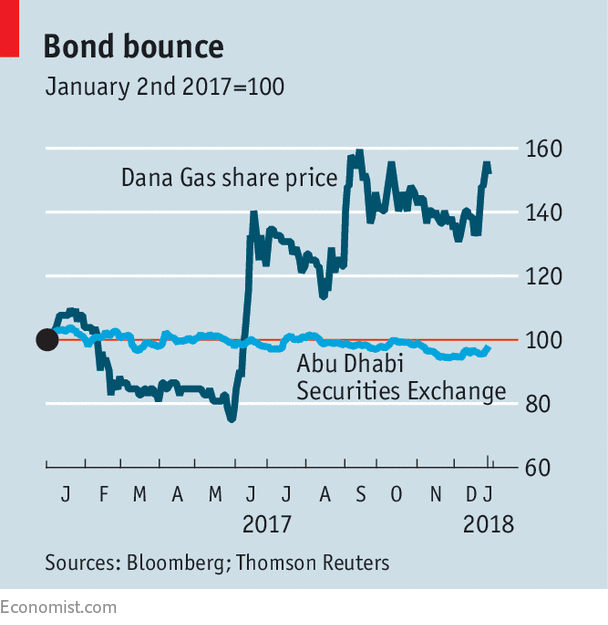
STOCKMARKETS in the Gulf do not observe Christian holidays, but still had a generally quiet day on December 25th. Shares in Dana Gas, an exploration business listed in Abu Dhabi, however, did make some noise, leaping by 13.2% on Christmas Day, to complete a buoyant six months for the stock (see chart). The surge may owe something to the company’s recent arbitration victory against the regional government of Iraqi Kurdistan, over $2bn it and its consortium partners are owed in overdue payments. But it also hints at shareholders’ belief that Dana will not be forced soon to satisfy its own creditors. They have been up in arms since the firm refused to honour a $700m Islamic bond, or sukuk, that matured in October.
Dana says it has received legal advice that the security no longer complies with sharia, the body of Koranic law, and so the bond is “unlawful” in the United Arab Emirates (UAE). In July, facing liquidity difficulties, it stopped redeeming…Continue reading
After a bumper 2017, will 2018 be kind to the financial markets?
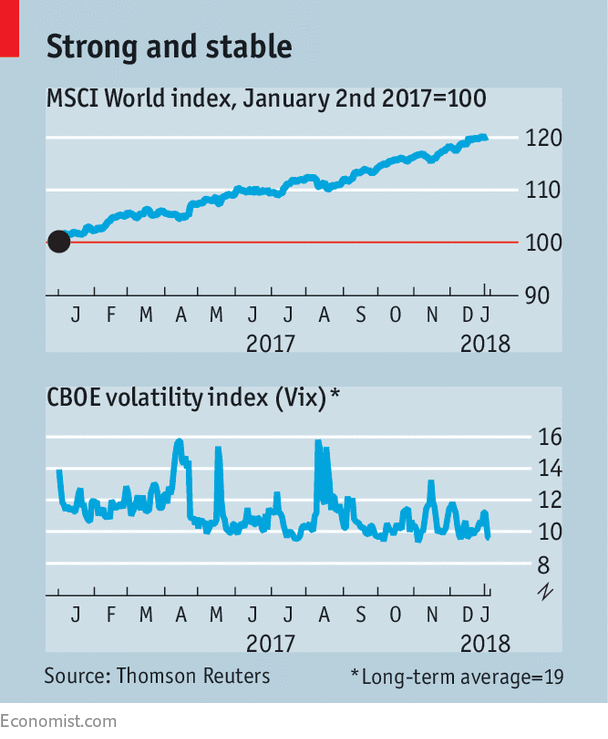
AFTER a bumper year for financial markets in 2017, can 2018 be anything like as good? Much will depend on the global economy. The rally in stockmarkets stretches back almost two years, to the point when worries about an era of “secular stagnation” started to diminish.
The first pieces of economic data to be published in January—the purchasing managers’ indices (PMI) for the manufacturing sector—were pretty upbeat. In the euro zone the index recorded its highest level since the survey began in 1997. China’s PMI was stronger than expected, and America’s index showed new orders at their highest level in nearly 14 years.
The obvious question is whether the markets have anticipated the good news about growth, and pushed share prices to a level from which returns can only be disappointing. The cyclically adjusted price-earnings ratio of the American market, which uses a ten-year average of profits, is 32.4; it has been higher only in September 1929 (just before the Wall Street crash)…Continue reading