
Tag: FINANCE
American banks pay depositors less than online accounts
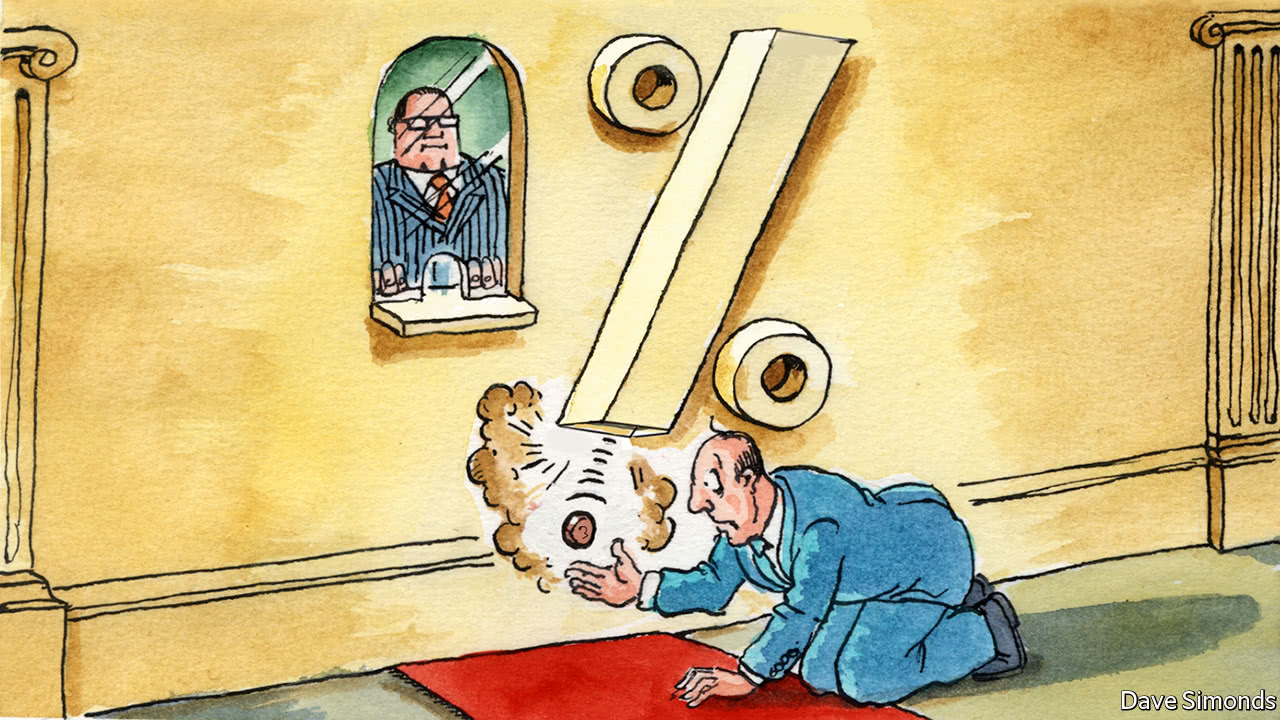
EVERYONE knows that interest rates are rising—except, perhaps, one group: American savers who have put $12trn in bank accounts. They have seen the government’s deposit guarantee, purportedly designed to protect them, become a ticket for banks to receive free money. For evidence, look no further than the ubiquitous bank branches dotting America’s high streets.
Those seeking a home for their money find that, unlike petrol stations or grocers, banks are not required to post their most important price, the interest rate. Ask and you will be referred to a specialised member of staff. After a wait, numbers are typed into a computer, followed by pauses for thought, a bit of throat clearing and, often, comments that the current rates on offer may not exceed inflation. Then come hints, doubtless filtered through a compliance department, of the higher returns available on the bank’s investment offerings, which, of course, carry risks (and fees).
Only then is the diligent customer told the…Continue reading
How to interpret America’s experiment with huge budget deficits
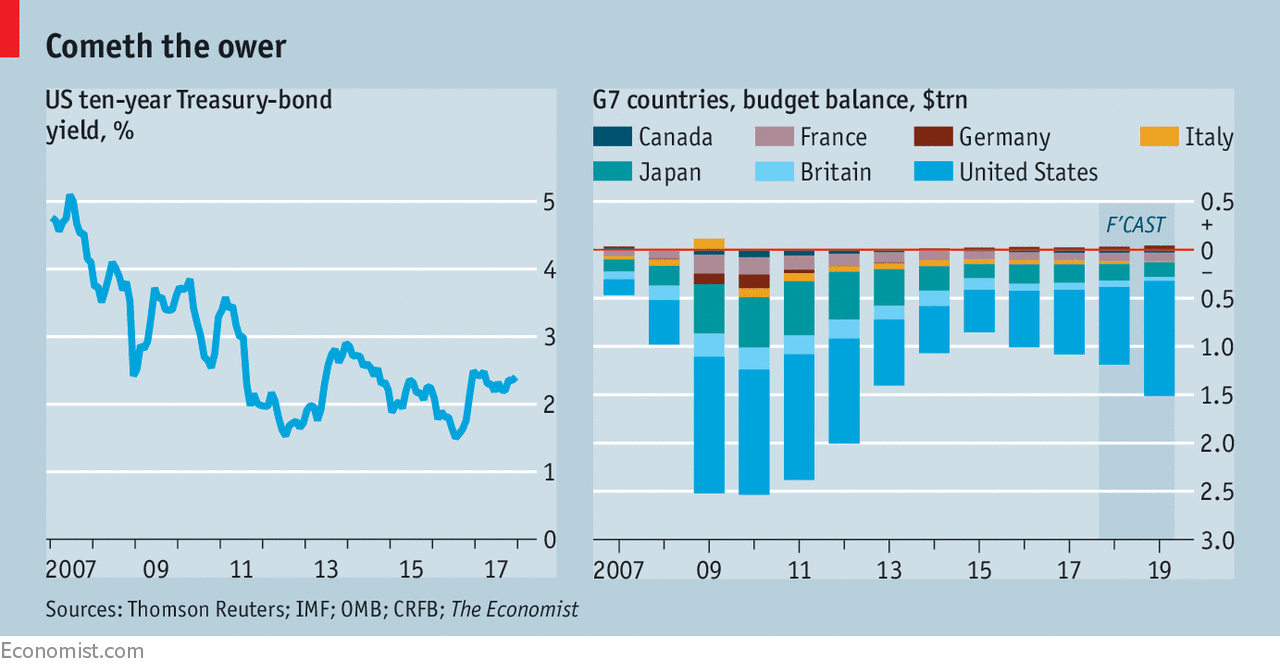
“DEFICITS don’t matter,” said Dick Cheney, then the vice-president, in 2004. He may have meant what he said, yet the administration he belonged to showed a decided lack of conviction when it came to borrowing, with the federal deficit never rising above 3.4% of GDP. Not so the current Republican government. In 2019 and 2020 the deficit is likely to rise to nearly 6% of GDP, the largest, outside of times of economic crisis, since the second world war. In his first term, Donald Trump’s deficits will be nearly as large, on average, as those run by Barack Obama during his presidency, according to analysis by JPMorgan. That is impressive given that Mr Obama faced the worst economic downturn since the Depression. In budgeting, as in so many areas, America is wandering into uncharted territory. What might it find there?
Orthodox economics suggests two ways in which things could go wrong. When an economy is running at close to full tilt, so that firms are borrowing and investing as much as banks are…Continue reading
The digital upstarts taking on Britain’s dominant few banks

CHRIS MATTHEWS joined Monzo last May. “A friend mentioned it over a curry. Everyone signed up at once. Nine or ten of us.” Mr Matthews, a structural engineer living in London, transfers money monthly from the big bank where his salary lands to the online upstart, for everyday expenses. Monzo’s smartphone app lets him track his spending precisely. He has found big banks’ security procedures frustrating, but he can block and reactivate his Monzo debit card with a tap on the app.
For some British millennials, Monzo is as close to a cult as a bank can be. Its coral-pink cards are hard to miss. “People in bars will get very excited if they see you are a fellow Monzo user,” says Mr Matthews, who is 29. Founded in 2015, it has had a full banking licence since April. It launched current accounts in the autumn; more than 370,000 have been opened, mainly by customers converting pre-paid cards, with which Monzo began. Tom Blomfield, the chief executive, says its marketing budget has been…Continue reading
Insider trading has been rife on Wall Street, academics conclude

INSIDER-TRADING prosecutions have netted plenty of small fry. But many grumble that the big fish swim off unharmed. That nagging fear has some new academic backing, from three studies. One argues that well-connected insiders profited even from the financial crisis.* The others go further still, suggesting the entire share-trading system is rigged.**
What is known about insider trading tends to come from prosecutions. But these require fortuitous tip-offs and extensive, expensive investigations, involving the examination of complex evidence from phone calls, e-mails or informants wired with recorders. The resulting haze of numbers may befuddle a jury unless they are leavened with a few spicy details—exotic code words, say, or (even better) suitcases filled with cash.
The papers make imaginative use of pattern analysis from data to find that insider trading is probably pervasive. The approach reflects a new way of analysing conduct in the…Continue reading
Bitcoin and its rivals offer no shelter from the storm
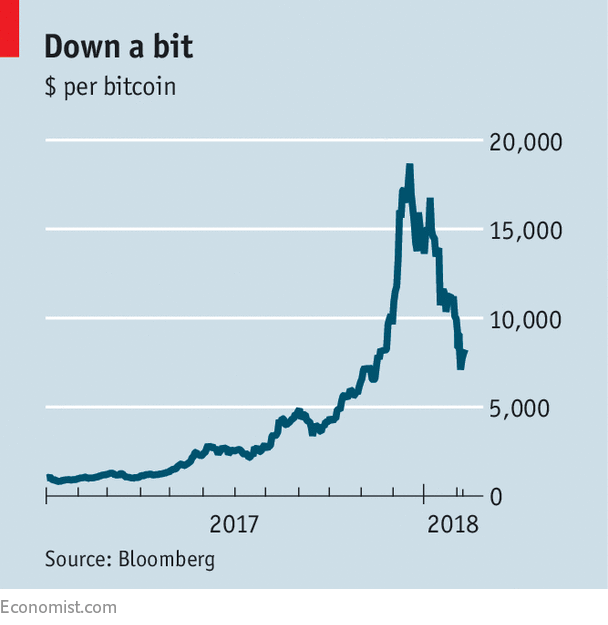
THE “biggest bubble in human history comes down crashing,” tweeted Nouriel Roubini, an economist, gleefully. After an exhilarating ride skywards in 2017, investors in crypto-currencies have been rudely reminded that prices can plunge earthwards, too. In mid-December the price of bitcoin was just shy of $20,000; by February 6th, it had fallen to $6,000, before recovering a little (see chart).
And bitcoin is not the only digital currency to have fallen. Figures from CoinMarketCap, a website, show that the total market capitalisation of crypto-currencies has fallen by more than half this year, to under $400bn. This slide has taken place amid a flurry of hacks, fraud allegations and a growing regulatory backlash.
Perhaps the most damaging allegations surround Tether, a company that issues a virtual currency of the same name. Tether allows users to move money across exchanges and crypto-currencies without converting it back into “fiat” (central-bank-backed) money first. In theory, each…Continue reading
South-to-South investment is rising sharply
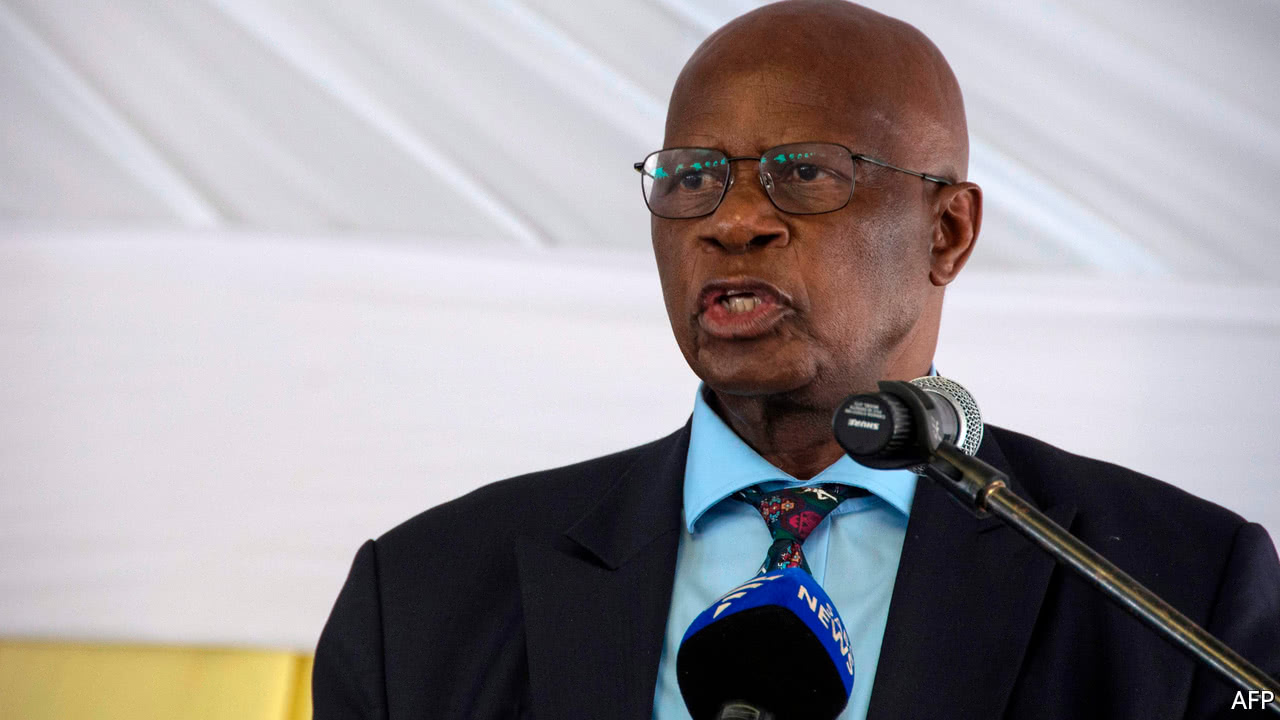
AT A meeting in Namibia last month Zimbabwe’s finance minister, Patrick Chinamasa, made a pitch to lure African investors to an economy ruined by Robert Mugabe. That he did so first in Windhoek, not London or New York, is telling. Although flows through tax havens muddy the data, 28% of new foreign direct investment (FDI) globally in 2016 was from firms in emerging markets—up from just 8% in 2000.
Chinese FDI, a big chunk of this, shrank in 2017 as Beijing restricted outflows and America and Europe screened acquisitions by foreigners more closely. But the trend of outbound investment is widespread. Almost all developing countries have companies with overseas affiliates. Most of their investment goes to the West. But in two-fifths of developing countries they make up at least half of incoming FDI. In 2015-16 the ten leading foreign investors in Africa, by number of new projects, included China, India, Kenya and South Africa.
A World Bank survey of more than 750 firms with FDI in developing countries found that those from…Continue reading
Wells Fargo suffers a rare punishment—a cap on assets
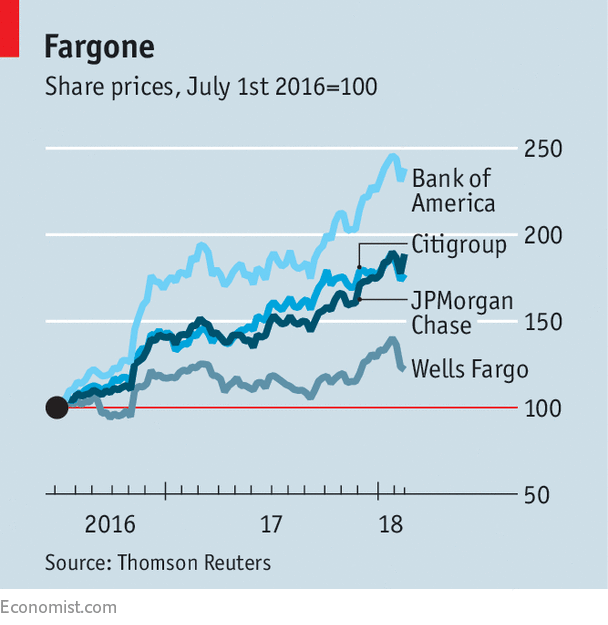
ON HER way out, Janet Yellen, who stood down as the Federal Reserve’s chair on February 2nd, paused to add yet another sanction to those already imposed on Wells Fargo for foisting unwanted insurance and banking products on clients. The latest punishment is a highly unusual one. Wells will be blocked from adding assets to the $2trn held on its balance-sheet at the end of 2017. Two other regulators had already imposed fines and penalties soon after the shenanigans began emerging in 2016. The bank has gone through a big reorganisation. The Fed’s belated response presumably took into account not only the errant conduct but also the political fallout. The government, as well as the bank, had been embarrassed.
At first glance, Wells is an odd target for such treatment. During the financial crisis it proved itself the best of the big banks, with relatively high underwriting standards and manageable losses. The scandal was huge—millions of clients were pushed into unwanted products. But the financial costs…Continue reading
Passive funds tracking an index lose out when its make-up changes

IS THERE hope for fund managers after all? Conventional “active” managers, who try to pick stocks that will beat the market, have been losing ground to “passive” funds, which simply own all assets in a given sector in proportion to their market value. The main advantage of the latter group is that they charge a lot less.
William Sharpe, a Nobel prizewinning economist, argued in 1991 that the “arithmetic of active management” means that the average fund manager is doomed to underperform. To understand why, assume that there are equal numbers of active and passive managers and, between them, they own all the market. The market returns 10%. How much will the passive managers earn? The answer must be 10%, before costs. The active managers own that bit of the market the passive managers don’t. But that proportion of the market must, thanks to simple arithmetic, also return 10%, before costs. Since the costs of active investors are higher, the average active manager must underperform. These…Continue reading
The markets deliver a shock to complacent investors
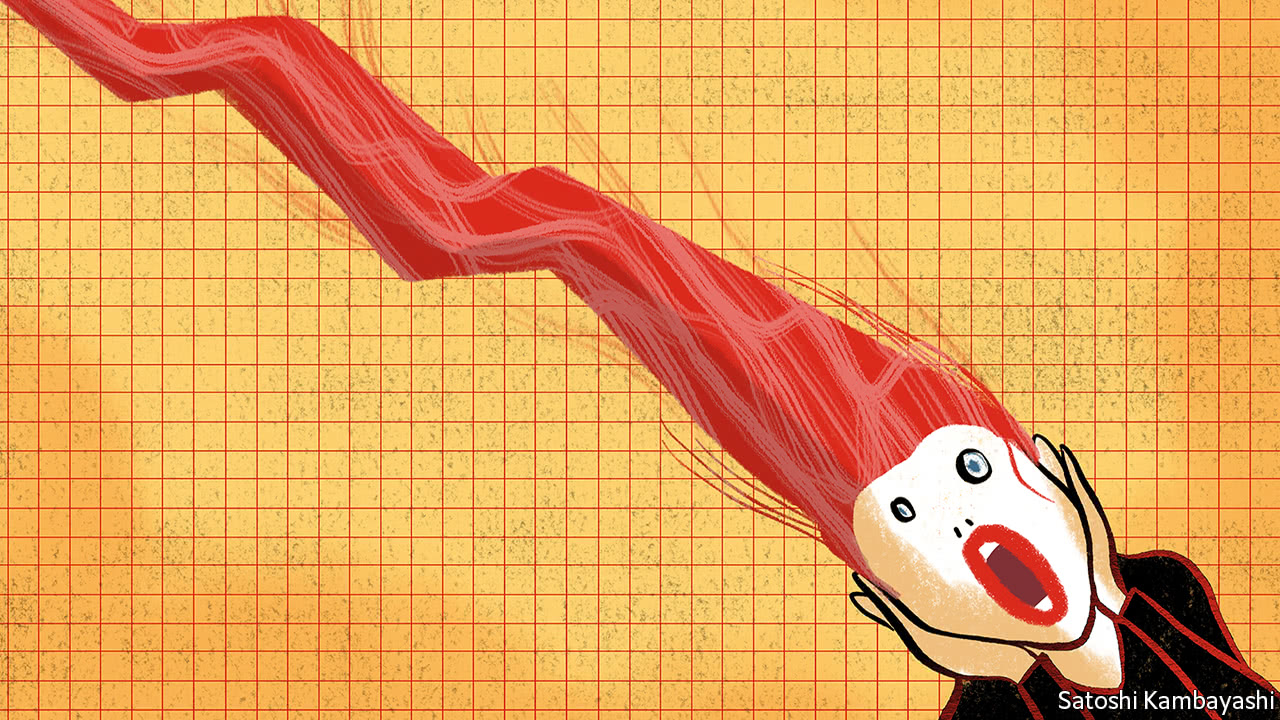
EVERY good horror-film director knows the secret of the “jump scare”. Just when the hero or heroine feels safe, the monster appears from nowhere to startle them. The latest stockmarket shock could have been directed by Alfred Hitchcock. The sharp falls that took place on February 2nd and 5th followed a long period where the only direction for share prices appeared to be upwards.
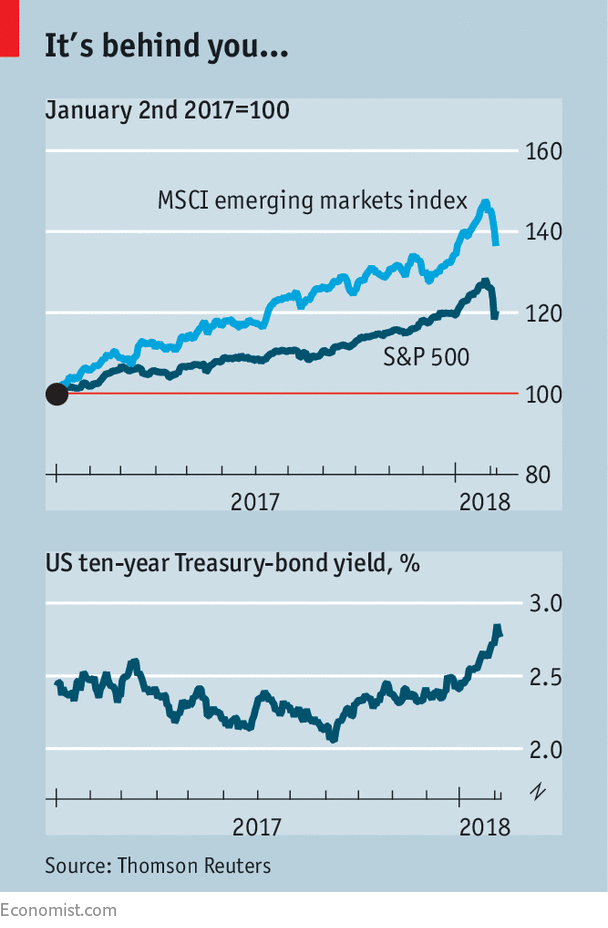
In fact the American market had risen so far, so fast that the decline only took share prices back to where they were at the start of the year (see chart). And although a 1,175-point fall in the Dow Jones Industrial Average on February 5th was the biggest ever in absolute terms, it was still smallish beer in proportionate terms, at just 4.6%. The 508-point fall in the Dow in October 1987 knocked nearly 23% off the market.
Bets on low market volatility went spectacularly wrong
THE Cboe Volatility Index, or Vix, known as the “fear gauge”, spikes when markets are most jittery. When Sandy Rattray, now at Man Group, an asset manager, worked on the Vix in the early 2000s, he and his team considered launching an exchange-traded product (ETP) linked to it, but concluded that it would be a “horror show” because of poor returns. Now, however, Vix-linked ETPs are a big industry, with around $8bn in assets. Formerly niche investments, they served vastly to exacerbate this week’s market turmoil, which saw the Vix’s largest ever one-day move, when it more than doubled on February 5th.
The Vix was always intended as a basis for financial products as well as a gauge. Vix futures were launched in 2004 and options in 2006. “Long” Vix products, which Mr Rattray looked into, seek to mirror the index . The problem is that this means buying futures contracts, with buyers having to pay a constant premium over spot prices. So these ETPs tend to lose money over time, punctuated (but not fully made up for) by gains when the Vix spikes. The largest “long” fund, VXX, issued by Barclays, has lost over 99.9% since its launch in 2009.
So other ETPs were developed to “short”—ie, bet against—the Vix index. Until this week, they were doing handsomely. Amid a long spell of subdued volatility, investors piled in. In January, assets in…Continue reading