
Tag: FINANCE
Manias, panics and Initial Coin Offerings

EVERY market mania reaches a point when pitches to would-be investors enter the realm of the surreal. So it goes for “initial coin offerings”, or ICOs. A new one by a firm called POW invites Facebook users to claim tokens for nothing; when they later become convertible into other tokens, the first to take advantage of the offer could “become worth $124bn…making them the richest person on Earth”, the blurb says. Not a bad return for no money invested and no risk borne. However bizarre, bubbles are hard to resist: no one wants to be the only one of their friends left out. They can also be financially ruinous. But gambling on a craze, even a highly dubious one, can be about more than blind greed.
The ICO boom is an outgrowth of the emerging, occasionally inscrutable world of cryptocurrencies. These are a form of money (bitcoin and ether are examples) used in transactions which are recorded on a distributed public ledger called a blockchain. An ICO is a scheme to raise funds for an…Continue reading
Venture capitalists with daughters are more successful

RICHARD NESBITT, a former chief operating officer at the Canadian Imperial Bank of Commerce, has long been an evangelist for women in business. In “Results at the Top”, a book he wrote with Barbara Annis, he describes his efforts to convince men to promote women. When speaking to bosses, he stresses data showing that companies with more senior women are more successful. But he has noticed that men with daughters tend to be more receptive to his message. At least for venture-capital (VC) firms, recent research confirms this observation, as well as the assertion that gender diversity boosts performance.
Paul Gompers and Sophie Wang at Harvard University wanted to determine whether VC firms with more women managers do better. Answering this question is tricky—firms that hire more women may have other characteristics that lead to success. VC-investing remains a predominantly male activity. In the authors’ sample of 988 VC funds in 301 firms, around 8% of new hires were women. Very few firms…Continue reading
The Bank of Japan sticks to its guns

SEVENTH time lucky? Minutes of the Bank of Japan’s (BoJ) policy meeting in July, published on September 26th, showed that the central bank had, for the sixth time since 2013, pushed back the date at which it expected prices to meet its 2% inflation target—to the fiscal year ending in March 2020.
Four-and-a-half years since Haruhiko Kuroda took office as governor and embarked on an unprecedented experiment in quantitative easing (QE), the bank is still far from its goal. It has swept up 40% of Japanese government bonds and a whopping 71% of exchange-traded funds. The bank’s balance-sheet has tripled. It is now roughly the size of the American Federal Reserve’s.
Yet, despite his apparent failure, and despite a snap general election, Mr Kuroda may yet stay for another five years when his term runs out next April. If not, most of his likely successors are signed up to the same reflationary policy. At least one member of the bank’s board gave warning at its…Continue reading
Three trade cases facing the Trump administration spell trouble
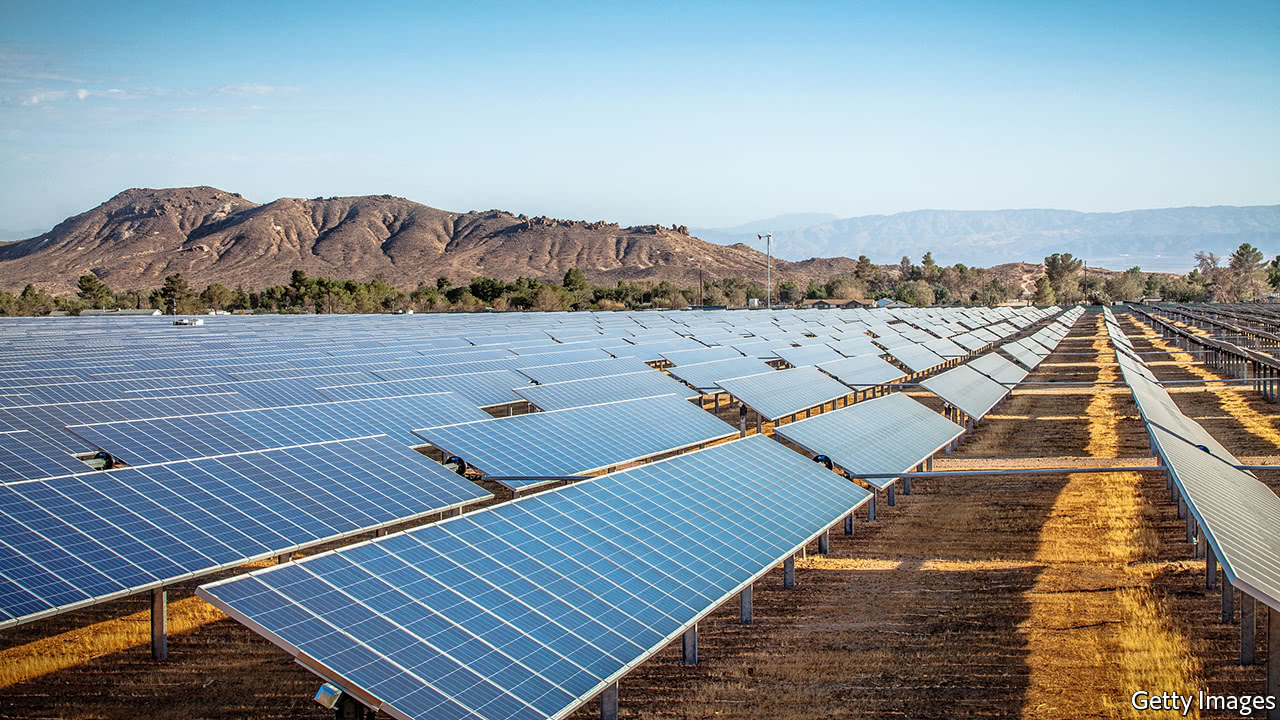
IN 1845 Frédéric Bastiat, a French economist, wrote an open letter to his national parliament, pleading for help on behalf of makers of candles and other forms of lighting. The French market was being flooded with cheap light, he complained. Action was necessary: a law closing all windows, shutters and curtains. Only that would offer protection against the source of this “ruinous competition”, the sun.
Three similar pleas are facing the administration of President Donald Trump. But these are not parodies. On September 22nd the United States International Trade Commission paved the way for import restrictions on solar panels, ruling that imports had injured American cell manufacturers. On September 26th the Department of Commerce pencilled in tariffs of 220% on airliners made by Bombardier, a Canadian manufacturer. A third decision on washing machines is due by October 5th.
This cluster of cases represents around $15bn of…Continue reading
Once a leader in virtual currencies, China turns against them
BITCOIN and China always made odd bedfellows. Devotees of bitcoin love its independence from central authorities; in China the central authorities love their power. That they would accept a cryptocurrency that weakened their control over something as fundamental as the management of money seemed unlikely. Yet China had become the world’s biggest bitcoin market, dominating both its trading and computer-powered “mining”.
It was not meant to be. Bitcoin’s surprising success in China appears to be nearing its end. A series of bans announced over the past month have made clear that bitcoin and all fellow travellers, from ethereum to litecoin, have little place within its borders. Some hope that the bans are temporary. The government has, after all, declared an ambition to make China a leader in the blockchain technology that is integral to bitcoin. But its seems more likely that officials will tighten their grip on China’s remaining crypto-coin bastions.
Bitcoin had been in trouble in China since February, when the central bank, aiming to stem illicit capital flows, ordered exchanges to halt virtual-currency withdrawals until they could identify their customers. China’s share of global bitcoin-trading went from more than 90% to just about 10% (see chart).
Nordic payments firms have become acquisition targets

THE Vikings were slow to adopt coins. They preferred to pay by cutting pieces off silver bars, at least until contact with the rest of Europe convinced them of the benefits of standardised coins. Today their Nordic descendants are abandoning coins and notes in favour of electronic payments. Two Nordic e-payments firms have recently announced that they will be acquired by foreign companies. The rest of the world, too, is using less cash. And they want the financial backing to enter new markets.
On September 25th Nets, a payments firm based in Denmark, announced that Hellman & Friedman, an American private-equity firm, had offered to acquire it for DKr33.1bn ($5.3bn). Nets is following Bambora, a Swedish-based payments firm, for which Ingenico, a French electronic-payments firm, offered €1.5bn ($1.7bn) in July.
Nets was created in 2010 from the merger of payments companies in Denmark and Norway. It has a strong presence in both countries. Dankort, Denmark’s national…Continue reading
The next financial crisis may be triggered by central banks
AS WITH London buses, don’t worry if you miss a financial crisis; another will be along shortly. The latest study on long-term asset returns from Deutsche Bank shows that crises in developed markets have become much more common in recent decades. That does not bode well.
Deutsche defines a crisis as a period when a country suffers one of the following: a 15% annual decline in equities; a 10% fall in its currency or its government bonds; a default on its national debt; or a period of double-digit inflation. During the 19th century, only occasionally did more than half of countries for which there are data suffer such a shock in a single year. But since the 1980s, in numerous years more than half of them have been in a financial crisis of some kind.
The main reason for this, argues Deutsche, is the monetary system. Under the gold standard and its successor, the Bretton Woods system of fixed exchange rates, the amount of credit creation was limited. A country that expanded its money supply too quickly would suffer a trade deficit and pressure on its currency’s exchange rate; the government would react by slamming on the monetary brakes. The result was that it was harder for financial bubbles to inflate.
But since the early 1970s more countries have moved to a floating exchange-rate system. This gives governments the flexibility to deal with an…Continue reading
Europe’s capital markets face a big shake-up and are not ready

FINANCIERS usually regard new regulations as dull, annoying drudgery best left to lawyers or the compliance department. That is not an option with the second iteration of the Markets in Financial Instruments Directive (MiFID 2), a European Union law years in the making and entering into force on January 3rd 2018. The law introduces radical changes to trading in trillions of euros-worth of stocks, bonds and derivatives. But its sheer scope and complexity mean that an unprecedented number of issues and technicalities are still unresolved.
MiFID 1, in force since 2007, was aimed at shares, and spawned a proliferation of new trading venues ranging from electronic platforms to “dark pools” run by investment banks, breaking the oligopoly of dozy national stock exchanges. The new, more ambitious, law seeks to bring transparency to a far wider range of asset classes, notably bonds and derivatives.
The single reform that has probably received most attention is the requirement to…Continue reading
The cost of innovation has risen, and productivity has suffered
WERE there far fewer undiscovered ideas out there than in our more primitive past, how would people know? This is not an idle question; decoding the mysteries of nature, from atmospheric pressure to electricity to DNA, allowed people to bend the natural world to their will, and to grow richer in the process. A dwindling stock of discoverable insights would mean correspondingly less scope for progress in the future—a dismal prospect. And some signs suggest that the well of our imagination has run dry. Though ever more researchers are digging for insights, according to new research, the flow of new ideas is flagging. But that uncovering new ideas is a struggle does not mean that humanity is near the limits of its understanding.
The development of new ideas—meaning scientific truths or clever inventions—allows economies to grow richer year after year. Adding more workers or machinery to an economy boosts GDP, but only for a while. Applying ever more men with hoes to the cultivation of a field will generate diminishing returns in terms of crop yields, for instance; wringing more from the soil eventually requires the use of better seed-stock or fertiliser. Unless humanity finds new ways to do more with the same amount of labour and capital, growth in incomes peters out to nothing.
Dwindling growth in incomes is not a bad description of what has happened…Continue reading
Marital choices are exacerbating household income inequality

“HERE’S what nobody is telling you: Find a husband on campus before you graduate,” wrote Susan Patton, a human-resources consultant, in 2013. In an infamous letter to the editor of Princeton’s student newspaper, Ms Patton warned female students at the university that they will “never again be surrounded by this concentration of men who are worthy of [them]”. Critics responded harshly. Ms Patton recalls that she was branded “a traitor to feminism, a traitor to co-education and an elitist”.
Economists might offer yet another critique of Ms Patton’s letter: it was largely unnecessary. It is clear to academics that people tend to marry spouses with similar levels of education. They also know that “assortative mating”, as the practice is called in the jargon, is exacerbating income inequality. In America, Britain, Denmark, Germany and Norway, they have found that household income would be more evenly spread if…Continue reading