
Tag: FINANCE
The finance industry ten years after the crisis
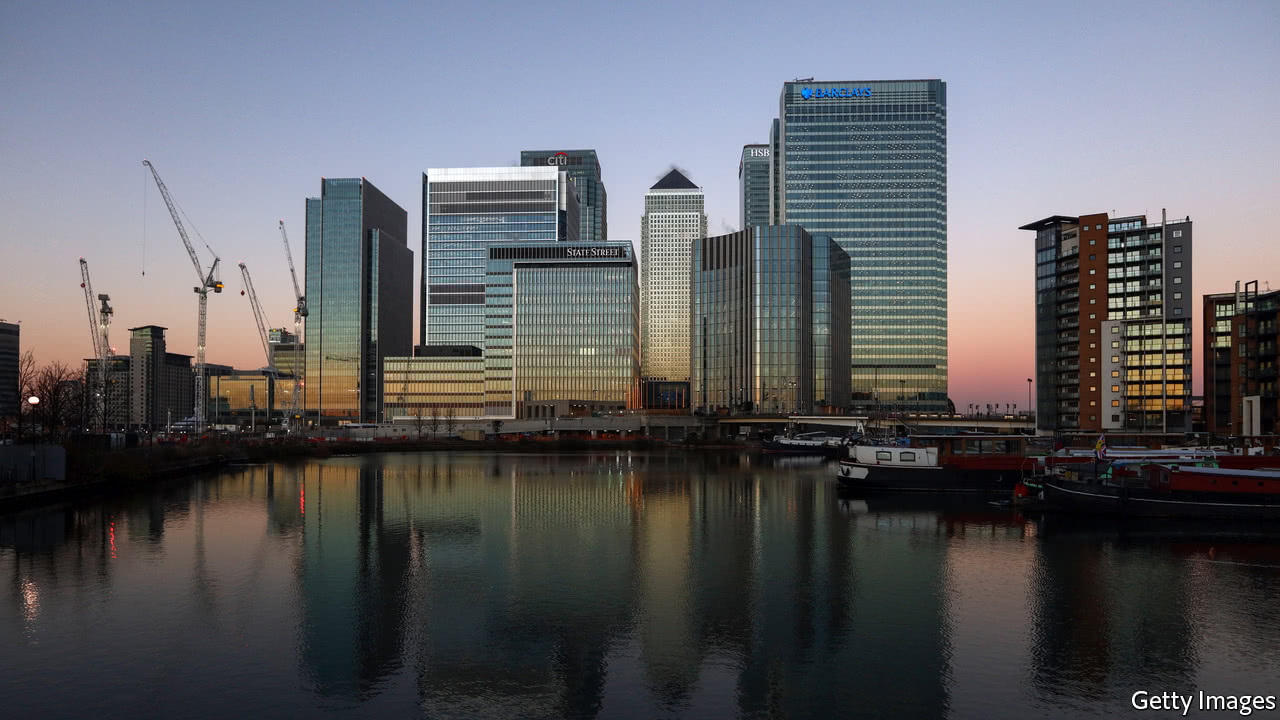
MANY people complain that the finance industry has barely suffered any adverse consequences from the crisis that it created, which began around ten years ago. But a report from New Financial, a think-tank, shows that is not completely true.
The additional capital that regulators demanded banks should take on to their balance-sheets has had an effect. Between 2006 and 2016, the return on capital of the world’s biggest banks has fallen by a third (by more in Britain and Europe). The balance of power has shifted away from the developed world and towards China, which had four of the largest five banks by assets in 2016; that compares with just one of the biggest 20 in 2006.
The swaggering beasts of the investment-banking industry have also been tamed. The industry’s revenues have dropped by 34% in real terms, with profits falling by 46%. Return on equity has declined by two-thirds. Staff are still lavishly remunerated, but pay is down by 52% in real terms. (Perhaps…Continue reading
Brexit will give the derivatives market a nasty headache

FOR all the talk of banks deserting London as Britain’s departure from the EU looms, relatively little attention has been paid to the derivatives market. Yet this is a crucial area of business for British-based banks. The City handles a big chunk of the market, including 39% of the market in interest-rate derivatives alone, where global daily turnover averages $3trn. The rest of the EU accounts for just 9%. Brexit seems sure to cause significant disruption. Mark Carney, the governor of the Bank of England, recently warned that the very “legal validity” of pre-existing derivatives contracts could be put into question.
Brexit-related discussion of derivatives has tended to focus on the role of clearing-houses, which ensure that a contract can be honoured even if one side goes bust. Since the financial crisis, most countries have made it mandatory to clear derivatives trades. LCH, a clearing-house in London, clears over 50% of interest-rate swaps across all currencies; London houses…Continue reading
Technology is revolutionising supply-chain finance

IN 2015 Kiddyum, a small company from Manchester that provides frozen ready-meals for children, won a contract from Sainsbury’s, a big British supermarket chain. Jayne Hynes, the founder, was delighted. But sudden success might have choked Kiddyum’s cashflow. Sainsbury’s pays its suppliers in 60 days; Ms Hynes must pay hers in only 30.
In fact Kiddyum gets its cash within a few days. Once approved by Sainsbury’s, its invoices are loaded onto the supermarket’s supply-chain finance platform, run by PrimeRevenue, an American company. The Royal Bank of Scotland (RBS) picks up the bills, paying Kiddyum early. Kiddyum pays a fee which, Ms Hynes says, is a small fraction of the cost of a normal loan. Sainsbury’s pays RBS when the invoice falls due.
Suppliers, of course, have always needed finance for the gap between production and payment. Traditionally, they could borrow on their own account, or sell their receivables—unpaid invoices—at a discount to businesses known…Continue reading
A Chinese carmaker agrees to buy a Danish investment bank
A COMPANY that moves up the value chain from refrigerator parts to cars is impressive but not that surprising. A car company that buys an investment bank is audacious. But Zhejiang Geely Holding Group, a conglomerate based in Hangzhou, China, did not become big by paring its ambitions. Having successfully made the fridge-parts-to-cars transition at home, it went global in 2010. It acquired Volvo, a Swedish carmaker, from Ford of America. Now Geely is back in Scandinavia for another acquisition. This time it is buying one of Denmark’s biggest banks.
Saxo Bank announced on October 2nd that Geely would acquire 51.5% of its shares. It will spend over $800m on the deal, which still requires regulatory approval. Sampo Group, a Finnish insurance company, will acquire 19.9% of Saxo shares for €265m ($311m), and Kim Fournais, Saxo’s co-founder and chief executive, will retain 25.7%. The sellers are Sinar Mas, an Indonesian conglomerate, and TPG, an American private-equity firm.
Saxo was an early adopter of online securities trading and still invests heavily in financial technology. It makes a substantial portion of its profits from selling trading platforms to other firms. Daniel Donghui Li, Geely’s chief financial officer, says Geely hopes to expand Saxo’s technologies into Asia. Besides facilitating this expansion, Geely does not intend to change how…Continue reading
A new study details the wealth hidden in tax havens
SWITZERLAND, which developed cross-border wealth-management in the 1920s, was once in a league of its own as a tax haven. Since the 1980s, however, tax-dodgers have been spoilt for choice: they can hide assets anywhere from the Bahamas to Hong Kong. The percentage of global wealth held offshore has increased dramatically. But it has been hard to say how much that is, and who owns it.
Few offshore centres used to disclose such data. But in 2016 many authorised the Bank for International Settlements (BIS) to make banking statistics publicly available. Using these data, a new study by Annette Alstadsaeter, Niels Johannesen and Gabriel Zucman, three economists, concludes that tax havens hoard wealth equivalent to about 10% of global GDP. This average masks big variations. Russian assets worth 50% of GDP are held offshore; countries such as Venezuela, Saudi Arabia and the United Arab Emirates climb into the 60-70% range. Britain and continental Europe come in at 15%, but Scandinavia at only a few per cent.
One conclusion is that high tax rates, like those in Denmark or Sweden, do not drive people offshore. Rather, higher offshore wealth is correlated with factors such as political and economic instability and an abundance of natural resources.
Proximity to Switzerland also remains a good indicator. But assets held there have declined since the financial…Continue reading
How protectionism sank America’s entire merchant fleet
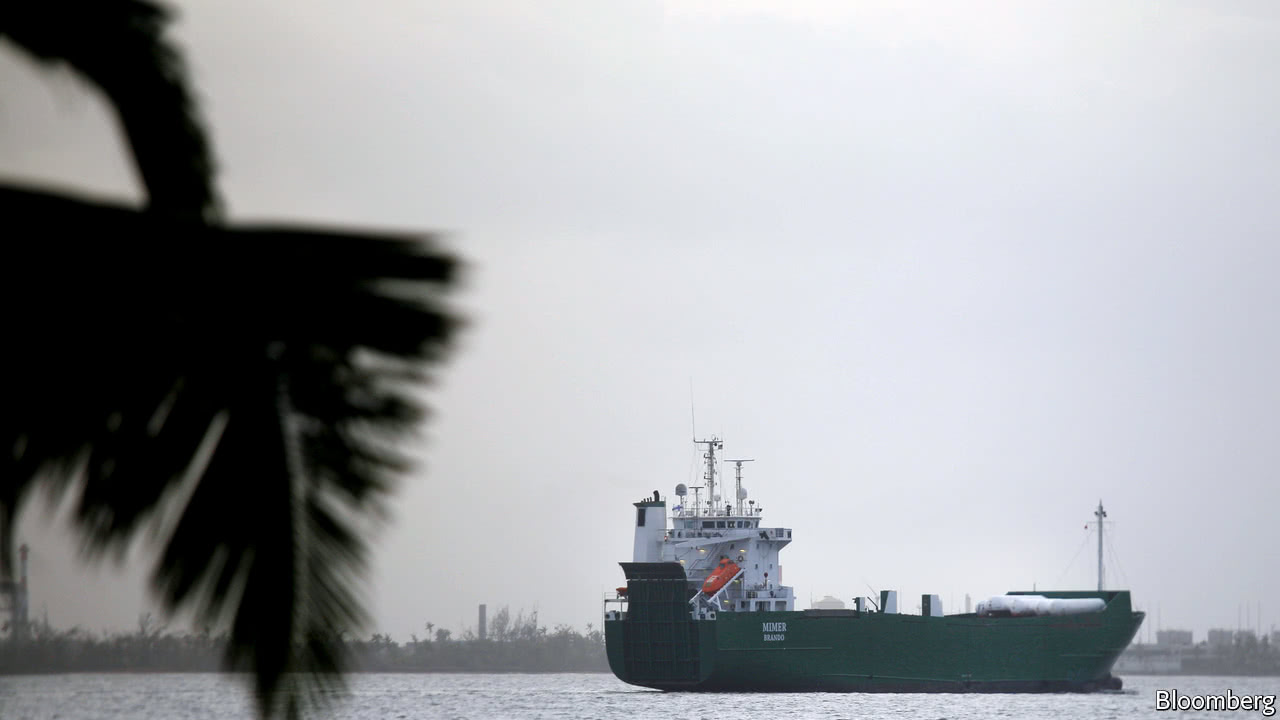
IN APRIL 1956 the world’s first container ship—the Ideal X—set sail from New Jersey. A year later in Seattle the world’s first commercially successful airliner, Boeing’s 707, made its maiden flight. Both developments slashed the cost of moving cargo and people. Boeing still makes half the world’s airliners. But America’s shipping fleet, 17% of the global total in 1960, accounts for just 0.4% today.
Blame a 1920 law known as the Jones Act, which decrees that trade between domestic ports be carried by American-flagged and -built ships, at least 75% owned and crewed by American citizens. After Hurricane Irma, a shortage of Jones-Act ships led President Donald Trump on September 28th to waive the rules for ten days to resupply Puerto Rico. This fuelled calls to repeal the law completely.
Like most forms of protectionism, the Jones Act hits consumers hard. A lack of foreign competition drives up the cost of coastal transport….Continue reading
Taxing fat and subsidising healthy eating widens inequality

IN RICH countries, people’s diets are getting worse and they are getting fatter. Hence the increasing popularity of a “fat tax”, to make unhealthy food cost more. Since Hungary led the charge in 2011 with a “chip tax” on fatty and sugary foods, other countries have followed. Britain is to join a long list next year.
Since the poor both spend a higher proportion of their income on food and tend to eat less healthily, they are the main targets of such taxes. In France, for instance, adult obesity is seen in over 20% of households with monthly incomes under €1,500 ($1,765) compared with less than 10% of those who earn over €3,000.
Punishing consumers, however, is politically painful. So “thin subsidies” have been gaining ground. But data on the impact of such policies are scarce. A recent study on the distributional impacts of fat taxes and thin subsidies from researchers at the universities of Oklahoma and Grenoble suggests policymakers should be…Continue reading
Unequal at work, men and women are even more so in retirement

“THE retirement-savings crisis is a women’s crisis,” says Sallie Krawcheck, co-founder of Ellevest, a financial-advice firm for women in America. When it comes to retirement income, women are far worse-off than men. The gender pension-gap may be less well-known than the gender pay-gap, but it is in fact far larger.
Among those retired in the EU, women on average receive 39% less in pension income—from state and workplace pensions—than men do (see chart). This puts women at greater risk of old-age poverty. The European Institute for Gender Equality, a think-tank, warned in a study in 2015 that it also makes them more likely to stay with abusive partners. Reforms to European pensions, tying benefits even closer to individual contributions and thus income, mean the gap may widen further.
American public pensions suffer from a gaping hole


SCHOOLS in Pennsylvania ought to be celebrating. The state gave them a $125m budget increase for 2017-18—enough for plenty of extra books and equipment. But John Callahan of the Pennsylvania School Boards Association says all the increase and more will be eaten up by pension costs, which will rise by $164m this year. The same happened in each of the previous five years; cumulatively the shortfall adds up to $586m. The pupil-teacher ratio is higher than in 2010. Nearly 85% of the state’s school boards said pensions were their biggest source of budget pressure.
A similar squeeze is happening all over America. Sarah Anzia, at the University of California, Berkeley, examined 219 cities between 2005 and 2014 and found that the mean increase in their real pension costs was 69%; higher pension costs in those cities were associated with falls in public-sector employment and capital spending.
The problem is likely to get worse. Moody’s, a rating agency, puts the total shortfall…Continue reading
Mergers and acquisitions often disappoint
WHEN you are the chief executive of a public company, the temptation to opt for a merger or acquisition is great indeed. Many such bosses may get a call every week or so from an investment banker eager to offer the kind of deal that is sure to boost profits.
Plenty of those calls are proving fruitful. In the first three quarters of 2017, just over $2.5trn-worth of transactions were agreed globally, according to Dealogic, a data provider. The total was virtually unchanged from the same period in 2016, but the number in Europe, the Middle East and Africa was up by 21%.
It is easy to understand why an executive opts for a deal. Buying another business looks like decisive action, and is a lot easier than coming up with a new, best-selling product. Furthermore, being the acquirer is far more appealing than being the prey; better to be the butcher than the cattle. A takeover may keep activist hedge funds off the management’s back for a while longer. And being in charge of a much bigger company is a more demanding task that will surely justify (ahem) a larger salary for the executives in charge.
But these temptations, good and bad, should generally be resisted. S&P Global Market Intelligence, a research arm of the ratings agency, has updated a study on the impact of deals on the acquiring company’s share price. The study looked at M&A deals done…Continue reading