
Tag: FINANCE
Investment in American infrastructure is falling

IT IS not a number to tweet about. President Donald Trump plans to plough $1trn of spending into America’s crumbling infrastructure. And a dearth of capital is not a problem: investors are keen on such assets. But investment seems to be falling.
Government infrastructure spending in the second quarter fell to 1.4% of GDP, the lowest share on record (see chart). According to Thomson Reuters, investment by American municipalities in the first seven months of this year, at $50.7bn, was nearly 20% below the same period in 2016. Private-sector infrastructure funds show a similar trend, according to Preqin, another data provider: deal volume in the first half of 2017 fell by 7.5%, year on year, to $36.6bn; the number of deals fell by a quarter.
Not long ago optimists were expecting an infrastructure-spending boom. In May Blackstone, a private-equity firm, announced with much fanfare a new $40bn fund for American infrastructure, with a $20bn investment from one of Saudi Arabia’s…Continue reading
Investors are not great at predicting politics
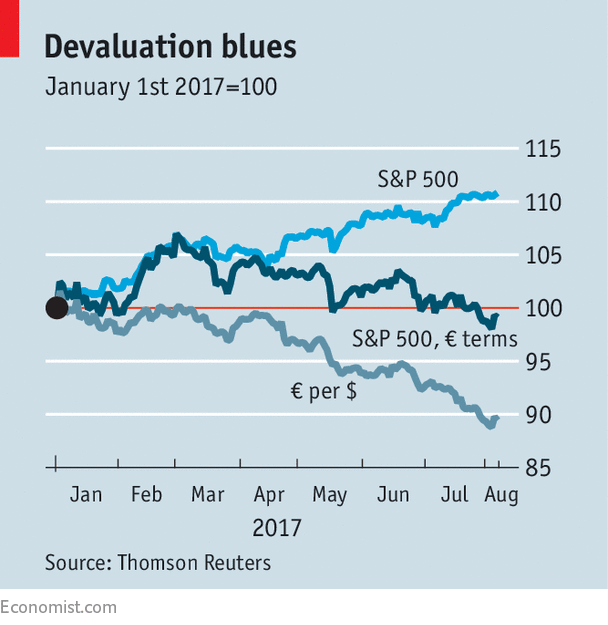
FINANCIAL markets are supposed to be the font of all wisdom, weighing up the information available and condensing it into a set of prices. Investors are presumed to have an insight into the future—falling bond yields are seen as a sign that the economy is slowing, for example.
But are investors that clever when it comes to politics? Gambling markets show how they assess political risk. They expected the Remain campaign to win the Brexit referendum and Hillary Clinton to become America’s president, and were proved wrong. Indeed, on Brexit, the mass of gamblers (the general public, in other words) backed Leave, but the odds were skewed by some wealthy punters who favoured Remain. Those rich gamblers were probably people who trade in financial markets; the plunge in the pound after the result suggests that most investors were caught on the hop.
Before the presidential election, most people on Wall Street to whom Buttonwood spoke thought that a victory for Donald Trump would be…Continue reading
Chasing higher yields, investors pile into risky countries
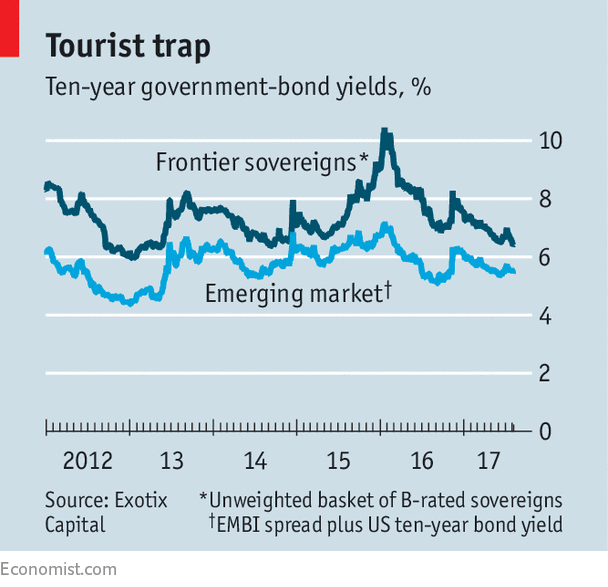
WHERE can you find a 7% interest rate on a sovereign dollar-bond? You would have to take a time-machine to the mid-1990s to find such a yield on a ten-year American Treasury. Alternatively, you could slip back a few days to August 2nd and bid for the $1bn of five-year bonds sold by the government of Iraq. The yield was expected to be 7%, but it was trimmed to 6.75% once orders rose above $6bn.
Such eagerness for hard-currency debt from a country still reeling from a civil war shows just how far bond investors will now go to get a decent yield. Oversubscribed issues for risky sovereign bonds have become almost normal. The Iraqi sale came just a week after Greece (whose privately held debt was partly written off in 2012) raised €3bn ($3.5bn) in its first bond sale for three years. In June Argentina was inundated with bids for its 100-year eurobond, as dollar-denominated bonds are known. Sceptics noted that Argentina had defaulted on its debts six times in the previous century, with the most…Continue reading
Why the world’s best footballers are cheaper than they seem

FOR football clubs, August is often the costliest month, when they make vast bids for each other’s players. This year has been particularly lavish. On August 3rd Paris Saint-Germain (PSG), a French team, signed Neymar da Silva Santos Júnior, a Brazilian forward, from Barcelona for €222m ($264m), more than double the previous record price for a footballer.
With three weeks of the transfer “window” left, teams in Europe’s “big five” leagues—the top divisions in England, Spain, Germany, Italy and France—have paid €3.2bn, just short of the record of €3.4bn set last year. The €179m splurged by Manchester City, an English club, on defenders outstrips 47 countries’ defence budgets. Arsène Wenger, a veteran manager of Arsenal, a London team, and an economics graduate, describes the modern transfer market as “beyond calculation and beyond rationality”.
Australia’s CommBank is accused of abetting money-laundering
WHEN the Commonwealth Bank of Australia on August 9th reported its profit for the year to June—above forecasts and just shy of A$10bn ($7.9bn)—it faced questions about cashflows of another sort. Six days earlier the Australian Transaction Reports and Analysis Centre (AUSTRAC), a regulator charged with gathering financial intelligence to combat money-laundering and terrorism, had launched proceedings against it for “serious and systemic non-compliance”. Citing “collective responsibility” for the bank’s reputation, Catherine Livingstone, its chairwoman, has announced cuts to bonuses for Ian Narev, the chief executive, and others.
Founded 106 years ago, CommBank, as it is known, is one of Australia’s biggest banks. AUSTRAC traces its case to 2012, when the bank started installing “intelligent deposit machines”. They accept cash, let depositors stay anonymous and allow money to be switched to other accounts in Australia and overseas straight away. CommBank sets…Continue reading
Who will be the next chair of the Federal Reserve?
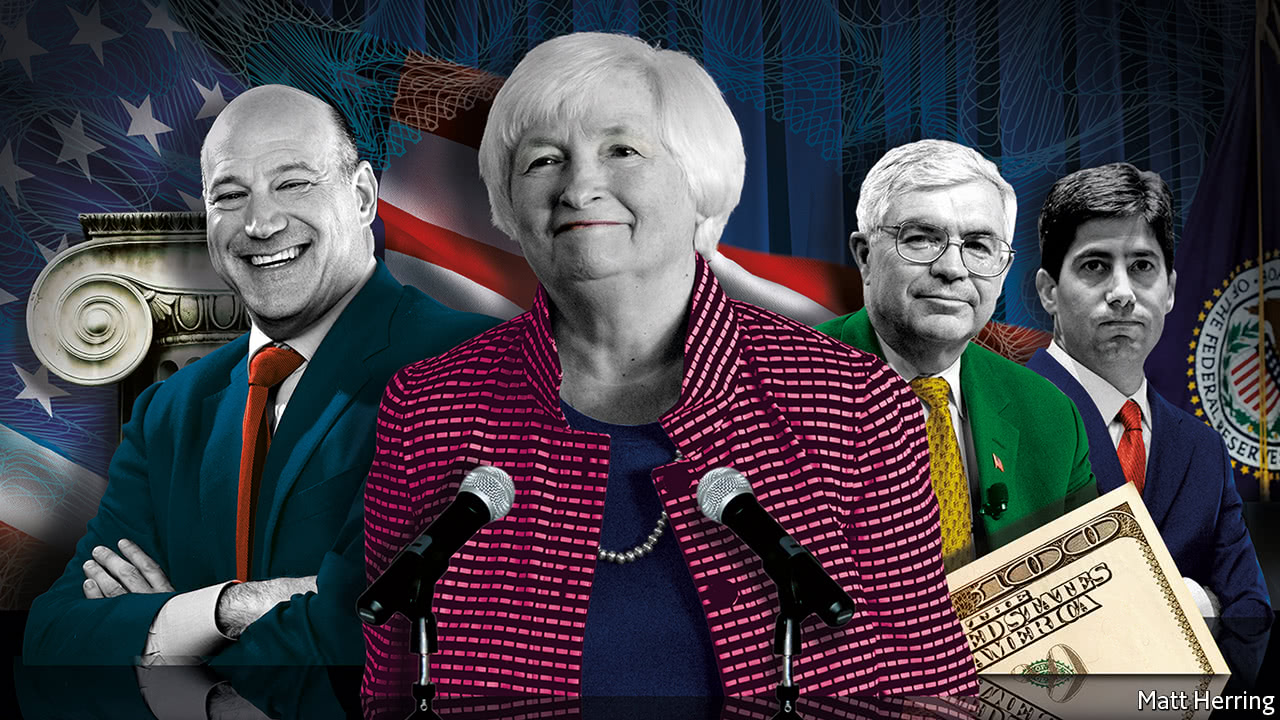
LOOK only at unemployment and inflation, says Peter Conti-Brown, a historian of the Federal Reserve, and Janet Yellen is the Fed’s most successful boss of all time. The second indicator may be below target, but that is a blip compared with the recessions most Fed chairmen have endured. So it is perhaps not surprising that President Donald Trump is openly considering retaining Ms Yellen, a Democrat installed by Barack Obama, after her term ends in February 2018. Nor by historical standards is it odd: the Fed’s past three leaders were all reappointed by presidents from the other party. Yet Ms Yellen, whom Mr Trump criticised on the campaign trail, is not the leading candidate. PredictIt, a betting site, gives her a 28% chance of staying put. In front of her, with a 36% chance of appointment, is someone else Mr Trump is publicly weighing up: Gary Cohn (on the left above).
Mr Cohn was until January the chief operating officer and president of Goldman Sachs. He left that role to become the…Continue reading
Research points to a new explanation of “Dutch disease”
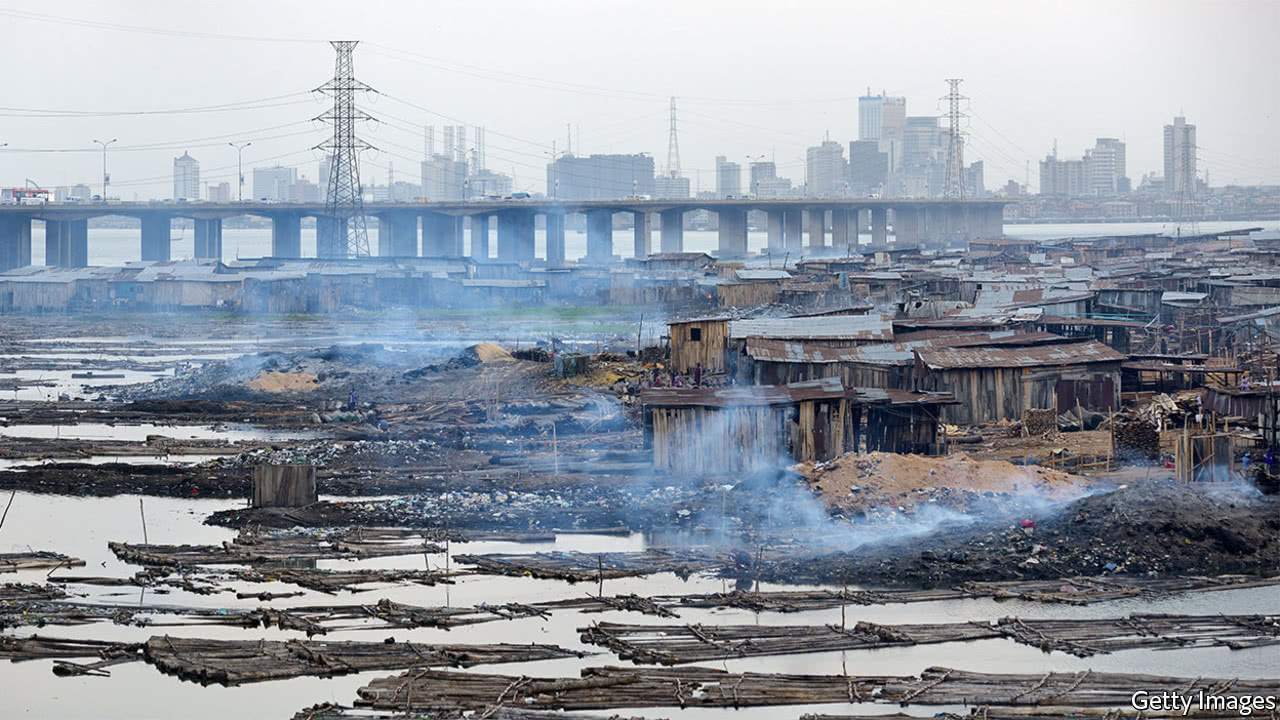
IN 1959 geologists discovered 2.8trn cubic metres of natural gas—the largest field in Europe—under the city of Groningen in the Netherlands. Cheap gas and free-spending energy firms were thought to be good news for the entire Dutch economy. But higher gas-export prices in the 1970s raised the value of the guilder by a sixth, hitting the competitiveness of Dutch manufacturing and services. In 1977 The Economist dubbed this economic curse “Dutch disease”.
Other resource-rich countries have tried to avoid this trap. Some have adopted fixed exchange rates to prevent their currencies appreciating. Others save capital inflows in sovereign-wealth funds to avoid distorting their economies. Yet many still have underdeveloped non-commodity sectors. And despite having plenty of cash to invest, banks are particularly affected.
Two recent IMF papers point to a new explanation of why commodity exporters have such stunted banks. The problem, they…Continue reading
A crucial interest-rate benchmark faces a murky future

EVERY working day, shortly before noon, British time, the London Interbank Offered Rate, or LIBOR, is published. For five currencies and seven maturities, from overnight to 12 months, it is the average, trimmed of outliers, of up to 20 banks’ estimates of the interest rate at which they can borrow from other banks. It is also the benchmark for financial contracts reckoned to be worth $350trn. Derivatives depend on it most. But plenty of asset-management products, as well as corporate loans and mortgages, are based on LIBOR and similar rates, notably EURIBOR, an interbank rate for euros.
Yet LIBOR’s days may be numbered. Regulators are promoting other benchmarks. On July 27th Andrew Bailey, the head of Britain’s Financial Conduct Authority, said that the FCA had spoken to banks about sustaining LIBOR until the end of 2021, but no longer. In April a working group set up by the Bank of England concluded that SONIA (the Sterling Overnight Interbank Average Rate), which the central bank…Continue reading
The private-equity business learns to be more flexible
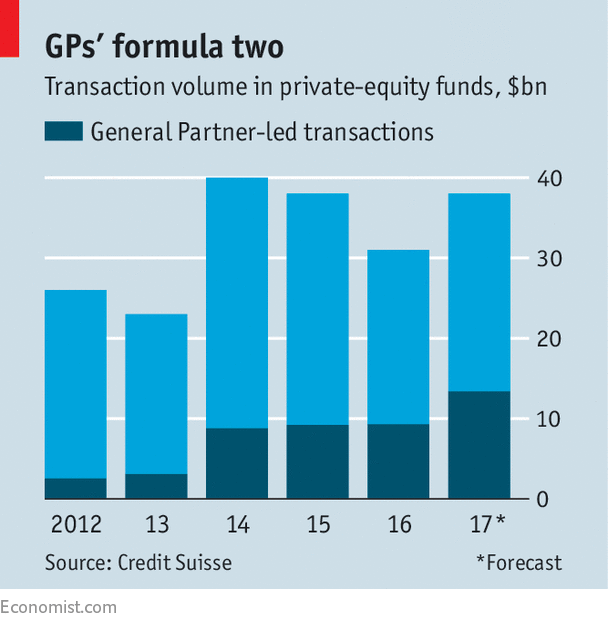
THE private-equity business presents a paradox. Its barons like to boast of revamping the companies they buy. But they themselves have been steadfast to their own business model, centred on funds with a ten-year life. Within this time span, fund managers, known as “general partners” (GPs), commit to buy, manage and sell a clutch of companies; investors commit to lock up their money for the duration. Sometimes GPs or investors chafe at the time constraint. A new segment of the secondary market, “GP-led” deals, has sprung up to help them.
Investors wanting to exit a fund early need to find a buyer for their stake in the secondary market. But sometimes none will offer an attractive price. Sometimes also, a fund nearing its expiry date may find itself still holding a large number of its investments. GP-led deals place the onus on fund managers to find buyers.
Such transactions have quickly grown from just 10% of the secondary market in 2012 to over one-third this year, according…Continue reading
Genetic testing threatens the insurance industry
IF A genetic test could tell whether you are at increased risk of getting cancer or Alzheimer’s, would you take it? As such tests become more accessible, more and more people are saying “yes”. The insurance industry faces a few headaches as a result.
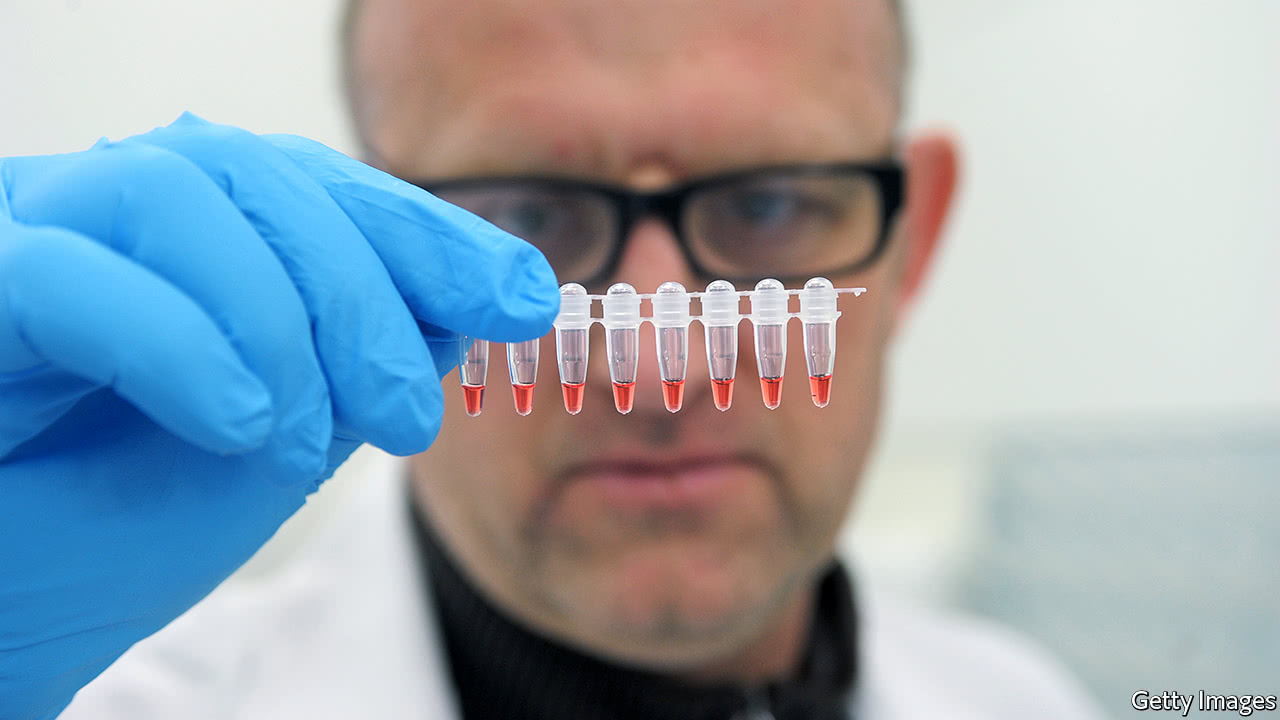
Once used only for medical reasons, basic predictive genetic tests can now be ordered online for a few hundred dollars. One company, 23andMe, in California, has collected some 4,000 litres of sputum since 2007, enlightening 2m people on their ancestry, health risks and what they may pass on to offspring. In April it received regulatory approval to screen for risk factors connected to ten diseases and genetic conditions, including late-onset Alzheimer’s and Parkinson’s. The ruling could open the floodgates for others to sell direct to consumers.
“Information is power”, argue many who take such tests. But insurers fear that without equal access to such information, they…Continue reading