
Tag: FINANCE
What history says about inequality and technology

ONE factor behind the rise of income inequality in America over the past four decades is that the labour market has increasingly favoured the well-educated. Real wages for college graduates have risen by over a third since 1963, whereas wages for those without high-school diplomas have dropped. As more of the economy becomes automated, doomsayers worry that the gap between the haves and the have-nots will only grow. History shows, however, that this need not be so.
The recent rise in earnings for skilled workers is a rare historical phenomenon. Compiling records from churches, monasteries, colleges, guilds and governments, Gregory Clark, an economist at the University of California, Davis, has put together a comprehensive dataset of English wages that stretches back to the 13th century. Mr Clark notes that in the past the skilled-wage premium, defined as the difference in wages between craftsmen, such as carpenters and masons, and unskilled labourers has been fairly stable, save for two sharp…Continue reading
The IMF is back in Africa
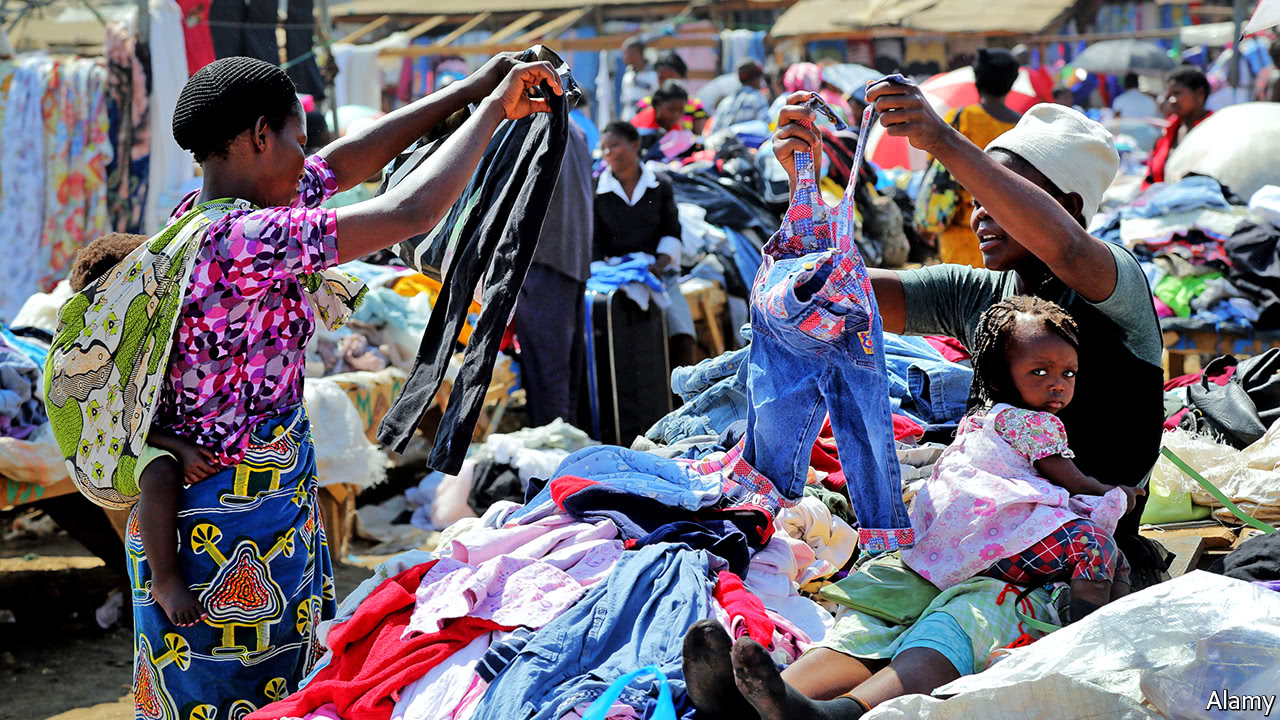
ZAMBIANS have good reason to distrust the IMF. In the 1990s, under the fund’s guidance, their government cut spending, scrapped subsidies, liberalised the exchange rate and privatised over 200 state-run firms. This “structural adjustment” was painful: employment shrivelled and, by the end of the decade, income per person had shrunk by 8%. In the words of Binwell Sinyangwe, a novelist, “they were the years of money first or else no friendship”.
So it was with some trepidation that Zambia welcomed an IMF mission, which concluded on June 10th. As in the 1990s, Zambia has been hit by plummeting prices for copper, its main export. The proposed package, which is likely to be finalised over the coming months, could be worth $1.3bn, which would be the country’s biggest with the fund in two decades.
The retro feel extends across Africa, where GDP grew last year by 1.4%, the slowest rate this century. Ghana agreed on a…Continue reading
Banco Popular fails and is bought by Santander

EVEN a bank failure can be presented as a triumph. This week Banco Popular, a big Spanish lender, endured a run. Depositors were said to be withdrawing €2bn ($2.2bn) a day. The bank lost half its stockmarket value in four days, as a self-imposed deadline to find a saviour loomed. On June 6th, it was declared by the Single Resolution Board (SRB), an independent agency of the European Central Bank formed in 2015 and charged with winding down banks, to be “failing or likely to fail”. The next morning, Santander, Spain’s biggest bank, announced its purchase for the symbolic sum of €1 ($1.10). It is to raise €7bn in capital to help absorb Popular’s property-related losses.
Spain’s government, the European Commission and Santander all cheered the outcome as a model European response to a bank crisis. Shareholders and junior bondholders in Popular have been wiped out. Spanish ministers pointed out that taxpayers would not have to pay for a rescue of the sort arranged for Bankia, a giant savings bank nearing collapse, when…Continue reading
A state bail-out of Monte dei Paschi draws near

HELP is at hand for the world’s oldest bank. On June 1st the European Commission said it had agreed in principle to a bail-out by the Italian government of Monte dei Paschi di Siena, founded in 1472. For years Monte dei Paschi, Italy’s fourth-biggest bank by assets, has lurched from crisis to crisis. Last July it flunked a test by European supervisors of its capital strength. In December a private-sector restructuring scheme came to naught and the state decided to step in.
The details, including the size of the bail-out, have yet to be hammered out. In December the European Central Bank (ECB) estimated that Monte dei Paschi would need €8.8bn ($9.2bn) in capital to withstand the “adverse scenario” in last summer’s test. The Bank of Italy reckoned that the state’s share would be €6.6bn.
That included €2bn to compensate retail investors in the bank’s junior bonds, many of them ordinary customers….Continue reading
Bangladesh worries about falling remittances
IT IS a mystery. Last year Bangladesh’s army of migrant workers abroad increased by a record 750,000, to reach 8m-odd. They travel to earn money for their families. Yet the statistics suggest they are sending less money home. In the fiscal year that ends this month, recorded remittances will have fallen for the second consecutive year, this time by more than 10%, to $12bn (see chart). To explain the puzzle, look to the places they work, to technology and to the growing popularity of a fiddle used by Bangladeshi importers.
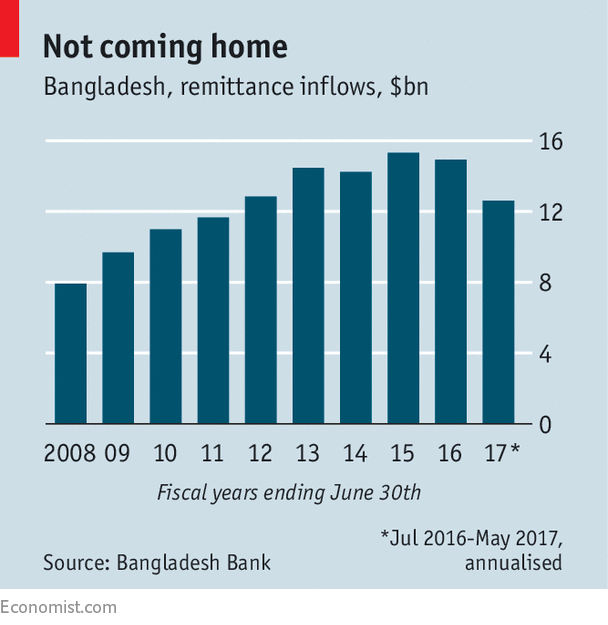
The abrupt cancellation last November by the Indian government of most banknotes by value was one factor: monthly inflows crashed, as the millions of Bangladeshis working in India were strapped for cash. In the Gulf, the source of 60% of Bangladesh’s remittances, the economy has been relatively sluggish.
But even without these shocks, remittances were falling—and fewer were being counted. Bangladesh is not unique in suffering such a downturn: for the first…Continue reading
To err is human; so is the failure to admit it

A NEWSPAPER cannot publish for 174 years without some mistakes. This one has made its share. We thought Britain was safe in the European exchange-rate mechanism just weeks before it crashed out; we opined, in 1997, that Indonesia was well placed to avoid financial crisis; we noted in 1999 that oil, at $10 per barrel, might well reach $5, almost perfectly timing the bottom of the market; and in 2003 we supported the invasion of Iraq. For individuals, like publications, errors are painful—particularly now, when the digital evidence of failure is both accessible and indelible. But they are also inevitable. The trick, then, is to err well: to recognise mistakes and learn from them. Worryingly, humanity may be getting worse at owning up to its goofs.
Few enjoy the feeling of being caught out in an error. But real trouble starts when the desire to avoid a reckoning leads to a refusal to grapple with contrary evidence. Economists often assume that people are rational. Faced with a new fact,…Continue reading
Why government-bond yields have been falling again
EVERY year it seems that analysts and investors play a ritual game. They begin by asserting that government bonds are terrible value and that, accordingly, this must be the year when yields will rise (and prices fall). And then they get mugged by reality.
The same pattern seems to be playing out in 2017. Back in December, a poll of fund managers by Bank of America Merrill Lynch (BAML) found that pessimists on global bonds outnumbered optimists by 58 percentage points. Investors believed in a “reflation trade”, with tax cuts from Donald Trump’s administration leading to faster American growth, to which the Federal Reserve would respond with higher interest rates.
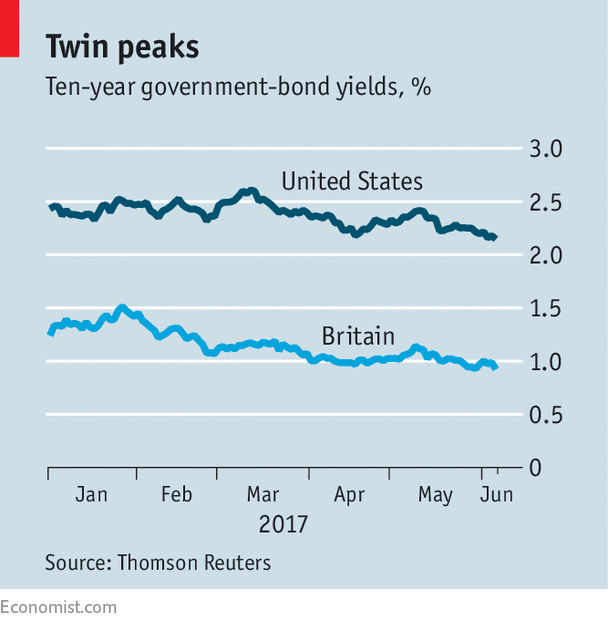
For a while, such forecasts seemed to be on the money. The yield on the ten-year Treasury bond picked up to 2.63% by March 13th (see chart). But since then the trend has changed. The Treasury-bond yield recorded a low for the year of 2.13% on June 6th. In Britain the yield on the ten-year gilt dipped below 1% on June 6th…Continue reading
Green bonds channel private-sector funding to the climate
WHEN Donald Trump announced America’s withdrawal from the Paris climate agreement on June 1st, he spelled out that it would no longer contribute to the Green Climate Fund. This is a UN initiative to use rich countries’ money to bring climate finance to developing ones. But even if the fund were going swimmingly, public-sector finance would only be able to provide a small part of the cash needed by poor countries, and indeed the world.
Private markets, however, are mobilising—notably that for “green bonds”, which tie the proceeds of bond issues to environmentally friendly investments. The market started a decade ago with issues from municipalities and multilateral development banks, worth just a few hundred million dollars annually.
By 2016 issuance had grown to $97bn, of which $32bn came from China alone; SEB, a Swedish bank, reckons volumes may hit $125bn this year. Public-sector issuers together accounted for only around 30% of the total last year. The largest portion, over 35%, was issued by financial institutions; around 20% came from other companies. Investor demand, too, is booming. Zurich Insurance, a Swiss insurer, has already invested over $1.2bn in green bonds, with plans to reach $2bn; BlackRock and other asset managers have set up dedicated green-bond funds.
As for the proceeds, over 40% is used to finance clean energy; nearly…Continue reading
Four BRICs don’t quite make a wall

EMERGING markets have been through a lot over the past four years. The “taper tantrum” in 2013 (prompted by fears of a change in American monetary policy); the oil-price drop in 2014; China’s botched devaluation of its currency in 2015; and India’s botched “demonetisation” of much of its own currency in late 2016 (removing high-value banknotes from circulation). But 2017 has started more brightly. Indeed, for the first time in two and a half years, the world’s four biggest emerging economies (Brazil, Russia, India and China, known as the BRICs) are all growing at the same time.
Russia’s GDP bottomed out at the end of 2015 (using seasonally adjusted figures) after the longest recession since the 1990s. It has expanded at a gathering pace for the past three quarters. Higher oil prices have helped, though Russia cannot profit fully from the improved market by ramping up sales without violating the production limits that caused the market’s recovery.
During the…Continue reading
In praise of America’s third-party debt collectors

FEW cheer the rising levels of America’s household debt, which reached a record $12.7trn at the end of the first quarter. Nearly 5% of the total, or $615bn, was in some stage of delinquency. One group, however, can barely hide its glee: third-party debt-collection firms, which try to recover mostly consumer loans on behalf of creditors without the resources to chase down bad borrowers themselves.
Business is expanding “at a robust rate”, says Keith Kettelkamp, the boss of Remex, a debt collector based in New Jersey whose clients include banks, utilities and musical-instrument sellers. Across the country more than 6,000 collection firms contact debtors more than 1bn times a year. One in eight Americans has an account with a third-party collector. The average amount outstanding is just over $1,300.
Third-party collectors have, it is fair to say, a dubious reputation: they are the target of more complaints from consumers than…Continue reading