
Tag: FINANCE
Barclays and four former executives are charged with fraud

IN 2008, as banks cracked on both sides of the Atlantic, Britain’s government prepared to shore up tottering lenders. It eventually poured £45bn ($71bn) into the Royal Bank of Scotland (RBS) and £20.3bn into Lloyds, which ministers coaxed into buying the stricken HBOS. Barclays, however, needed no such help: the bank raised enough equity from private investors, notably in Qatar, to meet higher capital targets set by regulators as the crisis deepened, and thus escape a taxpayer rescue.
However, for five years Britain’s Serious Fraud Office (SFO) has been investigating Barclays’ dealings with the Qataris. On June 20th those inquiries yielded criminal charges. These include (remarkably, some will say) the first such charges to be levelled at the head of a big international bank as a result of the crisis. John Varley is a pillar of London’s financial establishment. Save for one short break he spent 28 years at Barclays, more than six in the top job, before standing down…Continue reading
China enters the big leagues of global markets
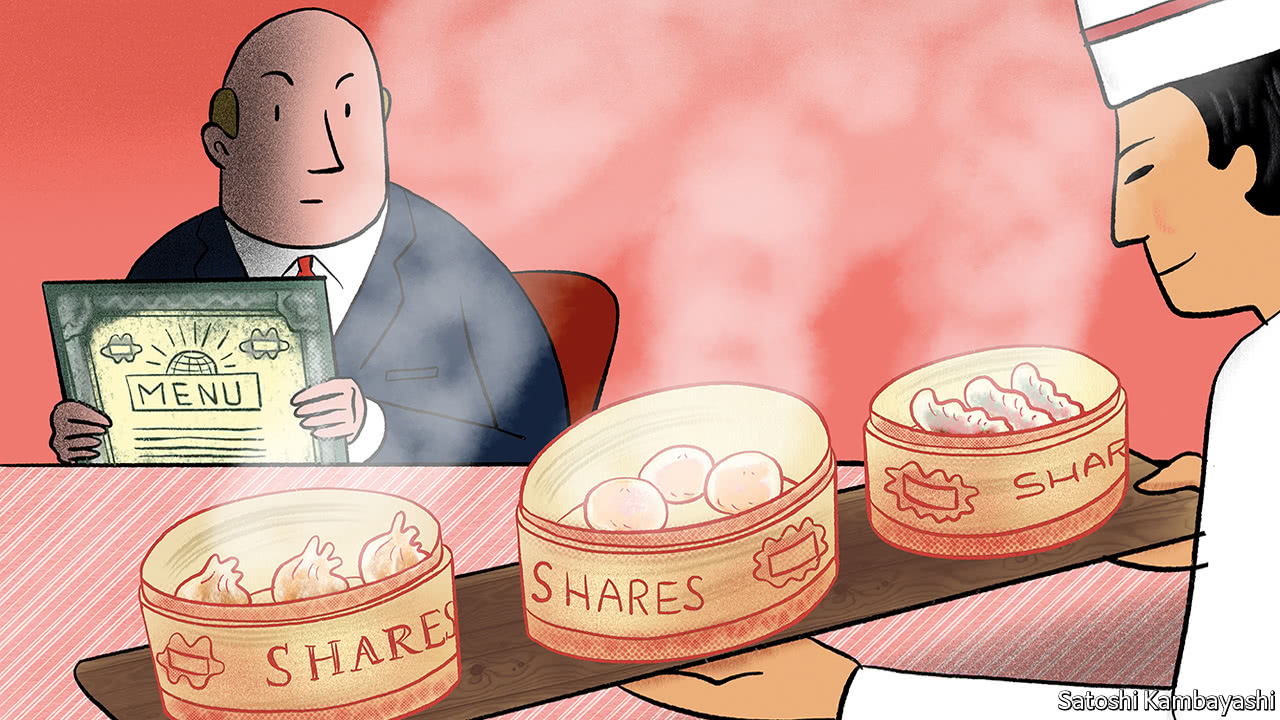
FROM shoes to shirts and phones to fridges, made-in-China goods have blanketed the globe over the past three decades, entering every country and just about every home. But one kind of Chinese good few abroad dare touch: its financial assets. Outsiders own less than 2% of its shares and bonds, far below the levels of foreign ownership seen in other markets. Capital barriers and financial risks have put investors off. This, however, is changing. The globalisation of China’s capital markets is slowly gathering steam, as symbolised by the inclusion of Chinese stocks and bonds in global indices.
MSCI, a company that designs stockmarket indices, announced on June 20th that it will bring Chinese equities into two of its benchmarks: one that covers emerging markets; and another that follows stocks around the world. To begin, it will include a small number of shares, just 222 of the more than 3,000 listed in China. But its decision matters to asset managers who track their performance against…Continue reading
Finland tests a new form of welfare

JUHA JARVINEN, an unemployed young father in a village near Jurva, in western Finland, brims with ideas for earning a living. He has just agreed to paint the roofs of two neighbours’ houses. His old business, making decorative window frames, went bust a few years ago. Having paid off debts, he recently registered another, to produce videos for clients.
Mr Jarvinen says that for six years he hoped to start a new business but it was impossible. The family got by on his wife’s wages as a nurse, plus unemployment and child benefits. He had a few job offers from local businesses, which are mainly in forestry, furniture and metalwork. But anything less than a permanent, well-paid post made no sense, since it would jeopardise his welfare payments. To re-enroll for benefits later would be painfully slow.
Mr Jarvinen’s luck turned in January, when he was picked at random from Finland’s unemployed (10% of the…Continue reading
Inflation has not yet followed lower unemployment in America

THAT central banks cannot endlessly reduce unemployment without sparking inflation is economic gospel. It follows from “a substantial body of theory, informed by considerable historical evidence”, according to Janet Yellen, chair of the Federal Reserve. Her conviction explains why, on June 14th, the Fed raised interest rates by a quarter of a percentage point, to a range of 1-1.25%.
Excluding food and energy, prices are only 1.5% higher than a year ago; the Fed’s inflation target is 2%. But Ms Yellen thinks unemployment is below its so-called “natural” rate, so inflation should soon rise. Is she right? Or has the relationship between unemployment and inflation, dubbed the Phillips curve, gone missing?
It is not the first time the theory has failed. After the financial crisis unemployment soared to 10%. This surfeit of workers should have sent inflation tumbling. But prices held up well; in October 2009, when unemployment peaked, underlying inflation was 1.3%, only a little…Continue reading
The perils of nationalisation
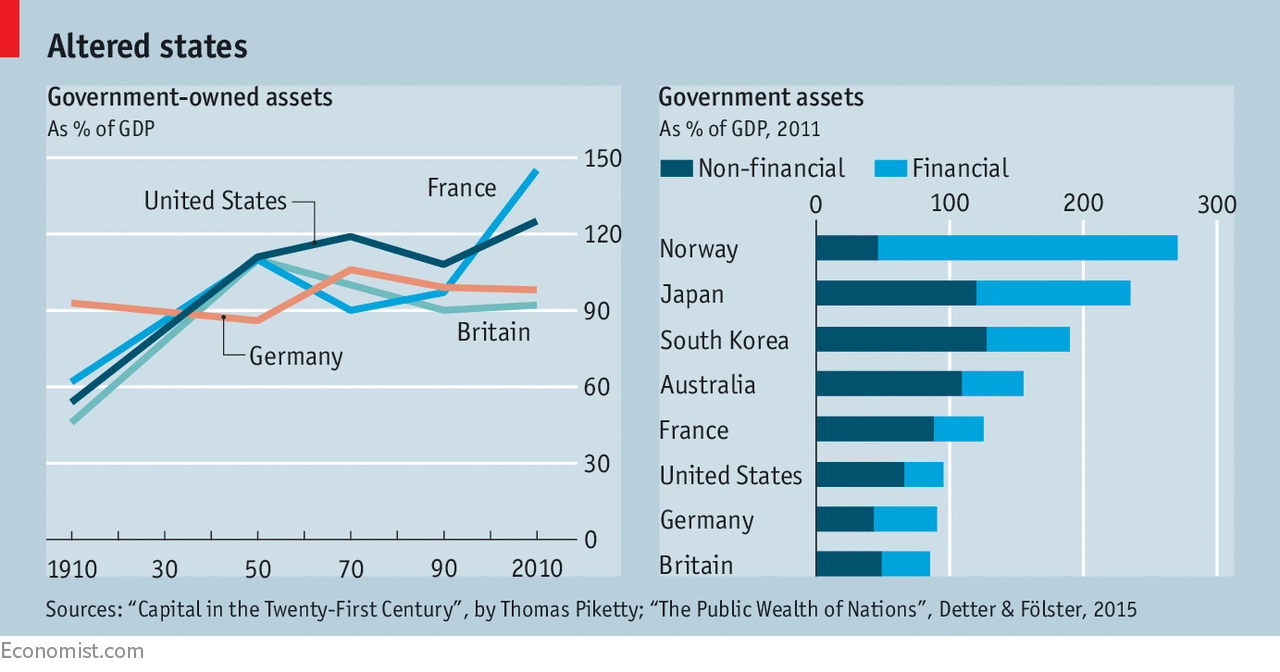
WHEN Jeremy Corbyn unveiled his Labour manifesto ahead of the recent British election, opponents gawked at pledges to renationalise the postal and rail systems. Such enthusiasm for state ownership smacks of a philosophy long since abandoned by leaders on both left and right. Despite Labour’s decent electoral performance, nationalisation is not everywhere on the march; on June 5th Donald Trump made public his desire to privatise air-traffic control. But the rise of Mr Corbyn and Bernie Sanders hints at a weakening of the rich-world consensus that the less of the economy owned by government, the better. That is a pity. Expanded state ownership is a poor way to cure economic ailments.
For much of the 20th century, economists were open to a bit of dirigisme. Maurice Allais, an (admittedly French) economist who won the Nobel prize in 1988, recommended that the government run a few firms in each industry, the better to observe the relative merits of public and private…Continue reading
Death pools can bring financial security for the long-lived

WHEN members of a private club in Manhattan suddenly start dropping dead at an alarming rate, Matt Scudder, a private detective, suspects more might be at play than bad luck to explain the bizarre series of suicides and violent accidents. If this sounds like the back-flap of a murder mystery, your deduction skills are as sharp as Mr Scudder’s. In Lawrence Block’s “A Long Line of Dead Men,” the cunning detective eventually uncovers the motive for the killing spree: the club of 31 men were all part of a tontine.
These ancient financial instruments are built on members paying money into a pool, which is invested and then pays out dividends once they reach a pre-agreed age. Those who live longest will see their income increase as others die; the last one standing receives the most. They are essentially a form of insurance against an unexpectedly long life.
Although most people will know them from the works of Agatha…Continue reading
Getting the most out of business taxes
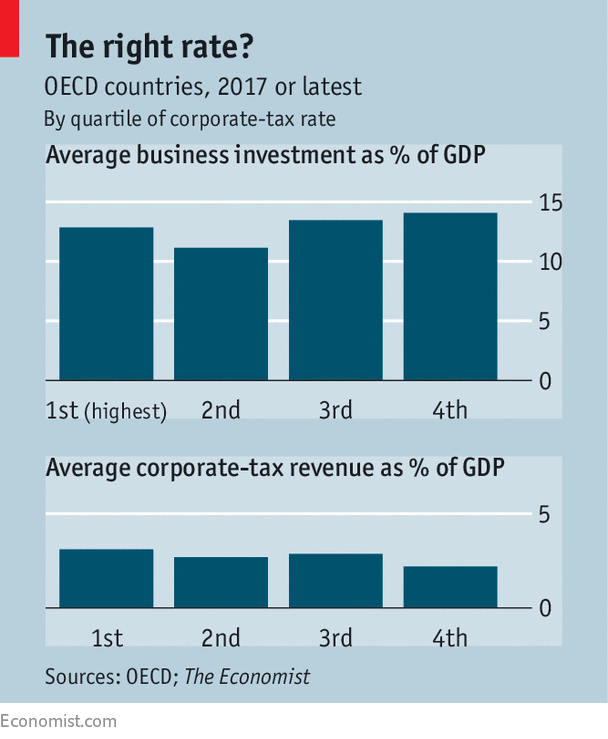
ONE of the hottest debates in economic policy at the moment is how to ensure companies are paying the optimal amount of tax. On the right, politicians think that a lower corporate-tax rate will lead to more business investment and thus faster economic growth. Hence the initial stockmarket enthusiasm after President Donald Trump was elected on a platform that included cuts in business taxes. On the left, the belief is that business is not paying its “fair share” of tax and that it can be further squeezed to pay for spending commitments. Hence the promise of the Labour Party in Britain’s recent election campaign to push the corporate-tax rate up to 26% (from 19%).
How do these theories translate into practice? To find out the effect on business investment, The Economist took the corporate-tax rates in OECD countries and divided them into quartiles from highest (1st) to lowest. Then we calculated the five-year average in each quartile for gross…Continue reading
The EU wants to supervise London clearing-houses after Brexit
THE Brexit devils will be in the details. That much is clear from the European Commission’s latest plans for euro-denominated clearing, a crucial bit of financial plumbing. Clearing-houses sit in the middle of a securities or derivatives transaction, and make sure that deals are honoured even if one side defaults. Clearing has become a much bigger business in the wake of the financial crisis, after which the G20 group of large economies mandated that over-the-counter derivatives should be cleared: 62% of a notional $544trn global market is now settled in this way.
London houses have an outsize role, clearing 97% of dollar interest-rate swaps and 75% of those in euros. Britain’s largest clearing-house, LCH, owned by the London Stock Exchange, alone clears over 50% of interest-rate swaps across all currencies. This has long had EU regulators worried about systemic-risk implications, and led them to consider their post-Brexit options. On June 13th the commission proposed a law that would set up a new system of direct supervision for clearing-houses that handle transactions in euros or other EU currencies, but are located outside the EU, as those in London will be.
Under this proposal, the European Securities and Markets Authority (ESMA), a regulator, would have direct oversight over non-EU clearing-houses deemed systemically important. Such oversight…Continue reading
The Treasury publishes proposals to cut red tape

TEN days after he became America’s 45th president in January, Donald Trump vowed to “do a big number on Dodd-Frank”, the elephantine law that recast financial regulation after the crisis of 2007-08. Soon after, he asked his treasury secretary, Steven Mnuchin, to measure all America’s rules (not just Dodd-Frank) against seven broad principles, including the prevention of bail-outs by the taxpayer and making regulation more efficient.
On June 12th Mr Mnuchin gave the first part of his answer, in a 147-page report on banks. Later instalments will cover capital markets, insurance and asset management, and non-bank institutions and financial technology. Banks of all sizes will be cheered by its proposals to ease regulation, make “stress tests” of their resilience less onerous and tame the Consumer Financial Protection Bureau (CFPB), a watchdog born of the Dodd-Frank act. To allay the confusion caused by America’s many regulators, Mr Mnuchin wants to give co-ordinating power to the…Continue reading
How Chinese overcapacity hits American workers

ALUMINIUM smelting is sweaty work. Inside the Hawesville plant of Century, an American aluminium producer, it can get so hot that the workers lie outside in the blazing summer sun to cool off. Dennis Harbath, the plant manager, oversees operations. He is worried about the workers. “They have mental fatigue,” he says.
The source of the stress is a number scrawled on a wall in white chalk. That is the dollar price of a tonne of aluminium, set on the London Metal Exchange (LME). The workers keep track of it on their smartphones. Their wives ask about it, too. “It’s hard to stay on the LME rollercoaster when trying to support a family,” says one.
A few years ago, they weren’t particularly aware of the price, says Andy Meserve, the local union president. That changed after 2015, when the price plunged to below $1,500 per tonne, prompting Century to shut down 60% of the plant’s capacity and lay off hundreds of…Continue reading