
Tag: FINANCE
The complicated failure of two Italian lenders
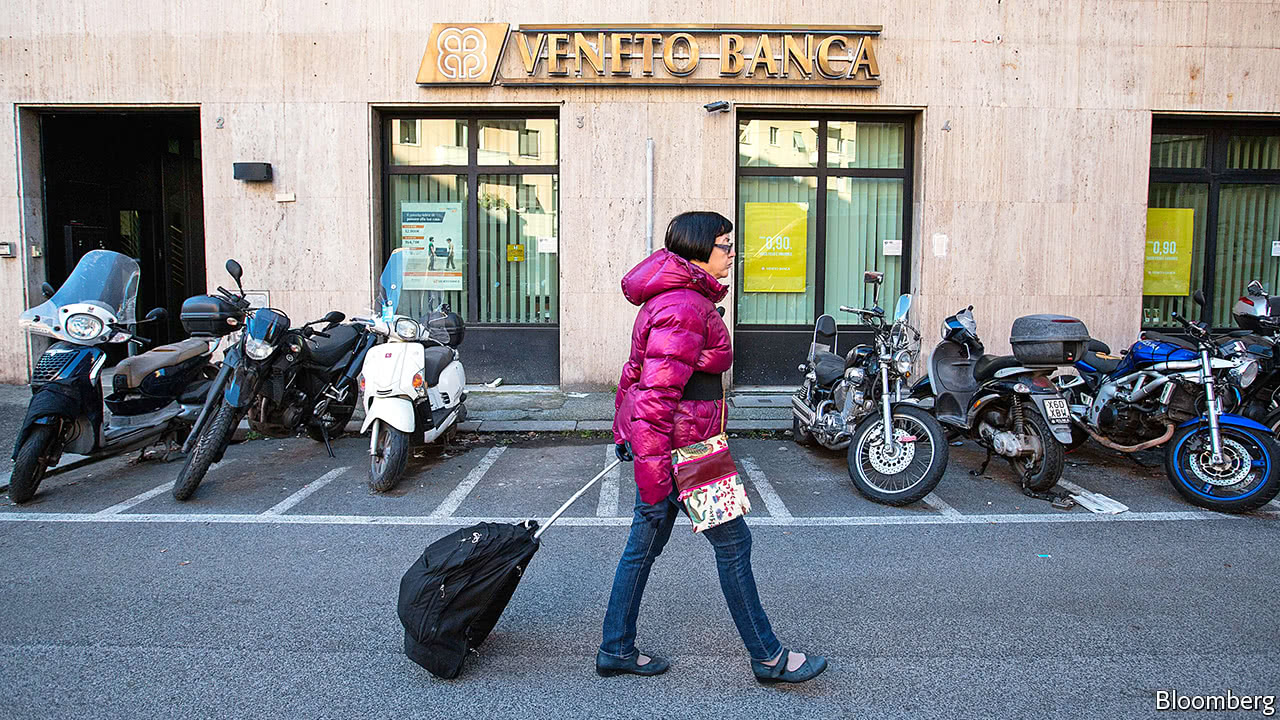
BANKS sicken slowly but die fast. For years Banca Popolare di Vicenza and Veneto Banca, in the prosperous Veneto, in north-east Italy, had been plagued by mismanagement. Even criminal investigations are under way. For months the Italian government had been wrangling with European authorities over the terms of a bail-out. For weeks it had seemed improbable that private investors would put in money alongside the state, as the European Commission insisted.
On June 23rd the European Central Bank (ECB) declared that the banks were “failing or likely to fail”. Two days later, after a frantic weekend, the Italian government pronounced them dead: their good assets were sold to Intesa Sanpaolo, Italy’s second-biggest lender, for a token €1 ($1.14), and their dud ones put into a “bad bank”. The operation may cost Italian taxpayers €17bn. This is the second call on Italy’s public purse this month. On June 1st the commission approved, in principle, the rescue of long-troubled Monte dei…Continue reading
Kenya launches the world’s first mobile-only sovereign bond
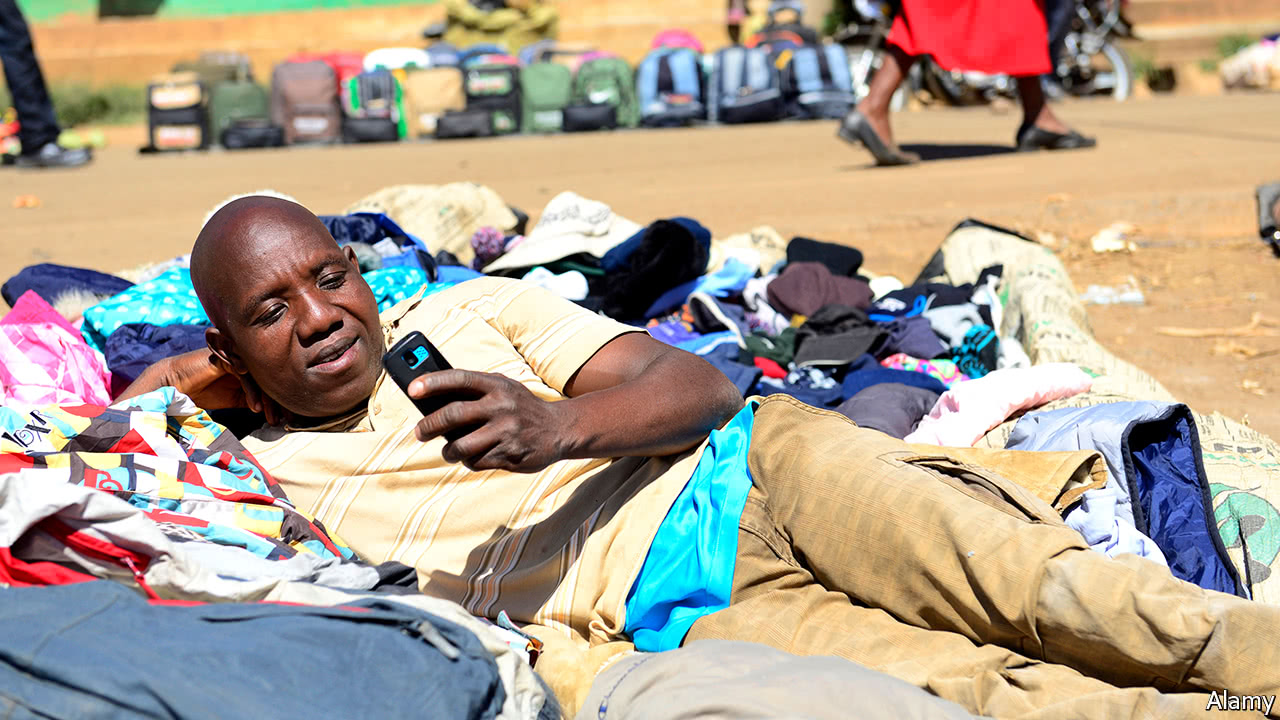
MOBILE money is ubiquitous in Kenya. Someone tapping on their phone might be paying school fees, sending money home or donating to a church. Soon they might be trading bonds. On June 30th the Kenyan government was due to launch M-Akiba, the world’s first sovereign bond to be sold exclusively through mobile platforms.
The bond is marketed at small investors, who will not need a bank account to take part. They can register on their phone in a few minutes and invest as little as 3,000 shillings ($29), far less than the 50,000 shillings needed to buy other treasury bonds. “Akiba” means savings in Kiswahili. The government is keen to promote thrift and is offering a juicy 10% annual return on the three-year bond, about three percentage points above deposit rates at commercial banks. Coupon payments are made through mobile money.
A pilot offer in March lured over 100,000 people to register. But only 5,692 of them went on…Continue reading
America’s programme to help trade’s losers needs fixing
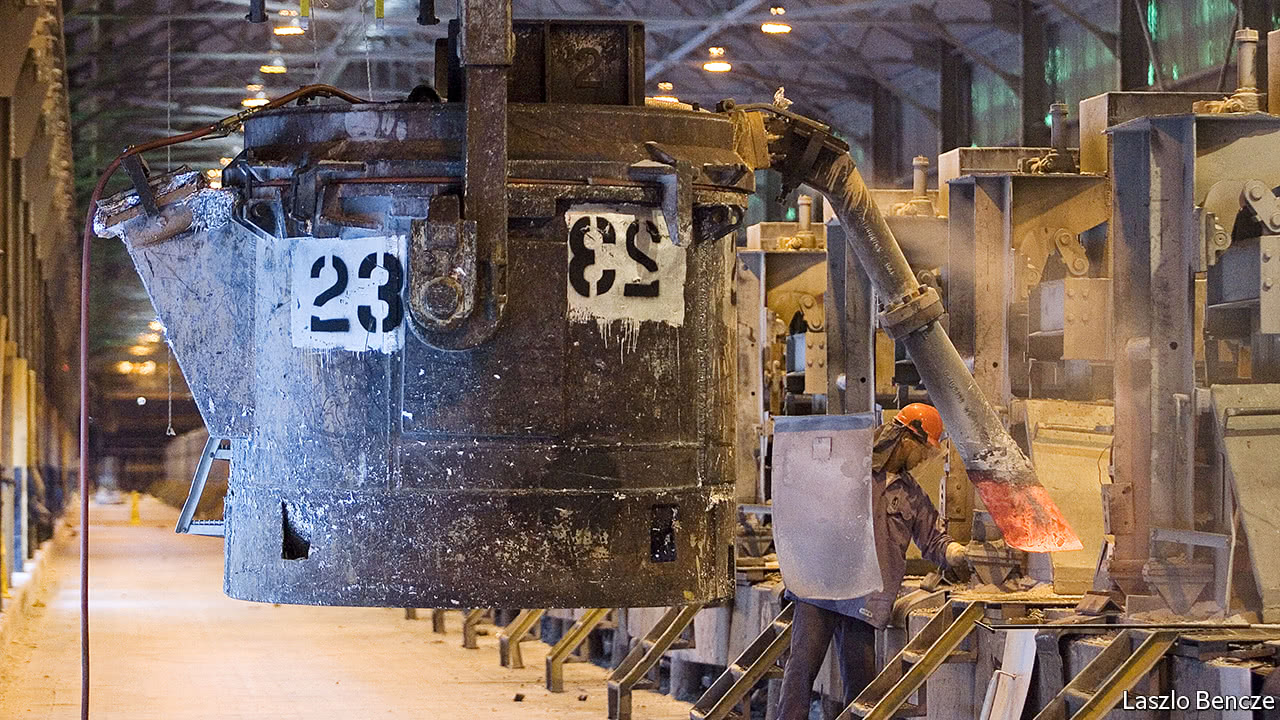
BRIAN AUNSPACH thought he had a job for life. After six years at a smelter owned by Alcoa, America’s largest aluminium company, his work was hard but the benefits decent. Warning signs came with crashing aluminium prices in the summer of 2015 and murmurings about unfair Chinese competition. Then reality hit: in January 2016 Alcoa announced the smelter’s closure. Around 600 people lost their jobs.
The events of 2016, from Brexit to Donald Trump’s election, were widely seen as a backlash against globalisation. The Warrick smelter in Indiana, which shut amid “challenging market conditions”, was perceived to be a victim of free trade. And the likes of Mr Aunspach, an American displaced by trade, are the objects of keen attention from wonks as well as politicians.
His is an old problem, with old solutions. Since 1962 America has earmarked funding to help people adjust to trade-related shocks. Trade-Adjustment Assistance (TAA)…Continue reading
The infant Islamic-bond industry faces a crisis
DANA GAS, an exploration business listed in Abu Dhabi, seems in a spot of bother. Ten years after sealing a landmark production deal with Iraqi Kurdistan, it is struggling to recover $900m it is owed by the autonomous region and the Egyptian government. So it faces a liquidity squeeze. That is not, however, why it says it wants to restructure $700m-worth of Islamic bonds maturing in October 2017. Rather, it says it has received legal advice that the bonds are no longer compliant with sharia—rules based on Islamic scripture.
The bonds were deemed compliant in 2013, but Dana cites evolution in the “interpretation” of Islamic financial instruments. It is seeking to have them declared invalid in a United Arab Emirates court. Its domestic assets are shielded from creditors under UAE law; it has also obtained injunctions in Britain and the British Virgin Islands protecting it from claims until the case is settled. Hearings are not due to start before December, months after the bond’s next payment-due dates.
Islamic law forbids the generation of money from money—interest. Sukuk, or Islamic bonds, thus differ from their conventional peers. They are backed by assets and instead of lending the issuer money, the holder owns a nominal share of what the cash was spent on and receives an agreed ratio of the…Continue reading
Investors snap up Argentina’s 100-year bonds

ONE hundred years ago, Argentina was not the country it is today. Thanks to a belle époque of lavish foreign investment, rapid inward migration and bountiful agricultural exports, its GDP per person in 1917 was comparable to that of Germany and France. Although the first world war brutally interrupted international trade and investment, the country profited from filling the bellies of soldiers on the front with tinned corned beef.
No one knows how Argentina may change over the next 100 years. But many investors seem willing to bet on one forecast: that its government will in 2117 repay $2.75bn-worth of dollar-denominated, 100-year bonds, sold to enthusiastic investors on June 19th.
Since Argentina has defaulted six times in the past 100 years, that belief seems brave. But instead of looking backwards, investors are looking from side to side, at the miserable yields on offer elsewhere. Argentina’s “century” bonds yield almost 8%. That…Continue reading
The Federal Reserve risks truncating a recovery with room to run
WHEN it comes to inflation, the Federal Reserve sometimes resembles a child freshly emerged from an age-inappropriate horror film. To its members, runaway price increases seem to lurk in every oddly shaped shadow. On June 14th America’s central bank raised its benchmark interest rate for the third time in six months, even as inflation lingered below its 2% target, as it has for most of the past five years. Some critics reckon the Fed’s 2% inflation target is too constraining. Indeed, in recent comments on a letter from prominent economists calling for a higher target, Janet Yellen, the chairman, signalled openness to the idea. But the Fed’s problem is less its target than an unforgiving pessimism about American productivity. If its bleak view is wrong, the Fed itself is partly to blame for slow growth.
Economists generally treat productivity growth as a “real” factor, outside central-bank control. Thus, it is thought to depend on things such as technological progress, workers’ skill levels and the flexibility of the economy. But productivity growth is cyclical: it varies depending on whether an economy is booming or busting. Central banks might therefore have more influence over it than they are prepared to admit.
Economies have a growth speed limit, determined by changes in population and productivity. When unemployment is high, the economy…Continue reading
Fund managers rarely outperform the market for long
THE big investment shift of recent years is from active to passive. Clients have been buying index funds, which passively track a benchmark like the S&P 500 index, and shunning fund managers who actively try to pick the best shares.
One reason for the shift is that passive managers charge lower fees than active funds. Many clients would be happy to pay more if that translated into better performance. However, it is very difficult for investors to select fund managers who can reliably beat their peers. Performance does not persist, as the latest data from S&P Dow Jones Indices show clearly.
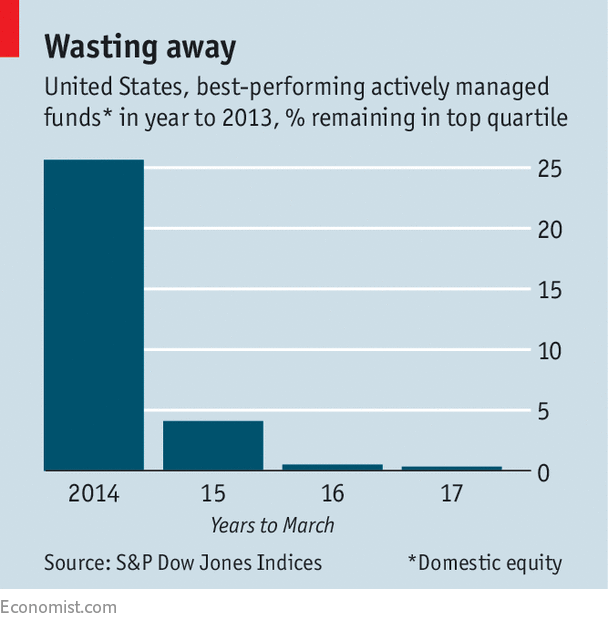
Suppose you had picked one of the best-performing 25% of American equity mutual funds in the 12 months to March 2013. In the subsequent 12 months, to March 2014, only 25.6% of those funds stayed in the top quartile (see chart). That result is no better than chance. In the subsequent 12-month periods, this elite bunch is winnowed down to 4.1%, 0.5% and 0.3%—all figures that are worse than…Continue reading
Klarna, a Swedish fintech unicorn, gets a full banking licence

BANKS moan incessantly about over- regulation. Yet their banking licences come with perks: in most places only licensed institutions can accept deposits and offer current accounts; within the EU, “passporting” means a bank licensed in one country may operate across the single market. So some European financial-technology (“fintech”) upstarts have started to seek banking licences. On June 19th, Klarna, a Swedish payments firm valued at $2.25bn, became the latest—and the largest so far—to get one.
European fintech firms have various reasons for seeking approval as a bank. Bunq, a Dutch firm and one of the first to get a licence, started out in payments, like Klarna, but expanded to deposit accounts. Some, like N26 in Germany or Atom Bank in Britain, sought to be full-service, online retail banks from the outset. Others, such as ClearBank, a new British clearing and settlement bank, want to offer services to other firms.
Of those focused on the retail market, Klarna…Continue reading
Investors in aircraft should get set for turbulence

AIR shows are where the aerospace business shows off. At this year’s Paris show, the world’s largest, which opened at Le Bourget airport on June 19th, the military types are most ostentatious. Aeronautical party tricks include helicopters that ascend into the sky tail-first and stealth fighters that fly backwards.
But no one is keener to strut their stuff than Airbus and Boeing, the world’s two biggest makers of airliners. At the 2015 show the pair sold 752 planes worth around $107bn. But the party atmosphere at that event—with copious food and wine laid on for customers and journalists alike—has given way this year to a more sober mood, weaker sales and a bring-your-own-lunch policy. This should give pause to investors in one of the world’s fastest-growing asset classes: aircraft.
Airbus and Boeing still booked plenty of orders. But for the first time, most came from lessors, which lease them to operators, rather than from the airlines that use them….Continue reading
Hong Kong’s stock exchange proposes a controversial reform
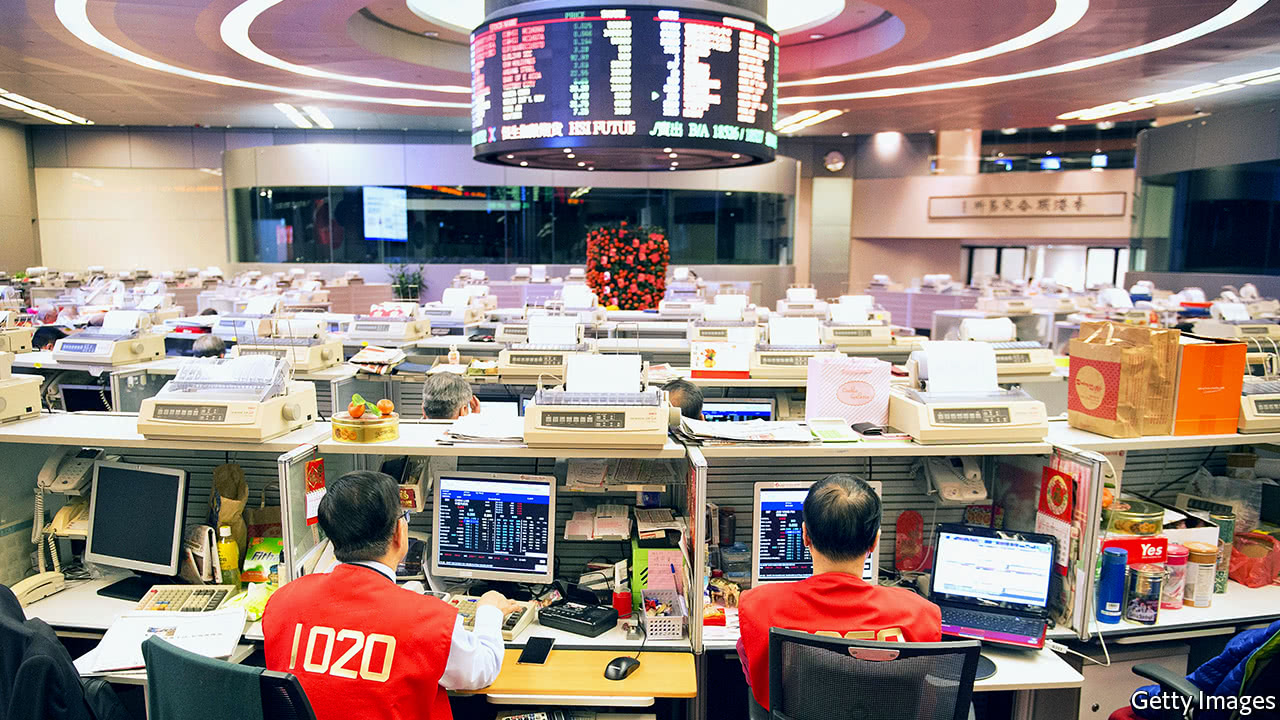
BOSSES at Hong Kong Exchanges and Clearing (HKEX) ought to be feeling smug. In five of the past eight years it has been the world’s leading exchange for initial public offerings (IPOs). Chinese companies have swarmed to list on its comparatively mature, open and transparent capital market, generating over 90% of the funds raised there in the past five years. Yet, launching a long-awaited consultation on reforms on June 16th, HKEX warned of “stagnation” if it does not change. It has one eye on its regional rivals. Last year Singapore knocked it into fourth place in a prominent ranking of financial centres. As Shenzhen and Shanghai, where trading volumes dwarf Hong Kong’s, open up, they could eat Hong Kong’s lunch.
Besides tinkering with the rules on Hong Kong’s main board and its second one, the Growth Enterprise Market, the proposed changes include, most contentiously, a third board. This would be designed to attract fizzy “new…Continue reading