
Finanzas
Masayoshi Son goes on a $100bn shopping spree

IF YOU want to find a spectacular vision of the future, Silicon Valley is not the only place to look. In Tokyo Masayoshi Son, the boss of SoftBank, a Japanese telecoms group, is starting an investment fund worth $100bn which, he hopes, will make him the Warren Buffett of technology. “Masa” is no stranger to risky bets: SoftBank was an early investor in Alibaba, a Chinese e-commerce company, and has sunk $22bn in Sprint, a struggling American telecoms firm. Now he has been seized by the kind of Utopian fever that would make the Sage of Omaha choke on his Cherry Coke.
Mr Son, who is 59, believes that the world will soon encounter what is known as the Singularity, the point at which artificial intelligence exceeds the human kind. The brains of people and machines will become enmeshed (see article). Every person will have over 1,000 devices linked by a seamless global network, with the data analysed by machines in the cloud. As well as smart glasses, people will wear smart shoes and every car and washing machine will…Continue reading
YouTube highlights problems with digital advertising
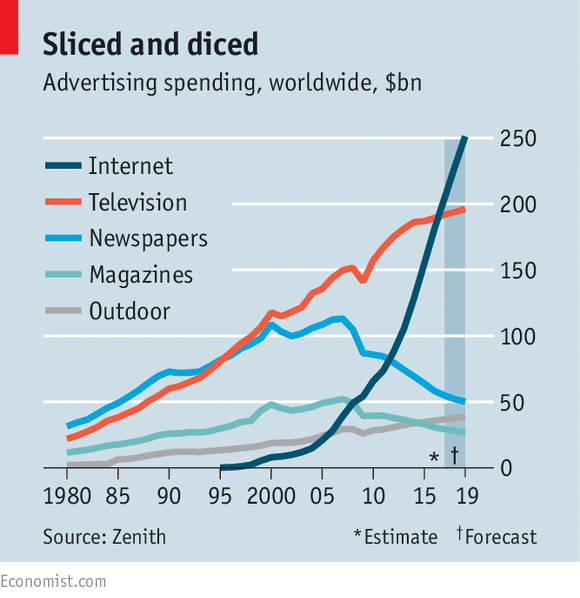
EVEN advertisers can be seduced by slick marketing. Google and Facebook have built huge businesses by promising that online ads are more effective and easily measured than traditional media, such as television, radio and print. This year the amount spent on internet advertising, globally and in America, is forecast to surpass television advertising for the first time (see chart). But a controversy at YouTube, an online-video site owned by Google, shows how digital advertising still has problems to sort out before it lives up to the dazzling sales pitch.
A slew of advertisers, including stalwarts such as Coca-Cola, Walmart and General Motors, have announced plans to suspend usage of, or move ad spending away from, YouTube because ads (in some cases their own) were appearing alongside offensive content, including videos by jihadist and neo-Nazi groups. Google’s own brand has suffered: the damage to the firm’s sales could be as much as $1bn in 2017, or around 1% of its gross advertising revenue. Shares of its parent company, Alphabet, have fallen by around 3% owing to the controversy.
It is not the first time that brands have fretted about where…Continue reading
Ameerpet, India’s unofficial IT training hub
 Eat your heart out, Stanford
UNIVERSITY campuses can take a while to get going in the mornings, as students recover from extra-curricular antics. Contrast that with Ameerpet, a squeezed neighbourhood of Hyderabad that has become India’s unofficial cramming-college capital. By 7.30am the place is already buzzing as 500-odd training institutes cater to over 100,000 students looking to improve their IT skills. If there are ivory towers here, they are obscured by a forest of fluorescent billboards promising skills ranging from debugging Oracle servers to expertise in Java coding to handling Microsoft’s cloud.
Expertise in the IT industry erodes fast as software programs are upgraded or become obsolete. Indian outsourcing giants such as Infosys and Wipro spend heavily to keep employees’ skills up to date. But staff looking to change their career paths—to say nothing of those who didn’t crack the interview in the first place—need rapid systems upgrades of their own. Training courses authorised by software providers exist but cost up to 375,000 rupees ($5,765). Fees at Ameerpet’s informal institutes are typically below 25,000 rupees for classes…Continue reading
Swiss watchmakers try to keep pace

BASELWORLD, a giant watch fair that ended this week, usually runs like clockwork. Companies show off new products; buzz and higher sales follow. However, something seems to have jammed. Exports of Swiss watches sank by a tenth in 2016, the worst performance since the financial crisis. Swatch, the world’s biggest watch company, saw profits plunge by 47%. In February exports were 10% lower than they had been a year earlier.
Swiss watchmakers have been around for long enough not to panic: Blancpain, owned by Swatch, dates back to 1735; Vacheron Constantin, owned by Richemont, a Swiss luxury conglomerate and Swatch’s closest rival, was founded 20 years later. In La Chaux-de-Fonds, a watch-manufacturing hub, workers toil much as they always have, at chin-high desks, using slim instruments to assemble springs, wheels, jewels and other tiny parts. But swings in demand have of late been particularly extreme.
The period from around 2004 to 2012 saw high growth. Chinese shoppers accounted for about half of Swiss watch sales during that time, reckons Thomas Chauvet of Citi, a bank. Manufacturers introduced pricier products and raised the cost of existing ones. The financial…Continue reading
Dijsselbloem rechaza ir al Parlamento Europeo tras los insultos al Sur
El presidente del Eurogrupo alega problemas de agenda después de la petición de dimisión por parte de eurodiputados de varios grupos políticos
Las constructoras ven posible una solución para las autopistas quebradas sin coste para el Estado
Seopan apuesta por acuerdos individuales por cada vía de peaje en quiebra que evite el desembolso de unos 5.000 millones a los contribuyentes
¿En qué comunidad y en qué sector hay más interinos?
Uno de cada tres trabajadores de la sanidad pública son interinos. El 20% de los profesores son eventuales
La recuperación económica ayuda a las administraciones públicas a cumplir el déficit por primera vez
La Administración central es la que más se desvía del objetivo. Los Ayuntamientos registran un superávit equivalente al 0,62% del PIB
What gets left behind in an Uber

IN THEORY, leaving an item in an Uber car should induce less panic than leaving something in a cab. After all, you can just pull out your phone and look up the name and number of your driver. Unless, of course, the item you left behind is your phone.
This week, the ride-hailing company unveiled the “Uber Lost & Found Index”, which documents the things most commonly left behind in its cars. Topping the list is, inevitably, phones.
Rings are the second most frequently abandoned possessions, followed by keys, wallets and glasses. The firm says that the day of the week has a significant effect on what is lost. (In truth, many of the conclusions can probably be explained by the Texas sharpshooter fallacy, but why spoil a fun story?) Saturdays bring the biggest haul of lost plane tickets. Passengers are likeliest to leave their swimsuits behind on Tuesdays. And wedding dresses are most often forgotten on Sundays—presumably because they are left behind by tired and emotional couples who had tied the knot the day…Continue reading
Acuerdo histórico contra la temporalidad del empleo público
El Gobierno y los sindicatos firman un pacto para convocar oposiciones para 250.000 plazas en tres años y convertir interinos en fijos. Habrá otras 67.000 vacantes para sustituir las jubilaciones de 2017