
Tag: Business and finance
Mining companies have dug themselves out of a hole

FOR mining investors there is something sinfully alluring about Glencore, an Anglo-Swiss metals conglomerate. It is the world’s biggest exporter of coal, a singularly unfashionable commodity. It goes where others fear to tread, such as the Democratic Republic of Congo (DRC), which has an unsavoury reputation for violence and corruption. It recently navigated sanctions against Russia to strike a deal with Rosneft, the country’s oil champion.
Yet Glencore could still acquire a halo for itself. It is one of the world’s biggest suppliers of copper and the biggest of cobalt, much of which comes from its investment in the DRC. These are vital ingredients for clean-tech products and industries, notably electric vehicles (EVs) and batteries.
The potential of “green” metals and minerals, which along with copper and cobalt include nickel, lithium and graphite, is adding to renewed excitement about investing in mining firms as they emerge from the wreckage of a $1trn splurge of over-investment during the China-led commodities supercycle, which began in the early 2000s. The most bullish argue that clean energy could be an even bigger source of…Continue reading
Green finance for dirty ships
 Smokestack lightening
SHIPPING may seem like a clean form of transport. Carrying more than 90% of the world’s trade, ocean-going vessels produce just 3% of its greenhouse-gas emissions. But the industry is dirtier than that makes it sound. By burning heavy fuel oil, just 15 of the biggest ships emit more oxides of nitrogen and sulphur—gases much worse for global warming than carbon dioxide—than all the world’s cars put together. So it is no surprise that shipowners are being forced to clean up their act. But in an industry awash in overcapacity and debt, few have access to the finance they need to improve their vessels. Innovative thinking is trying to change that.
A new report from the Carbon War Room (CWR), an international NGO, and UMAS, a consultancy, highlights the threat that new environmental regulations pose to the industry. The International Maritime Organisation, the UN’s regulatory agency for shipping, has agreed to cap emissions of sulphur from 2020. Last month the European Parliament voted to include shipping in the EU’s emissions-trading scheme from 2021. Without any retrofitting of ships to meet the…Continue reading
Economists argue about the impact of Chinese imports on America
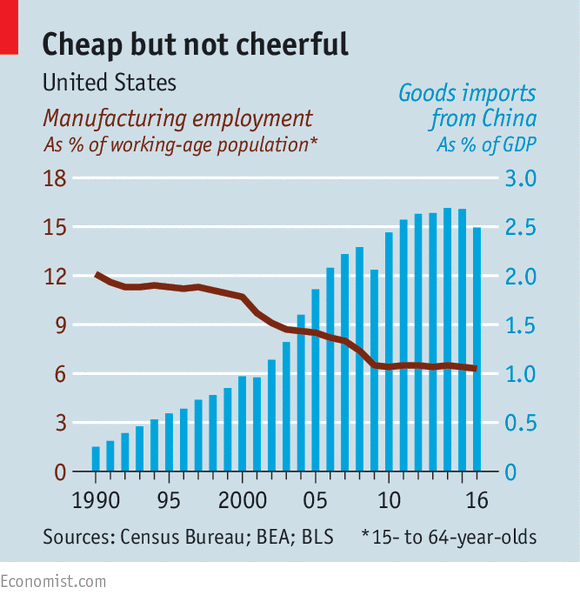
COMPETITION from Chinese imports may have cost some Americans jobs, but economists have done pretty well out of it. Since 2013 David Autor, David Dorn and Gordon Hanson have published nine separate studies digging into the costs of trade. They have found that, of the fall in manufacturing jobs between 1990 and 2007, one-quarter could be attributed to a surge in imports from China. Other sectors failed to soak up the extra workers. Their research also suggested that the China shock has cut the supply of marriageable men and opened the door of the White House to Donald Trump.
In recent weeks a dispute has erupted over their results. Jonathan Rothwell, an economist at Gallup, a pollster, alleged “serious flaws” in one paper, prompting a fierce eight-page response from the authors, and an acrimonious public tiff.
The row centres on how the effect of the China shock is measured. The trio wanted to isolate the effects of extra Chinese supply, rather than of something happening in America, so they checked that imports of particular Chinese products were surging in other rich countries, too. They then compared places in America…Continue reading
Deutsche Bank raises capital, and changes course
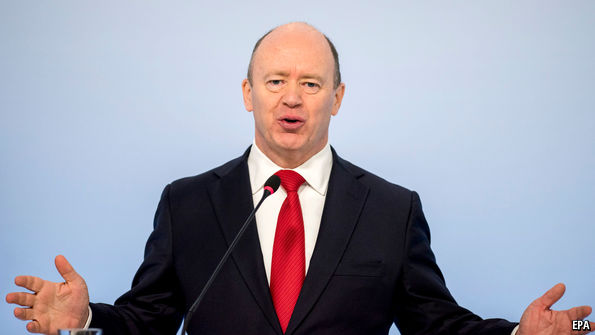
THREE times since the financial crisis, Deutsche Bank’s bosses have turned to its shareholders for cash: €10.2bn ($13.6bn) in 2010, €3bn in 2013 and €8.5bn in 2014. Since becoming chief executive in 2015, John Cryan has had no plans to ask for more. Deutsche still needed to thicken its equity cushion, but disposals, cost cuts and earnings (if any: it has made losses for the past two years) would provide the stuffing.
Well, plans change. On March 5th Mr Cryan announced an €8bn rights issue. Some comfort for investors: the price, €11.65 a share, is 39% below the previous close; and Mr Cryan, who had suspended the dividend, promises a return to “competitive” payouts next year. In another reversal, Deutsche will keep rather than sell Postbank, a mass-market retail business that was once part of the post office. Deutsche has owned it since 2010.
Postbank and the posher “blue” Deutsche Bank brand will be more closely integrated—notably, sharing computer systems. Mr Cryan is also selling a slice of Deutsche’s asset-management division and some lesser assets. And he is reorganising its corporate and investment bank to…Continue reading
Chinese startups push into foreign markets
 They’re coming your way
ON THE outskirts of Guangzhou, a city in southern China, lies an abandoned park filled with crumbling replicas of the wonders of the world. To the right are fading golden spires that are meant to represent Angkor Wat, a temple in Cambodia. On the left, a row of dusty Egyptian statues towers over a desolate Greek amphitheatre. Adding to the surrealism, the tops of the trees have been lopped off and a buzzing noise fills the night air.
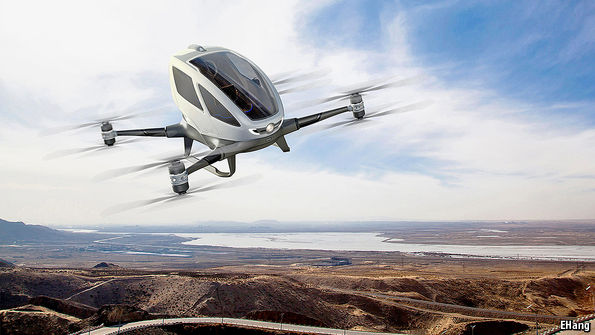
This strange place is the testing ground for EHang, a Chinese startup that makes drones. (The treetops were chopped off, an employee explains, because drones kept crashing into them.) Hu Huazhi, EHang’s founder, is beaming. His firm has just set a world record for a drone-swarm light show in Guangzhou, where it flew a thousand small drones in perfect unison. Next it plans to launch an autonomous flying-taxi service with a giant drone big enough to take a person (pictured). Dubai has just signed a deal with EHang to launch drone taxis this summer.
EHang is an example of a new kind of Chinese firm, labelled “micro-multinationals” by some. In the past,…Continue reading
The subdued mood in Singapore’s financial industry

SINGAPORE owes its existence, and its prosperity, to its place at the heart of intra-Asian trade. In more than 50 years of independence, the city-state has striven mightily to attract investment from all over the world. Such has been its success, indeed, that others hope to imitate its open, low-tax model. In Britain, for example, there has been talk of the country turning into a “European Singapore” once withdrawal from the EU is complete. (It would be a nice start if London’s Tube operated with anything like the same efficiency as Singapore’s subway network.)
The current mood in Singapore, however, is far less buoyant than you might imagine. Singapore has survived and thrived by steering a middle course between America and China. It has been alarmed both by the isolationist rhetoric of President Donald Trump and by recent, highly unusual, public spats with China.
Global trade growth has slowed in recent years. Despite signs of a pickup, this has had a big effect in a city that has the world’s second-busiest port and that (according to Barclays, a bank) is the country most exposed to the global value chains created by multinational…Continue reading
A big merger in the asset-management industry
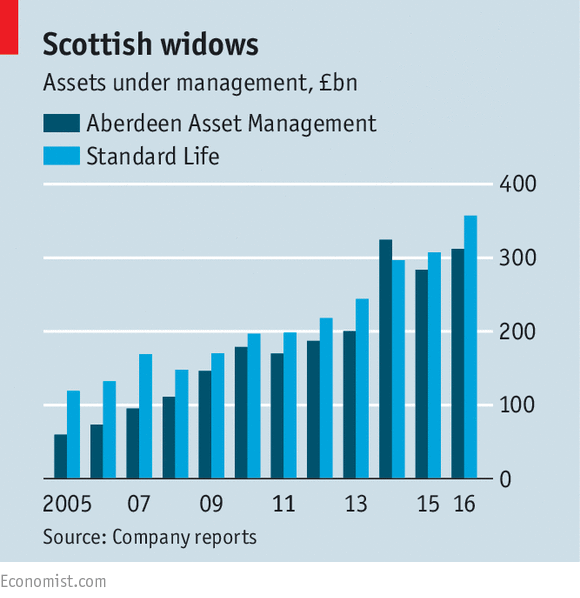
From fishing buddies to co-CEOs: that is how the relationship between Martin Gilbert, chief executive of Aberdeen Asset Management, and Keith Skeoch, his counterpart at Standard Life, will change after the companies this week announced plans to join forces. The merged company, to be based in Scotland, will have £660bn ($800bn) in assets under administration, making it Britain’s largest, and Europe’s second-largest, “active” asset manager.
Competition is forcing asset managers to consolidate. Henderson and Janus Capital teamed up last October; Amundi and Pioneer did the same in December. They hope to defend market share from fast-growing “passive” fund managers, whose funds track market indices rather than try to beat them, as active funds do. The research involved in trying to pick winners inevitably makes actively managed funds dearer than passive ones; once these costs are factored in, active managers tend to underperform passive ones. The fee gap is wide enough to have attracted scrutiny from British and European regulators: in Britain passive funds’ fees are around 0.15% of assets under management, compared with 0.9%…Continue reading
A New York startup shakes up the insurance business
 When insurance quickened the pulse
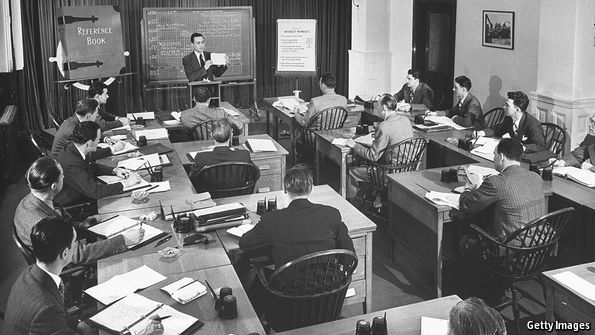
IT IS not typhoons or earthquakes that insurers should fear most, but geeks alert to their businesses’ inefficiencies. Daniel Schreiber and Shai Wininger, tech entrepreneurs with no insurance background, spotted that the industry is huge (worth $4.6trn in global premium income a year, reckons Swiss Re, a reinsurer), distrusted, antiquated and hopelessly unreformed.
In September they started Lemonade, a New York-based insurer for homeowners and renters. Some describe it as a peer-to-peer insurer (“Spiritually we’re a tech company,” says Mr Schreiber). Most agree that its app makes insurance a lot easier. This appeals to the digital generation: of 2,000 policies sold in its first 100 days, over 80% were to first-time buyers.
Insurance, the founders reasoned, suffers from misaligned incentives. Every dollar paid out comes from insurers’ pockets, encouraging poor behaviour. Normally upright people have few qualms about defrauding their insurer (as 25% of Americans do), pushing up premiums. Lemonade’s solution is to take 20% of premiums as a fee and to reward under-claiming…Continue reading
The coming revolution in insurance

IN THE stormy and ever-changing world of global finance, insurance has remained a relatively placid backwater. With the notable exception of AIG, an American insurer bailed out by the taxpayer in 2008, the industry rode out the financial crisis largely unscathed. Now, however, insurers face unprecedented competitive pressure owing to technological change. This pressure is demanding not just adaptation, but transformation.
The essential product of insurance—protection, usually in the form of money, when things go wrong—has few obvious substitutes. Insurers have built huge customer bases as a result. Investment revenue has provided a reliable boost to profits. This easy life led to a complacent refusal to modernise. The industry is still astonishingly reliant on human labour. Underwriters look at data but plenty still rely on human judgment to evaluate risks and set premiums. Claims are often reviewed manually.
The march of automation and technology is an opportunity for new entrants. Although starting a new soup-to-nuts insurer from scratch is rare (see
The end of “secular stagnation”?
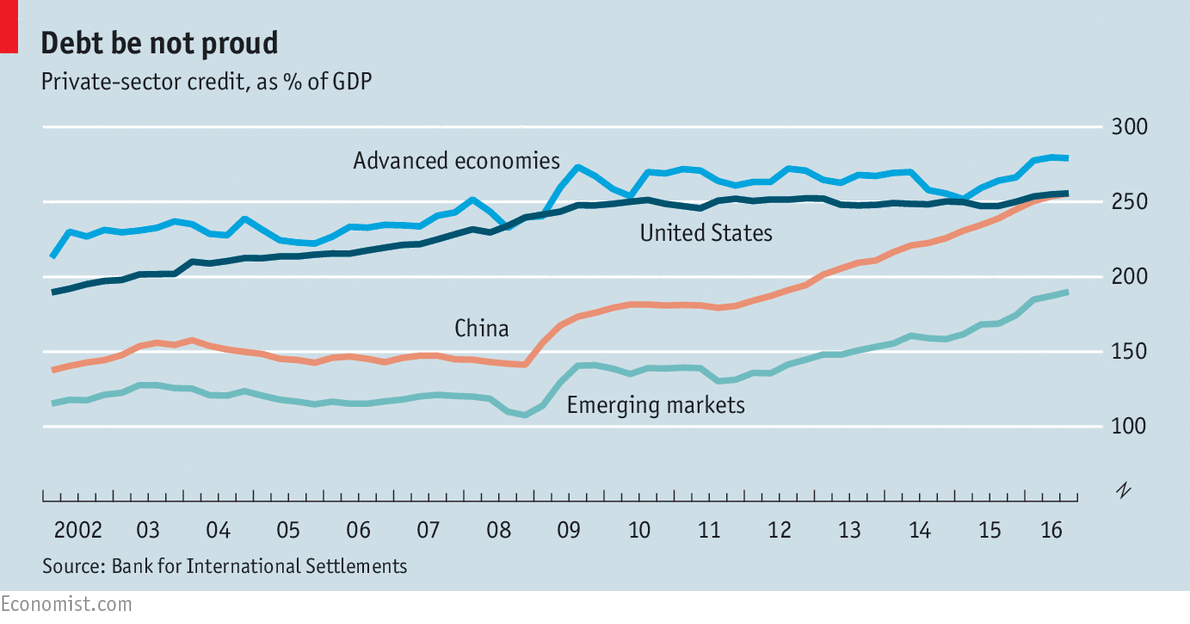
IN PERIODS of economic stress all sorts of theories are entertained about the nature of the problem. When better times return, some theories fade from memory. Others linger, however. During the economic mess of the past decade, economists frightened themselves with tales of “secular stagnation”: a nasty condition that dooms its victims to chronically weak growth. Now that the economic outlook is brightening a bit—deflation has been dispatched, and for most advanced economies 2017 is forecast to bring a third consecutive year of economic growth—it is tempting to laugh off the idea of secular stagnation as a bit of crisis-induced hysteria. Tempting, but also premature.
In a time of secular stagnation, the normal relationship between saving and investment goes haywire. People save some portion of their income each year. Because one person’s spending is another’s income, such saving can drain away demand and lead to recession, unless the funds set aside by savers are reinjected into the economy through lending to those looking to invest: as when banks lend savers’ deposits to businesses, for example. Central banks help manage this…Continue reading