
Tag: Business and finance
Podcast: Microsofter
Microsoft has reinvented itself under its new CEO Satya Nadella with a move to the cloud. Is its friendlier approach to program developers likely to pay off? Also: as the Netherlands goes to the polls, our Europe editor Matt Steinglass examines how each party’s financial manifestos were put to the test. And: many people are fed up with their banks. Now help is at a hand from Europe’s banking regulators. Simon Long hosts.
The Middle East’s once fast-expanding airlines are coming under pressure

LAST April, Etihad Airways, the flag-carrier of the emirate of Abu Dhabi, claimed that 2015 had been its fifth consecutive year in the black, with net profits of $103m. James Hogan, the firm’s chief executive, hailed the result as proof that Etihad is a “sustainably profitable airline”. Yet less than one year on, both Mr Hogan and his chief financial officer, James Rigney, have been eased out amid a “company-wide strategic review” to “improve cost efficiency, productivity and revenue”; reforms ill-befitting a healthy business. Just across the sand, Emirates, the flag-carrier of Dubai, has deferred orders for 12 double-decker Airbus A380s in response to a 75% drop in profits. Qatar Airways, the region’s other super-connector airline, has abandoned plans for a subsidiary in Saudi Arabia. After years of uninterrupted and speedy growth, the Gulf carriers are hitting turbulence.
Taken in isolation, falling profits and waning sales should be of no great concern to these industry goliaths. Low oil prices and jitters about terrorism may have sapped demand for business and leisure travel—particularly in their neighbourhood—but overall the global economy is holding up…Continue reading
The hounding of Owen Jones

IN THE big scheme of things, the retreat of a Guardian columnist from social media is not a huge event—it will be drowned out by the latest antics of Donald Trump, the extraordinary diplomatic dispute between the Netherlands and Turkey, the triggering of article 50 by the UK and Scotland’s push for a second independence referendum.
Actually, though, I think that it’s possible to tie all these events together as evidence of a much wider trend; one that is corrosive to both global politics and economics. Let us start with the specifics. Owen Jones (pictured) is a left-wing writer; initially a great enthusiast for Jeremy Corbyn, Britain’s Labour leader, he has become disillusioned. Those who previously agreed with his columns have denounced him on Facebook and Twitter. As he wrote in one final post (complete with language that may offend some)
On a daily basis I have angry strangers yelling at me, on the one hand, that I’m responsible for the destruction of the Labour Party, and on the other, I’m a right-wing sellout careerist who’s allied to Tony Blair and possibly in the pay of the Israeli government (and that I’m a Blairite cunt who needs to go fuck myself,…Continue reading
Leaked travel advice for spooks from the CIA

AMONG the trove of American intelligence agency documents released by Wikileaks this week is one that instructs the country’s spies on protocols to follow while travelling abroad. Some of these are quite specific to the CIA’s needs. (“Talk to CCIE/Engineering about your planned TDY timeline,” the document begins, adding such tidbits as “Breeze through German Customs because you have your cover-for-action story down pat.”) But others are just good common-sense business travel tips—for spies and corporate sales managers alike.
The first universal advice in the document, which appears to be designed for spooks visiting an operations base in Frankfurt, is this: “If you are using a personal credit card, be sure to call your credit card company and notify them of your travel to Germany.” That seems like sound guidance. Even better is the pithy advice on which airline to fly with:
Flying Lufthansa: Booze is free so enjoy (within reason)!
Flying United: My condolences, but at least you are earning a United leg towards a status increase.
Hardly…Continue reading
Admit it: Republicans’ proposed Obamacare overhaul offers relief for some middle earners

WHAT is the best part of House Republicans’ proposed reform of Obamacare? There isn’t one, if you believe much of this week’s commentary. The bill will benefit the young and healthy, by bringing their premiums down, but only at the cost of the old and sickly. But most writers are overlooking the help the bill would offer to one group that has clearly suffered unfairly under Obamacare. So long as Paul Ryan’s reform does not send the market into a death spiral—which is not a sure thing (see article)—this group will get some needed financial assistance under the Republican plan.
I’m talking about people who buy health insurance for themselves, rather than through an employer, and who do not get the subsidies which shield those on low incomes from Obamacare’s high premiums. It is easy to overlook this group, because the vast majority of the 10m people who buy insurance through Obamacare’s websites (or «exchanges») receive subsidies. For example, here is Jared…Continue reading
Can a railway legend deliver at America’s CSX?
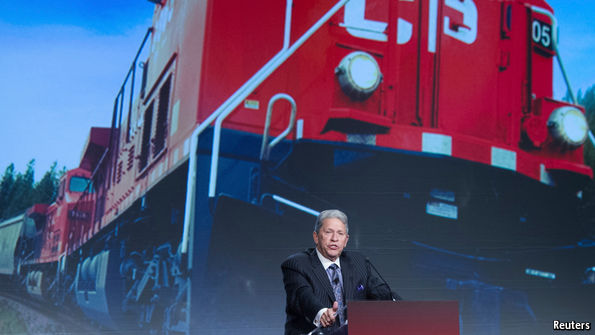
E. HUNTER HARRISON, a veteran railway executive, tried retiring in 2010, after he made Canadian National (CN), a formerly state-owned company, the best-performing of the large railways in North America. But once he pocketed the gold watch and attended the retirement party he faced a void that raising and training horses for showjumping did not fill. By mid-2012 he was back at the helm of another railway, Canadian Pacific (CP), whose glory days were long past. Once he had turned around CP, he didn’t make the same mistake again. On January 18th the 72-year-old Tennesseean both announced his departure and entered negotiations with Florida-based CSX to become that railway’s CEO.
Just the rumour that Mr Harrison might be moving to CSX caused the share price to rise by 23% in 24 hours. It continued to rise when the negotiations became public. At last, on March 6th, CSX appointed Mr Harrison as CEO and met the condition set by Mantle Ridge, an activist hedge fund with which he has partnered, to name five new board directors. Mr Harrison made long-term shareholders in CP and CN rich, tripling profits at both during his tenures. CSX shareholders expect…Continue reading
New technologies could slash the cost of steel production
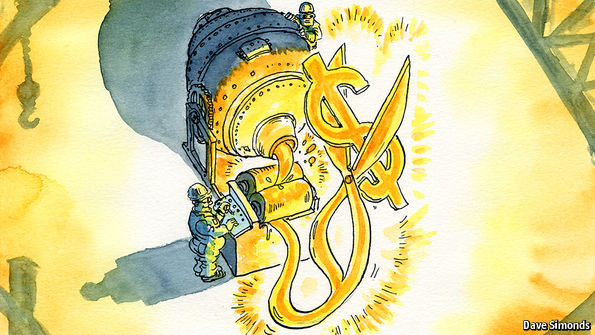
ALTHOUGH he is best known for developing a way to mass-produce steel, Henry Bessemer was a prolific British inventor. In the 1850s in Sheffield his converters blasted air through molten iron to burn away impurities, making steel the material of the industrial revolution. But Bessemer knew he could do better, and in 1865 he filed a patent to cast strips of steel directly, rather than as large ingots which then had to be expensively reheated and shaped by giant rolling machines.
Bessemer’s idea was to pour molten steel in between two counter-rotating water-cooled rollers which, like a mangle, would squeeze the metal into a sheet. It was an elegant idea that, by dint of having fewer steps, would save time and money. Yet it was tricky to pull off. Efforts to commercialise the process were abandoned.
Until now. Advances in production technology and materials science, particularly for new types of high-tech steel, mean that Bessemer’s “twin-roll” idea is being taken up successfully. An alternative system that casts liquid steel directly onto a single horizontally moving belt is also being tried. Both techniques could cut energy…Continue reading
Foreign buyers push up global house prices

MANY Americans were taken aback when news broke in January that Peter Thiel, an internet billionaire and adviser to Donald Trump, had New Zealand citizenship. For five years this backer of an “America first” president had kept his Kiwi passport quiet. Then the government released details of his $10m-lakeside estate (pictured).
A growing horde of rich foreigners see New Zealand as a safe haven. In 2016 overseas investors bought just 3% of all properties. But their purchases were concentrated at the expensive end of the market, which is growing fast: sales involving homes worth more than NZ$1m ($690,000) increased by 21%. That helped push prices in the country up by 13% over the past year, to lead The Economist’s latest tally of global house-price inflation (see table).
New Zealand is one of several countries where the impact of foreign money on housing is under scrutiny. Prices have also risen rapidly in Australia and Canada. Central bankers fret about the dangers fickle capital flows pose to financial stability. London’s mayor has ordered a study on foreign ownership in the capital after property prices…Continue reading
A deal sparks talk of car-industry mega-mergers

THE Peugeot 3008, a striking SUV, was voted European car of the year on March 6th, the eve of the opening of the Geneva motor show, an annual industry shindig. PSA Group, the maker of Peugeots and Citroëns, would doubtless view it as the second prize it scooped that day. News also came that the French carmaker was buying Opel (branded as Vauxhall in Britain), the European operation of America’s General Motors (GM). Few of the car-industry experts at the show, however, would call Opel a trophy.
The consensus was that GM was right to rid itself of a business that had lost money for 16 years straight. Opel has around 6% of the European market; that makes it too small and inefficient in a business where scale is key. It has been confined mostly to Europe for three reasons: the particular tastes of the region’s car buyers (for instance, for small diesel cars); tighter emissions regulations outside Europe; and GM’s fear of taking sales from its other brands further afield. The result has been to leave it boxed in and isolated.
Shorn of Opel, the American firm can redirect investment to China and America, where its profit margins are…Continue reading
The retreat of globalisation threatens the Dutch economy

AS ANY football fan knows, little delights the Dutch more than beating the Germans. So, as the country prepares for an election on March 15th, it should be cheering an economy that, after lagging behind Germany’s for years, is at last outpacing it. GDP grew by 2.1% last year, which was the fastest rate since 2007 and a stronger performance than its neighbours, including Germany. Unemployment has fallen to 5.3% and more people are in work than before the crisis in 2007-08.
After years of belt-tightening, households are spending again, thanks to a strong housing-market recovery and rising wages. Government finances are sound. This year the budget may be in balance—perhaps even in surplus—and public debt may drop below 60% of GDP. Yet this sunny outlook has not brightened the mood of a tetchy election campaign.
That is not so surprising. Marieke Blom, the chief economist at ING, a bank, attributes the positive forecast mostly to tough government reforms over the past few years—particularly raising the retirement age to 67 (from 2021) and reforming the financing of the health-care system. Years of reform, austerity and…Continue reading