
Tag: Business and finance
A clause in Donald Trump's new travel ban could cause problems for everyone

IF YOU are an Iraqi, or a Syrian refugee, President Donald Trump’s new travel ban will seem like an improvement over the old one. But a little-noticed clause in the measure could make travelling to America a much greater hassle, even for people carrying passports that spare them the toughest restrictions, such as Europe and Asia.
The major provisions of the updated executive order, which Mr Trump signed on March 6th, have been well publicised. The decree will once again face swift legal challenges but, if it survives, citizens of six majority-Muslim countries will still be barred from entering America for the next three months. Iraqis, though, will now be exempt from the ban and the indefinite exclusion on Syrian refugees has also been lifted, once a 120-day period has expired.
However, the Daily Beast spotted a provision on the collection of biometric data. The issue is not actually new. After the 9/11 attacks, Congress passed a law mandating the collection of such things as fingerprints and photos from…Continue reading
A volatile start for shares in Snap
 Filter bubble?
WHEN Snap, the parent company of Snapchat, an app popular among teenagers for its disappearing messages, staged a public offering on March 2nd, Evan Spiegel, its 26-year-old boss, became a self-made billionaire. (Only John Collison of Stripe, an online payments startup, rivals him for such youthful tycoonery). Whether public-market investors will strike it rich remains to be seen. In its first day of trading Snap’s shares rose by 44%; they have since fallen by 16% from their peak, meaning around $5bn of market value vanished in days.
The volatility will probably continue. Optimists reckon that Snap’s market value could increase more than fourfold from around $26bn today as it adds users and advertisers. Very few large internet companies have gone public recently, which gives it tremendous scarcity value, says Roger Ehrenberg of IA Ventures, an early-stage investment firm.
But sceptics are growing in number. Every analyst who has started covering Snap’s stock has issued a negative rating. They question its high valuation and underline all the challenges. Snap’s growth has slowed in recent…Continue reading
Mukesh Ambani has made the business world’s most aggressive bet

SOME businesspeople are guided by experts, spreadsheets and crunchy questions. What is your three-year target for market share? Will a project deliver a reasonable return on the capital invested? A few hurl all the forecasts and reports into the bin and surrender to their own hunger to make a mark.
One such figure is Mukesh Ambani, India’s richest man. In September 2016 he placed one of the biggest business bets in the world by launching Jio, a mobile-telecoms network that allows India’s masses to access data on an unprecedented scale. In the past six months it has won 100m customers. Only one other firm on the planet has such an acquisition rate—Facebook. From Kolkata’s slums to the banks of the Ganges, millions of Indians are using social media and streaming videos for the very first time.
To achieve this, Mr Ambani has spent an incredible $25bn on Jio, without making a rupee of profit, terrifying competitors and many investors. The motivation for his gamble probably lies with his turbulent family history. Reliance Industries Limited (RIL), Mr Ambani’s company, was set up by his father, Dhirubhai, in 1957. Born in humble…Continue reading
GM says ‘au revoir’ to Europe
General Motors has sold its Vauxhall and Opel brands to PSA in France. Adam Roberts our European business editor asks how the car industry is reacting to the consolidation. Also: can Snapchat succeed as a public company? And might President Trump’s accusation that China hasn’t been playing by the rules have a point? Simon Long hosts.
Why some airlines remove Israel from their online route maps
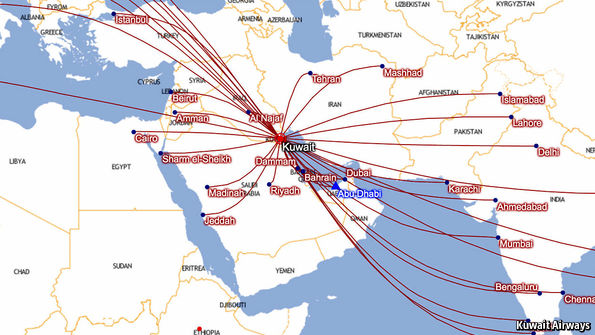
STARING at an airline’s route map can cause the heart to flutter. It seems to divide the world into two distinct groups, between memories and possibilities. But on some carriers’ maps, a third classification exists: the non-existent.
Many airlines’ route maps show every country in the world, regardless of whether they fly there. Those that do not usually illustrate their network by showing only those cities and countries served by the airline. But a few are more selective still, omitting only a single country from their worldview: Israel.
A new paper*, which is currently under peer review, by Joel Waldfogel and Paul Vaaler, both of the University of Minnesota, looks into the phenomenon. The pair classified 111 of the world’s international airlines depending on how they treat Israel on their online route maps. Outside the Middle East, all dealt with it consistently: either Israel was shown as part of a comprehensive map, or it its inclusion was dependent on whether the airline served the country.
Not so for those based in the Middle East. Here, many airlines simply erase Israel’s name off otherwise comprehensive maps (this is often done by…Continue reading
The ouija-board theory of democracy

EVER since the June 2016 referendum vote in Britain on membership of the European Union, there has been a battle over the terms of departure. The government, and right-wing press, are averse to there being any kind of scrutiny over the process by either the courts or Parliament. Judges who ruled that Parliament should approve the triggering of Article 50 (the technical start of negotiations over exit terms) were dubbed “enemies of the people” by the Daily Mail, a term that has since been taken up by Donald Trump.
But the referendum posed a very general question—“Should the United Kingdom remain a member of the European Union or leave the European Union?”—without setting out the manner of departure. Britain could have remained a member of the single market and customs union while being outside the EU (as was suggested by some members of the Leave campaign); the Conservative manifesto of 2015 (to which the government owes its legitimacy) talked about
The European Parliament votes to reintroduce visas for Americans
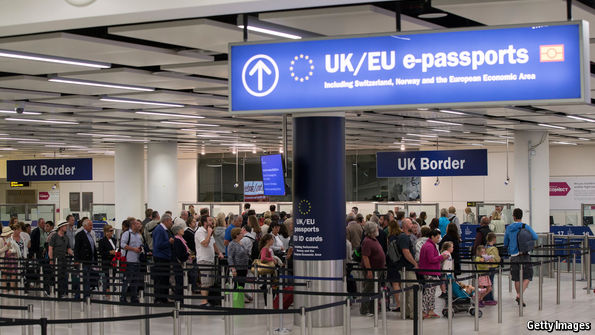
EUROPE and America have been slowly drifting apart for millions of years. Tectonic shift means that the physical distance between the continents grows by about an inch every year. If only the political divergence were so languid. From NATO to Donald Trump’s travel ban to accusations of currency manipulation, the gap between once-strong allies on either side of the Atlantic has rarely felt as chasmic.
Relations may get frostier yet. On March 2nd, the European Parliament voted temporarily to suspend visa-free travel for Americans visiting the EU. The vote is not binding—it will be up to the European Commission, the body’s executive arm, to decide whether to implement the recommendation. Nonetheless, the decision marks a sad state of affairs.
The main reason for the vote is the way that travellers from some EU countries are treated by America. While most citizens of EU countries can travel to the United States without a visa, those from Bulgaria, Croatia, Cyprus, Poland and Romania must still obtain one. Because the EU demands equal treatment of all its citizens in such matters, it says it is legally obliged to fight back.
Some media outlets, including…Continue reading
Who will lose when globalisation retreats?

THE new nationalists are on the march in Europe and America. They argue that globalisation has benefited the elites and penalised the ordinary workers and that governments should put America/Britain/France first. That means favouring domestic producers and restricting global flows of people, goods and (this gets mentioned less often) capital. The latest proposal came from the Trump White House last night—a threat to ignore World Trade Organisation rules and impose tariffs on countries with “unfair” trade practices.
A previous column suggested that the world may have entered a third phase of the post-1945 economy, after the Bretton Woods phase (fixed exchange rates and recovery) from 1945-early 1970s and the globalisation phase from 1982-2007. Each phase ended in a crisis (stagflation in the 1970s, a credit crunch after 2008). The next era could see globalisation in retreat for the first time since 1945.
That…Continue reading
The Trump administration’s trade strategy is dangerously outdated
 The trade guns of Navarro
ON THE campaign trail, Donald Trump’s trade policy was an alarming mixture of coruscating complaints and fierce threats of protectionist retaliation. But the world has been in the dark about how much of this rhetoric his administration might turn into reality. A flicker of light came on March 1st as the administration’s trade-strategy document was presented to Congress. Washington wonks see the hand of Peter Navarro, Mr Trump’s trade adviser and author of a book (and film) called “Death by China”. Robert Lighthizer, the nominee for the United States Trade Representative (USTR), has not yet been confirmed.
Little is new in the document’s promises of “ new and better trade deals” or of strict enforcement of American trade laws. But a preference for bilateral trade deals over multilateral ones is a change of tack. And the tone is certainly confrontational: “It is time for a more aggressive approach.” The document also gives an indication of how a Trump administration might take a trade fight to China: by using sections 201 and 301 of the Trade Act of 1974.
The first weapon,…Continue reading
A corruption probe raises uncertainty over the future of Eni’s boss
 Badluck Descalzi?
WHEN Eni, Italy’s oil major, this week revealed a return to profit in the fourth quarter and a long-term commitment to keep the barrels flowing, there was much to cheer. Three years on from Claudio Descalzi’s appointment as CEO, Eni has made spectacular oil and gas discoveries even as its peers retrenched amid the oil-price slump. Sanford C. Bernstein, a research firm, says only half in jest that it is “evolving into an actual oil company”.
But a cloud hangs over the firm, which is 30% state-owned—and over Mr Descalzi (pictured) personally. He is caught up in an Italian probe into alleged corruption in a deal Eni struck in partnership with Royal Dutch Shell in Nigeria, just as he is seeking reappointment as CEO in April. The company’s response to the scandal, especially its treatment of independent board members, raises questions about its commitment to good corporate governance.
In 2011, Eni and Shell jointly paid $1.3bn for a huge offshore oil block, known as OPL 245, which has more than 9bn barrels of probable reserves. Over $1bn of this flowed to a shell company. That firm, Malabu,…Continue reading