
Tag: Business and finance
Competition for private-equity deals heats up

TIME was, the private-equity industry felt spoiled for choice. The difficulty was choosing deals, not finding them. Yet according to numbers from Dealogic, a data provider, that have been crunched by Bain & Company, a consultancy, private-equity houses are now losing out in mergers and acquisitions (M&A) to non-financial companies. In 2016 private equity’s global share of all deals dipped to 4.2%, the lowest level since the depths of the post-crisis recession in 2009. This was down from 5.4% as recently as 2014 and an all-time high of 7.9% in 2006. The same trend is evident in Europe and in America, private equity’s two biggest markets (see chart).
Yet the pressure on private-equity firms to deploy their capital has never been greater. The industry has raised well over $500bn from investors in each of the past four years, the longest such streak ever. The amount of uninvested cash they are sitting on (“dry powder”) reached a record $1.47trn at the end of 2016. Of that, $534bn was specifically earmarked for buy-outs. Investors, who pay fees as a percentage of the capital they have committed, even when it is still uninvested,…Continue reading
Second-degree moral hazard
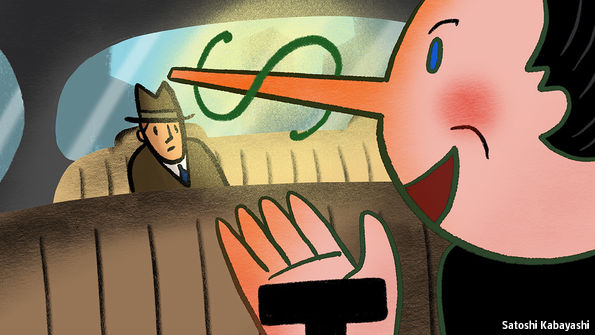
MORAL hazard is a problem that crops up often in economics. People behave differently if they do not face the full costs or risks of their actions: deposit insurance makes customers less careful about picking their bank, for example.
Moral hazard can also be second-hand. Take medicine. A patient with private insurance may be happy to sit through extra tests, and a doctor may be happy to order them. Doctors might be more reluctant to order tests if they know that the patient would bear the full cost.
A newly published paper* sets out to test this secondary problem by examining a common-enough situation—taking a taxi ride in a strange city. The authors, a trio of academics at the University of Innsbruck, sent researchers on 400 taxi rides, covering 11 different routes, in Athens, Greece. In all cases, the researchers indicated they were not familiar with the city. But in half the cases, the researchers indicated that their employers would be reimbursing them for the journey. The researchers in the latter group were 17% more likely to be overcharged for their trip and paid a fare that was, on average, 7% higher.
The most common form of…Continue reading
Interest rates and investment returns

IF THERE is one aspect of the current era sure to obsess the financial historians of tomorrow, it is the unprecedentedly low level of interest rates. Never before have deposit rates or bond yields been so depressed in nominal terms, with some governments even able to borrow at negative rates. It is taking a long time for investors to adjust their assumptions accordingly.
Real interest rates (ie, allowing for inflation) are also low. As measured by inflation-linked bonds, they are around -1% in big rich economies. In their latest annual report for Credit Suisse on global investment returns, Elroy Dimson of Cambridge University and Paul Marsh and Mike Staunton of the London Business School look at the relationship between real interest rates and future investment returns. Very low real rates have in the past been associated with poor future equity returns (see chart).
That may come as a nasty shock for state and local-government pension funds in America. They have to assume a future rate of return on their investments when calculating how much they need to contribute to their plans each year. Most opt for 7-8%, a level that has…Continue reading
Travis Kalanick’s uber-apology

“I MUST fundamentally change as a leader and grow up.” It is rare for the boss of a big technology firm to be so contrite. It is even more of a surprise to have Travis Kalanick (pictured), the chief executive of Uber, a popular ride-hailing company, go that far: he is one of the most pugnacious entrepreneurs in Silicon Valley. “This is the first time I’ve been willing to admit that I need leadership help and I intend to get it,” he added.
Mr Kalanick had little option but to grovel. On February 28th Bloomberg, a media group, released a video showing a heated discussion between him and an Uber driver, Fawzi Kamel, about the fact that the firm has lowered the rates its drivers receive. Mr Kamel told Mr Kalanick that he had lost $97,000 and gone bankrupt because of him, at which point Mr Kalanick lost his cool: “Some people don’t like to take responsibility for their own shit.”
The video capped a terrible month for Mr Kalanick. First, more than 200,000 subscribers deleted their Uber app after the firm was accused of breaking a strike by taxi drivers protesting Donald Trump’s executive order against refugees. Then a former…Continue reading
Podcast: Money talks
There are a number of growing threats to Europe with Brexit and maybe another Greek disaster looming. But Eurogroup president Jeroen Dijsselbloem tells Sacha Nauta the EU is actually on the mend. Also: Why Oscar mix-ups symbolise how independent films such as Moonlight are overshadowed by the big studios. Simon Long hosts.
Air passengers rail against allowing mobile-phone calls on planes

ONE by one, airline passengers’ privileges have been taken away: free checked bags, free carry-ons, complimentary food and drink, on-board entertainment. Now, with the advent of “basic economy” class, some flyers are even losing the ability to choose their seats, sit with family members and accrue qualifying miles toward elite status. So it is rather interesting that when passengers are offered the chance of a new privilege, their response seems to be an overwhelmingly “no thank-you”.
The issue at hand is the use of cell phones on planes. The U.S. Transportation Department recently sought public comment on whether it should continue to ban calls from mobiles in the air. More than 8,000 people weighed in before the deadline in February. And in an era when it’s hard to achieve public consensus on just about anything, this issue seems to unite people to an uncommon degree.
Of the last 100 public comments submitted, for example, just one was in favour of calls on planes—and only if airlines agreed to strict regulations and imposed “no call periods” during takeoff, landing…Continue reading
How quickly will the Federal Reserve tighten?

EVER since the Presidential election, markets have focused on the potential for fiscal policy—tax cuts and spending increases—to boost the American economy. But over the last few days, there has been a reminder that monetary policy, which has dominated investors’ thoughts for much of the period 2008, still has the potential to have a big impact. The possibility of a rate rise from the Federal Reserve this month overshadowed President Donald Trump’s speech to Congress.
William Dudley of the New York Fed said that the case for tightening had become a “lot more compelling in recent months” and that “the risks for the outlook are now starting to tilt to the upside”. John Williams of the San Francisco Fed said that a March hike was now getting serious consideration. Bloomberg reckons the markets are pricing in a 60% chance of a rate hike on March 15th; Brown Brothers Harriman reckons the probability is 74%. The acid test…Continue reading
Taxi drivers overcharge when passengers are on expenses

MORAL hazard is a problem that crops up frequently in economics. People behave differently if they do not face the full costs or risks of their actions: deposit insurance makes customers less careful about choosing their banks, for example.
Moral hazard can also be second-hand. Take medicine. A patient with private insurance may be happy to sit through extra tests, and a doctor may be happy to order them. Doctors might be more reluctant to order tests if they know that the patient would bear the full cost.
A newly published paper* sets out to test this secondary problem by examining a common-enough situation—taking a taxi ride in a strange city. The authors, a trio of academics at the University of Innsbruck, sent researchers on 400 taxi rides, covering 11 different routes, in Athens, Greece. In all cases, the researchers indicated they were not familiar with the city. But in half the cases, the researchers indicated that their employers would be reimbursing them for the journey. The researchers in the latter group were 17% more likely to be overcharged for their trip and paid a fare that was, on average, 7% higher.
The most…Continue reading
William Jennings Trump and the monetary elite
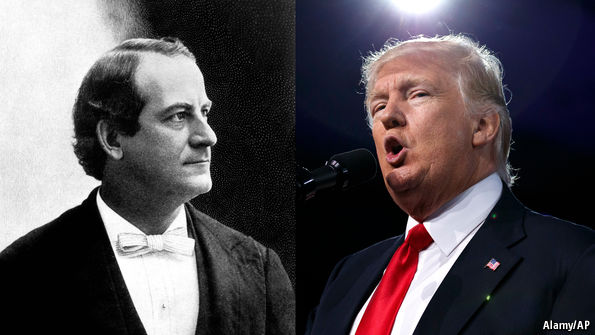
DONALD Trump has been compared with many past politicians—Richard Nixon for his suspicion of the press and Warren Harding for his isolationism are two obvious examples. Steve Bannon, Mr Trump’s alt-right hand man, has just compared him with William Jennings Bryan, who ran unsuccessfully for President in 1896, 1904 and 1908 on the Democratic ticket.
Mr Bannon said that Mr Trump was an orator in the class of Bryan, although that seems pretty hard to credit. The current President has displayed nothing like the eloquence used by Bryan in his most famous speech, to the 1896 Democratic convention.
You come to us and tell us that the great cities are in favour of the gold standard. I tell you that the great cities rest upon these broad and fertile prairies. Burn down your cities and leave our farms, and your cities will spring up again as if by magic. But destroy our farms and the grass will grow in the streets of every city in the country.
Having behind us the commercial interests and the labouring interests and all the toiling masses, we shall answer their demands for a…Continue reading
The rise of artificial intelligence is creating new variety in the chip market, and trouble for Intel
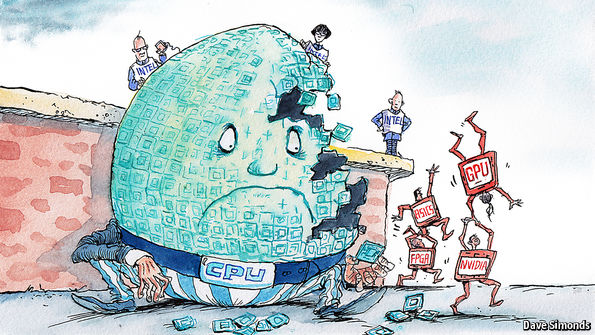
“WE ALMOST went out of business several times.” Usually founders don’t talk about their company’s near-death experiences. But Jen-Hsun Huang, the boss of Nvidia, has no reason to be coy. His firm, which develops microprocessors and related software, is on a winning streak. In the past quarter its revenues increased by 55%, reaching $2.2bn, and in the past 12 months its share price has almost quadrupled.
A big part of Nvidia’s success is because demand is growing quickly for its chips, called graphics processing units (GPUs), which turn personal computers into fast gaming devices. But the GPUs also have new destinations: notably data centres where artificial-intelligence (AI) programmes gobble up the vast quantities of computing power that they generate.

Soaring sales of these chips (see chart) are the clearest sign yet of a secular shift in information technology. The architecture of computing is fragmenting…Continue reading