
Tag: Business and finance
In fintech, China shows the way

CHINESE banks are not far removed from the age of the abacus. In the 1980s they used these ancient counting boards for much of their business. In the 1990s many bank employees had to pass a basic abacus test. Today the occasional click-clack, click-clack can still be heard in villages as tellers slide their abacus beads up and down the rack.
But these days the abacus is mainly a symbol, more likely to be used in the branding of China’s online-finance companies than as a calculating tool. At least three internet lenders have paid homage to it in their names: Abacus Loans, Small Abacus and Modern Abacus. The prominence, so recently, of the abacus is testament to how backward Chinese banking was a short time ago. The rise of the online lenders shows how quickly change has come.
By just about any measure of size, China is the world’s leader in fintech (short for “financial technology”, and referring here to internet-based banking and investment). It is far and away the biggest market for digital payments, accounting for nearly half of the global total. It is dominant in online lending, occupying three-quarters of the global market. A…Continue reading
Why taxing robots is not a good idea

BILL GATES is an unlikely Luddite, however much Microsoft may have provoked people to take a hammer to their computers. Yet in a recent interview with Quartz, an online publication, he expressed scepticism about society’s ability to manage rapid automation. To forestall a social crisis, he mused, governments should consider a tax on robots; if automation slows as a result, so much the better. It is an intriguing if impracticable idea, which reveals a lot about the challenge of automation.
In some distant future robots with their own consciousnesses, nest-eggs and accountants might pay income taxes like the rest of us (presumably with as much enthusiasm). That is not what Mr Gates has in mind. He argues that today’s robots should be taxed—either their installation, or the profits firms enjoy by saving on the costs of the human labour displaced. The money generated could be used to retrain workers, and perhaps to finance an expansion of health care and education, which provide lots of hard-to-automate jobs in teaching or caring for the old and sick.
A robot is a capital investment, like a blast furnace or a…Continue reading
Are airlines' new "last class" fares just a bait-and-switch?
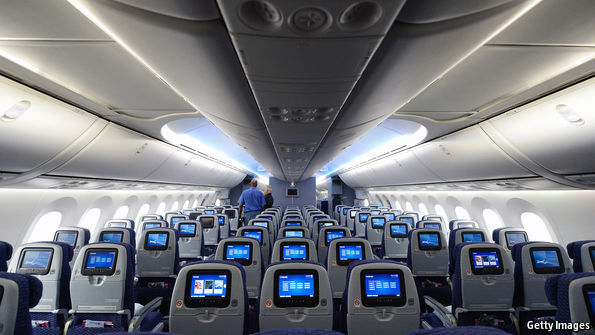
THIS week, United Airlines introduced the change that no flyers were eagerly awaiting: “basic economy” class. You might think that some budget-conscious travellers would welcome the arrival of the new no-frills designation, which offers the lowest fares but strips away flyers’ ability to select their seats, bring full-size carry-on bags onto the plane and earn elite qualifying miles. They might, except basic economy doesn’t actually bring lower fares than the ones already available.
Ben Schlappig was the first to note this on his popular «One Mile at a Time» blog. Mr Schlappig looked at fares on a Minneapolis-Denver route before and after the introduction of basic economy. (On February 22nd United began offering basic economy only between its seven American hubs and Minneapolis; other routes in the United States, Latin America, and the Caribbean will follow.) Prior to the rollout, he found that standard economy fares on this route started at $173. When the “new” fares became available, the basic economy seats began…Continue reading
What to drink at 30,000 feet

THERE exists a genre of information which might be termed “little-known facts that everyone knows”. It is the sort of tidbit you expect to amaze your friends at a dinner party, but which is greeted with rolled eyes. Casinos don’t have clocks or windows. Alanis Morissette’s song “Ironic” contains no example of irony. The body exerts more calories digesting celery than is contained within the vegetable. (Except the last of these facts—and everyone knows this—is in fact untrue.)
Then there is Bloody Marys and aeroplanes. Have you ever wondered why the only time most people fancy gulping down vodka, tomato juice and Worcestershire sauce is when strapped into the seat of a passenger jet? It is a little-known fact (that everyone knows) that our taste buds are dampened by the low pressure and humidity in the cabin, as well as the white noise of the engines. This particularly affects flavours that are sweet and salty. The umami taste, however, remains prominent. Tomato juice is high in umami. Worcestershire sauce, meanwhile, is what one cook…Continue reading
Clean energy’s dirty secret
Could the rise of renewables be putting the traditional electricity market into a crisis? Also: Economist Diane Elson takes governments to task about the gender biases in their economic policies. And how the Brazilian government is tackling one of its biggest financial problems: pensions.
The busiest airports in Europe

ANYONE who has tried to hold a conversation in a West London garden will wonder how it is possible to squeeze any more more flights into Heathrow Airport. On average, a chinwag is interrupted every minute or so by a Boeing or an Airbus rumbling overhead.
And yet each year more people manage to pass through. The latest figures from Airports Council International (ACI), an industry group, show that in 2016 passenger numbers grew by 1% at Europe’s busiest hub, to 75.7m. Charles de Gaulle in Paris, Europe’s second busiest airport, lags way behind (see chart).

Heathrow’s two runways are currently running at the very limit of their capacity. That will change once a third runway opens, perhaps in 2026. But in the meantime the only way for the airport to continue to grow is to service bigger planes. This year Korean Air became the ninth airline to fly A380 superjumbos into the airport….Continue reading
Dubai is to test passenger-carrying drones
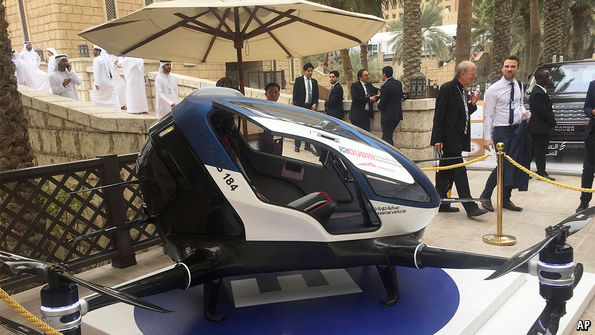
AT TIMES it can feel like we are living in an episode of “Travel Futurama”. This week: flying drone taxis.
Dubai, a city that sometimes seems to inhabit a time zone five years ahead of the rest of the planet, has embraced another improbable travel innovation, to go alongside its enthusiasm for hyperloop trains and long driverless metro lines. This week, the Emirati metropolis announced it is to test passenger-carrying drones in its skies by July.
The unpiloted drone taxis won’t exactly replace the traditional earthbound sort, since they will be able to carry only one passenger, who together with luggage cannot weigh more than 100 kilograms (220 pounds). And it will have a range of just 50 kilometres (31 miles), or half an hour of flying time. But if it works, the long-term implications are huge not only for Dubai, which has among the world’s Continue reading
Samsung’s boss is arrested on bribery charges

IN ONE of the many interrogations Lee Jae-yong has undergone in connection with a presidential influence-peddling scandal, he said that he would surrender management control of Samsung, the South Korean electronics giant that he is running on behalf of his incapacitated father, Lee Kun-hee, “if there is anyone better than me”. He may now be forced to do so. On February 17th Mr Lee was arrested on suspicion of bribery, embezzlement, perjury, moving assets abroad illegally and concealing evidence of criminal profit, after a local court agreed to a request from a special prosecution team for a pre-trial detention.
Last month investigators accused Mr Lee of paying 43bn won ($36m) in bribes to organisations tied to Choi Soon-sil, a confidante of South Korea’s president, Park Geun-hye (who is herself under investigation by the constitutional court). The prosecution team’s first request for a pre-trial arrest warrant was rejected. But the court reversed its decision, it said today, after prosecutors put forward additional evidence. (The court denied, however, a request to arrest another Samsung executive, Park Sang-jin, on similar charges.) The move…Continue reading
Euphoria returns to markets
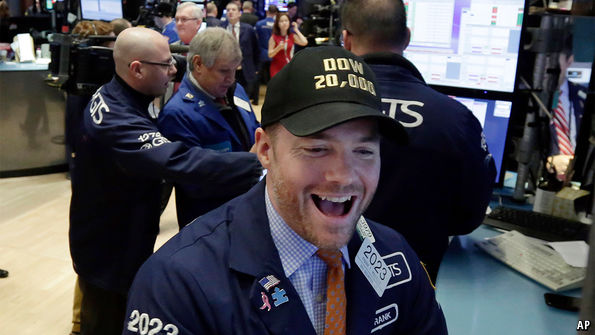
LIKE the weather in Chicago, you don’t have to wait long for a new trend in the stockmarkets. Just a few weeks ago, investors seemed to have second thoughts about their Trump-related euphoria (which itself was a contrast to the widespread nervousness ahead of the election). Now they have been recording new highs again.
While the spark for the rally seems to have been a Presidential comment about forthcoming tax cuts, the causes have been much broader; the MSCI World Index has also hit new highs. Commodity prices have perked up, which may be a sign that the Chinese economy is holding up (if you recall, a Chinese slowdown was the big worry 12 months ago). Asian trade has perked up after a long period of sluggishness (the exports of South Korea, a bellwether in this respect, have risen for three months in a row). According to…Continue reading
Asia’s exports rebound
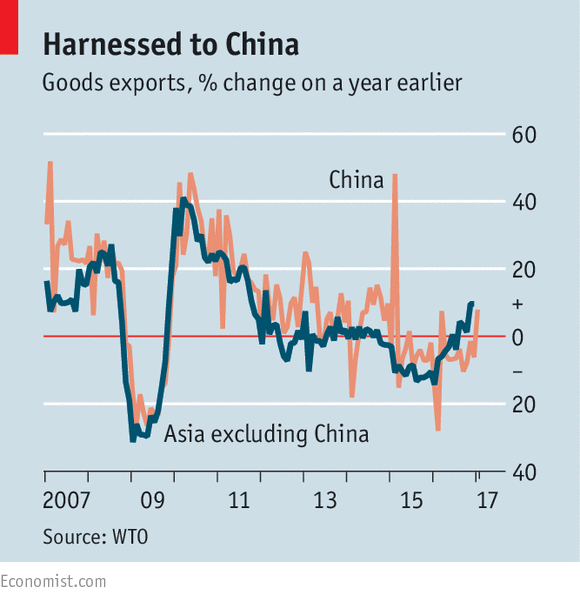
IT IS easy to be downcast about the state of global trade. It has faced stiff headwinds in recent years: in 2016, for the first time in 15 years, it grew more slowly than the world economy. Regional and global trade deals are going nowhere, slowly. And America’s new president has promised to protect his country from trade-inflicted “carnage”.
Amid all this gloom, optimism seems foolhardy. But in Asia’s export dynamos, trade is picking up steam. In January, Chinese exports rose year-on-year for the first time in ten months; South Korean shipments have increased for three months in a row. Surveys reveal strong export pipelines in Japan, Singapore and Taiwan. Healthy order books for Asia’s manufacturers normally bode well for global trade and indeed the global economy. It is too soon to declare a definitive upturn in global trade, but it looks like more than a blip (see chart).
The simplest explanation for the rebound is that global demand is itself on solid ground. Global growth is still slower than before the financial crisis of 2008, but is heading in the right direction. Both the IMF and the World Bank think it will…Continue reading