
Tag: Business and finance
Sovereign-bond issuers shrug off downgrades
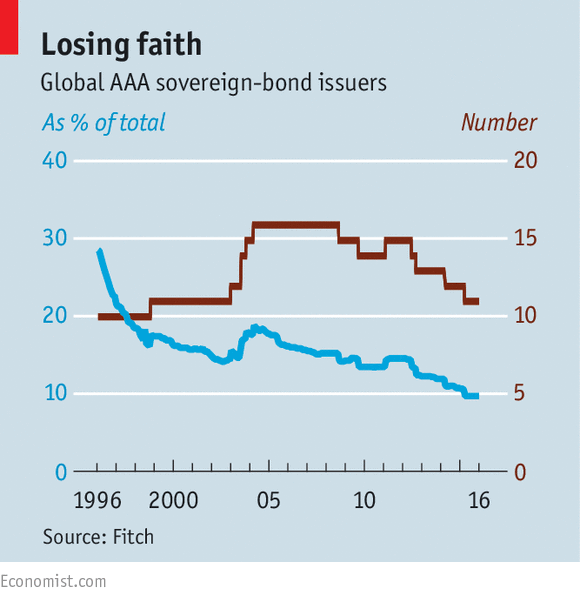
ONCE upon a time, countries jealously guarded their credit ratings. Before the 2010 British election, George Osborne, soon to be the chancellor of the exchequer, emphasised the importance of cutting the budget deficit in order to maintain the country’s top AAA rating.
But despite the spending cuts and the tax increases he imposed, Britain was downgraded in 2013. There are only 11 countries with AAA status, according to Fitch, a rating agency, down from 16 in 2009. By value, only 40% of global sovereign debt has the highest rating, down from 48% a decade ago.
There has been an even more dramatic downward trend in corporate debt ratings. There were 99 AAA-rated American corporations in 1992, according to S&P Global, another ratings group; now there are just two. That trend is linked to the tax deductibility of interest: in terms of tax efficiency, it has made sense to increase the amount of debt, and reduce the equity, on the balance-sheet.
Clearly, at the sovereign level, the deterioration has been driven by the global financial crisis, which dented both economic growth and tax revenue. But with bond yields very…Continue reading
A settlement ends Hank Greenberg’s epic lawsuit

A SETTLEMENT to be signed in front of a New York judge as The Economist went to press on February 16th marked the end of years of attritional legal warfare. It was less clear who had won: the state of New York or Maurice (Hank) Greenberg, the now 91-year-old former chief executive of AIG, once the world’s largest insurer, but saved by a government bail-out in 2008.
Eric Schneiderman, New York’s attorney-general, had seemed in little doubt when he issued a surprise statement on February 10th. Hank Greenberg had admitted “to initiating, participating and approving two fraudulent transactions…that fundamentally misrepresented AIG’s finances.” He had agreed to pay a $9m fine.
Mr Greenberg, however, saw things differently. Within hours of Mr Schneiderman’s statement, his attorney, David Boies, issued a response, accusing the state of being false and misleading and noting that Mr Greenberg’s own carefully negotiated statement had no “reference to any accounting being fraudulent” or suggested that Mr Greenberg was aware of any fraud.
By February 13th Mr Greenberg was on the offensive. In a press…Continue reading
Spain’s banking clean-up

ALMOST five years have passed since the near-collapse of Bankia, one of Spain’s biggest lenders, forced the country into a European banking bail-out. But inquiries into what went wrong continue—and widen. This week, for the first time, the investigations embroiled Spain’s financial regulators, including a former governor of the central bank, the Bank of Spain, Miguel Angel Fernández Ordóñez.
On February 13th the national court indicted Mr Fernández Ordóñez and seven other senior regulators, ordering a criminal investigation but without specifying any charges. The court is questioning why they allowed Bankia to sell shares in an initial public offering in 2011, less than a year before Bankia’s portfolio of bad mortgage loans forced the government to seize control of it. It said there was evidence the regulators had “full and thorough knowledge” of Bankia’s plight. After its nationalisation, it went on to report a €19.2bn ($24.7bn) loss for 2012, the largest in Spanish corporate history.
The investigation comes as several bankers are already awaiting sentencing for mismanagement and fraud. Most prominent…Continue reading
The European Union’s delicate political economy

GREECE’S marathon crisis is at least instructive. Past flare-ups have illustrated a textbook’s worth of economic principles. The latest episode—a dispute over the sustainability of Greece’s mammoth debt—provides a lesson in political economy. The beleaguered economy itself is not at the centre of the disagreement; rather it is the European Commission and the IMF and others that are at loggerheads, squabbling over projections of Greek growth. This sort of institutional wrangling is not incidental to the process of European integration; it has historically been a crucial ingredient, helping defang the continent’s tricky interstate relations. But as Greece’s latest turn in the spotlight demonstrates, the role of Europe’s institutions has changed during the euro-area crisis. Paradoxically, they themselves have become part of the existential threat facing the European project.
Like European identity itself, the role of “institutions” can seem vague, amorphous and of overstated importance. Yet institution-building has been one of the most consequential aspects of European integration. Economists view institutions as the solutions to social…Continue reading
International visitors are already turning their back on Trump-era America

WHEN President Donald Trump announced his travel ban last month, affecting people from seven majority-Muslim countries, this blog wondered what effect it would have on tourism and business travel to America. “The direct impact to tourism of a travel ban from these countries will be small,” a fellow Gulliver noted, since “each sends a piddling number of visitors to America.” But there was a bigger concern: “Will the decree—easily interpreted as a deep hostility to the world beyond America’s shores—put off global travellers?”
Two weeks later, it has become clear that the answer is yes.
Last week, the travel ban was blocked temporarily by a federal judge and the suspension upheld by a panel of appeals court judges. But that hasn’t stopped Mr Trump’s executive order from having an effect on travel to the United States.
Hopper, a market research firm, looked at online searches for flights into America, comparing the final weeks of the Obama administration with the…Continue reading
Investors flock to buy a piece of Mexico’s leading tequila-maker

OVER the course of more than 200 years in the tequila business, Jose Cuervo will have been responsible for a fair few moments of giddy pleasure. Last week, it got one of its own thanks to a successful initial public offering (IPO). It was eight times oversubscribed and raised 18.6bn pesos ($920m) in exchange for 15% of the company.
Jose Cuervo, which is based in the western state of Jalisco, is one of the country’s best-known brands, and has been run by the same family for 11 generations. It dominates the Mexican tequila industry; sales in 2015 came to 18.5bn pesos. It also holds an assured place in the history of mixology: the original margarita cocktails were purportedly made with Jose Cuervo tequila.
Long considered a candidate for flotation, it eventually published a prospectus in September 2016. The IPO was delayed, though, seemingly to allow the company to take stock of the impact of Donald Trump’s election victory in November. Since then the peso has dropped over 10% against the dollar, and Mr Trump’s desire to rework, even to rip up, the North Atlantic Free-Trade Agreement, and perhaps impose a border tax on Mexican exports to America has sent tremors…Continue reading
Banks on the move
Are thousands of banking jobs set to migrate from Britain into the eurozone? Patrick Lane discusses potential destinations with host Simon Long. Also: a currency catastrophe in Zimbabwe and the decline of the executive jet
Business travellers are keener on the sharing economy than their employers
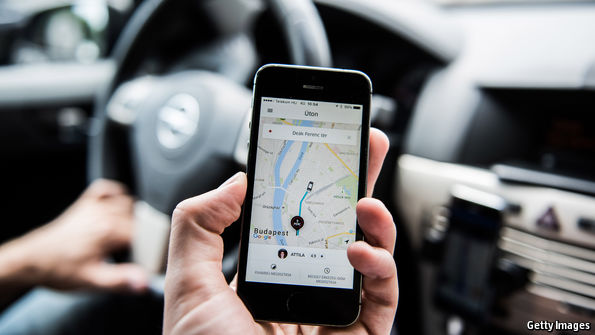
RIDE-HAILING apps and home-rental sites are fast becoming mainstays of the corporate travel world—but perhaps not quite as fast as many business travellers would like.
Two recent reports shed light on the rapid changes taking place within the industry. One comes from the Global Business Travel Association (GBTA), which represents corporate travel managers. Its latest survey found that the number of businesses allowing their employees to use ride-hailing services such as Uber and Lyft has increased by nearly 15% since June. Over the same period, the share permitting workers to book lodging through Airbnb and similar services increased 20%. Yet despite that growth, half of corporate travel policies still don’t allow employees to use ride-hailing apps, and 70% prohibit home-rental services in favour of traditional hotels.
At first glance, those figures appear at odds with a survey released by Certify, which makes software that tracks business-travel expenses. It found…Continue reading
The problem that links business, finance and politics

THE problem is as old as mankind. The Roman author Juvenal encapsulated it into a phrase “Quis custodiet ipsos custodes” or “Who guards the guards themselves?” It was neatly illustrated in the classic BBC series “I, Claudius”. The infirm Claudius wants the return of the Republic. But the Praetorian guard, set up by his relatives, needed an Emperor to ensure their special status. So on the murder of Caligula, they drag Claudius from his hiding place behind a curtain, and make him Emperor.
Throughout history, dictators have faced this problem. They can surround themselves with men with swords or guns. But it only takes one guard with a sword or gun to turn into an assassin or to seize power for himself. The Shah of Iran had a huge army in 1979 but it did him no good; the soldiers had more sympathy with the revolutionaries than with the Shah himself.
In business and finance, this is known as the “principal-agent” problem. Shareholders employ managers to run a company; investors use fund managers to look after their savings. That makes sense. It allows us to take advantage of the expertise of others, and of…Continue reading
Passengers like flying on planes not made by Boeing or Airbus

ONE statistic that never fails to amaze is the claim by Boeing that one of its 737-model planes lands or takes off somewhere in the world every two seconds. Airbus, the American planemaker’s bitter European rival, makes a similar assertion about its A320 series (although fewer have been built). So ubiquitous are these mid-sized, short-haul aircraft that if you are sat on a modern plane with 120-200 seats you are all but guaranteed to be on an A320 or a 737. That duopoly is nice for Boeing and Airbus, which have collectively delivered 16,800 of the two models. But, in Europe at least, passengers are getting a taste of what else might be.
Last July, Swiss International Air Lines became the first carrier in the world to fly the Bombardier CSeries on scheduled commercial operations. It currently deploys five CS100s (pictured) from Zurich to two dozen European cities. The 125-seat jets are borrowed from parent company Lufthansa, Germany’s flag-carrier, which has ordered 30 CSeries and expects to receive another 12 of the planes this year. More recently, Air Baltic, the flag-carrier of Latvia, became the first to fly the CS300, a larger variant which it has configured with 145…Continue reading