
Tag: Business and finance
Stockmarkets are confident, banks not so much

THE headline-grabbing market event of 2017 so far has been the move of the Dow Jones Industrial Average through 20,000 (although the average is a flawed measure). But while investors have been pushing the value of shares up, the credit rating of its constituents has been deteriorating.

That is the conclusion of a new service called Credit Benchmark, which has the ingenious idea of aggregating the private credit ratings used by banks (in other words, the ratings generated by the bank’s internal risk models). At the moment, the service is getting data from 13 banks although another 12 have signed up; it has ratings for 10,000 companies. Donal Smith, one of the firm’s founders says that banks tend to be more conservative in their approach than the ratings agencies and move their ratings more quickly.
The…Continue reading
Should America want a strong dollar? It's complicated

IN AN experience we have all had, Donald Trump, unable to sleep, reportedly rang his National Security Advisor at 3:00 in the morning to ask whether America should want a strong dollar or a weak one. Look, there are no stupid questions. This one is actually more interesting than you might think. There are a few ways to answer it.
One way is to ask what it would mean if there were a random rise in the dollar (caused, say, by noise trading). Tyler Cowen takes this approach. Since most Americans have their incomes and wealth in dollars, a rise in the dollar would generally be good for America and bad for non-Americans: with caveats, including the fact that a stronger dollar might cause financial trouble for indebted emerging markets which could feed back into the American economy.
That’s fine and all, but the dollar usually does what it does for a reason, or some set of reasons, and the answer to the question depends on why the dollar is strong or weak. Matt Yglesias
Tata’s governance is still faulty
 Chandra in, Cyrus out
PROFIT is to good corporate governance what tides are to swimming trunks: when the former is high, absence of the latter tends to go unnoticed. The ebbing of profits at Tata, India’s largest conglomerate, in recent years has prompted a power struggle that in turn has exposed the often dysfunctional relationship between several dozen businesses, holding companies, people and charities that use the Tata name. The struggle is now over: on February 6th, Cyrus Mistry, Tata’s boss until last October (pictured on next page, on the right) was finally booted out of the company. Natarajan Chandrasekaran (on the left), the boss of one of the group’s key operating firms, Tata Consultancy Services, takes over as chairman on February 21st.
Executives at the 149-year-old group hope that will close a grim chapter in its history. Mr Mistry, whose family owns an 18% stake in Tata Sons, the main holding company, which is unlisted, reacted badly to being evicted as its chairman last year. The move to oust him was set in motion by Ratan Tata, the group’s 79-year old patriarch (and Mr Mistry’s interim successor)….Continue reading
Ralph Lauren and Macy’s tell a similar tale of woe

NEW YORK’s fashion week, which will start on February 9th, promises the usual show of glamour, but a more fascinating industry display came a week earlier. On February 2nd Ralph Lauren, a well-known brand, said that the executive it had hired in 2015 to overhaul its business would leave. On February 3rd the Wall Street Journal reported that Macy’s, America’s biggest department store, might be bought by Hudson’s Bay, a smaller Canadian rival. Each is an institution of American retailing. Each is a reminder of how hard it is to keep pace.
Consumer habits have changed especially rapidly in their world. Frocks, bags and shoes are now disproportionately bought online compared with other goods. Last year clothes and accessories accounted for a fifth of e-commerce, estimates Cowen, a financial-services firm; far higher than their 8% share of total retail spending. Cowen expects Amazon to surpass Macy’s as America’s top clothing seller this year.
For manufacturers, such as Ralph Lauren, the picture is more mixed. For some clothing firms, particularly small ones, Amazon offers a new way to reach…Continue reading
Internet firms’ legal immunity is under threat

GOOGLE, Facebook and other online giants like to see their rapid rise as the product of their founders’ brilliance. Others argue that their success is more a result of lucky timing and network effects—the economic forces that tend to make bigger firms even bigger. Often forgotten is a third reason for their triumph: in America and, to some extent, in Europe, online platforms have been inhabiting a parallel legal universe. Broadly speaking, they are not legally responsible, either for what their users do or for the harm that their services can cause in the real world.
It is becoming ever clearer, however, that this era of digital exceptionalism cannot last for ever. Governments and courts are chipping away at the sovereignty of internet firms, and public opinion is pushing them to police themselves better. Given their growing heft, this shift is likely not just to continue but to accelerate.
When the internet went mainstream in the mid-1990s, online firms feared being held liable if their services were used in illegal ways—for instance, when subscribers posted copyrighted content or defamatory information. The danger was underlined in…Continue reading
China tightens monetary policy (discreetly)

IF ASKED before the start of 2017 to bet on which important central bank would be the first to raise interest rates this year, the safe choice would have been the Federal Reserve. Some gamblers, relishing the long odds, might have gone for the Bank of England or even taken a flutter on the European Central Bank. All these guesses would have been wrong. The first to budge this year? The People’s Bank of China.
On February 3rd the Chinese central bank raised a series of short-term rates. The decision received scant attention. The increases were, after all, small: one-tenth of a percentage point for the main rates. It also seemed quite technical, primarily affecting liquidity tools that lenders can tap if short of cash. And there was no fanfare: the central bank did not publish an explanation.
But China’s move is important for two reasons. First, it highlights the government’s dilemma in managing the economy. Growth is expected to slow from last year’s pace of 6.7%, and recent surveys suggest that momentum is already ebbing. Sentiment is fragile: investment by private companies last year increased at its slowest pace in more than a…Continue reading
Remaking American financial regulation

AT FIRST blush, there is little to be excited about. The eighth executive order of Donald Trump’s infant presidency, signed on February 3rd, lists seven “core principles” for regulating America’s financial system. These include the prevention of bail-outs by taxpayers; advancing the American interest in international negotiations; and tidying the unruly thatch of federal regulation. The treasury secretary and regulators must report by early June on how well existing laws fit the bill. “There is little in the actual executive order that the Obama administration would have disagreed with,” says Doug Elliott of Oliver Wyman, a consulting firm.
And yet. Although the edict does not mention the Dodd-Frank act of 2010, which redefined financial regulation after the crisis of 2008, it is chiefly aimed at that law. (Another presidential memorandum paves the way to aborting a rule tightening financial advisers’ obligations to Americans saving for retirement.) Many banks, especially smaller ones, loathe the 848-page act and its reams of ensuing rules. According to Davis Polk, a law firm, 111 of its 390 “rule-making requirements” have not yet…Continue reading
Explaining euro-zone market jitters
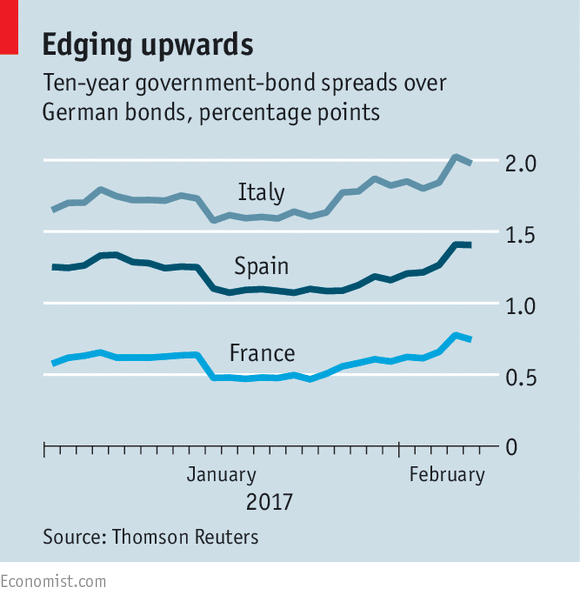
IT was not an ideal way to mark a silver jubilee. The 25th anniversary of the signing of the Maastricht treaty, which gave life to the idea of a single European currency, fell on February 7th, the same day that the IMF published its annual health-check on the Greek economy. It said most (but not all) of its board favoured more debt relief to get Greece’s public finances in order—an idea quickly trashed by euro-zone officials.
A day earlier the spread between ten-year government bonds in France and Germany had reached its widest level in four years. The proximate cause seemed to be a growing concern about political risks to the euro. François Fillon, once the front-runner in the race for the French presidency, is embroiled in a scandal and losing ground. A fear is that his fall from grace might boost support for Marine Le Pen, leader of the National Front, who wants France to leave the euro and the EU.
Shorter odds on a Le Pen victory would certainly justify a higher risk premium on French bonds. Yet there is more to the latest bout of euro-area bond jitters than a sharper focus on politics. After all, bond markets…Continue reading
Big data, financial services and privacy

DONALD TRUMP’s health-insurance premiums could soon go up, and not just because of his love of burritos. Data-crunchers have found a link between the negativity of someone’s tweets and his risk of dying of heart disease. The education levels of your Facebook friends or the activity on your phone can help reveal how likely you are to repay a loan. Money-managers are rummaging ever more curiously through customers’ digital lives.
This is all part of an “intensifying data arms-race in finance”, says Magda Ramada Sarasola from Willis Towers Watson, a consultancy, which claims that no industry used more big data last year. Banks and insurers used to rely only on what customers and credit agencies told them, but today websites and mobile-banking apps let them get much more close and personal. Less conventional sources are also popular. Social-media profiles, web-browsing, loyalty cards and phone-location trackers can all help. In a trial, FICO, America’s main credit-scorer, found that the words someone uses in his Facebook status could help predict his creditworthiness (tip: avoid “wasted”). Even facial expressions and tone of voice are being…Continue reading
Snow-making companies in a warming world
 Better than mud
THE creamy glide of fresh powder sends skiing enthusiasts into ecstasies. Scraping over brown patches and dodging lumpen rocks inspires far less enthusiasm. Thousands of families will hit Europe’s slopes this month, hoping that snow conditions will be more favourable than at the start of the season in December. A warming world is changing precisely how, when and where snow falls. For the winter-sports industry, such shifts could hit profits harder than a springtime avalanche.
The snowfall season has become shorter in places such as the Alps, says David Robinson of Rutgers University in New Jersey, as snow arrives later and melts earlier than it once did. Resorts at lower altitudes are among the most vulnerable. Since the 1970s the duration of the snow season, averaged over the northern hemisphere, has declined by five days a decade, according to the European Environment Agency. Huge regional variation exists, however, both in Europe and elsewhere. Californian slopes that were unable to open in recent years because of snow shortages had to close at the start of 2017 because too much of the stuff had…Continue reading