
Tag: Business and finance
Investors in America’s housing-finance giants lose in court

ONE unresolved issue from the financial crisis is the future of Fannie Mae and Freddie Mac, the two firms that stand behind much of America’s housing market. Fannie and Freddie purchase mortgages, bundle them into securities and sell them on to investors with a guarantee. When America’s housing market collapsed a decade ago, the government had to bail them out. Its treatment of the firms since then has created a titanic legal struggle. Shareholders have cried foul. On February 21st, a federal appeals court upheld a ruling in the government’s favour.
At issue is the Obama administration’s decision in 2012 to hoover up all of Fannie and Freddie’s profits. Until then, it had received a fixed dividend on its investment. The timing of the shift was striking—just before a surge in the firms’ profitability. Since 2008 the Treasury has sucked in about $250bn from the firms, 30% more than the cost of the bail-out.
The change enraged hedge funds who had bought Fannie and Freddie’s shares and found themselves expropriated. The investors’ lawsuit held that the government overstepped its authority by seizing all profits. A federal court…Continue reading
3G missed Unilever but its methods are spreading
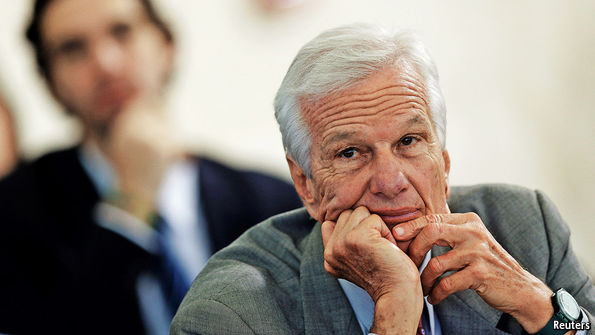 Rejected suitor
JORGE PAULO LEMANN (pictured), a Brazilian investor, is ill-accustomed to failure. On February 17th Kraft Heinz, backed by Mr Lemann’s 3G Capital, said it had bid $143bn for Unilever, a maker of food and personal products. 3G has gobbled many a consumer firm, slashed costs, then bought an even bigger one. Even so, the Unilever bid was surprising in its audacity—the merger would have been the second-largest ever. As shocking, it collapsed two days later.
Kraft Heinz had hoped to continue talks in private, but news of its offer leaked out. Its management appeared to have badly misjudged the depth of Unilever’s attachment to its culture and its pursuit of long-term, “sustainable” growth. Unilever’s outright rejection meant that 3G and Warren Buffett, who was expected to help fund a deal, faced the prospect of going hostile against a revered firm. It was a rare stumble. But the episode doesn’t spell the end of its model. More deals are likely. And Kraft Heinz is already changing how Unilever and other rivals operate.
Times are hard for big consumer companies, once among the world’s…Continue reading
It is easier than ever to fund an indie film, but harder than ever to get people to see it
 Atypical success
IT MIGHT seem a great time for indie cinema. The Academy Awards on February 26th will be something of a showcase for films not financed by a major studio. “Manchester by the Sea”, a contender for six Oscars, including best picture, was a darling of the Sundance Film Festival last year. Kenneth Lonergan’s masterpiece (one scene is pictured) about family and loss has earned $46m in cinemas in America and Canada, a spectacular return on its production costs of $8.5m. Amazon, which bought distribution rights, will benefit.
Movie buffs can find all manner of films online that are made more cheaply still. “The Break-In”, a horror film shot by Justin Doescher on his girlfriend’s iPhone for less than $20, has earned him more than $20,000, with more than half a million people having watched at least part of it on Amazon’s streaming-video platform.
For every success story there are thousands of indie films that go unwatched. The digital age has made it easier than ever to make a film, but also harder than ever to break through the clutter of entertainment options to an audience. Chris Moore, a…Continue reading
The sanctity of trade statistics
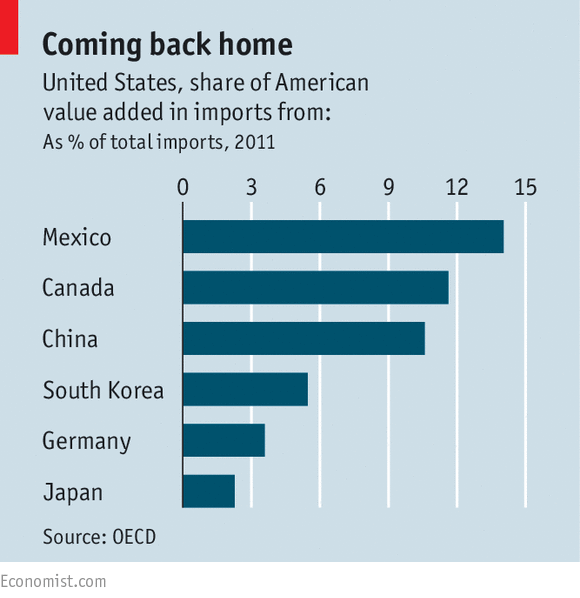
MIGHT Donald Trump’s promise to shake up America’s trade policy extend to its statistics? According to a report in the Wall Street Journal, discussions are afoot on changing the way trade figures are tallied. The Bureau of Economic Analysis, the country’s main statistical body, calls this “completely inaccurate”. But in trade as elsewhere, the new administration seems prone to using statistics as a drunk uses a lamppost—for support rather than illumination.
The proposal reportedly involves stripping out some of America’s exports from the gross numbers. America sold $1.5trn of goods abroad in 2016, but of that $0.2trn were re-exports that left the country much as they had arrived. This type of trade has been growing, reflecting America’s role as a hub for North American trade. As a share of its combined exports to Mexico and Canada, re-exports rose from 12% to 20% between 2002 and 2016. Truckers and shippers benefit from this kind of trade. But critics see it as “padding”, obscuring gloomier trends in “made in America” exports.
Stripping out re-exports makes no sense when thinking…Continue reading
Europe’s securitisation market remains stunted
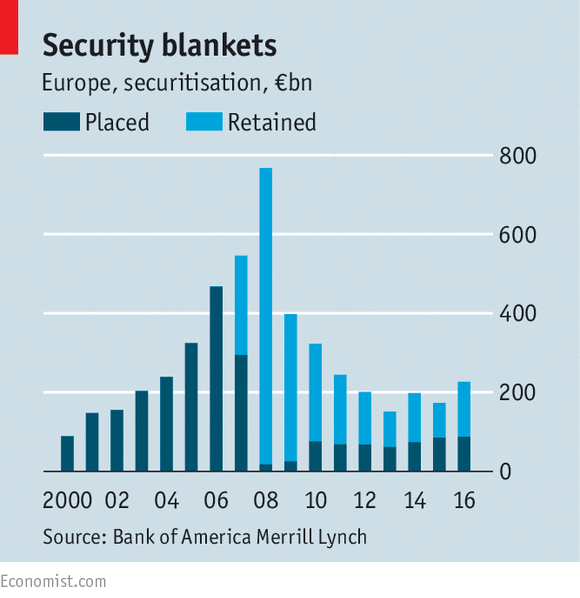
SECURITISATION, the bundling and repackaging of income streams as tradable securities, goes in and out of fashion. America is still dealing with the fallout from the disaster in one part of the market—sub-prime mortgages—in 2008-09 (see article). In Europe, the swings in popularity have been just as marked. During the crisis, European securitised assets were hit by only small losses but the market suffered from guilt by association. It has since enjoyed a limited renaissance.
Leading the revival, oddly, are European regulators. They have sought not just to rehabilitate, but indeed actively to promote such “structured” finance. As early as 2013 the European Central Bank (ECB) was effusive not only about securitisation’s ability to spread risks, but also about its ability to channel funding to the economy, including small and medium-sized enterprises (SMEs). The ECB and the Bank of England even published a rare joint paper in 2014 making the case for a “better-functioning…Continue reading
India’s hostels for the upwardly mobile
 Rite of passage
IF SEVERAL hundred million Indians do migrate from the countryside to cities between now and 2050, as the UN expects, it will be a fiendishly busy few decades for Vivek Aher, who runs a low-cost hostel, one of five, on the outskirts of Pune, a well-off city three hours’ drive from Mumbai. A fair few of the new arrivals will have their first experience of urban living bunking in one of the hostels’ 1,350 beds. Should recent experience be anything to go by, most of the new arrivals will test Mr Aher’s patience by tacking posters on his hostel’s walls, or endlessly complaining about the Wi-Fi.
India has two main drags on economic growth. One is the difficulty of finding a job, especially in the places people live. The other is a chronic shortage of cheap housing. Aarusha Homes, Mr Aher’s employer, started in 2007 to help people seize economic opportunities far from home. Its rooms are basic and cheap. They include up to six beds, a bathroom for every three or four residents, some common areas and little else. Rent ranges between 3,500 and 10,000 rupees ($52-$149) a month including food.
Most…Continue reading
Toymakers bounce back in the land of adult nappies

WILLIAM ELLIOT GRIFFIS, an American educator who travelled to Japan in the 1870s, noted that in the previous two and a half centuries, “the main business of this nation was play”. He described toyshops filled as full as Christmas stockings and plenty of grown-ups “indulging in amusements which the men of the West lay aside with their pinafores”.
Griffis would have found it familiar walking today around Hakuhinkan Toy Park, one of the largest toy stores in Tokyo. Teens, office workers and grandparents are mostly to be seen perusing its 200,000-odd knick-knacks across five floors. Its director, Hiroyuki Itoh, says he wants the store to be a place where everyone can play. After work, suited salarymen come to spend ¥200 (under $2) for a five-minute whizz around a 36-metre slot-car racetrack. In another corner a gaggle of university students fiddle with displays of toys from the era of their childhoods.
Playthings aimed at the over-20s make up 27% of Japan’s domestic toy sales, according to figures from Euromonitor, a market-research firm. That grown-up portion of the market has been crucial for Japan’s three biggest players,…Continue reading
Why national budgets need to take gender into account
 A good investment
LIKE many rich-country governments, Britain’s prides itself on pursuing policies that promote sexual equality. However, it fails to live up to its word, argues the Women’s Budget Group, a feminist think-tank that has been scrutinising Britain’s economic policy since 1989. A report in 2016 from the House of Commons Library, an impartial research service, suggests that in 2010-15 women bore the cost of 85% of savings to the Treasury worth £23bn ($29bn) from austerity measures, specifically cuts in welfare benefits and in direct taxes. Because women earn less, rely more on benefits, and are much more likely than men to be single parents, the cuts affected them disproportionately.
The government does not set out to discriminate, says Diane Elson, the budget group’s former chair. Rather, it overlooks its own bias because it does not take the trouble to assess how policies affect women. Government budgets are supposed to be “gender-neutral”; in fact they are gender-ignorant. Ms Elson is one of the originators of a technique called “gender budgeting”—in which governments analyse fiscal policy in…Continue reading
Are technology firms madly overvalued?
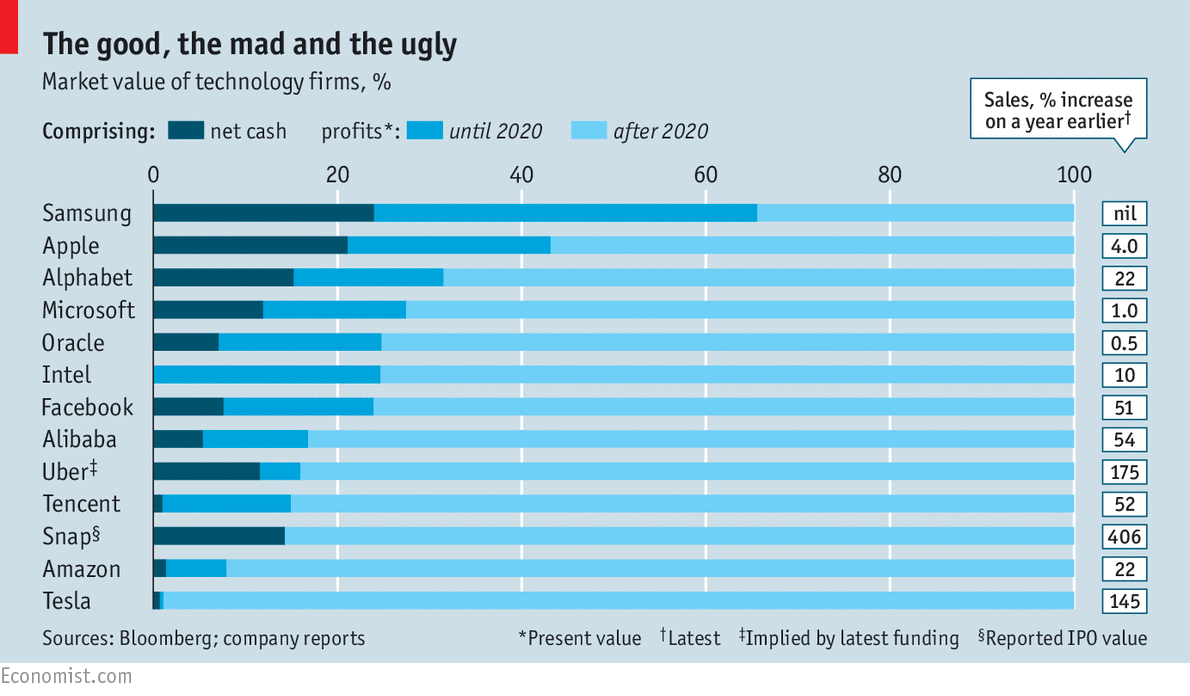
IS THE technology industry in La La Land? There are alarming signs. House prices in San Francisco have risen by 66% more than in New York over the past five years. Even at the height of the dotcom bubble in 2001, the gap was lower, at 58%. Shares of technology firms trade on their highest ratio to sales since the turn of the century. Four of the world’s most valuable firms are tech companies: Apple, Alphabet, Microsoft and Amazon. Snap, a tiddler with $400m of sales and $700m of cash losses in 2016, is expected to list shares on March 1st that will give it a valuation of over $20bn.
For companies and investors in any industry, it is hard to work out if you are living in a bubble. To help, Schumpeter has created three sanity tests for global tech firms. These examine their cashflow, whether investors differentiate between companies, and whether forecasts of their future earnings suffer from a fallacy of composition. The exercise suggests that tech valuations are frothy, but not bubbling.
The first test is cashflow, and the industry passes it with flying colours. In 2001 about half of all listed tech firms were unable to convert…Continue reading
The rise of “deep-tech” is boosting Paris’s startup scene

EUROPE will never create a hub of tech firms and investors to rival Silicon Valley, many experts on entrepreneurship concur. Its markets are still fragmented along national lines, flows of capital into the region are limited and because of lingering, conservative attitudes to risk, few startups grow to rival American champions. “Europe is toxic”, argues Oussama Ammar, an outspoken founder of an incubator in Paris. “Life that should happen, does not happen”, he says.
But some digital life does flourish, spread among cities rather than fixing in one spot. Fintech firms cluster in London. Gamers and music-sharing sites do well in the Nordic countries. Berlin has a crop of companies that go beyond the kind of me-too consumer sites incubated by Rocket Internet, a notorious startup factory: new companies with expertise in the “internet of things”, for example. Milan, with strong medical universities, has flourishing biotech startups.
The most striking case of fresh growth is in Paris. Mention of France has long elicited sighs from venture capitalists. Its rigid labour laws and hefty taxes on wealth and on stock options have meant that…Continue reading