
Tag: Business and finance
Behind the bid for Sky is a less powerful Murdoch empire

IT WOULD seem to be a stunning comeback for Rupert Murdoch and his clan. Five years ago News Corporation was engulfed by scandal. One of its British papers, the News of the World, had routinely hacked private phones. In the aftermath the company gave up a bid it had made for BSkyB (now simply called Sky), a satellite broadcaster in which it had a stake. A parliamentary report declared Mr Murdoch unfit to lead a large company. James Murdoch, his son, resigned as chair of BSkyB and chief of the newspaper division. Ofcom, Britain’s media regulator, eviscerated his leadership as “difficult to comprehend and ill-judged”.
Now the Murdoch empire appears to be striking back. On December 9th, 21st Century Fox, the Murdochs’ entertainment business, said it had reached a preliminary deal to pay £11.2bn ($14.1bn) for the 61% of Sky it does not already own. James Murdoch is ascending once more: indeed, this deal is chiefly his doing. Last year he succeeded his father as boss of 21st Century Fox, and in January he reclaimed his Sky chairmanship. But the show of strength comes with new weaknesses.
Much has…Continue reading
Do fiscal rules work in emerging markets?
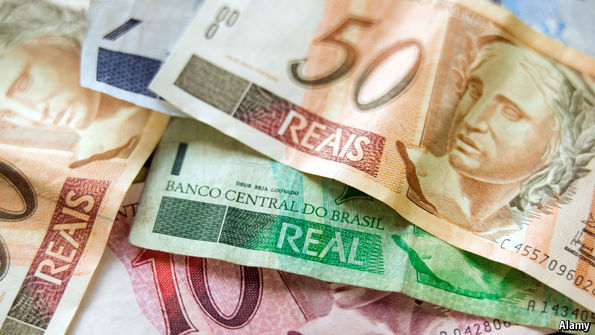
FROM its headquarters in Brasília, a sterile, technocratic city, Brazil’s federal government doles out money for health, education, generous pensions and artistic awards, among other things. Over the past two decades, this spending has grown by more than 185% in real terms. Over the next 20 years, its growth will be zero.
That, at least, is the intention of a constitutional amendment passed this week by Brazil’s Senate. The measure, which allows federal spending (excluding interest payments and transfers to states and municipalities) to grow no faster than inflation, is an unusually ambitious example of a fiscal rule: a quantitative limit on budget-making, which lasts beyond a single year and perhaps beyond a single government.
The best known, and least loved, fiscal rule is the euro area’s stability and growth pact. But such rules are also now common among emerging economies. According to the IMF’s latest count, 56 developing countries in 2014 had rules of some kind, including 15, like Brazil, that impose limits on the growth of public spending.
The reasons so many emerging-market governments choose to limit their fiscal…Continue reading
France’s corporate raider, Vincent Bolloré, makes a bid for Italy’s biggest broadcaster

NO BOSS in French business can match Vincent Bolloré for swagger and aggression. Variously described by the press in France as a stubborn Breton, a ruthless profiteer and a smiling killer, the 64-year-old corporate raider has acquired interests in media, transport, advertising, telecoms and more, scattered across Europe and Africa. Opinion at home is divided between those who say his methods are too brutal and others who welcome his effect on an often dozy business world.
This week it was the turn of Italian newspapers to rant against the French “pirate” and “mercenary”. On December 13th the news came that France’s Vivendi, a media firm in which Mr Bolloré’s company, Bolloré Group, owns 20% (he effectively controls it) was racing to buy up shares in Mediaset, Italy’s biggest TV-broadcaster. Things moved swiftly. By the next day Vivendi had a 20% stake in Mediaset, up from 3% two days earlier. The Italian firm claims a hostile takeover attempt—the smiling killer’s speciality—is under way.
Mr Bolloré has long aimed at winning a share of Mediaset. Earlier this year, Vivendi had agreed a plan with Mediaset in which…Continue reading
Alphabet’s Google is searching for its next hit
 Deflated hopes
“JUDGE a man by his questions, rather than his answers,” Voltaire advised. Google has become one of the most successful firms in history by heeding that advice. It evaluates the intention of web-surfers’ queries and returns relevant advertising alongside search results. But for years there has been a lingering question about Google: can it create a new, highly profitable unit to rival its search business?
Not yet. In the past five years, Alphabet, formed as a holding company for Google and other disparate projects in October 2015, has spent $46bn on research and development (see chart). Much has gone to so-called “moonshot” projects, such as self-driving cars, smart contact lenses and internet delivered via balloons. Its British artificial-intelligence unit, DeepMind, also falls into the category of other projects. Since the start of 2015, these bets have together recorded a loss of $6bn.
 Continue reading
What DeepMind brings to Alphabet

DEEPMIND’S office is tucked away in a nondescript building next to London’s Kings Cross train station. From the outside, it doesn’t look like something that two of the world’s most powerful technology companies, Facebook and Google, would have fought to acquire. Google won, buying DeepMind for £400m ($660m) in January 2014. But why did it want to own a British artificial-intelligence (AI) company in the first place? Google was already on the cutting edge of machine learning and AI, its newly trendy cousin. What value could DeepMind provide?
That question has become a little more pressing. Before October 2015 Google’s gigantic advertising revenues had cast a comfortable shade in which ambitious, zero-revenue projects like DeepMind could shelter. Then Google conjured up a corporate superstructure called Alphabet, slotting itself in as the only profitable firm. For the first time, other businesses had their combined revenues broken out from Google’s on the balance-sheet, placing them under more scrutiny (see Continue reading
Venezuela’s lunatic experiment in demonetisation
 Bum notes
ANYTHING India does, Venezuela can do worse. Last month, in a dramatic effort to curb corruption, India’s government cancelled all its high-denomination banknotes without warning. Since 98% of transactions in India are done in cash, commerce seized up. It is a huge mess, but India will after a while print enough replacement notes. And it has a plausible plan to help its many poor people join the cashless digital economy.
Not so Venezuela. President Nicolás Maduro says that the constant shortages of more or less everything in Venezuela are caused by evil speculators. (They are actually caused by his price controls.) Mr Maduro claims that “mafias” in Colombia are stockpiling lorryloads of bolívars, the Venezuelan currency, and sneaking across the border to buy up price-controlled goods. Given Venezuela’s soaring inflation, this seems improbable. “The idea that anybody would want to hoard a currency that has lost 60% of its value in the past two months is absurd,” says David Smilde of the Washington Office on Latin America, a think-tank.
Nonetheless, on December 11th Mr Maduro announced that the…Continue reading
An early salvo in a trade war between America and China?
ANNIVERSARIES should be happier than that on December 11th, marking China’s 15 years as a member of the World Trade Organisation (WTO). On that day, China expected to be unshackled from its legal label as a “non-market economy” and attain “market-economy status”. In the event, America and the European Union refused to give it the nod. On December 12th the Chinese reacted: see you in court.
The fight will focus on the wording in the original accession agreement. The Americans and the Chinese are both confident of winning. Legal experts are divided. The WTO does not provide a clear definition of a “market economy”. And clumsy legal drafting does not help.
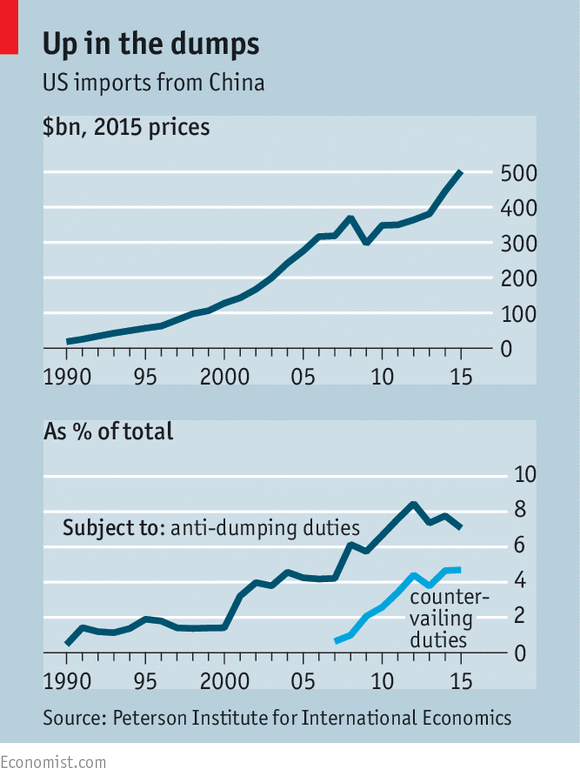
The meat of the row is over the method WTO members use to protect their industries against cheap Chinese imports. Alleging that Chinese companies enjoy subsidised credit, energy and raw materials, America and the EU slap anti-dumping duties on 7% (see chart) and 5% respectively of their Chinese imports. The agreement welcoming China into the WTO explicitly gave other members licence to treat it as a non-market economy until December 11th 2016….Continue reading
Management theory is becoming a compendium of dead ideas
NEXT year marks the 500th anniversary of the event which, more than any other, gave birth to the modern world: Martin Luther promulgated his 95 theses and called the Catholic church to account for its numerous theological errors and institutional sins. Revisionist historians have inevitably complicated the story (including questioning whether he did actually nail his proposals to the door of All Saints’ Church in Wittenberg) but the narrative remains clear. The church was ripe for change. It was sunk in corruption and divorced from the wider life of society. And by unleashing that change, Luther brought the Christian faith, including Roman Catholicism itself, a new lease of life.
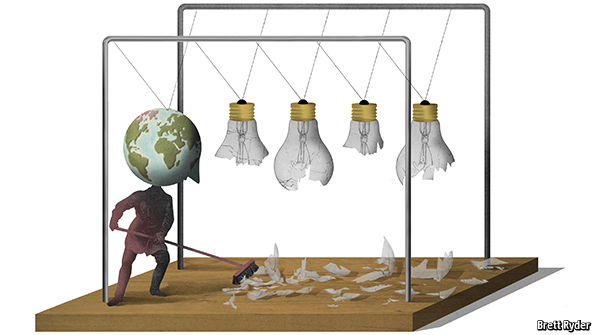
The similarities between medieval Christianity and the world of management theory may not be obvious, but seek and ye shall find. Management theorists sanctify capitalism in much the same way that clergymen of yore sanctified feudalism. Business schools are the cathedrals of capitalism. Consultants are its travelling friars. Just as the clergy in the Middle Ages spoke in Latin to give their words an air of authority, management theorists speak in mumbo-jumbo. The medieval…Continue reading
The Asian Development Bank tries to evolve

JUST outside the Asian Development Bank (ADB) headquarters, a barefoot girl in a tattered yellow shirt stretches out her hand as a few of its employees walk past. One gives her change—not exactly a textbook approach to development lending but a natural-enough impulse. “It reminds you of what you’re doing every day,” he says as he reaches into his wallet.
It is also a small reminder of what sets the ADB apart from its China-led challenger, the Asian Infrastructure Investment Bank (AIIB). Since its formal launch in 2015, the AIIB has garnered much more attention than the ADB. But the ADB is still much bigger, with a presence throughout Asia’s poorest areas and a focus on all aspects of development, from education to anti-corruption projects, not just infrastructure.
It also has an impressive track record. December 19th will mark the ADB’s 50th anniversary. It funds projects and provides policy advice from Georgia in the west to the Cook Islands in the east. It had a hand, albeit a small one, in the economic miracle Asia has witnessed in its lifetime. It has never suffered a default on the $250bn that it has doled out over the years…Continue reading
Italy’s biggest bank unveils a recapitalisation plan

THIS is no time to be timid. Or so Jean-Pierre Mustier seems to think. On December 13th, after five months in the job, the chief executive of UniCredit presented his plan for Italy’s biggest bank. He didn’t hold back. UniCredit is shedding €17.7bn worth ($18.8bn) of bad loans, taking a one-off provision of €8.1bn. It will save €1.7bn a year by 2019, cutting 6,500 jobs on top of 7,500 previously announced to shrink its workforce by 14%. And in a rights issue next year it will raise €13bn—just €2bn less than its market value before the announcement. The markets lapped it up: the shares gained 16%, before retreating the next day.
Mr Mustier had already been busy. The previous day UniCredit sold Pioneer, its asset-management arm, to France’s Amundi (though it will still distribute Pioneer’s products). It recently unloaded its stake in Bank Pekao, in Poland, as well as 30% of Fineco, an Italian online bank of which it will retain control. The bad-debt write-down, restructuring costs and other bits and bobs will partially offset the gains from these sales and the rights issue. But the boss expects UniCredit’s ratio of…Continue reading