
Tag: Business and finance
The financial markets in an era of deglobalisation

FOR more than two decades after the early 1980s, it seemed as if the financial markets were moving in only one direction. More and more money was flowing across borders; capital markets were becoming increasingly integrated.
Since the 2008 financial crisis this particular aspect of globalisation has stalled, and even partly retreated. The reversal is illustrated by the triennial survey of foreign-exchange markets, conducted by the Bank for International Settlements (BIS). Daily turnover in April was $5.1trn, down from $5.4trn in April 2013.
That is still a huge number compared with the turn of the century, when daily turnover was around the $1trn mark. But it is a sign that markets are getting a little less frenetic; spot (or instant) currency trading has fallen by 19% in three years.
Other data from the BIS confirm the trend. Cross-border banking claims peaked in the first quarter of 2008 at $34.6trn. By the second quarter of 2010, they had dropped to $27.9trn, and they have never recovered their pre-crisis levels. In the second quarter of this year (the most recent data), claims were $28.3trn. Part of this may be a…Continue reading
Place-based economic policies as a response to populism

HOW do you solve a problem like Ohio? Over the course of a generation America’s once-thriving industrial heartland has withered. Economic stress has contributed to rising rates of drug addiction and falling life-expectancy. Frustrated, Ohioans and other Midwesterners pushed Donald Trump to victory in November. That has focused attention on the plight of declining industrial areas in the rich world. Yet orthodox economics has few answers to the problem of regional inequality.
Economists used to think the best policy was often merely to wait. From 1880 to 1980 the incomes of poorer and richer American states tended to converge, at a rate of nearly 2% per year, according to research by Peter Ganong and Daniel Shoag of Harvard University. That pattern has since broken down (see chart). Yet the shift of resources and the movement of people from declining places toward thriving ones remains an important part of the process of economic growth. In theory, the gains should be big enough to compensate those harmed by the shift, leaving everyone better off. “Governments should not try to rescue failing towns,” The…Continue reading
Republican plans to cut corporate taxes may have unpleasant side-effects

SINCE Donald Trump won America’s presidential election investors have salivated over the prospect of lower taxes. Mr Trump has promised to cut corporation tax, a levy on firms’ profits, from 35% to 15%. Republicans remain in charge of both houses of Congress; Paul Ryan, the speaker of the House of Representatives, wants to cut the levy to 20%. The coming reforms, though, are about more than just lower rates. Republicans want to overhaul business taxes completely. Unfortunately, this task is far from straightforward.
America’s corporate-tax rate, which reaches 39.6% once state and local levies are included, is the highest in the rich world. But a panoply of deductions and credits keeps firms’ bills down. These include huge distortions, such as a deduction for debt-interest payments, as well as smaller scratchings of pork like special treatment for NASCAR racetracks. After all the deductions are doled out, corporate-tax revenues are roughly in line with the average in the rest of the G7, according to economists at Goldman Sachs.
Still, a high tax rate and a narrow tax base is a glaringly inefficient combination. Politicians of all…Continue reading
The Fed finally manages to lift rates in 2016

TODAY, finance and economics journalist gathered for a long-awaited Federal Reserve announcement: that the Fed’s benchmark interest rate would rise once more, by 25 basis points, to a range between 0.5% and 0.75%. If the scene looked familiar, well, no surprise there. It was December a year ago that the Federal Reserve announced another increase in its benchmark interest rate, of 25 basis points—the first in nearly a decade. It was also December a year ago that Fed projections suggested that rates would soar upward in 2016, to close to 1.5% by year’s end. The Fed has repeated that tradition as well; the projections published today repeat last year’s heroic call, of a rate near 1.5% one year hence.
Whether the third act of the holiday tradition—an inevitably disappointing performance of inflation and wage growth, which forces the Fed to abandon all but one of its expected rate hikes—will also be repeated remains to be seen. In some important ways, conditions…Continue reading
The Federal Reserve at last manages to lift rates in 2016
ON DECEMBER 14th, finance and economics journalists gathered for a long-awaited Federal Reserve announcement: that the Fed’s benchmark interest rate would rise once more, by 25 basis points, to a range between 0.5% and 0.75%. If the scene looked familiar, well, no surprise there. It was December a year ago that the Federal Reserve announced another increase in its benchmark interest rate, of 25 basis points—the first in nearly a decade. It was also December a year ago that Fed projections suggested that rates would soar upward in 2016, to close to 1.5% by year’s end. The Fed has repeated that tradition as well; the projections published today repeat last year’s heroic call, of a rate near 1.5% one year hence.
Whether the third act of the holiday tradition—an inevitably disappointing performance of inflation and wage growth, which forces the Fed to abandon all but one of its expected rate hikes—will also be repeated remains to be seen….Continue reading
Food packaging is not the enemy of the environment that it is assumed to be

ROUGHLY a third of food produced—1.3bn tonnes of the stuff—never makes it from farm to fork, according to the UN’s Food and Agriculture Organisation. In the poor world much of this waste occurs before consumers even set eyes on items. Pests feast on badly stored produce; rough roads mean vittles rot on slow journeys to market. In the rich world, waste takes a different form—items that never get picked off supermarket shelves, food that is bought but then goes out of date.
Such prodigious waste exacts multiple costs, from hunger to misspent cash. Few producers and processors record accurately what they throw away, and supermarkets resist sharing such information. But some estimates exist: retailers are reckoned to mark down or throw out about 2-4% of meat, for example. Even a tiny reduction in that amount can mean millions of dollars in savings for large chains.
Waste also damages the environment. The amounts of water, fertiliser, fuel and other resources used to produce never-consumed food are vast. The emissions generated during the process of making wasted food exceeds those of Brazil in total. Squandering meat is particularly…Continue reading
An airline apologises after threatening to sack a pilot who was too tired to fly

A POST on this blog from earlier this month talked about how airlines are sweeping the issue of pilot fatigue under the carpet. The London School of Economics had surveyed some 7,000 European captains and first officers—around 14% of all commercial pilots in the region—on various issues. Although most said that airline managers take safety seriously, they have a blindspot when it comes to tiredness. Close to 60% of pilots said that they and their colleagues were often fatigued and half said that their employers do not pay enough heed to the issue.
Right on cue, Thomas Cook Airlines, a British carrier, has been forced to apologise to a pilot who refused to take to the air because he was too knackered to fly. Captain Mike Simkins was suspended for six months and told he faced the sack after refusing to fly his Boeing 767 with over 200 passengers. According to BALPA, a pilots’ union, Mr Simkins took the difficult decision not to take off “after three extremely early starts…Continue reading
Dow 20,000?
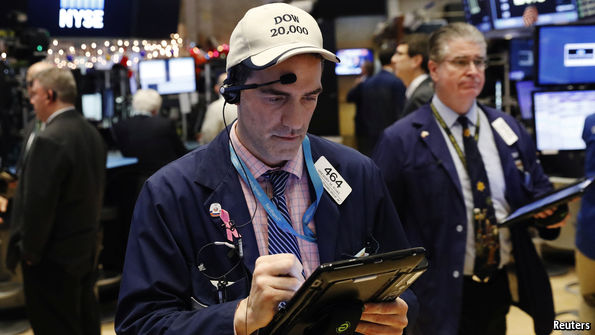
SOME time soon, the Dow Jones Industrial Average seems likely to break through the 20,000 barrier, an event that will be greeted with banner headlines and a sign that capitalism is flourishing again. In fact, the Dow is a flawed measure, which uses the odd approach of weighting its component companies by share price. The biggest stock in the Dow is Goldman Sachs and despite its prominence on the campaign trail (and among Donald Trump’s new team), it is hardly the most important company in America; its weight depends on its near-$240 share price. Like other financial shares, it has shot up in the wake of Mr Trump’s election; boosted both by hopes of bank deregulation and of potentially higher interest rates, which tend to boost bank profits. William Wright of New Financial estimates that Goldman staff’s wealth, in the form of options and shares, has risen by $2.3bn since the polls; not exactly a «revolt against the elite».
The Dow is up 9% since November 7th, well ahead of the more broadly-based S&P 500’s 6.6% gain. The S&P uses a weighting by market value—its…Continue reading
Qantas is to fly direct between Australia and Britain

WHEN the England cricket team travelled to play Australia in the first ever Test match in 1887, the journey down under took around 50 days by steamship. (The Aussies won, as they have mostly continued to do over the subsequent 129 years.) When the team flies out to compete in the latest installment of the Ashes next year, the journey time will be much reduced. If they fly from London to Perth on Qantas, they could conceivably do it in under 17 hours, nonstop.
The Australian flag carrier announced over the weekend that it is to launch a direct service from Western Australia to London. According to Forbes the 14,498-kilometre journey will slot in behind Air India’s Delhi to San Francisco route (15,140 kilometres) to become the second longest nonstop flight in the world—although the Qantas plane will in fact be in the air for two hours longer because the India-America route takes advantage of the jet stream.
We don’t have to look back to the 19th century to see just how far things have improved. According to Alan Joyce,…Continue reading
Lessons from a fight between economists and historians

IN A fascinating new piece at the Chronicle of Higher Education, Marc Parry examines an intense, ongoing debate between historians and economists on the role American slavery played in the industrial revolution. A number of recent books by historians (including Edward Baptist’s The Half Has Never Been Told, with which The Economist has an unfortunate history) argue that growth in output in American cotton, made possible by America’s slave economy (and rising brutality within it), was crucial in fostering the nascent industrial revolution, which had its beginnings in the mechanisation of textile industries. The conclusions of these historians stand in stark contrast to the general view among economists and economic historians, that in the absence of slavery, industrialisation would have occurred more or less as it actually…Continue reading