
Tag: Business and finance
Why Donald Trump can’t create 25m jobs

DONALD TRUMP promises to deliver 25m jobs over the next decade, 18m more than is forecast today. In our print edition, we have consistently argued that this is infeasible, because America is ageing rapidly:
Arithmetic suggests this pledge is fanciful: even if the labour-force participation of 25- to 54-year-olds returns to its record high, only 4.3m new workers will appear by 2024.
But at Free Lunch, a blog at the Financial Times, the excellent Martin Sandbu disagrees:
The US is seriously underperforming relative to its own record on employment. The employment-to-population ratio for 25 to 54-year-olds (which should not be affected by ageing or college attendance) is 78.1 per cent, almost four points below the record set in the last year of the Bill Clinton presidency. The ratio for 16 to 24-year-olds is 10 points down. Restoring those ratios should add about 8m-9m jobs or 6 per cent of the…Continue reading
Why do hotels still bother with receptionists?

AS A rule, when Gulliver first arrives at a hotel, he would prefer not to have to deal with another human. There are three main reasons for this. The first is that he is, by nature, cantankerous. The forced jollity of the initial exchange with a receptionist does not come easily after an exhausting trip. The second, perhaps not unrelated, is the fear that a porter might latch on to him and insist on showing him to his room. What is it about Gulliver’s demeanour that suggests he is incapable of counting room numbers sequentially, or is unable to identify which of the two chambers in his room is the toilet? (If in doubt, it is usually the smaller one.) Being pressured to tip a porter whose sole purpose seems to be to point out which of the Gulliver-length objects in the room is for sleeping in, and which he might fill with bubble bath, is always riling. Finally there is the annoyance of having to hang around at the front desk, with the heating on full blast, while the receptionist deals with a queue of other people. At that point all he really wants to do is head to his room and peel off a few of the layers that have been protecting him from the arctic conditions…Continue reading
America’s audit watchdog uncovers serious misconduct at Deloitte Brazil

ACCOUNTING scandals are nothing new in Brazil. Its former president, Dilma Rousseff, was impeached in August for cooking her government’s books. The bosses of its biggest building firms have landed behind bars for padding contracts with Petrobras, the state-run oil company. At least, governance gurus joke, all the imbroglios—and a three-year-old law against bribery—have prompted companies to replace what people used to call corruption departments with compliance offices. How ironic, then, that Brazil’s latest affair involves a firm that is meant to ensure that firms stay on the straight and narrow.
On December 5th it emerged that America’s Public Company Accounting Oversight Board (PCAOB) fined the Brazilian arm of Deloitte, the biggest of the “Big Four” accounting networks, $8m, for what Claudius Modesti, the watchdog’s director of enforcement, called “the most serious misconduct we’ve uncovered”. Deloitte is the first of the Big Four to be accused of failing to co-operate with a probe by the PCAOB, created by the Sarbanes-Oxley act of 2002, itself a response to a massive accounting scandal at Enron, an energy giant. The firm will also have to pay 5.4m reais ($1.6m) to Brazil’s…Continue reading
Winners and losers from the Trump stockmarket rally
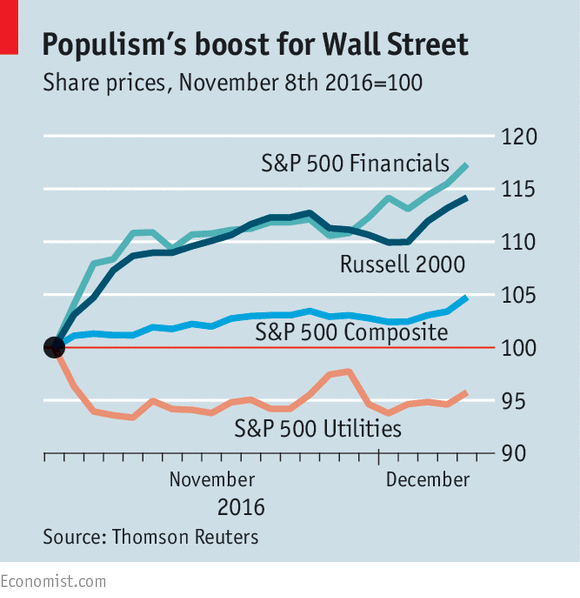
SELL on the rumour, buy on the news runs one version of a hoary stockmarket adage. And it certainly applied to last month’s presidential election. Before the poll, many investors were concerned about the risk that Donald Trump might become the 45th president. But as soon as the result was confirmed, they piled into shares. American equity mutual funds enjoyed four consecutive weeks of inflows, the longest streak since 2014, according to EPFR Global, a data provider.
One driver of the rally was Mr Trump’s planned fiscal stimulus. Investors believe this will lead to bigger deficits; hence the rise in bond yields since the election. But they also hope it will boost the American economy. That may explain why the Russell 2000 index of smaller companies, which tend to have a domestic focus, has outperformed the S&P 500 since the election (see chart). If this goes on, such stocks may become known as the Trumpettes.
Another factor was the planned cut in corporate-tax rates. The official American corporate income-tax rate is 35% (rising to 39% when state taxes are added). Standard & Poor’s, a ratings agency, reckons that the effective rate paid…Continue reading
The oil industry is bouncing back after OPEC’s meeting

PROUDLY, they call themselves elephant hunters. They are the geologists who scour the treacherous depths of the Arctic, or Brazil’s Atlantic pre-salt fields, or offshore west Africa, or the deep waters of the Gulf of Mexico, hoping to bag giant oil discoveries that can generate billions of dollars of cash for their firms over a span of decades. In some cases, they get naming rights. The Gulf of Mexico is peppered with fields named after geologists’ wives (risky if they are duds), or their favourite albums, bands, stars and football chants. They are part of the industry’s folklore. The question is, are they a dying breed?
Several prospective deals announced this month, from the deep waters of the Gulf of Mexico to onshore Iran, suggest that the industry may be shying away from expensive forays into uncharted territory, and taking a more cost-conscious approach to exploration and production. It remains to be seen whether they can maintain their discipline if oil prices recover. But, for now, “they’ve all gone back to the drawing boards,” says Andy Brogan, an oil-and-gas specialist at EY, a consultancy.
On December 1st BP, a…Continue reading
Italian banks after the referendum

THE first casualty was Matteo Renzi’s hold on office. As he had promised, Italy’s prime minister resigned on December 7th, three days after voters rejected his proposals to overhaul the constitution. The second is likely to be a planned private-sector recapitalisation of Banca Monte dei Paschi di Siena, the country’s third-biggest bank and the world’s oldest. As The Economist went to press, the scheme’s chances looked slim. A government rescue was reportedly being prepared.
Monte dei Paschi has been in trouble for years. It has already had two state bail-outs and frittered away €8bn ($10bn) raised in share sales in 2014 and 2015. Its stockmarket value has dwindled to €600m, having fallen by 85% this year (see chart). Its non-performing loans (NPLs), even after provisions, are 21.5% of its total; the gross figure is 35.5%. In July it fell ignominiously short in European stress tests, ranking 51st of 51 lenders. The European Central Bank, its supervisor, asked it to raise more capital by the end of the year. This week the bank asked for more time.
Pre-empting the test results, Monte dei…Continue reading
The Federal Reserve prepares to raise interest rates again

AMERICA’S central bank tries to be predictable. When in December 2015 it raised interest rates for the first time since 2006, nobody was much surprised. The central bank had telegraphed its intentions to a tee. Similarly, if the overwhelming consensus in financial markets is to be believed, on December 14th—almost exactly a year later—rates will rise again, to a target range of 0.5-0.75%. Donald Trump’s tweets and phone calls may upend trade, fiscal and foreign policy in a matter of minutes, but Janet Yellen, the Federal Reserve’s chairwoman (pictured), is tweaking monetary policy at only a cautious annual pace.
Yet in another sense, the Fed has confounded predictions—at least, those it made itself. A year ago the median rate-setter foresaw four rate rises in 2016. None has happened yet. This might seem like a straightforward reaction to events. At the start of the year, stockmarkets sagged on worries about Chinese growth. Then, in June, Britain voted to leave the European Union, sending markets spinning again for a while. But the delay also resulted from a gradual acceptance by Fed officials that low rates have become a longer-lasting…Continue reading
A Dallas public pension fund suffers a run
 The mayor and Dallas’s finest
BANK runs, with depositors queuing round the block to get their cash, are a familiar occurrence in history. A run on a pension fund is virtually unprecedented. But that is what is happening in Dallas, where policemen and firefighters are pulling money out of their city’s chronically underfunded plan, and Mike Rawlings, the mayor, is suing to stop them.
At the start of the year the fire and police pension fund had $2.8bn in assets. Since then nearly $600m has been withdrawn from the plan, of which almost $500m has been taken out since August 13th. That is an alarming acceleration; in 2015 total withdrawals were just $81m.
Even at the start of 2016, the plan was just 45% funded, and was expected to become insolvent within 15 years. When some workers take out their money, they get the full value of their benefits; leaving a smaller pot to be shared among the remaining members. (The city estimates that the funded ratio has fallen to 36% after the withdrawals.) As in a bank run, it seems rational to withdraw your money if you worry that all the benefits won’t be paid.
The crisis…Continue reading
An epic legal battle with big implications for litigation funding

FOUNDED by former African American slaves, the west African country of Liberia has produced an insurance case that has bounced between the courts of several countries for a quarter of a century, condemning the claimants and their opponent to a generation of legal bondage. At long last, the saga might just be drawing towards a conclusion. It may also leave a legacy: to shift the calculus when third-party litigation funders assess the risks they face.
In the early 1990s, Liberia’s biggest importer, Lebanese-owned AJA, sued Cigna, an American insurer, in the federal court in Philadelphia for refusing to pay out over property damage incurred during Liberia’s civil war. AJA won, but a district-court judge overturned the verdict with a “judgment notwithstanding the verdict”—a rare device that can be employed when a jury is deemed to have deviated far from the law (in this case by failing to acknowledge a war-risk exclusion). The judge’s move was upheld by a higher appeal court.
Livid, AJA applied to Liberian courts and in 1998 won a judgment for $66.5m (now worth double that with interest). Cigna counter-sued, and in 2001 won an…Continue reading
Europe’s nastiest takeover battle reaches its second anniversary

THE life of a predator can be fraught. Expend too much energy on hunting your prey and even success can be costly. Saint-Gobain, a French maker of glass and other building materials, might be learning that lesson. It mostly grows by snapping up smaller fry, but an attempt to buy a midsized Swiss rival, Sika, has gone on for two years. It could take as long again for Swiss courts to resolve the most intractable corporate struggle in Europe.
Pierre-André de Chalendar, Saint-Gobain’s CEO since 2007, was doubtless impressed by Sika’s high returns on its business selling industrial adhesives, mortar and construction chemicals. Its annual return on capital over the past decade has been an attractive 12.6%, more than double Saint-Gobain’s 5.1% (see chart). So when in 2014 the current, fourth generation of the Burkard family, which founded Sika in 1910, offered to sell 52.4% of the voting rights in their firm, Mr de Chalendar bit.
The family investment is kept in a body called Schenker-Winkler Holding (SWH) which, following the death of the matriarch in 2013, the dynasty agreed to sell to the French firm for SFr2.75bn…Continue reading