
Tag: Business and finance
Economists cannot stop Trump, but perhaps they can understand him

ECONOMISTS seem to be warming to the idea that regional inequality is a problem, if only because it leads to political movements that threaten broader prosperity. While that is a useful development, it brings economics to a very difficult question, which is: what can usefully be done about that inequality? In a post generating quite a lot of discussion, Tim Duy says that economists need to get busy thinking about the problem:
The dry statistics on trade aren’t working to counter Trump. They make for good policy at one level and terrible policy (and politics) at another. The aggregate gains are irrelevant to someone suffering a personal loss. Critics need to find an effective response to Trump. I don’t think we have it yet. And here is the hardest part: My sense is that Democrats will respond by offering a bigger safety net. But people don’t want a welfare check. They want a job. And this is what Trump, wrongly or rightly, offers.
Donald Trump says he will cancel an order for a new presidential jumbo jet

EVEN when all other orders evaporate, at least Boeing can rely on one important customer for its jumbo jet: the president of the United States. That was the gist of a post that Gulliver wrote earlier this year on the travails of the 747, a once-popular aircraft that has fallen foul of today’s aviation economics.
Gulliver may have spoken too soon. Today, Donald Trump seemingly announced that he would cancel an order to develop a new jumbo, due to come into service in 2024, to ferry around whomever is then the leader of the free world. In a tweet, Mr Trump wrote: “Boeing is building a brand new 747 Air Force One for future presidents, but costs are out of control, more than $4 billion. Cancel order!” He later reiterated his concern outside Trump Towers, his New York hotel, saying: “The plane is totally out of control. I think it’s ridiculous. I think Boeing is doing a little bit of a number. We want Boeing to make a lot of money but not that much money.”
Mr Trump already has his own plane—a Boeing 757. Might he be planning to steer clear of the vehicle that comes with his…Continue reading
How the weakest bank in Europe just got weaker
We examine Monte dei Paschi di Siena, the bank at the epicentre of the crisis in Italy. Last week OPEC moved to rescue oil prices. Will companies now rush back into exploration? And how the birth of a new motorbike in downtown New York could revitalise inner-city manufacturing
Transport employees in America were secretly paid by the government to search travellers' bags

THERE are many reasons why you might have been stopped at an American transport hub and your bag searched by officials. You might have be chosen at random. Perhaps you matched a profile. Or you could have been flagged by an airline, railroad or security employee who was being secretly paid by the government as a confidential informant to uncover evidence of drug smuggling.
A committee of Congress heard remarkable testimony last week about a long-running programme by the Drug Enforcement Administration. For years, officials from the Department of Justice testified, the DEA has paid millions of dollars to a variety of confidential sources to provide tips on travellers who may be transporting drugs or large sums of money. Those sources include staff at airlines, Amtrak, parcel services and even the Transportation Safety Administration.
The testimony follows a report by the Justice Department that uncovered the DEA programme and detailed its many potential violations. According to that report, airline employees and other informers had an incentive to search more travellers’ bags, since…Continue reading
If Matteo Renzi’s proposals lose, insufficient economic reform could be to blame

ITALIANS take to the polls this weekend to vote on reforming their political system. Reform of many sorts would certainly be welcome; the IMF recently declared that it would take some two decades for Italy to regain the economic footing lost since 2007. Whether the referendum set for December 4th by Matteo Renzi, the prime minister, authorising a constitutional reform to which attempts to loosen up a sclerotic legislative system, is the right medicine remains to be seen. Yet many Italians will be basing their votes not on the content of the referendum question, but on how they feel about Mr Renzi and a course of labour-market reforms adopted last year.
Those changes were meant to make it easier to hire and fire workers. They apply only to new hires, however, and thus disproportionately target young people who now look set to vote “no” amid a rate of youth unemployment of 37%. Perhaps more importantly, they have been insufficiently ambitious in their scope.
Philippe Aghion, an economist at Harvard University, reckons that rich economies (and Italy qualifies, despite recent stagnation) cannot grow in a rapid and sustained fashion if they do…Continue reading
Why the Chapecoense football team’s plane ran out of fuel

MUCH remains unknown about Lamia Airlines flight 2933, which crashed into the hills of Colombia on November 28th, killing 71 of the 77 people on board (see article in this week’s print edition). Fans of Chapecoense, a Brazilian football team, must wait to hear the full story of how a plane carrying 22 of their players and several staff members failed to arrive safely. (Only three players are among the survivors.) Many Brazilian reporters covering the crash knew one of the 21 journalists on board, and are starting to ask why these lives were lost in such devastating circumstances.
The chartered plane was to fly the footballers from São Paolo in Brazil to the Colombian city of Medellín for the biggest match of their lives, the final of a continental club tournament. Two refuelling stops in Bolivia were scheduled, first in Santa Cruz de la Sierra and then in Cochabamba. But the second of these never happened. In a black-box recording leaked to the press, the pilot, Miguel Quiroga, could be heard saying that the plane was running out of fuel…Continue reading
Siemens and General Electric gear up for the internet of things

IT DOESN’T take long to walk from Siemens’s old headquarters in Munich to its new one, inaugurated in June: the German industrial conglomerate has built it right next door. The design is cutting-edge, as are the building’s environmental features. It is packed with energy-saving sensors; channelled rainwater is used to flush the toilets.
General Electric, Siemens’s big American rival, will soon have a new base, too. But it takes three hours to drive from the old site in Fairfield, a Connecticut suburb, to the new one in Boston. Its building will also boast plenty of green technology, such as a huge canopy made of solar panels, as well as spaces that the public can enter, including co-working areas and lounges. There will be laboratories both for internal startups and some from outside.
The two industrial giants aren’t so much showing off as signalling transformation. Both firms are going through the most profound change in their corporate histories, attempting to switch from being makers of machines into fully digital businesses. GE’s chief executive, Jeff Immelt, says the plan is to join the world’s top ten software firms…Continue reading
Insurers grapple with cyber-attacks that spill over into physical damage

AS HACKERS wreak havoc with depressing regularity, the insurance industry finds itself forced to contemplate a whole new set of risks. They range from the theft of millions of credit-card numbers from American retailers to the disabling of the power grid, as happened in Ukraine last December. The dedicated “cyber-insurance” policies that companies offer against data breaches have become relatively routine. But the risks they insure under other policies are also affected by cyber-risks—and they are still struggling to understand this so-called “silent” cyber-exposure.
Insurance that protects firms who suffer data breaches has been on offer for around 15 years. It is much harder to put a precise value on, for example, stolen health records than on a property or car. Insurers sidestep the problem by covering only the direct costs that a company incurs from a hack. Typically, these include hiring a specialised forensics firm to work out exactly what was stolen, notifying affected customers (which 47 American states currently require), short-term business interruption and fines.
The industry will be shaken up by new EU data-protection…Continue reading
France’s nuclear-energy champion is in turmoil
 Under pressure
THESE are difficult times for Electricité de France (EDF), the country’s quasi-monopolistic electricity provider, serving 88% of homes. Outages at no fewer than 18 of the 58 EDF-owned nuclear reactors that provide three-quarters of France’s electricity have meant a slump in production: the company says annual nuclear output could fall to 378 terawatt hours (TWH), from 417 TWH last year. Eight reactors are currently lying idle and several may not restart for weeks or months. Power stations are burning coal at a rate not seen since the 1980s. As electricity imports and prices soar, officials are having to deny that a cold snap could bring blackouts.
The cause of the crisis—possibly faulty reactor parts throughout EDF’s fleet—suggests it may not be easily contained. France’s nuclear regulator, the Autorité de Sûreté Nucléaire (ASN), this summer ordered urgent tests of reactor parts, mostly bases of cylindrical steam generators. Inspectors are worried about high carbon levels found in steel forged by Creusot Forge, which is owned by Areva, another French firm, and by Japan Casting & Forging…Continue reading
Africa’s stock exchanges meet but size holds them back
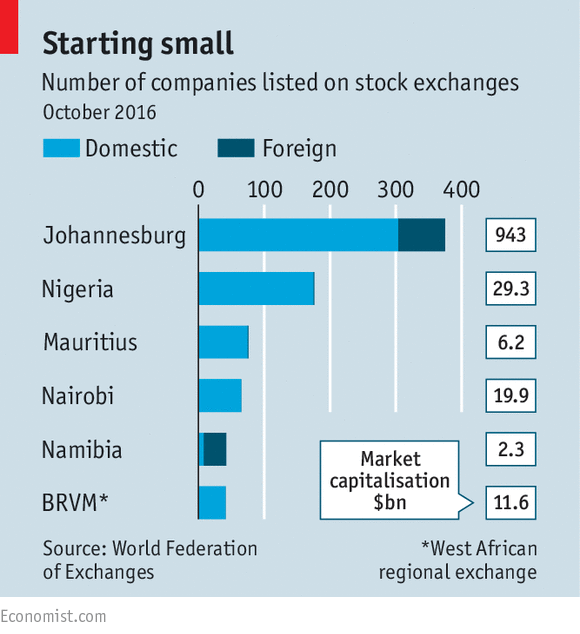
AS THE trading bell rings, a handful of brokers, in crisp scarlet jackets, gather around a whiteboard at the Rwanda Stock Exchange in Kigali. There are only seven listed companies, and it takes just a couple of minutes to write up the day’s bids. But Celestin Rwabukumba, its chief executive, is excited for the future. “If it works elsewhere, then why not here?” he asks.
Why not indeed? Johannesburg, with a market capitalisation of nearly $1trn, is in a league of its own. But sub-Saharan Africa has many small exchanges, lots of them created in the 1990s to help privatise state enterprises. Most struggle to attract new issues. Seven of the eight domestic listings on the Uganda Securities Exchange came from government divestments. Older exchanges, in Kenya and Nigeria, are dominated by big firms: a third of Nigeria’s market is the Dangote Group, a conglomerate with interests from cement to salt.
Stock-exchange leaders were in Kigali this week for the annual conference of the African Securities Exchanges Association. Much of the talk was about coaxing smaller, family-owned businesses to list. But many owners are loth…Continue reading