
Tag: Business and finance
How companies should treat their most enthusiastic customers

THE hero of Nick Hornby’s novel, “High Fidelity”, cannot get enough of vinyl records. By day Rob Fleming runs a record shop where he spends his time sampling the stock and constructing fantasy compilations with his equally obsessive assistants. By night he moons over his favourite songs. “Is it so wrong, wanting to be at home with your record collection?” he asks himself. “There’s a whole world in here, a nicer, dirtier, more violent, more peaceful, more colourful, sleazier, more dangerous, more loving world than the world I live in.”
Rob is an example of what management gurus dub “super-consumers”, “lead consumers” or “high-passion fans”. Only a tenth of customers are super-consumers but they account for 30-70% of sales, an even greater share of profits and almost 100% of “customer insights”, says a new book, “Super-Consumers”, written by Eddie Yoon of the Cambridge Group, a consultancy.
These people are not defined simply by the amount of stuff they buy (though they tend to be heavy users), but by their attitude to the product. Like Rob, they regard the things that they consume as answers to powerful…Continue reading
Schrödinger’s Brexit

SOMETIMES an analogy strikes you on the head with the force of a plummeting cricket ball. On Radio 4 yesterday, Hamish Johnson, editor of physicsworld.com, had the brilliant insight to explain the British government’s policy in terms of physics; Schrödinger’s Brexit.
The poor cat is stuck in a box with a radioactive substance and a poison; when the substance decays, the poison is released. Since it is impossible to predict when the substance will decay, the cat may be deemed simultaneously alive and dead. The only way to know is to open the box.
Before Britain voted to leave the European Union in June, then prime minister David Cameron promised to trigger Article 50 (the exit mechanism) immediately. Five months on, Article 50 has yet to be triggered. The new prime minister, Theresa May, has promised to do so by the end of March. But in terms of what Britain wants, we have heard nothing but platitudes: “Brexit means Brexit”, or “have our cake and eat it”. Pushed for details, Ms May has said there will be “no running commentary” on negotiations. In fact, it is quite easy to do a running…Continue reading
How “driver mode” for phones will affect those who work behind the wheel

FOR business travellers moving between cities, there’s no better place to get work done than the train. But for travellers in America, going by rail is generally not an option outside of the transit corridor from Washington, DC to Boston. And so people covering ground for business are often forced to make do with cars, and with whatever they can manage behind the wheel—which usually means making a lot of phone calls.
That could soon change. Just as airplane mode has restricted travellers from using cellular networks while in the skies, “driver mode” may soon severely limit communications on the road.
Last week, the National Highway Traffic Safety Administration called for makers of mobile phones and similar devices to include a driver mode on those products that will prevent drivers from making calls, sending texts and checking social media. Under these guidelines, all applications other than music and navigation could be locked for drivers.
“Distraction is still a problem,” the transportation secretary, Anthony Foxx, Continue reading
Barcelona hits Airbnb with a hefty fine

THE phoney war between home-sharing websites and Barcelona seems to have come to an end. After months of sparring between the parties, this week Barcelona levied fines of €600,000 ($636,000) each on Airbnb and HomeAway, which it says have been offering to rent properties that do not have a tourist licence to holidaymakers. The firms had already been fined a nominal amount last year. HomeAway says it will pay the fine; Airbnb is appealing.
Airbnb says that it is “part of the solution” in Barcelona. That depends on which problem it thinks it is addressing. Barcelona is a cramped town. The number of visitors to the city has more than doubled since the start of the decade, from 3.1m in 2000 to 7.8m in 2014. That is close to five tourists for every inhabitant. Tourist accommodation is scarce. The average hotel occupancy rate in Barcelona is 78%, the highest of any of Spain’s main towns. Hotels’ revenue per room, too, is higher than in other cities. All of which suggests a strong demand for…Continue reading
The business of reselling returned shop items
 Can I send him back, too?
IN STORES and warehouses across America, they wait: towers of toys, scarves piled on scarves, box upon box of shoes. The official start of holiday shopping in America begins on “Black Friday” on November 25th. Retailers hope to sell more than $650bn of goods this season, roughly the annual economic output of Switzerland. Ideally, companies’ supply of products would precisely match demand for them. In reality millions of items will stay on shelves or get sent back after purchase—in all of 2015 Americans returned goods worth $261bn, out of a total $3.3trn sold. What happens next?
Some returned goods will be resold by the very same retailer, but many will not. By the time an item is returned it might be either damaged or stale, points out Steven Barr of PwC, an accounting firm and consultancy; shops might want to offer newer wares. And resale is not an option for the stacks of goods that are never sold at all.
For retailers and manufacturers, this is a big headache. Dealing with unwanted goods can amount to a tenth of the cost of making and distributing them in the first place. But for…Continue reading
The future of the A380

AT THE world’s major airports, plane-spotters often spend days waiting for the world’s largest passenger plane, the Airbus A380, to make an appearance. The nerds at Dubai International Airport are spoilt for choice. It is home to Emirates, an airline that owns 86 of the monster aircraft, almost half of the global A380 fleet. These planes have propelled Emirates from insignificance a decade ago to its position as the world’s biggest carrier (measured by international passenger mileage in 2015). Now the airline has hit a rough patch. That is bad news for Airbus, the European aerospace and defence giant which makes the A380, and for the plane itself.
Demand once seemed insatiable for flights through Emirates’ hub in Dubai, which is known in the industry as a “super-connector” airport. Now its location helps explain the airline’s difficulties as well as its spectacular past growth, says its president, Sir Tim Clark. When he helped set up the airline in 1985, he says, Dubai was “an enchanting Arab village” that generated little air traffic. Instead of filling up the planes with locals, his strategy was to use its position halfway between…Continue reading
India grapples with the effects of withdrawing 86% of cash in circulation
 A short, sharp liquidity shock
A NEW strain of trickle-down economics has been spawned by the decision, on November 8th, to withdraw the bulk of India’s banknotes by the end of this year. As holders of now-useless 500-and 1,000-rupee ($15) notes rushed to deposit them or part-exchange them for new notes, an e-commerce site offered helpers, at 90 rupees an hour, to queue outside banks in order to save the well-off the bother.
Elsewhere, a chronic shortage of banknotes in a cash-dominated economy has left most trades depressed. Seven out of ten kiranas (family-owned grocers) have suffered a decline in business, according to a survey by Nielsen, a consultancy. Supply chains, in which wholesalers and truckers deal mostly in cash, have fractured. Some 20-40% less farm produce reached markets in the days after the reform. City folk admit to hoarding the 100-rupee note, the largest of the old notes to remain legal tender. Taxi drivers refuse to break the new 2,000-rupee note. Road-tolls have been suspended until at least November 24th, to prevent queues. Beggars have disappeared from parts of Delhi; no one has…Continue reading
American bankers look forward to a bonfire of financial rules

BEFORE the presidential election, Wall Street dreaded Donald Trump as a dangerous, unpredictable and disruptive, if improbable, president. Since his victory, fear has turned to hope. Stockmarkets are at record highs and shares in financial institutions have been among the best performers. Mr Trump, it turns out, looks to big finance like good news.
Partly this reflects Mr Trump’s change of tack. He campaigned as the leader of a rustbelt revolt against the besuited, pampered elites. As president-elect, he seems less of an outsider. Among the rumoured names he has been mulling as his choice for treasury secretary are Jamie Dimon, boss of JPMorgan Chase, and Steven Mnuchin, a 17-year veteran of Goldman Sachs. Wall Street’s access to the corridors of power seems likely to be unimpaired.
But the euphoria mostly reflects the finance industry’s excitement at one of the more achievable of Mr Trump’s campaign promises: to cut red tape. In a YouTube video this week outlining his priorities, he announced a new rule: for every new regulation, two old ones must be eliminated. No industry in America feels as browbeaten by regulators as does…Continue reading
Donald Trump’s conflicts of interest
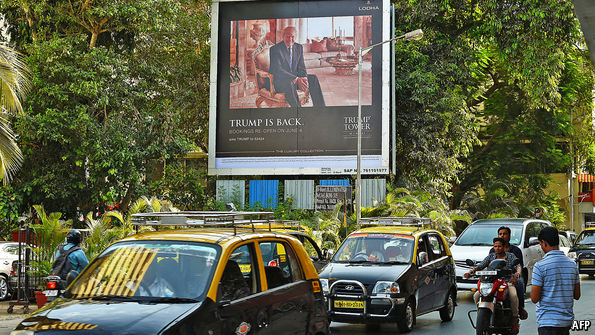
THE NEW Trump Tower in Worli, a buzzing district of Mumbai, looks like any building site but its marketing sells a dream. A golden structure soars to the sky alongside a picture of Donald Trump. He is—potential residents are assured—the gold standard around the globe, a dealmaker without peer who operates across the gateway cities of the world and the man who built the American dream. Until a few days ago the developer, Lodha, carried a message on its website: “Congratulations Mr President-elect”. But now that a storm has blown up over the possible conflicts of interest between the various operations of Mr Trump’s group and his new job, it has been deleted.
The self-embellished legend is of a global tycoon. In a kind of mirror image, outraged suspicion is mounting that the Trump Organisation could morph into a vast global network of cronyism. America has been treated to reports of multi-billion dollar projects across the planet, to photos of Mr Trump glad-handing businessmen and to images of exotic, Trump-branded buildings standing like monuments to the decay of American ethics. Paul Krugman, a left-of-centre economist, has suggested that the…Continue reading