
Tag: Business and finance
Technology firms may struggle to disrupt the food business

THE office parks of Silicon Valley boast many firms that are trying to change the world. But there are plenty with more modest goals. Zume Pizza, a tiny startup that is located a few miles from the sprawling headquarters of Google, wants to redesign the way pizzas are made. Zume has programmed robots to make pizzas that are then baked inside vans as they hurtle towards customers. Ovens are timed to finish cooking in sync with the vehicles’ arrival at their destination, so the pies are always piping hot.
In recent weeks spies from rival pizza companies and from food-delivery firms have been driving by in unmarked cars taking photographs of the office and the vans, says Julia Collins, one of Zume’s co-founders. To protect its business, the startup has patented the process of cooking food in ovens while a vehicle is moving (the patent probably gives Zume fairly defensible intellectual property, according to one patent lawyer). The company only operates in Mountain View, but has expansion plans. Since its founding last year it has reportedly raised $6m from investors, among them Jerry Yang, a co-founder and former boss of Yahoo, an early giant of the…Continue reading
The sharing economy brings tycoon lifestyles within reach of some

LAMENTING the rise of inequality is one of the few growth industries in an age of stagnation. One authority on the American wealthy, Robert Frank of CNBC, a TV channel, worries that the rich are “floating off” into their own country. Chrystia Freeland, a journalist-turned-politician, frets about the rise of the “new global super-rich” and the fall of everyone else. Charles Murray, America’s gloomiest social scientist, warns that society is “coming apart” as the rich retreat into their gated communities.
At the top of the income scale, however, a small counter-trend is observable. Never before have so many people been able to get access to the accoutrements of tycoonery—private planes, luxury yachts, fancy cars and interior-designed, exclusive homes. There is only so much comfort to be had from the fact that it is easier for the merely rich to lay claim to the lifestyle of the super-rich. But as a result of a combination of new technologies and businesses, that is nonetheless what is happening.
Tycoon living begins with a private jet. Whereas yachts are dispensable (not everyone wants to float around for weeks with the…Continue reading
The changing face of global trade

TRADE has changed a lot in the last 25 years. Indeed, we are still struggling to understand why trade growth was so rapid before the 2008 crisis, and has been relatively sluggish since. Richard Baldwin’s new book «The Great Convergence: Information Technology and the New Globalization» was reviewed in last week’s issue (and here are the thoughts of the FT’s Martin Wolf). But the book is so important that it is worth looking again at some of its insights.
The first is that we tend to think of competitiveness of individual states (particularly in an era of populist nationalism) – the US is competing against China and Germany. But goods are no longer assembled entirely within the bounds of one factory in one country. Instead, many goods are assembled in «global value chains» in which products are designed in one country, but made from parts built in several countries and assembled in another country. As Mr Baldwin…Continue reading
The hole at the heart of economics

AMERICA has a debt ceiling. It’s a statutory limit on how much debt the federal government can issue. For most of its existence (the ceiling will turn 100 next year) Congress has simply voted to raise the limit when borrowing threatens to hit it. In 2011 and 2013, however, Republicans in Congress chose a different approach. They threatened not to vote to raise the ceiling unless various budget demands were met. It was a dangerous course of action; had the ceiling not been raised the government would have found itself forced to choose between default—potentially triggering a massive financial crisis—or large, sudden cuts to spending of all sorts, triggering a deep recession.
In both 2011 and 2013 the brinkmanship concluded with a deal. Before those deals were cut, as the moment of doom loomed, some economics writers argued that the Treasury should make use of an obscure loophole in a law designed to allow the government to create platinum commemorative coins to issue a $1tn coin, which could then be used to fund government operations without violating the debt ceiling. The measure seemed legal but sounded completely barmy. At one point…Continue reading
By launching Trip, Airbnb hopes to capture every step of the travel process

OVER the past year, cities around the world have begun to crack down on illegal Airbnb listings, threatening the home-rental firm’s seemingly unstoppable expansion. As regulation bites in some of its most important markets, so Airbnb is looking for new ways to grow.
Last week, the company announced the launch of Trips, a service through which locals can offer guided tours and other experiences to travellers. It will start modestly, offering 500 things to do across 12 cities: London, Miami, Nairobi, Havana, Florence, San Francisco, Los Angeles, Tokyo, Detroit, Seoul, Paris and Cape Town. These include activities like “violin making in Paris or marathon running in Kenya”, according to the site. An additional 39 cities will soon be added; experiences will range in cost from $30 to several hundred dollars for multi-day events.
That is only the start. Airbnb hopes ultimately to capture every step of the travel process. Eventually Trips will offer travellers the ability to rent cars, book flights and restaurants, and order groceries. At a time when both leisure and business travellers are…Continue reading
By launching Trips, Airbnb hopes to capture every step of the travel process
OVER the past year, cities around the world have begun to crack down on illegal Airbnb listings, threatening the home-rental firm’s seemingly unstoppable expansion. As regulation bites in some of its most important markets, so Airbnb is looking for new ways to grow.
Last week, the company announced the launch of Trips, a service through which locals can offer guided tours and other experiences to travellers. It will start modestly, offering 500 things to do across 12 cities: London, Miami, Nairobi, Havana, Florence, San Francisco, Los Angeles, Tokyo, Detroit, Seoul, Paris and Cape Town. These include activities like “violin making in Paris or marathon running in Kenya”, according to the site. An additional 39 cities will soon be added; experiences will range in cost from $30 to several hundred dollars for multi-day events.
That is only the start. Airbnb hopes ultimately to capture every step of the travel process. Eventually Trips will offer travellers the ability to rent cars, book flights and restaurants, and order groceries. At a time when both leisure and business travellers are…Continue reading
Will supersonic passenger planes boom again?

SINCE the moment that three British Airways Concordes touched down at Heathrow in 2003, on their final journey before being retired from service, air-heads have pined for the days of supersonic passenger jets. Concordes were cramped and noisy, but they were the very emblem of the jet-setting elite. One’s time had to be very valuable indeed to justify paying thousands of pounds extra to shave three-and-a-half hours off of a transatlantic trip.
One of Concorde’s most wide-eyed fans was Richard Branson. The airline boss apparently kept a model of the plane—with his Virgin livery replacing British Airways’, naturally—on his desk. Little wonder, then, that he is putting his effort behind the latest in a line of pretenders to the supersonic crown.
This week Boom Technology unveiled a prototype of a plane that will eventually be capable of flying at Mach 2.2. That would allow the three-engine, 50-seat jet (pictured above) to cross the Atlantic in three hours and thirty minutes, about the same as the old Concorde. It hopes to test a one-third-sized model in the skies next year, with the final version ready to take paying passengers in 2023—20 years after the…Continue reading
Airlines are finally explaining what “last class” means. It isn’t pretty
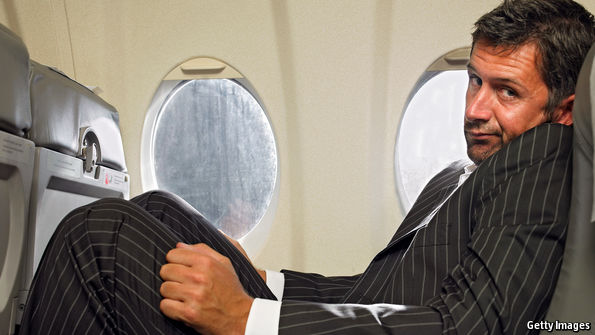
OVER the past couple of years America’s three biggest carriers, Delta, United and American, have each unveiled a fare class below economy. The new designation, known as “basic economy” to the airlines and derided as “last class” by their customers, is an attempt to compete with the low fares on profitable no-frills carriers such as Spirit and Frontier.
From the airlines’ initial announcements, it seemed that the sacrifices passengers would have to make in order to secure last-class fares would be modest. The most notable was the inability to select seats when booking a flight. For families travelling together that might be unpalatable, since they would run the risk of being split up. For solo travellers it would mean more chance of a middle seat—not ideal, but worth the lower cost for many flyers.
That changed this week when United, on a call with investors, dropped a bombshell: flyers in basic economy would be barred from using the overhead bins. Instead, they will be allowed only a small carry-on bag that can fit under the seat in…Continue reading
Amp my ride

“THE car is the ultimate mobile device,” said Jeff Williams, an executive at Apple, last year. It was taken as another sign that the maker of iGadgets would be deepening its interest in the automotive sector (among other projects, it is developing an in-house smart car that is codenamed Project Titan). Now Samsung Electronics, its big rival in the smartphone world, is following. On November 14th the South Korean company said it would pay $8bn for Harman, a firm based in Stamford, Connecticut, that makes internet-connected audio, information and security systems for cars. The deal is Samsung’s largest ever, and the first big transaction for its vice-chairman and heir apparent, Lee Jae-yong, grandson of the firm’s founder.
Though it is best known for its sound systems, Harman is one of the world’s largest supplier of smart parts for “connected cars” that help owners to drive by linking to the internet and to chip-enabled devices. It made $7bn in revenue in the year to September, two-thirds or so of it from the car sector, and has over three times that in new orders. Its products are the first step towards autonomous vehicles. Over 30m…Continue reading