
Tag: Business and finance
Rethinking central bank independence

CENTRAL bankers are under fire. In America, President-elect Donald Trump said that the Federal Reserve chair Janet Yellen should be «ashamed of herself» for keeping rates too low; in Britain, Mark Carney of the Bank of England has been criticised for his views on the economic risks of Brexit; and in Europe, Mario Draghi has faced attacks from critics in Germany (for being too lax) and Greece (for being too tight).
In a new paper Ed Balls, who played an influential role in making the Bank of England independent, has teamed up with James Howat and Anna Stansbury to try to think through the role and wider responsibilities of the central bank. It is very much worth a read and here are my first thoughts (colleagues will doubtless chip in later).
As the paper points out, central bank power has increased in the wake of the 2007-08 crisis, extending well beyond the narrow pre-crisis focus on using interest rate policy to meet inflation targets. But the worry is that
Absolutist interpretations of complete central bank independence may both…Continue reading
Pot of gold
 Flat white joint to go
IN THE 1990s Snoop Dogg, a rapper, called cannabis “chronic”. The drug was illicit and cool. In 2016 Mr Dogg is a cannabis investor, and the drug is poised to earn another title: consumer staple. On November 8th four states, including California, voted to approve recreational cannabis use. Four other states eased rules for medical marijuana. About three-fifths of America’s population lives in states that now allow cannabis use in some form.
So pot entrepreneurs face the thrilling prospect of normality. This week industry leaders were meeting in Las Vegas to discuss how the sector might expand. They have in prospect a vast, partially established market. More than 32m Americans already use cannabis. As the business becomes more normalised, it is sure to attract new customers. “It’s not often that you see an industry and you know the inevitability of it,” says Brendan Kennedy of Privateer Holdings, a private-equity firm that specialises in cannabis. Last year legal sales reached $6bn, according to the Arcview Group, an investment and market-research firm. By 2020 Arcview expects legal sales to be…Continue reading
Facebook, and the trouble in being everything to everyone

OXFORD Dictionaries has just named «post-truth» its word of the year. The timing certainly seems apt. Among the many recriminations unfolding in the wake of the American election are darts aimed at the press which, some argue, did an inadequate job during the campaign sorting truth, from half-truth, from innuendo, from outright fabrication. Interestingly, among those groups in the crosshairs is Facebook, which is now struggling to work out what its journalistic responsibilities are in this strange new digital age.
Facebook, which has nearly 2b monthly active users, is a media goliath. Users spend much of their time at the site interacting with friends and family, or sharing photos and videos. Yet Facebook is also an increasingly important location for the publication and sharing of news. According to a study conducted by the Pew Research Centre, 44% of American adults said they get some news from Facebook. Some of that news, as it turns out, is fake….Continue reading
An uncertain time for business

AN AGE of uncertainty is upon us. For the past three decades or so, businesspeople have been able to steer by a few lodestars. Trade negotiators lowered and simplified trade barriers. Central bankers tried to keep inflation to a minimum. Policymakers around the world negotiated multilateral treaties on the environment. Global bodies such as NATO provided security in Europe. Today the lodestars are exploding, one after the other.
Meanwhile, Donald Trump is making policy on the hoof. It turns out that the Affordable Care Act of 2010, or Obamacare, is not so bad after all. A big section of his planned wall on the border with Mexico will be a fence. In the past presidents have always arrived in the White House with a detailed set of policies. Mr Trump arrives with a tatty envelope scrawled with a few jottings on the back. Across the Atlantic, Brexit has opened a Pandora’s box: nobody knows whether Britain will leave the European single market or negotiate the equivalent of an associate membership. The Supreme Court has yet to determine how much say Parliament will have in shaping the negotiations.
One of the big promises from…Continue reading
Uncertain business
AN AGE of uncertainty is upon us. For the past three decades or so, businesspeople have been able to steer by a few lodestars. Trade negotiators lowered and simplified trade barriers. Central bankers tried to keep inflation to a minimum. Policymakers around the world negotiated multilateral treaties on the environment. Global bodies such as NATO provided security in Europe. Today the lodestars are exploding, one after the other.
Meanwhile, Donald Trump is making policy on the hoof. It turns out that the Affordable Care Act of 2010, or Obamacare, is not so bad after all. A big section of his planned wall on the border with Mexico will be a fence. In the past presidents have usually arrived in the White House with a detailed set of policies. Mr Trump arrives with a tatty envelope scrawled with a few jottings on the back. Across the Atlantic, Brexit has opened a Pandora’s box: nobody knows whether Britain will leave the European single market or negotiate the equivalent of an associate membership. The Supreme Court has yet to determine how much say Parliament will have in shaping the negotiations.
One of the big promises from populists is…Continue reading
Reversal of fortune

FOR MUCH of 2016, things seemed to be going well in emerging markets. A pickup in commodity prices signalled that the global economy (and China’s, in particular) was more robust than feared as the year began. In the manufacturing sector, the average level of the purchasing managers’ index in developing countries ticked up from 49 at the start of the year (indicating contraction) to 51 (expansion) by October, according to Goldman Sachs.
Signs of stability could be identified even in the economies that most worried investors in recent years—the so-called “fragile five” of Brazil, India, Indonesia, South Africa and Turkey. All had seen their current-account deficits shrink in the past three years, making them less dependent on foreign inflows of capital.
Confidence in emerging markets had also revived among international investors. Before the American presidential election both the MSCI emerging-stockmarket index and JP Morgan’s emerging-market bond index had outperformed their developed-world equivalents this year.
But Donald Trump’s victory seems, at least temporarily, to have changed minds. On November 11th emerging-market currencies suffered…Continue reading
Turkey’s dream of becoming the epicentre of global aviation looks shaky

UNTIL recently, the worst thing about transiting through Istanbul’s Ataturk Airport was the heaving throng of passengers crammed into its over-stretched terminals and under-staffed security lines. It was also the best thing. Witnessed from the sanctuary of a barstool with time on your side, the endless haze of Nigerians, Swedes and Pakistanis dancing around one another creates the most sublime of spectacles. It is a modernist dream that quickly becomes a nightmare, of course, when you join the scrum yourself. Yet the appeal of the global hub endures for all but the most battle-worn and hardened of business travellers.
So it was each time Gulliver visited Ataturk until September, when his stopover to East Africa and back took on a more sombre, desolate tone. This was his first time in the airport since June, when suicide bombers loyal to Islamic State killed 42 and injured 200 at the hub. The very next month, a failed coup d’état left 250 dead and 2,000 injured across the country. In the airport, complaints about the lack of free Wi-Fi were replaced by uneasy glances over hunched shoulders. Seats were easier to find.
Anecdotal…Continue reading
Seize the day
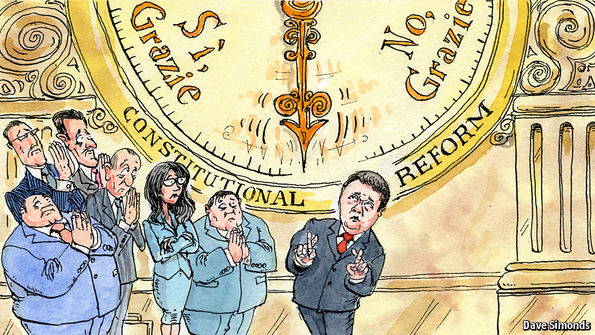
“THE biggest risk in Europe is the Italian referendum,” said Gianfelice Rocca, head of Assolombarda, Milan’s chamber of commerce, this summer. For corporate Italy, much is at stake in the vote on constitutional reform, which will be held on December 4th. Victory for Matteo Renzi, the business-friendly prime minister, could mean a big fillip for firms of all sizes, whereas a loss would be “a shock in the system”, said Mr Rocca.
The national employers’ federation, Confindustria, agrees with him. If those campaigning for a “yes” vote are to be believed, firmer government, easier conditions for investors and generally brighter economic prospects would follow. The two main issues to be decided are reform of the Senate’s powers—whether to let the lower chamber pass future laws, even when opposed by the Senate—and whether decision-making powers should be brought back from regional governments to the centre.
Francesco Starace, the chief executive of Enel, a giant European electricity company that is one of Italy’s more successful firms, sets out a strong case that the proposed changes would bring important benefits to…Continue reading
Brexit means…a lot of complex trade decisions

POLITICIANS campaign in soundbites but reality deals in awkward paragraphs. For all the sloganeering (Brexit means Brexit) and the prevarication, the British government must finally decide what kind of trade-offs it is willing to accept when it leaves the EU. The UK trade policy observatory at the University of Sussex has an excellent new paper out on the choices facing the country, which was the subject of a lunchtime seminar today.
The British government seems to have four red lines. It wants to stop free movement of labour; to be allowed to pursue an independent trade policy; not to contribute to the EU Budget; and to break away from legal oversight by the European Court of Justice. (All of these can be summed up by the slogan «taking back control»). The EU’s sole red line seems to be that Britain cannot benefit from «cherry picking» – for example, benefiting from membership of the single market in terms of goods trade, but not allowing free labour movement.
To understand the trade-offs, we must first understand the terms. The single market is an…Continue reading