
Tag: Business and finance
How worrying is the global market reaction to the American election?

IT HAS not yet been a week since Americans elected Donald Trump their next president, and already there is a lot to digest. While Mr Trump’s initial personnel decisions deserve plenty of scrutiny, the global market reaction to the election also demands attention.
This morning, the decline in bond prices that began last week continued. In America, the 10-year government bond yield rose above 2.26%, the highest level since the end of 2015, while the 30-year bond yield reached 3%. Treasuries are faring worse than many other bonds, however. Yields are going up nearly everywhere, but emerging markets and the euro-area periphery are experiencing especially large moves. (It is, as my colleague Buttonwood quipped on Twitter, a «Trump tantrum».) What is happening here, and why?
The conventional wisdom is that markets are pricing in an expected move toward expansionary policy in America. Mr Trump is expected to cut taxes dramatically, increasing the American budget deficit, while also spending more on infrastructure and defence. That boost is coming at a time when America’s economy, while still…Continue reading
A Trump presidency probably spells bad news for America’s travel industry

OVER the weekend a United Airlines pilot was forced to leave his cockpit in order to mediate between fighting passengers, after a disagreement over the virtues of Donald Trump turned nasty. In today’s world that amounts to a non-story: people lose their senses on aircraft all the time. But it feels prescient to read that a Trump presidency is already disrupting travel. Many in the industry worry what effect his policies might have beyond an increase in the number of tetchy flyers.
So what will a Trump administration mean for American tourism? As with many things about the next four years, uncertainty abounds. Much will depend on the extent to which Mr Trump keeps his pre-presidential word.
Some of his pledges would clearly create problems for the industry. If he were, for example, to implement a ban on Muslims entering the United States—which he vowed to do on his first day in office, and which he could enact
Dubai is to test the feasibility of hyperloop trains

FOR years Elon Musk, a South African-born tech entrepreneur, has been telling anyone who will listen that the future of travel is the hyperloop. (Although he thinks it might also be driverless cars. Or perhaps affordable space travel.) Dubai may be about to test the limits of Mr Musk’s imagination.
The hyperloop is a train that moves along a tube that is kept at a thousandth of the normal atmospheric pressure at sea level. Because air resistance is one of the biggest obstacles to high-speed travel, all but eliminating it means that hair-raising velocity becomes possible. The proposed technology could shunt passengers along tunnels at perhaps 745mph, which is faster than a…Continue reading
Trump and the political economy of liquidity traps

AFTER the Brexit referendum and the election of Donald Trump, and the subsequent market reactions, I think we are closing in on a decent theory of the way liquidity traps end.
That might be going too far. Markets have not had that much time to process the American election outcome, and what time they have had has sent some mixed signals. Yet among the clearest market moves since the morning of November 9th has been a sharp drop in Treasury prices, accompanied by a sharp rise in implied inflation expectations as determined from inflation-protected Treasury securities. Now: sharp is relative. But markets are showing signs of that they expect reflation under Mr Trump. And they have reason to. Mr Trump seems keen on massive tax cuts and a big increase in government spending (on defence, and perhaps also on infrastructure). Mr Trump might just represent macroeconomic regime change.
Let’s back up. The theory of liquidity traps first began to develop in the 1930s, when John Hicks picked up where John Maynard Keynes left off, in response to events of the Depression. Keynes explained that when an economy was operating at less than full employment, then a rise in government…Continue reading
System crash
 The world according to Thiel
“I’D LIKE to wake up now please,” tweeted Sam Altman, who heads Y Combinator, Silicon Valley’s foremost startup school. The sentence neatly encapsulates the mood in the high-tech hub. To many in the technology industry, America under Donald Trump means dystopia. Perhaps no other sector regards his victory with less enthusiasm.
The main reason is that his stated views are antithetical to the beliefs that most entrepreneurs and tech types hold on a range of topics from trade to offshoring to policy on immigration. By one estimate the tech industry gave nearly $8m to Hillary Clinton’s campaign. Silicon Valley also worries that it will lose its direct lines to the administration in Washington. According to the Campaign for Accountability, a transparency group, no fewer than 22 former White House officials have gone to work for Google since Barack Obama moved in. Under Mrs Clinton the door would have kept revolving.
Only one noted Valleyite is likely to have the president’s ear: Peter Thiel, a venture capitalist. He alone supported Mr Trump, speaking at the Republican convention…Continue reading
Online checkout

“EVERY little helps.” The thieves may have found Tesco’s advertising slogan only too apt. Over the weekend of November 5th and 6th, Tesco Bank, the financial arm of Britain’s biggest retailer, detected “suspicious transactions” on 40,000 current (ie, checking) accounts. Online raiders succeeded in stealing from 9,000: some customers spotted dodgy payments to companies in Brazil and Spain. On November 8th Tesco Bank said it had reimbursed all losses, to the tune of £2.5m ($3.1m). Online transactions from current accounts, which it had suspended, were up and running again.
If the bank or other investigators have any idea who stole the money and how, they are not saying. Reports say that GCHQ, a spy agency, has been called in. All this has fed rather than starved speculation: an MP has said “state-sponsored” crime cannot be ruled out. There is little to go on, notes Alfredo Pironti of IOActive, a cyber-security company. One possibility is that the thieves found a weakness in the bank’s web application. Another is that they managed to filch lots of customers’ passwords over a period of time and exploited them in one go. Still…Continue reading
The great divergence

ONE of Joseph Schumpeter’s best-known observations was that successful businesses stand on ground that is “crumbling beneath their feet”. A danger is that standing still and resting on your laurels can precipitate a swift tumble. Rivals, meanwhile, can draw on the available stock of knowledge and technology to catch up with the leaders. To stay ahead, front-runners must keep inventing new things. This means that capitalism is inherently unforgiving: today’s leader is tomorrow’s failure. But it also means that it is inherently progressive, since clever ideas are quickly spread through the economy.
Some striking new research suggests that this Schumpeterian mechanism may have broken down. The leaders are staying ahead much longer than is desirable. A group of researchers at the OECD, a club of mostly rich countries, examined the performance of a representative set of companies in 24 of its 35 member countries between 2001 and 2013. They discovered that the top 5% of them, dubbed “frontier firms”, have continued to increase their productivity while the other 95% (the laggards) have been stagnant in this regard.
Plenty of economists…Continue reading
Taking notes

NOT much distinguishes a valuable banknote from any old piece of printed paper, as Indians discovered this week. In a surprise televised address on November 8th, Narendra Modi, the prime minister, announced that the country’s two highest-denomination notes, worth 500 and 1,000 rupees ($7.50 and $15), were to be legally worthless with near-immediate effect. This odd variant of alchemy is the latest in a series of moves to curb illicit income; economists hope long-term gains will justify a chaotic spell as India adapts.
The idea is not as barmy as it might first appear. Mr Modi has implemented a flurry of schemes to flush out “black money”, the term Indians use for cash which is both unaccounted for and outside its formal financial system. Piles of ill-gotten income have long been easy to launder into gold or property, where using notes for at least part of a purchase is the norm. “Demonetising” high-value tender means existing notes must be traded in at banks and post offices before the end of the year. That will force those with suitcases of cash either to come clean or to renounce their loot.
Still, it is dramatic: central banks…Continue reading
African potholes
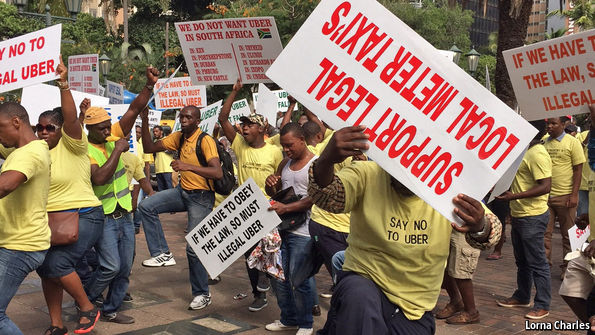
“I WAS lucky my customers were three big white guys,” says Themba, an Uber driver in Johannesburg recounting a close call with taxi-drivers who tried to block him from collecting passengers at the airport that serves South Africa’s economic hub. “They pushed them out the way and we managed to drive off.”
The ride-hailing app has made a splashy if slow start in Africa. Of the 529 cities in which Uber connects riders with drivers, just 14 are on the continent. Yet Africa is fertile ground for a firm offering cheap and safe transport. Most passengers have to spring for overpriced cabs or catch a white-knuckled ride on the back of a motorcycle taxi.
In Abuja, locals have long used a low-tech version of ride-sharing. Many folk simply stick out a hand at the roadside to hail any passing car before negotiating a fare. Yet locals warn that fake taxis cruise the streets with robbers hiding in the boot, ready to jump out at a traffic light. In Lagos some taxi-drivers are even thought to be in cahoots with kidnappers. Not surprisingly, Uber seems to be growing quickly in the few cities where it has launched. In many places rides cost less…Continue reading
Internship
Internship: Applications are invited for a Marjorie Deane internship in The Economist’s New York bureau. The award is designed to provide work experience for a promising journalist or would-be journalist, who will spend three to six months at The Economist writing about economics and finance. Applicants are asked to write a covering letter and an article of no more than 500 words, suitable for publication in The Economist. Applications should be sent by December 14th to deaneinternny@economist.com.