
Tag: Business and finance
Turning off the tap

EUROPE has yet to produce a rival to Silicon Valley, but London’s “Silicon Roundabout” by Old Street station is closest. As a funding hub, the city’s venture-capital industry tends to attract more money than rivals in Berlin, Munich or Paris. And more venture capital is invested in Britain, relative to its GDP, than in any other big European economy. Britain’s vote to leave the European Union threatens this lead. Besides unknown risks, there is a prosaic worry: the most important backer of such firms is the European Investment Fund (EIF), an EU institution, whose mandate includes “fostering EU objectives”.
As the biggest investor in European venture funds, the EIF supplied almost a fifth of all commitments last year, with Britain, France and Germany the main recipients. It is also among the largest and earliest investors in any fund. For every pound it pumped into Britain in 2015, the EIF reckons it mobilised another four of private capital. Venture-capital managers debate the extent to which the EIF spurs private investment, but generally accept it is a linchpin of the industry. Nenad Marovac, of DN Capital, a technology…Continue reading
Net debt, big returns

AS DONALD TRUMP sees it, America’s trade deficit is a sign of economic weakness, proof that lousy trade deals have sent production overseas. But Uncle Sam does not just import goods from the rest of the world and send nothing in return (though that would be a lucrative arrangement). Rather, the net inflow of goods is matched by a net outflow of stocks, bonds and other financial assets.
That makes America a debtor. In theory the interest and dividends paid to foreigners should chip away at national wealth in future. Since 1989 foreigners have owned more assets in America than Americans have owned overseas; in the jargon, the net international investment position (NIIP) has been negative. But America is an unusual borrower. For almost all of that time, it has received more income on its overseas investments than it has paid out to foreigners. This is strange: it is akin to someone’s savings earning more than enough interest to service his far bigger debts.
This contrast is getting starker (see chart). In recent years the NIIP has tumbled to -44% of GDP, the lowest since 1976, when the data begin. Yet net primary income—the…Continue reading
Political business
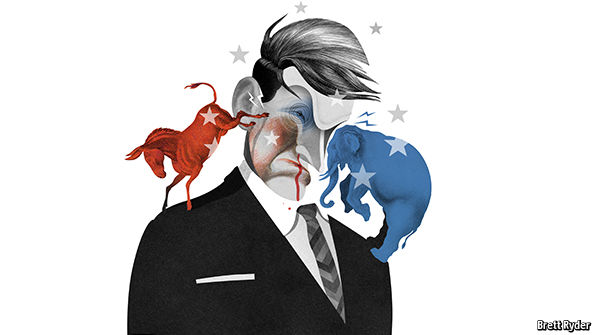
AS AMERICA’S presidential election approaches the country’s business class is in its weakest political position for decades. Twenty years ago both parties competed to be the most pro-business. Today they compete to denounce the malefactors of great wealth. The most startling change is that business has lost control of its ancestral party, the Republicans. Donald Trump may well embody many an American business type: somebody who inherits a fortune and goes on to make it even bigger. But he has taken over the Republican Party by channelling blue-collar anger against all elites.
Mr Trump has trashed free trade, liberal immigration rules and other corporate non-negotiables. Big companies have shied away from donating to his campaign. Meg Whitman, the boss of Hewlett Packard Enterprise, has called him “reckless and uninformed”. Tom Donohue, head of the United States Chamber of Commerce, has described his policies as “pretty sort of stupid”.
All this has driven lots of business people to cross the political aisle: an Ipsos poll shows that 53% of those earning $250,000 or more (the top 5% of households) plan to vote for Hillary Clinton,…Continue reading
A turning-point?

EVERYONE wants to spot the moment when markets change trend. By riding one of the great bull markets—the rally in equities from 1982 onwards, for example—or avoiding a crippling bear market like that of 2007-08, fortunes can be made, or saved. The key lies in spotting the turning-point.
Commentators see several potential turning-points in today’s markets. The first is in government bonds. The ten-year American Treasury bond yield bottomed at 1.37% on July 7th and has since risen to 1.80%. The ten-year German bond yield reached a low of -0.18% on around the same date and has since edged back into positive territory, at 0.13%. British bond yields of the same maturity have shown an even sharper shift, rising from 0.61% to 1.17% thanks to worries about the economic impact of Brexit.
These yields are still very low by historical standards. But there has been a revival of talk that the long downward march of bond yields (and upward march of bond prices) dating back to 1982 may at last have reached an end.
A second turning-point may already have occurred, earlier in the year. Risky assets seem to have recovered in unison,…Continue reading
Apps and downsides

DURING a recent ride with Uber, this passenger received a surprising word of thanks for talking softly. To complete the job, the driver needed to follow the route provided by Uber, read out turn-by-turn by his phone; noise from the back seat drowned out the critical instructions. The control Uber exercises over its drivers, whom it calls “independent contractors”, is increasingly a point of dispute. Two were recently judged to be entitled to some employment benefits—such as a minimum wage and holiday pay—by a tribunal in London sceptical of the degree of independence they actually enjoy. In fact, the drivers sit within a grey area in employment law; rules regarding firms’ obligations to their workers will need to adjust in response.
More than the profitability of Uber is at stake. According to a recent report by the McKinsey Global Institute, 162m people in America and Europe, or more than 20% of the working-age population, work outside normal employment. Nearly half rely on such work for their primary income. Sensible changes to work rules to take account of the rise in gig work could make life better for millions of workers; bad ones could mean…Continue reading
Permian hyperbole

ON THE outskirts of this west Texan city, on top of one of America’s most prolific oilfields, sit 230 square miles (600 square km) of scrubland owned by one family for more than a century. David Fasken, a Canadian lawyer, paid about $1.50 an acre ($3.70 a hectare) back in 1913, hoping to make a fortune out of cattle. But the land lacked sufficient groundwater. Before he died some years later, he swore it was the worst deal he had ever done.
Today the farm, still owned by a few Fasken heirs, is valued in the billions. Oil-rich land in the Permian Basin, a 250m-year-old sea of oil lying up to 12,000 feet (3.7km) underground, has changed hands this year for an average of more than $25,000 an acre. On October 31st Occidental Petroleum (Oxy), a large American oil company, said it had paid $2bn in cash for 59,000 acres in the Permian. Amid a flurry of such deals, Bernstein, a research firm, predicts prices will go as high as $100,000 an acre. The nicknames range from “Saudi America” to “Texarabia”.
But Tommy Taylor, head of oil at Fasken Oil and Ranch, smells a rat. He has worked on the Permian, where oil was first struck in the…Continue reading
Seeking asylum—and jobs
 Unskilled, unemployed and unhappy
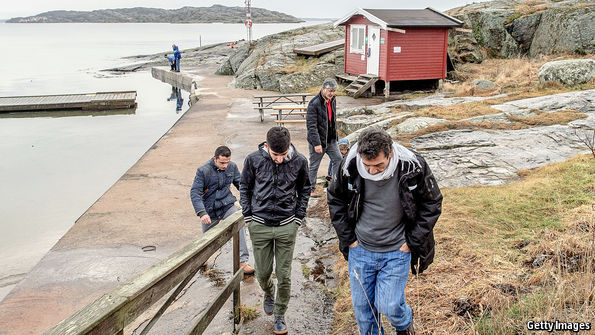
WHEN Ameen first arrived from Aleppo, he was thrilled to have made it to Sweden. Speaking as he takes a break from a protest near parliament, he says he thought there would be plenty of jobs. But none was available. Now that the government has made it harder for family members to join the refugees, some have taken to Stockholm’s cobbled streets. The rules on asylum-seeking in Europe mean refugees like him have to stay in their country of arrival. “If we could leave, many of us would,” he says.
A big reason refugees cause alarm across Europe is the fear that they will steal jobs. But a more serious problem may be their joblessness. France, Germany and Norway all have big employment gaps between native- and foreign-born workers. But the gap is widest in the Netherlands and Sweden—and these figures do not yet include the 163,000 asylum-seekers who arrived in Sweden last year (see chart).
 Continue reading
Will the dollar rise or fall on a Trump victory?

YESTERDAY’s decline in the American stockmarket, on news of a narrowing in the poll gap between Hillary Clinton and Donald Trump (under two points according to Real Clear Politics), confirms the argument made in last week’s column. A combination of Mr Trump’s adverse policy proposals on trade, foreign policy and the Fed, and uncertainty about how much of this agenda would get through Congress, would hit equities hard were he to be elected.
But what about the dollar? The picture is far from clear. Over the last 24 hours, the US currency has lost ground against the Swiss franc, euro, yen and sterling but gained against emerging market currencies like the Mexican peso and Brazilian real. That makes some sense. A Trump victory would make international investors less confident about the direction of US economic policy. This in turn might lead to the Fed being less willing to tighten…Continue reading