
Tag: Business and finance
Irrational tossers

THERE are few sure things in investing. But the chance to bet on a rigged coin sounds like a good one. Alas, a paper by two fund managers, Victor Haghani of Elm Partners (and co-founder of the collapsed Long-Term Capital Management) and Rich Dewey of Pimco, shows that it is possible to get even that wrong.
The paper invited 61 people, a combination of college-age students in finance and economics and some young professionals at finance firms (including 14 who worked for fund managers), to take a test. They were each given a stake of $25 and then asked to bet on a coin that would land heads 60% of the time. The prizes were real, although capped at $250.
Remarkably, 28% of the participants went bust, and the average payout was just $91. Only 21% of the participants reached the maximum. 18 of the 61 participants bet everything on one toss, while two-thirds gambled on tails at some stage in the experiment. Neither approach is in the least bit optimal.
Apparently the right strategy is to use the Kelly criterion, named after a…Continue reading
RFIDs are set almost to eliminate lost luggage

HAVING bags go astray on a flight is rare but infuriating. Indeed, according to a study by Skytrax, lost luggage was passengers’ number one complaint last year, beating even flight delays and cramped seats. That frustration could become rarer still. The aviation industry is increasingly using radio frequency identification devices (RFIDs, pictured) to track bags. Airlines have begun to attach these RFIDs to luggage tags. Doing so could significantly reduce the number of bags that are mishandled.
Research by SITA, an IT firm, and the International Air Transport Association, an industry association, found that a widespread adoption of RFIDs could allow 99% of bags to be tracked successfully. Already, other new technologies have cut the number of mishandled bags in half since 2007. RFIDs could reduce that number by a further 25% over the next six years, even as volume continues to increase.
Currently, as the Los Angeles…Continue reading
There are better and worse arguments for keeping interest rates low

With the Federal Reserve set to raise interest rates in December, my colleague R.A. argues that:
Fed members argue that they are choosing to raise rates now, before inflation has returned to target, so that inflation will not jump above 2%, forcing them to raise rates in a much more rapid manner. If the choice is between above target inflation and a recession, the Fed will take the latter. They are prepared to risk keeping inflation from ever getting to target in the first place (and also a recession) by raising rates with inflation below 2%…
and that:
…recent experience has probably distorted central bankers’ perspective, and made them excessively quick to see inflation in the data and react to it

His criticism of the Fed combines multiple lines of argument. One is that central bankers are too keen to spot inflation in the data. That is probably…Continue reading
Aviation executives doubt a third runway at Heathrow will be built anytime soon

LAST week, the British government gave London Heathrow airport the go-ahead to expand. The decision to allow it to build a third runway had been a long time coming. It is 70 years since the area around London last saw a new one built, and Heathrow, Europe’s busiest hub, is operating at 99% capacity. But already two aviation executives have expressed their cynicism about whether a runway will be built anytime soon. Or to cost.
Willie Walsh (pictured), the boss of IAG, the parent company of British Airways (BA), by far Heathrow’s biggest tenant, kicked off proceedings. “Do I have confidence that the current team at Heathrow can do it?” he said in an interview on Friday. “No, I don’t.”
Mr Walsh is not exactly a disinterested observer. The proposed £17.6bn ($21.4bn) expansion of Heathrow is to be financed privately; IAG fears that this will mean higher charges for BA. Even before the vote Mr Walsh, perhaps disingenuously, had come out against the building of a new runway for this reason. Last year, after the Airports Commission had…Continue reading
Is Mark Carney indispensable?

OVER the weekend, rumours flew that Mark Carney, the dashing Canadian at the helm of the Bank of England, might leave his job in 2018. (He initially promised to serve for five years, but a full term is eight, and many Britons hoped he would stay on.) An early exit for Mr Carney, who has been on the job since 2013, would be understandable. While Canada is the world’s great liberal icon, Britain is a mess. Not only must Mr Carney steer the British economy through the rough, post-referendum economic seas, but he has also faced criticism from Tory leaders, who are angry with Mr Carney for trying to warn Britons that Brexit would in fact be economically damaging.
This morning, the Financial Times reports that the rumours are wrong, and Mr Carney stands ready to serve a full term. One could practically hear the sighs of relief around the City. Yet is it right that so much should seem to ride on the presence or absence of one man?
Back in 2012,…Continue reading
Anatomy of a stupid rumour

MARK Carney, the governor of the Bank of England, has upset many people in the Conservative party because of his warnings about the economic impact of Brexit. So some including former chancellor Lord Lawson and Daniel Hannan, a eurosceptic MEP, have called on him to resign.
As we argue in a leader in the latest issue, this political pressure on an independent central bank governor is a great mistake. On the day after the referendum vote, the prime minister resigned and Brexit campaign leaders were nowhere to be seen; it was Mark Carney who stepped forward to calm the markets. He was the only grown-up in the room.
Now the stories are circulating that Mr Carney might resign, with some even suggesting that it
Chinese firms are investing heavily in American hotels
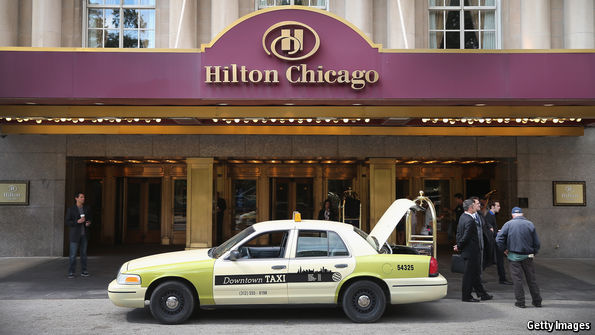
CHINESE tourists are an increasingly common sight in America’s cities, from New York to Honolulu. About 2m Chinese visit the country each year; that figure is expected to rise to over 3m by the end of the decade. But it is not just Chinese tourists who have been enjoying American hospitality; it’s Chinese investors, too.
This week HNA Group, a Chinese firm that began life as an aviation company, announced that it is to buy a 25% stake in Hilton Worldwide Holdings. It will be the largest shareholder in the hotelier whose brands also include Embassy Suites, Hampton Inn and Conrad.
The deal is the latest in a year that has already seen substantial Chinese investment in American hotels. In April, an HNA division announced it was buying Carlson Hotels, which owns Radisson and several other brands. Last month, Anbang Insurance Group completed the purchase of 15 American hotels in a deal worth more than $5bn, including the JW Marriott Essex House in New York, the Westin St. Francis in San Francisco, the InterContinental in Chicago, a Four Seasons in Washington, DC, and two Ritz-Carlton resorts. And just last week came the news that China…Continue reading
The only thing we have to fear is fear of inflation

DON’T look now, but after years of lingering on the brink of (or in) deflation, rich economies are heading in a different direction. Inflation is rising, and a handful of economy watchers are worrying that accelerating price increases could «rattle global markets», as Mike Bird of the Wall Street Journal writes:
Rich-country government-bond prices tumbled Thursday, sending yields up on both sides of the Atlantic to levels not seen since the U.K.’s vote to exit from the European Union in June. In the U.S., the yield on the 10-year U.S. Treasury note surged as high as 1.847%, according to Tradeweb, its highest level in four months. Yields rise as bond prices fall. The German bund’s yield rose about 0.07 percentage point to 0.161% and the 10-year U.K. gilt yield was up about 0.10 percentage point to 1.259%, according to Tradeweb.
The rising yields are the latest sign that investors are bracing for what could be an epic shift across markets. In recent years, falling commodities, meager wage rises and insipid economic growth kept prices low and pushed investors into…Continue reading
Angling for the future of TV

IMAGINE a television which, as in the old days, has only a handful of channels to choose from instead of hundreds, as a typical cable set-up might offer today. In a decade or so TVs will once again have only a few channels, but each will run miles deep, with content that can be viewed on demand. Netflix might be one such offering; Amazon another. Both firms are spending billions of dollars making and buying TV shows and films to sell directly to viewers to watch when they like, and on devices other than the box in the corner of the room. And other rich tech firms may join them.
It is this vision that is now driving the direction of television and media. Broadcasters are willing to pay more to show live sporting events, and to invest more in producing TV shows, to make their networks the must-see choice for viewers. This trend has spurred the largest-ever merger of a telecommunications company with a media firm. AT&T, America’s wireless and pay-TV giant, announced on October 22nd an offer for Time Warner, the owner of HBO, CNN and Warner Brothers studio, worth $109bn. In doing so AT&T is betting that a few vertically integrated platforms will…Continue reading
Wind and solar advance in the power war against coal
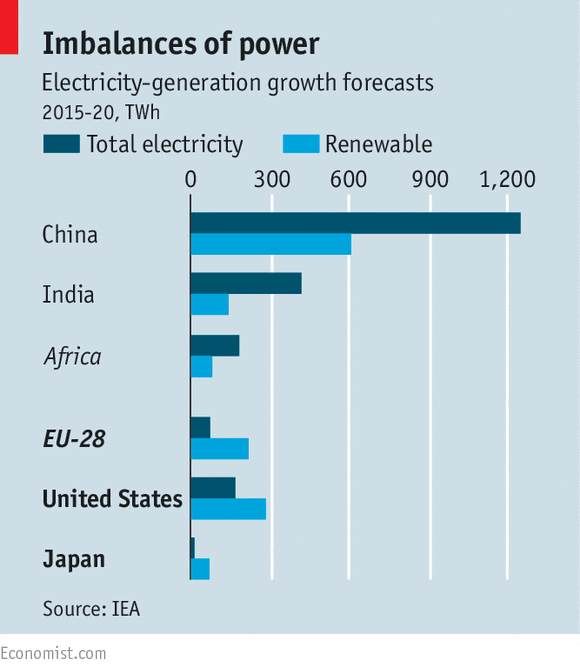
THE battle between clean energy and dirty coal has entered a new phase. The International Energy Agency (IEA), an industry forecaster, this week reported that in 2015 for the first time renewable energy passed coal as the world’s biggest source of power-generating capacity.
The IEA, whose projections for wind and solar energy have in the past been criticised as too low, accepted that renewables are transforming electricity markets. Last year 500,000 solar panels were installed every day around the world. In China alone, home to a whopping 40% of the 153 gigawatts (GW) of global growth in renewable-energy installations, two wind turbines were erected every hour. Based on existing policies, it forecasts that from 2015-21, 825GW of new renewable capacity will be added globally, 13% more than it projected just last year.
All those new wind and solar plants will not generate electricity all the time. Unlike coal, which burns around the clock, renewables are intermittent. But the IEA expects the share of renewables in total power generation to rise to almost 28% from 21%. Government policies to curb global warming and reduce air…Continue reading