
Tag: Business and finance
Taiwanese bosses are the Chinese-speaking world’s oldest

DESPITE her father’s pleas, Cherry Liu refused to work for the family business, a small electronic-components company founded in 1979 on the outskirts of Taipei. A 34-year-old diamond dealer based in Sydney, Ms Liu says she is simply not passionate about gadgets such as circuit-breakers. Nor are her siblings. Her 64-year-old father cannot find a successor, but he will not even consider recruiting someone outside the family, she says. He fears that a newcomer might leave and take the family’s precious list of customers and suppliers with him.
Taiwan’s economic boom was fuelled by people like Ms Liu’s father, entrepreneurs who started from nothing to build successful family-run companies, many of which are now huge. These firms still dominate Taiwan’s export-reliant economy, which specialises in high tech. Of all listed firms, 70% are family-run, compared with 33% for Chinese firms and 40% for Hong Kong-based ones. Almost three-quarters of family concerns are operated…Continue reading
Spotify opts for an unusual way of going public
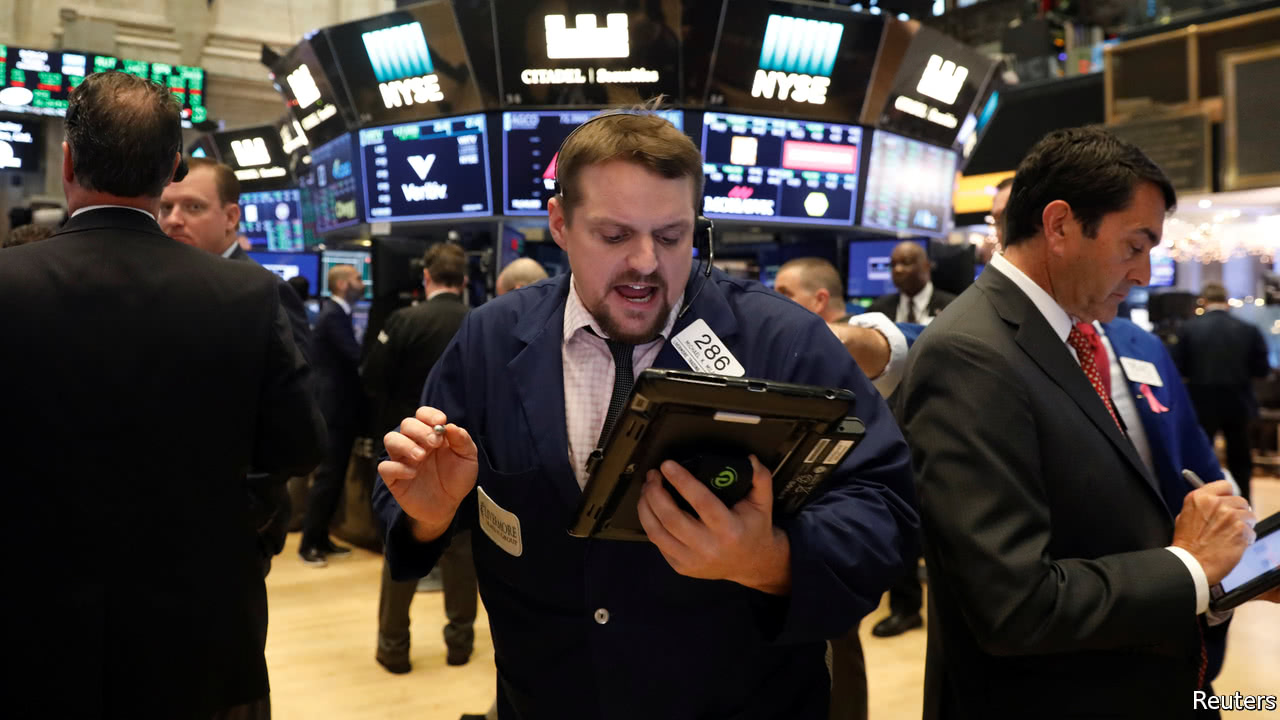
FOR seasoned bankers and starry-eyed entrepreneurs alike, doing an IPO, or initial public offering, is synonymous with the very idea of taking a firm public. No wonder, then, that the decision by Spotify, a music-streaming service, to opt for an unconventional alternative called a “direct listing” has prompted debate. Instead of paying investment banks hefty fees to arrange an IPO, Spotify plans to have existing shares simply switch one day to being tradable on the New York Stock Exchange (NYSE).
IPOs themselves have become rarer, as startups such as Uber and Airbnb have chosen to raise money through private markets instead. Although there was an uptick in the number of IPOs in America in 2017—108, compared with 74 in 2016—the average number of IPOs has remained at around 100 annually since 2000, compared with over 300 in the course of the two previous decades. But until now no big company had contemplated direct listing as an alternative. The structure has been seldom used: in…Continue reading
Spectre and Meltdown prompt tech industry soul-searching
THE timing could hardly have been worse. Just as the tech industry was preparing for its big annual trade show, CES, held this week in Las Vegas, it was hit by one of the most worrying computer-security scares of recent times. On January 3rd it emerged that most microprocessors, the brains of electronic devices, are vulnerable to hacker attacks aimed at stealing sensitive data, such as passwords or encryption keys. Instead of enthusing over the new gadgets presented at the event (see article), many attending discussed only one question: how great would the damage be?
Once the weaknesses became public earlier this month (researchers had first discovered them in June), some cyber-security experts said the only full protection would be to replace all affected processors. The problem is baked into the chips and enables two separate, but…Continue reading
India’s tea industry is going through tepid times
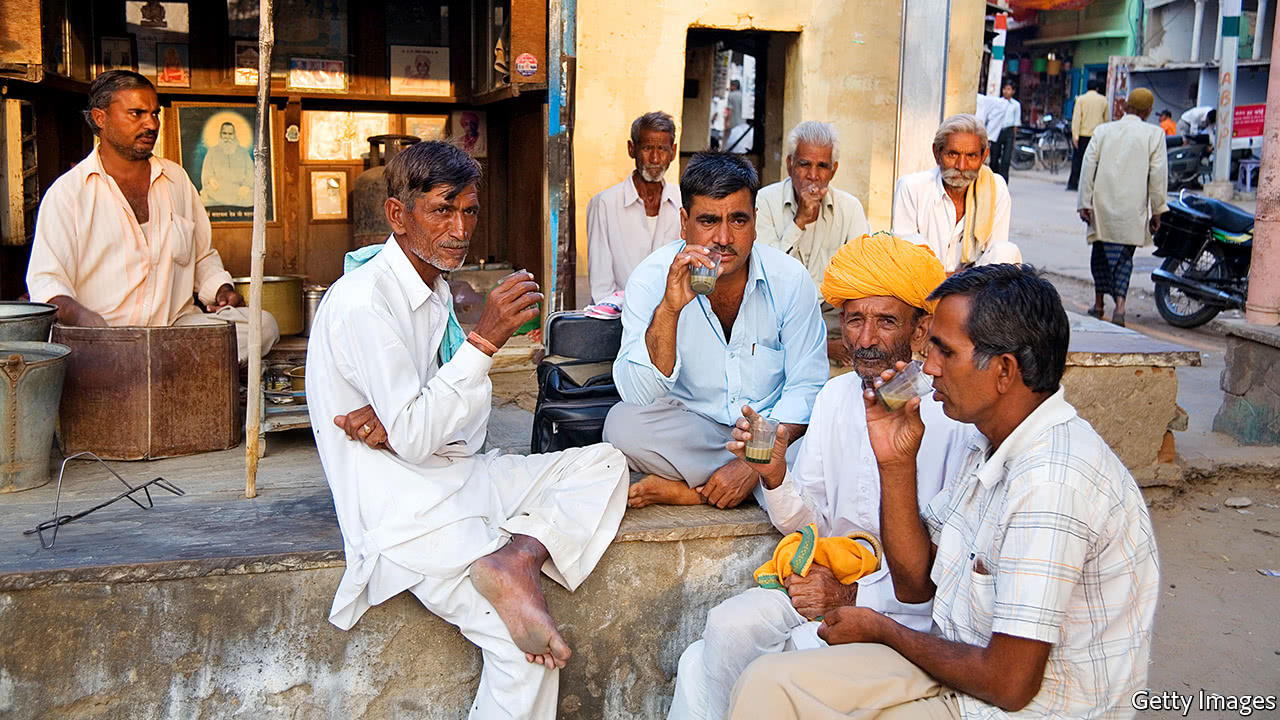
BULK tea sales at the offices of J Thomas in Kolkata, which first started auctioning the stuff in 1861, lack the boisterousness of years past. Gone is the noisy trading pit, replaced by a handful of buyers sitting behind their laptops in a silent auditorium. Armed with tasting notes, they bid electronically on hundreds of lots drawn from the city’s hilly hinterlands in Assam and West Bengal. To passing visitors, it appears as if everyone in the room could do with a little caffeination. Yet within only three hours or so, enough tea changes hands to brew 24 Olympic-sized swimming pools.
If Indian tea delights those who get to drink the country’s finest blends, it frustrates all those who plant, pluck and peddle it. Archaic government regulations have in recent years pushed up production costs to around 175 rupees ($2.70) per kilogram, well above average auction prices of 140 rupees, which makes large cultivators grumble. Pickers complain about…Continue reading
Artificial intelligence dominated the Consumer Electronics Show
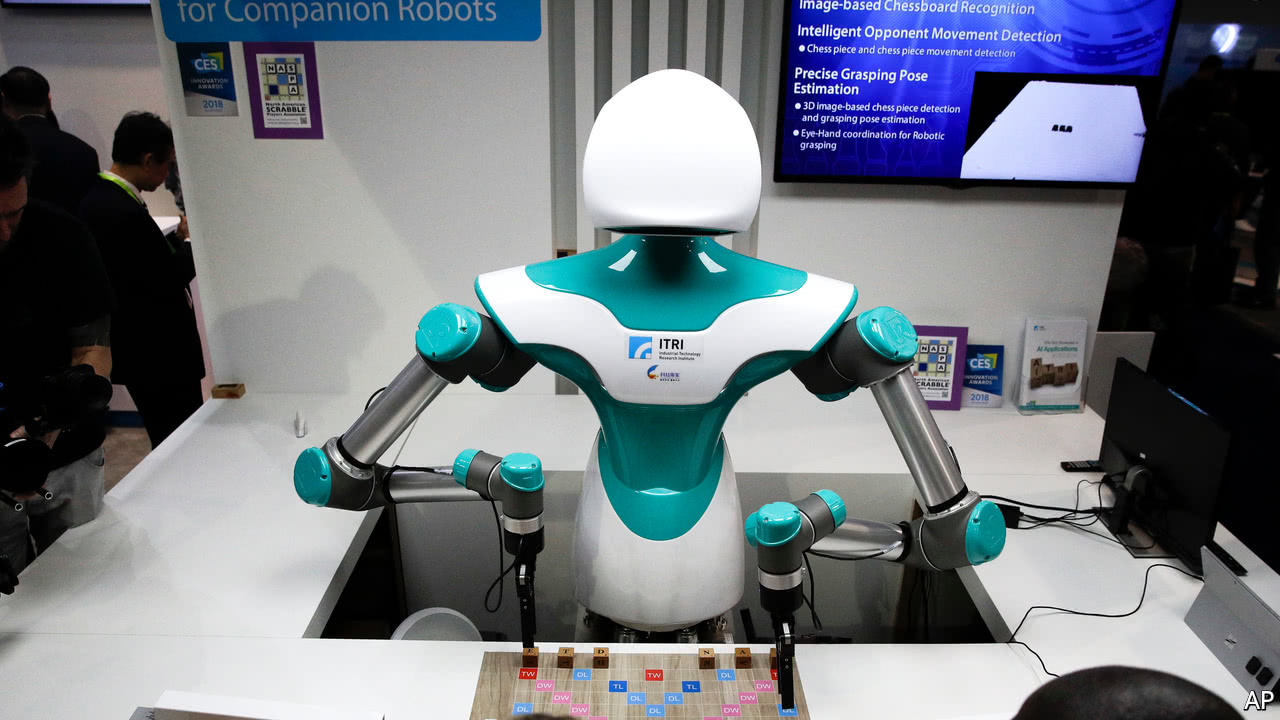
WHEN the electronics industry meets in Las Vegas at CES, its main trade show, buzzwords abound. But rarely has one been as pervasive as this week. “Artificial intelligence” or variations on the theme (“AI-driven”, “AI-powered” and so on) were slapped across most new products—although often the artificial overcame the intelligence.
Those attending gawped at an interactive bathroom mirror on the stand of Haier, a giant Chinese white-goods maker. Look into it, like the Wicked Queen in Snow White, and instead of being told you are the fairest, your data profile appears on the glass. It displays weight (from an interactive scale), urine-test results (from a sensor on a connected lavatory) and other health-related things.
For those attentive visitors who could see past the AI assault, another theme could be identified: firms innovating around how they innovate. Haier’s stand also had a new device that is the result of combining its product development with that of…Continue reading
Donald Trump’s difficult decision on steel imports
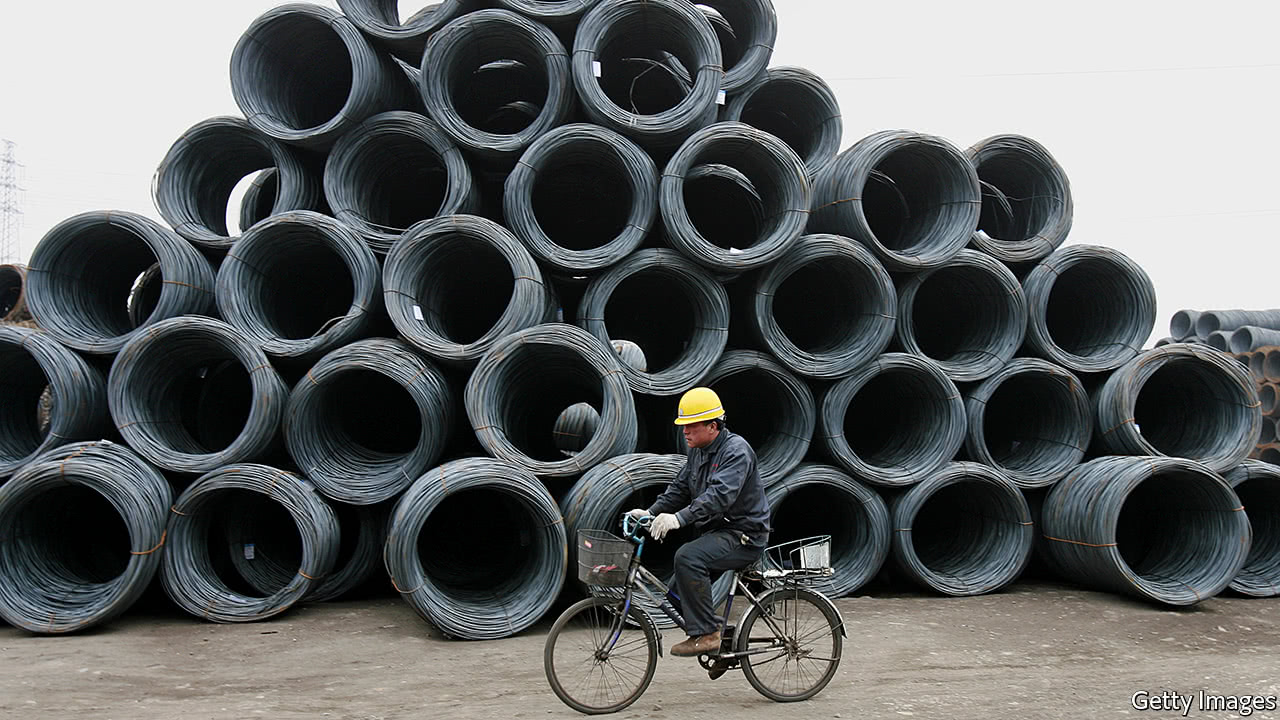
EVERY Tuesday, senior members of the administration gather in the White House to discuss trade. They are divided between hawks, who argue that America needs to be tougher in its defence against what they see as economic warfare waged by China, and doves, who worry about the costs of conflict. So far, against all expectations when President Donald Trump entered the White House, the doves have prevailed. The first of a series of legal deadlines could soon unleash the hawks.
Last April Wilbur Ross, the commerce secretary, initiated a probe into whether steel imports were a threat to America’s national security. His department pointed to a “dramatic” increase in steel imports over the previous year and to the idling of nearly 30% of America’s steel-production capacity, as imports feed a quarter of its consumption. If the report, due by January 15th, finds imports are a threat, Mr Trump, under Section 232 of the Trade Expansion Act of 1962, will have 90 days to respond.
The…Continue reading
Natural disasters made 2017 a year of record insurance losses
THAT 2017 suffered from more than its fair share of natural catastrophes was known at the time. In the wake of Hurricane Harvey, the streets of Houston, Texas, were submerged under brown floodwater; Hurricane Irma razed buildings to the ground on some Caribbean islands. That the destruction was great enough for insurance losses to reach record levels has only just been confirmed. According to figures released on January 4th by Munich Re, a reinsurer, global, inflation-adjusted insured catastrophe losses reached an all-time high of $135bn in 2017 (see chart). Total losses (including uninsured ones) reached $330bn, second only to losses of $354bn in 2011.
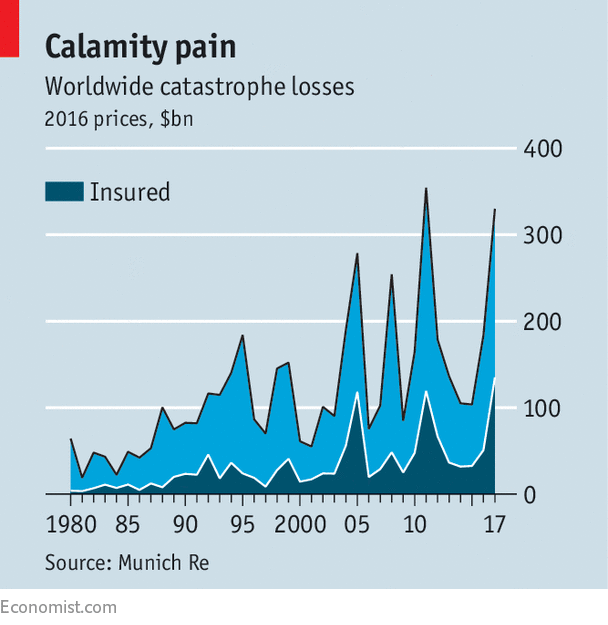
A large portion of the losses in 2011 was caused by one catastrophe: the earthquake and tsunami in Japan. Losses in 2017 were largely traceable to extreme weather. Fully 97% were weather-related, well above the average since 1980 of 85%. If climate change brings more frequent extreme weather, as Munich Re and others expect, last year’s loss levels may…Continue reading
Accountancy takes root in the inhospitable soil of Afghanistan
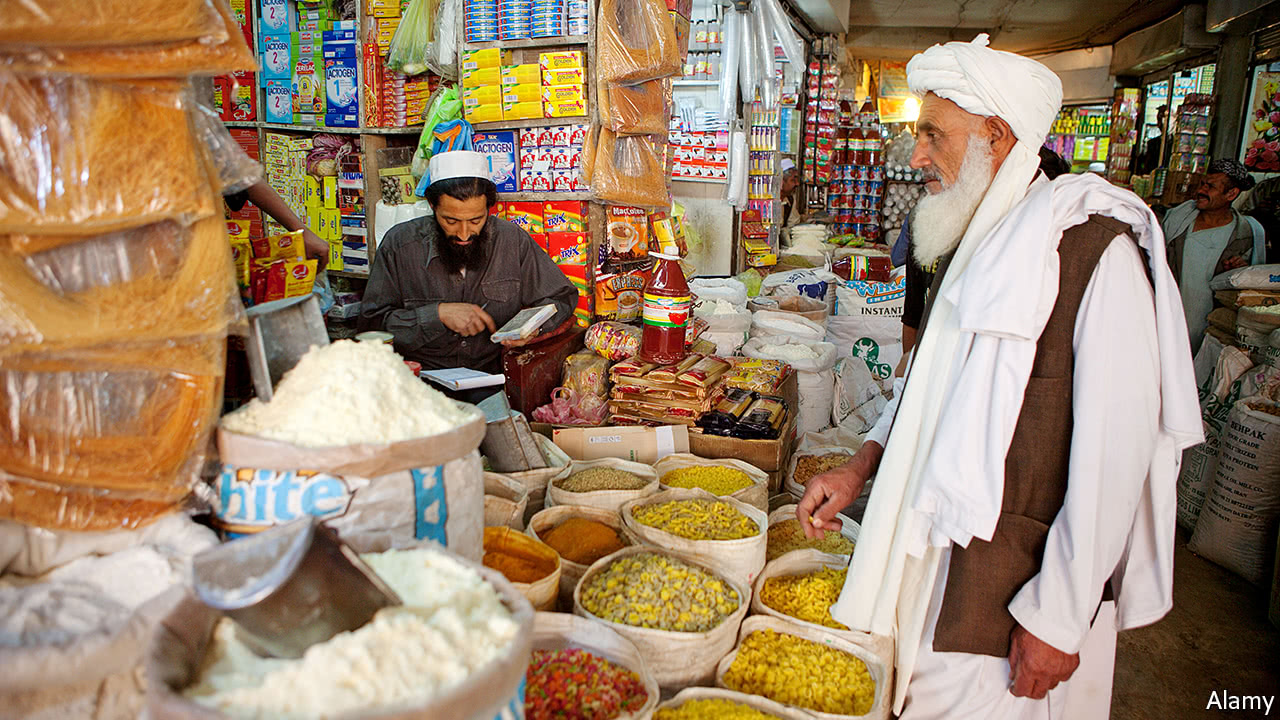
WHEN Afghan lawmakers were debating rules of conduct for accountants, some were confounded by their strictness. Why should those found guilty of murder, asked one member of parliament, be struck off? That is a sign of the challenges facing the professional body for bean-counters, Certified Professional Accountants (CPA) Afghanistan, which was launched last month.
Attempts to establish a home-grown profession start from a low base. Back in 2009 Kabul, a city of around 4m, had fewer than 20 qualified accountants. Neither standards nor oversight for the profession were in place. Most local outfits were branches of firms from elsewhere in South Asia or farther afield.
Boring old accountancy might not seem a priority for a war-torn country. But in business it can foster trust and transparency—scarce commodities in a country where corruption is systemic. Because of the difficulty of verifying borrowers’ financial positions and valuing…Continue reading
Bitcoin is no long the only game in crypto-currency town
IT STARTED as a joke. Dogecoin was launched in 2013 as a bitcoin parody, using as its mascot a Japanese shiba inu dog, a popular internet meme. The crypto-currency was never really used, except for tipping online, and one of its founders has called it quits. But recently its price has soared: on January 7th the dollar value of all Dogecoins in circulation reached $2bn, a sign of how crazy crypto-currency markets have become. It is also a reminder that, for all the focus on bitcoin, it is no longer the only game in town. Its market capitalisation now amounts to only about one-third of the crypto-market (see chart).
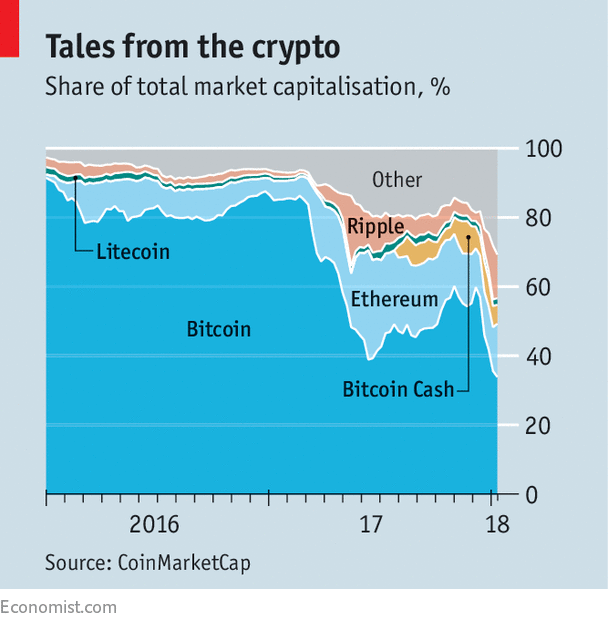
A new crypto-currency is born almost daily, often through an “initial coin offering” (ICO), a form of online crowdfunding. CoinMarketCap, a website, lists about 1,400 digital coins or tokens, including UFO Coin, PutinCoin, Sexcoin and InsaneCoin (worth $7m). Most are no more than curiosities, but by January 10th, around 40 had a market capitalisation of more than…Continue reading
Peter Sutherland, former head of the GATT and the WTO, dies

LIKE the showman he sometimes was, Peter Sutherland, on December 15th 1993, concluded seven years of torturous trade negotiations by banging a gavel. He received a standing ovation. Mr Sutherland, who died on January 7th, had an indispensable role in dragging the “Uruguay round” of trade talks to agreement. He did not know that this was to be the last such comprehensive, multilateral trade deal of his lifetime.
As director-general of the General Agreement on Tariffs and Trade and, on its founding, of the World Trade Organisation, the Irishman was the public face of bodies helping to integrate the global economy. The sobriquet “father of globalisation” was, at the time, a compliment. He remained proud of the WTO. In 2004 he wrote that “for the first time in history, the world can embrace a rules-based system for economic coexistence.”
Mr Sutherland, a lawyer by training, came to Geneva by way of the Irish attorney-general’s office and the European Union. Briefly…Continue reading